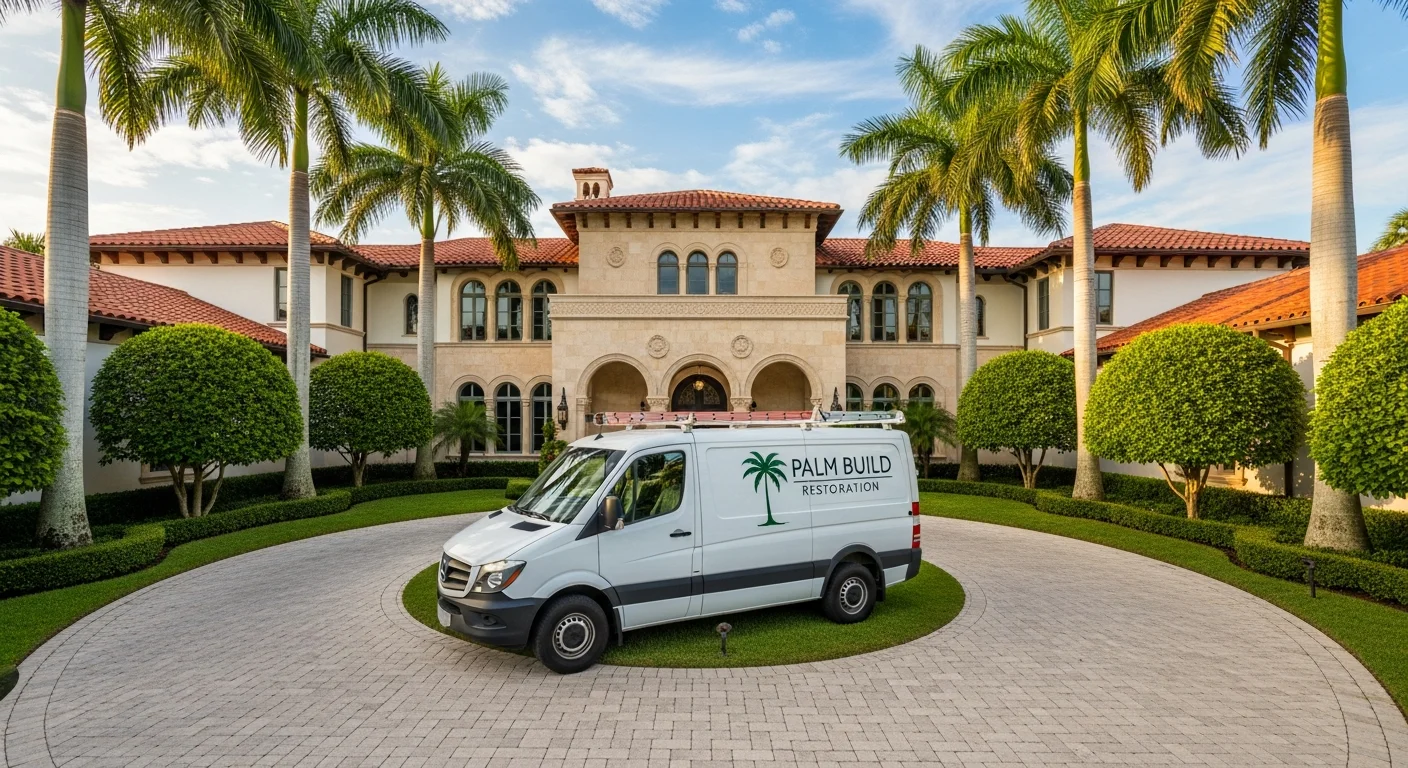
Water Damage Restoration in Palm Beach, Florida
From Estate Section Mediterranean Revival homes to Worth Avenue condo towers, Palm Build responds to water damage on Palm Beach island with estate-aware protocols, luxury-finish drying, and insurance documentation built for the Town of Palm Beach's high-value property market and Zone B coastal flood exposure.
35-45 min
Emergency Response
24/7
Dispatch Available
IICRC
Certified Technicians
Local Risk Factors
Why Palm Beach Properties Require Specialized Water Damage Response
Palm Beach island's combination of direct hurricane exposure, high-value finish materials, seasonal vacancy, and salt-air envelope fatigue creates water damage conditions that require estate-aware protocols — and mold can begin colonizing surfaces within 24 hours in this coastal humidity.
Barrier Island With No Inland Buffer
The Town of Palm Beach is a 16-mile barrier island — every property faces direct Atlantic hurricane exposure with no geographic protection. Wind-driven rain intrusion through stucco cracks, aging window seals, and flat roof membranes is the island's most common water damage pathway during tropical events. Zone B evacuation status and potential bridge access restrictions after named storms mean damage can worsen for 24–72 hours before any mitigation team arrives.
Luxury Finishes Demand Precision Drying
Palm Beach properties contain finish materials that don't tolerate standard restoration drying protocols. Marble and terrazzo craze from too-fast dehumidification. Plaster walls crack if dried too aggressively. Dade County pine framing (common in pre-1950 estates) is extremely dense and requires extended drying cycles. Custom millwork must be stabilized before warp sets permanently. Every Palm Beach job begins with a finish inventory so drying equipment is calibrated to the specific materials present.
Seasonal Vacancy Turns Leaks Into Disasters
Palm Beach's snowbird population closes estates and condos from May through October — six months during which a slow pipe leak, irrigation system failure, or HVAC condensate overflow can develop into a Category 2 or 3 water event before any owner or caretaker notices. A supply line that drips 1 gallon per day for three months delivers 90+ gallons into wall cavities and flooring. By discovery, the mold clock has been running for weeks. Remote monitoring and pre-departure plumbing inspection are the best prevention.
Salt Air Accelerates Every Building System Failure
Ocean salt air is a persistent stressor unique to barrier island properties. Metal fasteners, HVAC components, window hardware, and rebar inside CBS block corrode faster than in inland markets. Corroded fasteners loosen roof tiles. Failed window hardware allows frames to rack and seals to gap. Rebar corrosion expands inside CBS block, cracking stucco — creating water pathways directly into wall assemblies. Annual inspection of all metal building components is essential in Palm Beach's corrosive coastal environment.
Zone B · FEMA VE · FEMA AE
Palm Beach Zone B: What Your Flood and Evacuation Zone Means for Restoration
The Town of Palm Beach is entirely in Evacuation Zone B. Your FEMA flood zone classification — VE or AE — affects insurance requirements, documentation standards, and how restoration scope must be structured for your claim.
Evacuation Zone B
The Town of Palm Beach publishes its emergency planning through Palm Beach County's evacuation zone system. The entire island — every property — is classified as Evacuation Zone B, among the first zones to evacuate during a significant hurricane. This means bridge access can be restricted for 24–72 hours after a named storm, delaying restoration response. For seasonal homeowners, damage can worsen significantly before re-entry is permitted.
FEMA VE Zone
VE zones are the highest-hazard coastal classification. They include velocity flood risk from wave action, elevated base flood elevations, and mandatory flood insurance for all mortgaged properties. VE zone flood damage has additional NFIP documentation requirements — elevation certificate coordination and velocity zone scope standards — that affect claim documentation and restoration scope. Palm Beach oceanfront and A1A corridor properties are typically in VE zones.
FEMA AE Zone
AE zones are the standard 100-year floodplain designation with determined base flood elevations. Flood insurance is mandatory for mortgaged AE zone properties. Standard NFIP and private flood policies apply. Palm Beach's interior neighborhoods and Intracoastal-adjacent properties — Ibis Isle, Everglades Island, the Intracoastal corridor — are typically in AE zones. Standard HO-3 and HO-6 policies do not cover flooding regardless of zone.
Access Restriction Reality
After named storms, Palm Beach island can be under re-entry restrictions for 24–72 hours while authorities assess bridge safety and road conditions. For seasonal residents who are not on the island during a storm, this means water damage from roof intrusion, window failures, or storm surge can develop unmitigated for up to three days. Remote monitoring systems and pre-storm preparation — HVAC pan tablets, storm shutter deployment, emergency contacts — are the only defense against this gap.
Verify your Palm Beach flood zone at msc.fema.gov using your property address. Flood zone classification determines insurance requirements, NFIP premium rates, and the documentation standard for any restoration claim.
Seasonal Risk Calendar
Palm Beach Water Damage Calendar: When Risk Peaks
NOAA normals for West Palm Beach record 61.75 inches of annual rainfall with a clear wet season peak from May through October. Understanding when damage events peak on the island helps seasonal homeowners protect their properties year-round.
January – April
Dry Season — Peak Occupancy and Plumbing Stress
Palm Beach's dry season aligns with peak seasonal occupancy — the busiest period for water damage from interior plumbing failures. Guest traffic and high-season property usage stress supply lines, water heaters, appliances, and irrigation systems that may have deferred maintenance from summer vacancy. January–April is also when seasonal homeowners discover slow leaks that developed undetected during summer closure: water staining, soft flooring, musty odors in closed rooms.
Primary cause:Plumbing failures, appliance leaks, deferred damage discovery
May – June
Wet Season Onset — Departure Season Meets First Heavy Rains
May and June bring the transition to South Florida's wet season just as most Palm Beach homeowners are closing their properties and departing. June averages 9.02 inches of rainfall — the island's wettest month. Properties closed with HVAC in economy mode lose dehumidification just as humidity climbs above 80%. Stucco cracks, window seal failures, and roof tile displacement that went unnoticed during dry season begin admitting water into unoccupied buildings with no one present to catch it.
Primary cause:Storm intrusion into vacant buildings, first hurricane season watches
July – October
Hurricane Season — Direct Atlantic Exposure at Peak Activity
Atlantic hurricane season peaks August through October. Palm Beach island's barrier position means no geographic buffer from Atlantic systems — including northeast-approaching late-season storms like Hurricane Nicole (November 2022). Wind-driven rain intrusion through stucco cracks, aging window seals, and flat roof membranes is the primary damage mechanism. Most properties are vacant during this period: damage can accumulate for days or weeks before discovery. July through September see the highest month-over-month rainfall totals.
Primary cause:Hurricane/tropical storm intrusion, vacant-property undetected damage
November – December
Season Re-Opening — Mold Discovery and Post-Storm Assessment
November and December mark the return of seasonal residents. Properties re-opening after six months of vacancy reveal what accumulated over summer: mold in HVAC fan-coil units, water staining from slow leaks, storm damage to stucco and roofing, and deferred plumbing failures. Palm Build receives a predictable surge of calls in November and early December as homeowners discover damage that may have a Florida statute 627.70132 claim deadline clock already running from the date of the original event — not the date of discovery.
Primary cause:Seasonal discovery, mold events, delayed storm damage claims
Neighborhood Risk Guide
Palm Beach Water Damage Risk by Neighborhood
Damage patterns on Palm Beach island vary block by block depending on proximity to the ocean, Intracoastal, building era, and construction type.
Estate Restoration Guide
Restoring High-End Finishes in Palm Beach Estates
Mediterranean Revival architecture — the dominant style on the island — contains finish materials that require specialized restoration protocols beyond standard drying procedures. Applying the wrong technique to marble, plaster, or Dade County pine causes permanent damage.
Marble & Terrazzo Floors
High RiskFailure Mode
Crazing and grout failure from aggressive dehumidification
Protocol
Controlled slow-drying: reduce equipment airflow and increase dehumidifier capacity. Avoid direct air mover contact with stone surfaces. Monitor stone temperature differentials.
Barrel Tile & Clay Tile Roofs
High RiskFailure Mode
Tile displacement, broken tiles, failed mortar from storm/wind events
Protocol
Emergency tarping to prevent interior water entry before structural assessment. Document every displaced tile with photos. Mortar and flashing repair before any interior drying is closed out.
Plaster Walls (Lime & Gypsum)
High RiskFailure Mode
Cracking from too-rapid drying; hidden moisture behind intact plaster surface
Protocol
Use FLIR thermal imaging to locate saturation before drilling or opening. Plaster is often salvageable with guided slow-drying. Extends drying timeline — do not rush to accelerate.
Custom Millwork & Carved Wood
Critical RiskFailure Mode
Warp sets permanently if drying is not begun within 24–48 hours
Protocol
Stabilize with controlled humidity reduction immediately. Consult finish conservators for irreplaceable pieces before any removal decisions. Document all pre-existing condition.
Dade County Pine Framing
Moderate RiskFailure Mode
Extremely dense wood retains moisture far longer than modern lumber
Protocol
Extend drying cycles — standard 3-day readings are not adequate for Dade pine. Use deep-probe moisture meters. Do not use aggressive heat drying which may cause checking.
European & Handmade Tile
Moderate RiskFailure Mode
Grout failure and glaze damage from penetrating moisture meters
Protocol
Use non-penetrating (scan) moisture meters only on glazed tile surfaces. Document grout condition with close-up macro photography before any intervention.
Impact-Resistant Windows & Doors
Moderate RiskFailure Mode
Salt-air corrosion creates water pathways at frame junctions and weep holes
Protocol
Inspect all weep holes — blocked weeps trap water inside frame cavities. Assess internal frame corrosion with moisture probe. Reseal all compromised frame-to-wall junctions.
In-Slab Radiant Heating
High RiskFailure Mode
Wet slab conceals radiant system damage; flooring replacement over wet slab fails
Protocol
Use thermal imaging to verify full slab moisture extent before any flooring is replaced. Map radiant loop locations; repair or cap damaged loops before slab remediation closes.
For irreplaceable architectural elements — original carved limestone, period-authentic tile, historic stained glass — Palm Build coordinates with licensed conservators and specialty restoration artisans. We do not make removal decisions on historic material without a conservator's assessment.
Cost Guide
Water Damage Restoration Costs in Palm Beach, FL
Restoration costs in Palm Beach reflect the island's luxury market: high-finish materials, estate-scale square footage, and island access logistics push costs above mainland Florida norms — often significantly.
Minor — Category 1
- Supply line break, HVAC condensate, appliance leak
- Single room, under 300 sq ft affected
- Standard finishes: $2,500 – $6,000
- Luxury finishes (marble, hardwood, millwork): $5,000 – $12,000
- Drying timeline: 3–5 days
Moderate — Category 2
- Dishwasher, washing machine, toilet overflow
- Multi-room or multi-unit involvement
- Standard finishes: $8,000 – $20,000
- Luxury finishes / condo with multi-unit: $15,000 – $40,000
- Drying + mold prevention: 5–10 days
Severe — Category 3
- Sewage backup, floodwater, storm surge intrusion
- Structural materials affected, high-value contents at risk
- Standard finishes: $20,000 – $60,000
- Luxury estate / full-home scope: $50,000 – $200,000+
- Mitigation + reconstruction: 14–30+ days
Note: Costs reflect the Palm Beach luxury market. High-finish materials (marble, plaster, custom millwork), island access logistics, and HOA coordination requirements all contribute to higher project costs than mainland Florida. Every estimate includes Xactimate-standard documentation for your insurer.
Our Process
Palm Build's 6-Step Water Damage Response in Palm Beach
Estate-grade protocols from first call to final documentation. Every step is designed for Palm Beach's combination of luxury finish materials, gated access, and high-value insurance claims.
Emergency Dispatch — Estate-Aware from the First Call
Call (754) 600-3369 any hour. When you report a Palm Beach loss, our team dispatches with estate protocols: protective material coverings for marble and stone, documentation kits for high-value contents, and advance coordination with gated community security or HOA management. We route via I-95 South and Southern Boulevard for fastest island access — on-site within 35–45 minutes of your call.
Precision Moisture Mapping — Every Finish Accounted For
FLIR thermal cameras and calibrated moisture meters map the full saturation extent — behind plaster walls, under marble flooring, inside custom cabinetry, and through CBS block cores. In multi-unit buildings, we assess adjacent units and common areas to determine the full migration pathway. A complete finish inventory is documented before any drying equipment is placed.
Truck-Mounted Extraction with Finish Protection
High-capacity truck-mounted extractors remove standing water while our technicians place protective coverings over marble, hardwood, and custom flooring. For slab-on-grade properties with specialty tile or in-floor radiant heating, we use controlled extraction protocols that prevent thermal shock to finish materials. Category 2 and 3 events receive full decontamination before extraction.
Controlled Drying — Calibrated for Luxury Materials
Industrial LGR dehumidifiers, desiccant units, and directional air movers establish the drying environment. Marble and stone require slower drying rates than standard drywall — we calibrate equipment placement to prevent crazing, grout failure, and veneer delamination. Psychrometric data (humidity, temperature, moisture content) is logged every 24 hours for your insurer and adjuster.
Mold Prevention in a Coastal Environment
Palm Beach's ambient coastal humidity makes mold prevention non-negotiable on every job. EPA-registered antimicrobial treatments are applied to at-risk assemblies — especially CBS block cavities, plaster substrates, and HVAC-adjacent areas that retain moisture longer than modern materials. We monitor humidity throughout the drying cycle and alert you if any assembly requires additional action.
Documentation and Reconstruction Coordination
Every Palm Build job includes a complete Xactimate-standard scope, FLIR thermal images, moisture mapping reports, and equipment records — structured for Palm Beach County adjusters and high-value private insurers. For VE zone properties, we produce NFIP-compliant documentation. For properties requiring rebuild, Palm Build coordinates from permitting through the Town of Palm Beach's final inspection process.
Insurance Guide
Florida Insurance Claims for Water Damage in Palm Beach
Palm Beach homeowners navigate a unique insurance environment: Florida's strict claim deadlines, VE zone NFIP requirements, post-AOB-reform claim management, and a high-value property market where documentation quality directly affects recovery.
Florida Claim Deadlines — Strictly Enforced
Florida Statute 627.70132 requires initial claim notice within 1 year of the date of loss, and supplemental claims within 18 months. For Palm Beach seasonal homeowners, the gap between summer departure and fall return can consume months of that window — and the statute measures from the date of the water event, not the date of discovery. File notice immediately upon discovering any damage. Do not wait for a full scope or contractor estimate before notifying your carrier.
VE Zone Documentation Requirements
Properties in FEMA VE zones (oceanfront, A1A corridor) have additional NFIP documentation requirements. Restoration scope must reference velocity zone standards, elevation certificates may be required for post-storm repairs, and flood damage must be separated from wind-driven rain damage in the scope — which affects which policy responds. Palm Build produces VE-zone-compliant documentation from the first hour.
Assignment of Benefits Reform — Know Before You Sign
Florida's Senate Bill 2A (2022) restricts post-loss assignment of insurance benefits for policies issued or renewed after January 1, 2023. This means Palm Beach homeowners manage their own claims — restoration contractors cannot step into your shoes and deal directly with your insurer under an AOB agreement. Palm Build provides complete documentation and scope support without requiring any AOB assignment. Read every contractor document carefully before signing.
Citizens vs. Private Market in Palm Beach
High-value Palm Beach properties are frequently insured through admitted or surplus-lines private carriers rather than Citizens Property Insurance (the state insurer of last resort). Private high-value policies may have different sublimits for mold, different documentation requirements, and faster claim handling — but the Florida statutory deadlines apply regardless of carrier. Confirm your policy's water damage coverage, mold sublimit, and flood exclusion with your agent before hurricane season.
Common Questions
Water Damage FAQ for Palm Beach Homeowners
Trusted local pros in Palm Beach
Outside our restoration scope, these are the vetted, licensed contractors we trust alongside our work. Personally evaluated, reference-checked, and recommended by Palm Build.
Borkat Plumbing Services, LLC
Miami, FL
Miami's licensed plumber for the four-county reach Palm Build can't always cover ourselves — Miami-Dade, Broward, Palm Beach, and the Florida Keys, owner-led by Boris Inclan with an OSHA-disciplined crew.
Copperhead Plumbing LLC
West Palm Beach, FL
West Palm Beach's veteran-owned plumber Palm Build calls when the scope runs north of Boynton — Palm Beach County and northern Broward, owner-led by Nicholas P. Miller on a single Florida CFC1431257 license.
Dee Maria Plumbing, Inc.
West Palm Beach, FL
Plumbing West Palm Beach since September 1981 — the only Trusted Vendor on Palm Build's list with 44 years of continuous local service and a Florida-issued gas appliance, equipment, and piping installer license.
Flamingo Plumbing & Backflow Services
West Palm Beach, FL
The only Rinnai-installing tankless specialist in Palm Build's directory with 'Backflow' as a top-line brand-name specialty — Paul Shaughnessy's two-office West Palm Beach + Palm City shop has 813+ Google reviews at 4.9 stars and a Treasure Coast dispatch posture no other vendor on our list has natively.
Water Damage in Palm Beach? Our Team Is on the Way.
Palm Build's IICRC-certified team responds from Deerfield Beach with estate-grade protocols, luxury-finish drying, and insurance documentation built for Palm Beach island's high-value property market.