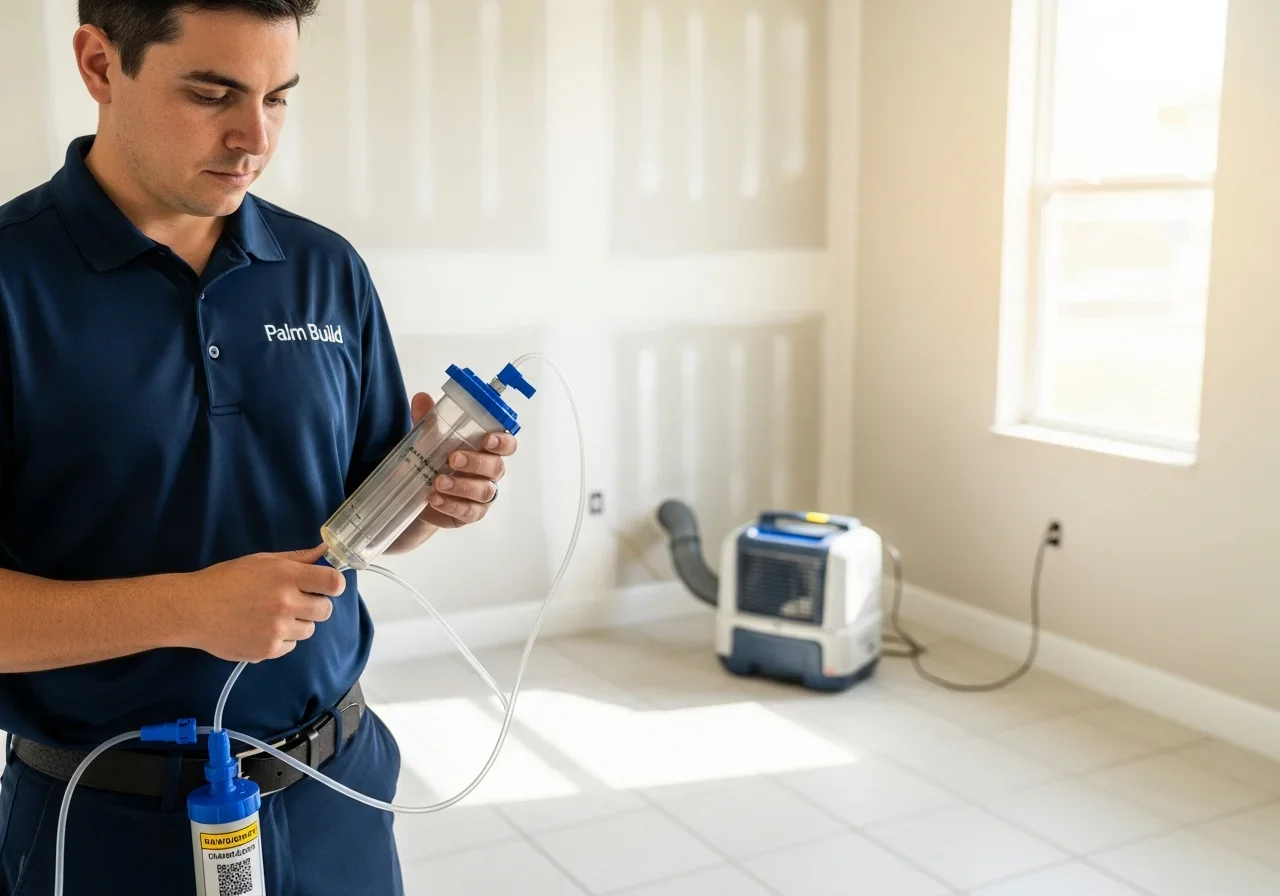
From HVAC condensation mold in North Andrews Gardens homes to hidden growth behind condo walls in Lake Emerald, Palm Build's Florida-licensed mold remediators bring professional containment, HEPA filtration, and post-remediation clearance testing Broward County property owners can trust.
Deerfield Beach Office — ~6 miles to Oakland Park Same day Response IICRC Certified
Oakland Park's specific combination of tropical humidity exceeding 70%, aging
mid-century CBS construction without vapor retarders, near-constant HVAC operation, and
a substantial condo housing stock creates some of the highest baseline mold risk in
Broward County. Understanding why mold thrives here is the first step toward permanent
remediation — not just cosmetic cleanup.
HVAC Condensation Epidemic
70%+
Summer relative humidity
Oakland Park's housing stock — median construction year 1972 — relies on aging HVAC systems that were never designed for today's tropical humidity loads. Condensate line clogs, drip pan corrosion, and deteriorated duct insulation create hidden moisture sources behind walls and above ceilings. In mid-century homes where replacement units were installed without upgrading ductwork, condensation on undersized supply ducts feeds mold colonies you can't see until they're advanced.
Aging CBS Construction
1972
Median construction year
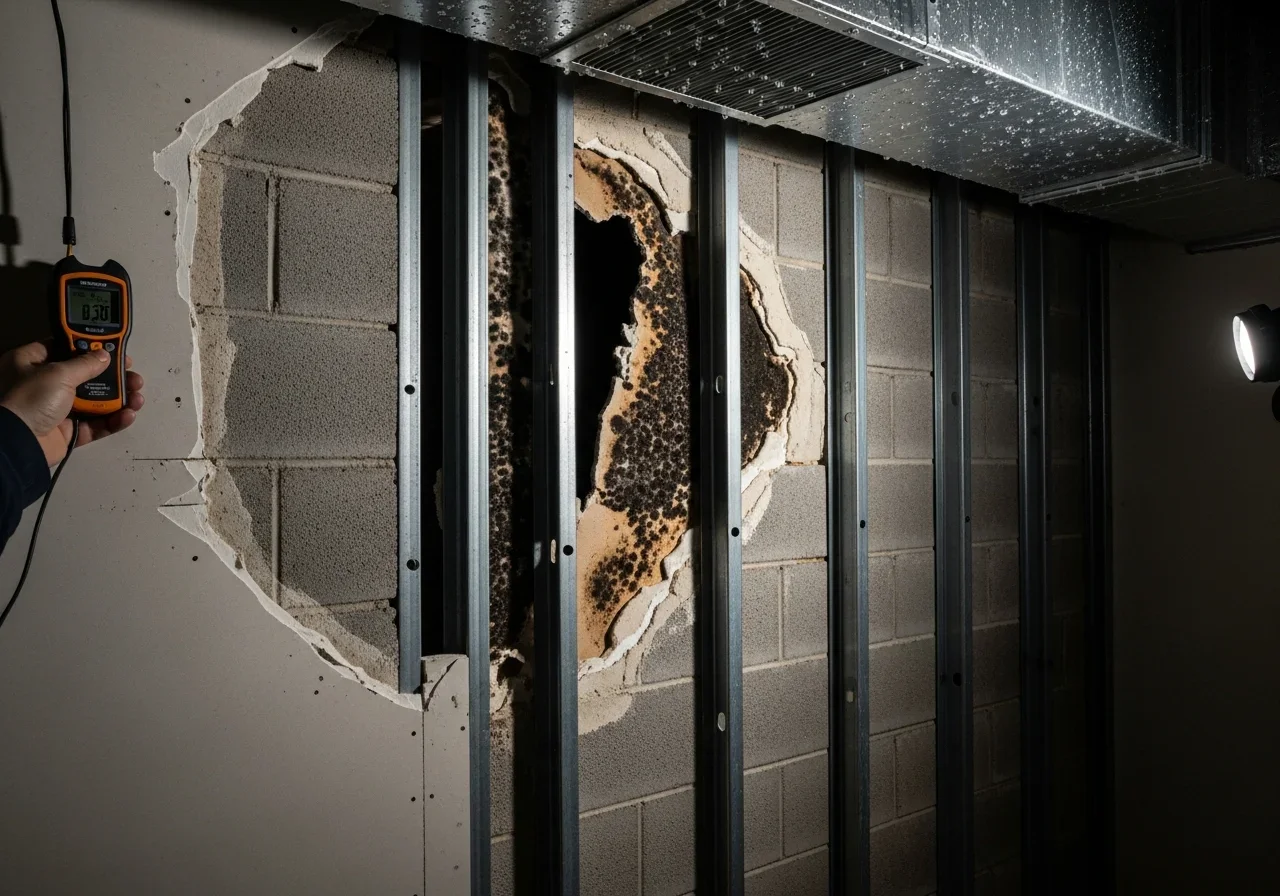
Nearly 80% of Oakland Park's homes were built between 1950 and 1989 using CBS (concrete block and stucco) construction — without modern vapor retarders. Decades of thermal cycling have created hairline stucco cracks that wick moisture into hollow block cavities during every rain event. Once inside, that moisture has no designed exit path. The combination of trapped moisture, organic material on drywall paper facing, and Oakland Park's year-round warmth makes CBS wall cavities ideal mold incubators.
Florida Mold Licensing Required
Required
FL mold remediator license
Florida is one of the few states that requires specific licensing for mold remediators under Chapter 468, Part XVI, administered by the DBPR (Department of Business and Professional Regulation). The law mandates separate licenses for mold assessment and mold remediation — the same company cannot perform both on the same project. This 'Chinese wall' rule protects Oakland Park homeowners from conflicts of interest. Verify any contractor's license at myfloridalicense.com before hiring.
Condo Mold Complexity
23%+
Housing in large multifamily
Oakland Park's significant condo and multifamily housing — over 23% of units are in large multifamily buildings — creates unique mold challenges. Shared plumbing walls, stacked wet areas, and common HVAC infrastructure mean a single moisture event can affect multiple units. HOA coordination, multi-party insurance claims, and containment protocols that protect adjacent units add layers of complexity that single-family remediation doesn't require.
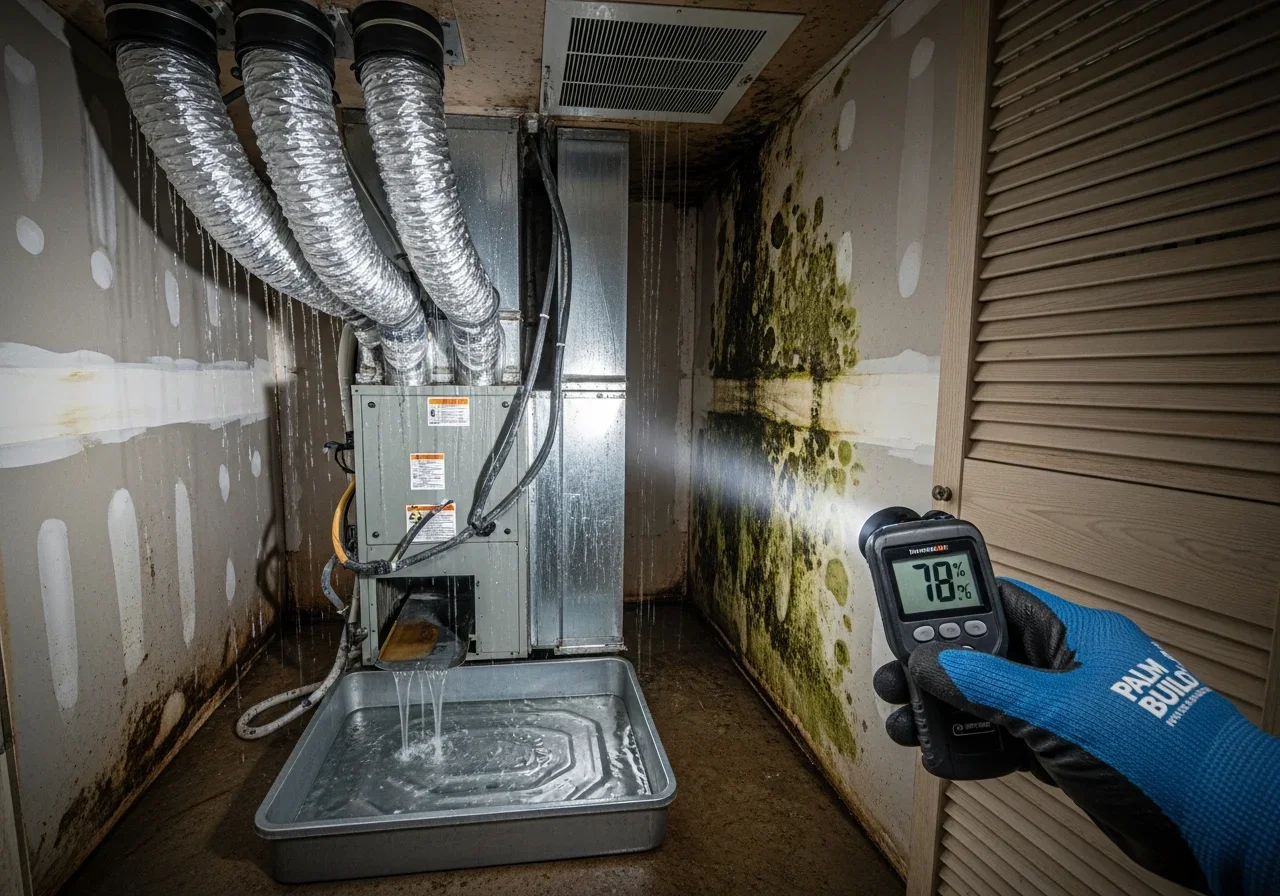
HVAC condensation mold in an Oakland Park home — aging systems in mid-century CBS
construction can't keep pace with tropical humidity, creating hidden moisture that feeds
mold growth behind walls.
Every Oakland Park neighborhood faces mold risk — but construction era, housing type,
and proximity to waterways create dramatically different risk profiles. North Andrews
Gardens' 1950s CBS homes, Lake Emerald's aging condo buildings, and Oakland Forest's
mixed community face the highest baseline exposure.
North Andrews Gardens
Critical Risk1950s-1960s | Single-family CBS homes
Oakland Park's oldest residential neighborhood with original CBS block construction predating any vapor retarder standards. Aging cast iron drain lines corroding underground cause hidden water damage beneath slabs. HVAC systems on second or third replacement cycle without ductwork upgrades — duct insulation deterioration and condensate line routing create persistent hidden moisture.
Lake Emerald
Critical Risk1970s-1980s | Condo community
Multi-story condo buildings with shared plumbing walls and stacked wet areas. A single leak in an upper unit sends water through floor assemblies into multiple units below. HOA maintenance response times vary — delayed leak detection allows mold colonization in shared wall cavities. Centralized and individual HVAC systems approaching end-of-life.
Oakland Forest
Critical Risk1970s-1980s | Planned community (homes & condos)
Mix of single-family homes and condo buildings built during the CBS era without vapor retarders. Mature tree canopy creates shade that keeps exterior stucco damp longer after rain, accelerating moisture intrusion through hairline cracks. Original HVAC ductwork in many homes has never been replaced.
Lloyd Estates
High Risk1960s-1970s | Single-family residential
Mid-century CBS ranch homes with original flat roof sections and minimal attic ventilation. Decades of moisture cycling have saturated block cavities. Many homes have had bathroom and kitchen remodels that added tile over existing surfaces — trapping moisture beneath impermeable layers where mold grows undetected.
Royal Palm Acres
High Risk1960s-1970s | Single-family residential
CBS homes on larger lots with mature landscaping that holds moisture against foundation walls. Original plumbing and HVAC systems. Slab-on-grade construction without sub-slab vapor barriers allows ground moisture to migrate upward through capillary action — feeding mold along baseboards and beneath flooring.
Sleepy River
High Risk1970s-1980s | Waterfront homes
Canal-adjacent homes face elevated ambient humidity from water proximity. CBS walls absorb moisture from both rain intrusion and humidity-driven vapor pressure. HVAC systems work harder to dehumidify, generating more condensation. Flood zone location means historical water events may have introduced moisture into wall assemblies that was never fully dried.
Central Oakland Park
Elevated Risk1950s-1970s | Mixed residential
Dense mix of single-family homes, duplexes, and small multifamily buildings. Oldest housing stock in the city with the most deferred maintenance. Many properties have undergone multiple ownership changes with incomplete renovation histories — hidden moisture problems from past water events may have been painted over rather than remediated.
Residential neighborhood with typical mid-century CBS construction. Lower density than condo areas but same fundamental moisture challenges — aging HVAC systems, stucco micro-cracks, slab vapor transmission. Homes near the Middle River face additional moisture pressure from elevated water table.
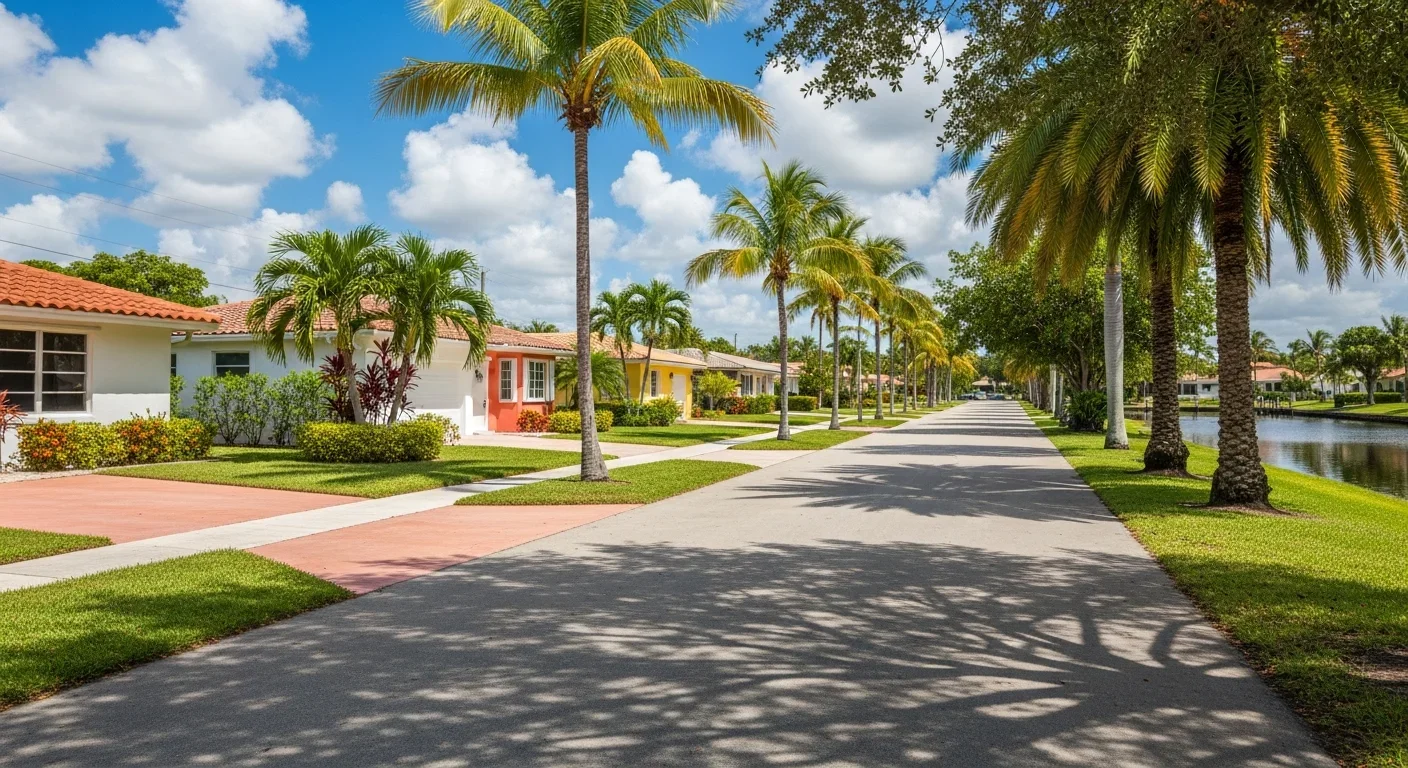
Typical mid-century CBS stucco homes in Oakland Park — aging construction without vapor
retarders creates hidden mold risk in every neighborhood.
Oakland Park's #1 Mold Problem
HVAC Condensation Mold: Why Mid-Century Systems Fail in Tropical Humidity
In Oakland Park, the primary mold vector isn't flooding or roof leaks — it's the air
conditioning system itself. HVAC units running 10-11 months per year generate constant
condensation. When drainage, insulation, or system sizing fails, that moisture feeds
mold inside your air handler, duct system, and surrounding wall cavities.
Most Oakland Park homes were built between 1950 and 1989 with HVAC systems that have
been replaced one or more times — but ductwork, drain routing, and insulation were
rarely upgraded. The result: modern compressors pushing cold air through deteriorated
1970s ductwork in attic spaces that reach 140+ degrees in summer. The condensation is
inevitable. The mold that follows is predictable.
Clogged Condensate Drain Lines
The #1 mold trigger in Oakland Park. AC systems running 10-11 months per year generate constant condensation. Algae and biofilm build up inside condensate drain lines, eventually blocking flow. Backed-up water overflows the drip pan into the air handler cabinet, ceiling cavity, or wall assembly. In mid-century homes where drain line routing was an afterthought, clogs happen faster and cause more hidden damage.
Duct Insulation Deterioration
Fiberglass duct insulation installed in the 1960s-1980s deteriorates in Oakland Park's humidity. As insulation breaks down, it creates condensation points on bare metal duct surfaces — cold supply air meeting warm, humid attic air. These condensation drips feed mold above ceilings and inside wall cavities for months before any visible sign appears. Deteriorated insulation also harbors mold spores that the blower distributes to every room.
Undersized Systems & Short-Cycling
Many Oakland Park homes have replacement AC units sized by rule-of-thumb rather than Manual J calculations. Oversized units cool air quickly but shut off before removing sufficient moisture — a cycle called short-cycling. Indoor humidity stays above 60% even when the thermostat reads 74 degrees. Undersized units run continuously but can't overcome the tropical humidity load, causing supply register sweating and condensation on cold surfaces.
Supply Vent Sweating & Hidden Wall Moisture
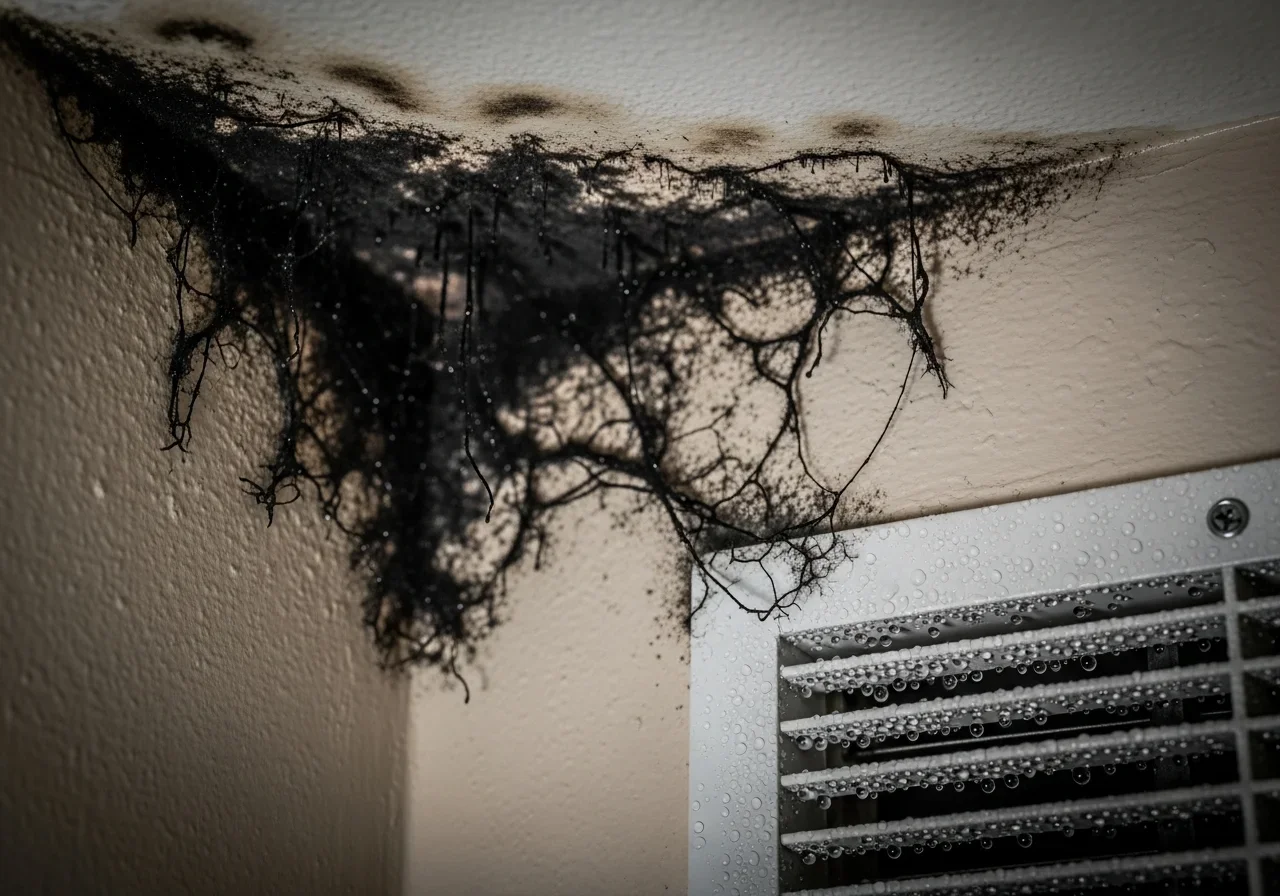
When cold supply air (55-60 degrees) exits vents into Oakland Park's warm, humid rooms, moisture condenses on the register face, surrounding drywall, and inside the wall cavity around the supply boot. Over months, this persistent condensation saturates drywall paper — the perfect organic food source for mold colonies that grow hidden behind walls until they're advanced enough to produce visible staining or musty odors.
HVAC condensation in an Oakland Park home — aging duct insulation and clogged drain
lines are the most common hidden mold sources in mid-century construction.Supply vent mold — cold air meeting humid room conditions creates condensation that
feeds hidden mold behind walls and around register boots.
Prevention Recommendations
Schedule condensate line flushing every 3 months during rainy season
Install a condensate line safety switch (float switch) to shut down AC before overflow
Replace deteriorated duct insulation — especially in attic-mounted systems
Verify AC sizing with a Manual J calculation during replacement
Run a whole-home dehumidifier if AC alone can't maintain below 60% RH
FL Regulatory Landscape
Florida Mold Licensing: What Oakland Park Homeowners Must Know
Florida has one of the strictest mold regulatory frameworks in the country. Under DBPR Chapter 468, Part XVI, the state requires separate licenses for mold
assessment and mold remediation — and explicitly prohibits the same company from
performing both on the same project within 12 months.
This conflict-of-interest separation prevents the company that finds the mold from
profiting by removing it. Florida mold assessors must carry $1 million in general
liability insurance, and mold remediators must demonstrate proof of financial
responsibility. Both licenses require continuing education and are enforced by the
Department of Business and Professional Regulation (DBPR). In Broward County, where
Oakland Park's tropical humidity makes mold endemic, unlicensed operators are
unfortunately also common — verify credentials before hiring anyone.
Beyond state licensing, the IICRC S520 standard provides the industry protocol
for professional mold remediation — covering containment requirements, air filtration, removal
procedures, and clearance testing. While not legally required in Florida, IICRC S520 compliance
is the benchmark that separates professional remediation from unlicensed spray-and-seal
operations.
Verify DBPR mold remediator license before hiring any company
Assessor and remediator MUST be separate licensed entities
Same company cannot assess and remediate within 12 months
Post-remediation clearance must come from a different licensed assessor
Check license status at myfloridalicense.com — free and instant
Full liability insurance and workers' comp coverage
Coordinates with independent FL-licensed assessors for clearance
Deerfield Beach hub — ~6 miles from Oakland Park
Red Flags to Watch For
No DBPR mold license or refuses to provide license number
Same company offers to assess AND remediate your mold
Offers to "spray and seal" without removing contamination
No containment barriers or HEPA filtration during work
Claims "no license needed" in Florida (false)
Quotes by phone without on-site inspection
IICRC S520 Protocol
Our Oakland Park Mold Remediation Process
Professional mold remediation follows a strict sequence defined by the IICRC S520
standard and Florida DBPR regulations. Here is exactly what happens when Palm Build's
licensed team arrives at your Oakland Park property.
01
Assessment & Moisture Mapping
Day 1
02
Containment Setup
Day 1-2
03
HEPA Air Filtration
Continuous
04
Removal & Cleaning
Days 2-4
05
Antimicrobial Treatment
Days 4-5
06
Clearance Verification
Day 5-6
01
Assessment & Moisture Mapping
Day 1
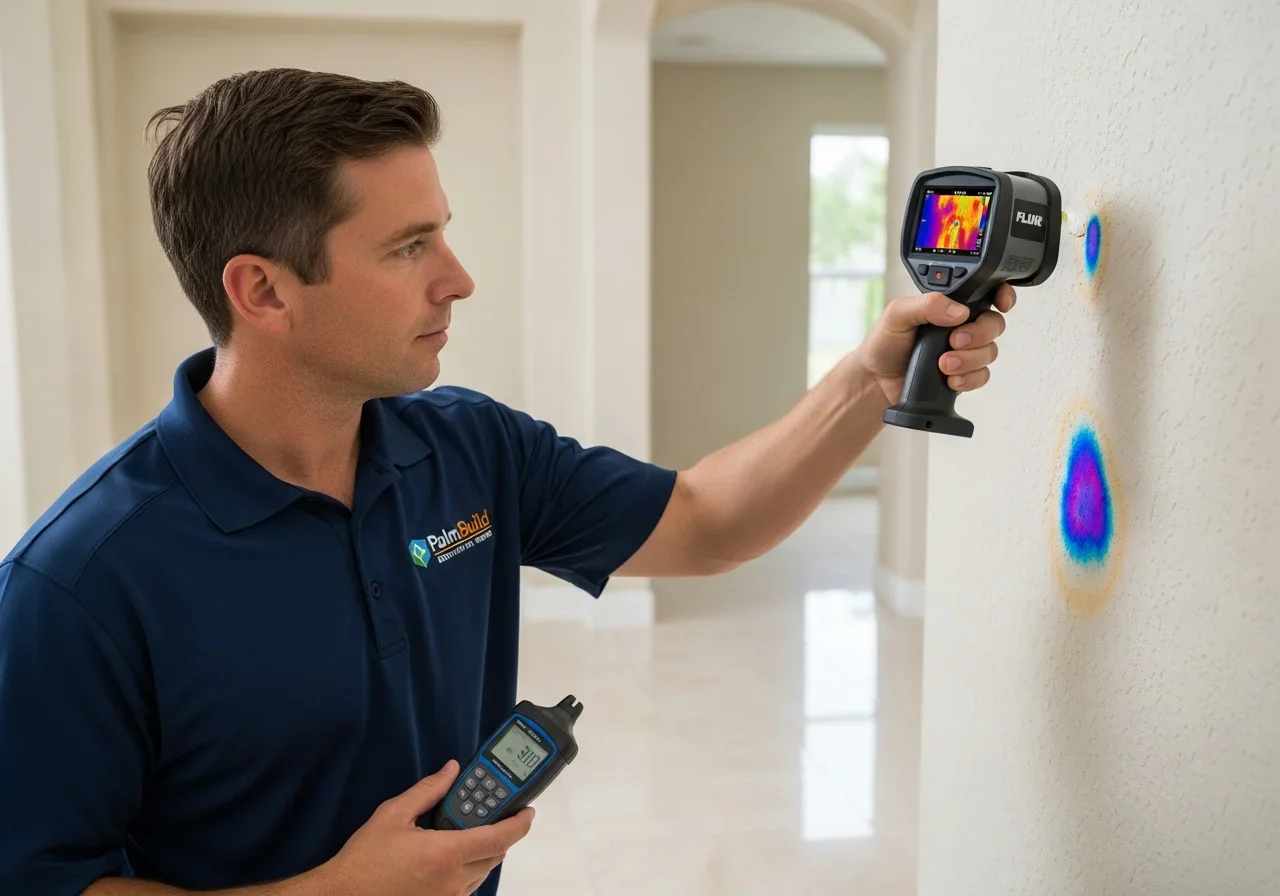
Comprehensive visual inspection, infrared thermal imaging of CBS walls, and air quality sampling. We identify the moisture source — HVAC condensate overflow, stucco crack intrusion, slab vapor transmission, or plumbing failure — and classify contamination level per IICRC S520. Florida law requires a separate DBPR-licensed mold assessor for the initial report.
02
Containment Setup
Day 1-2
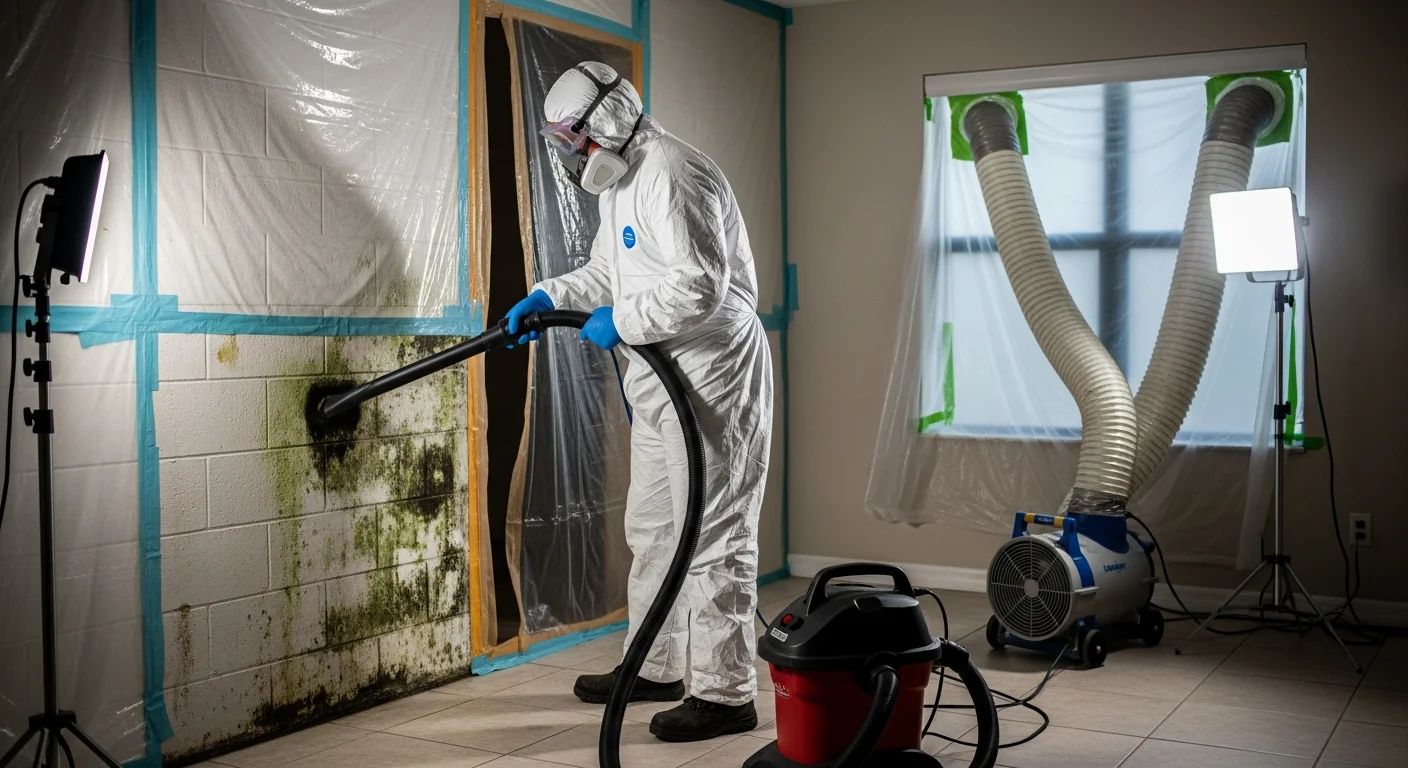
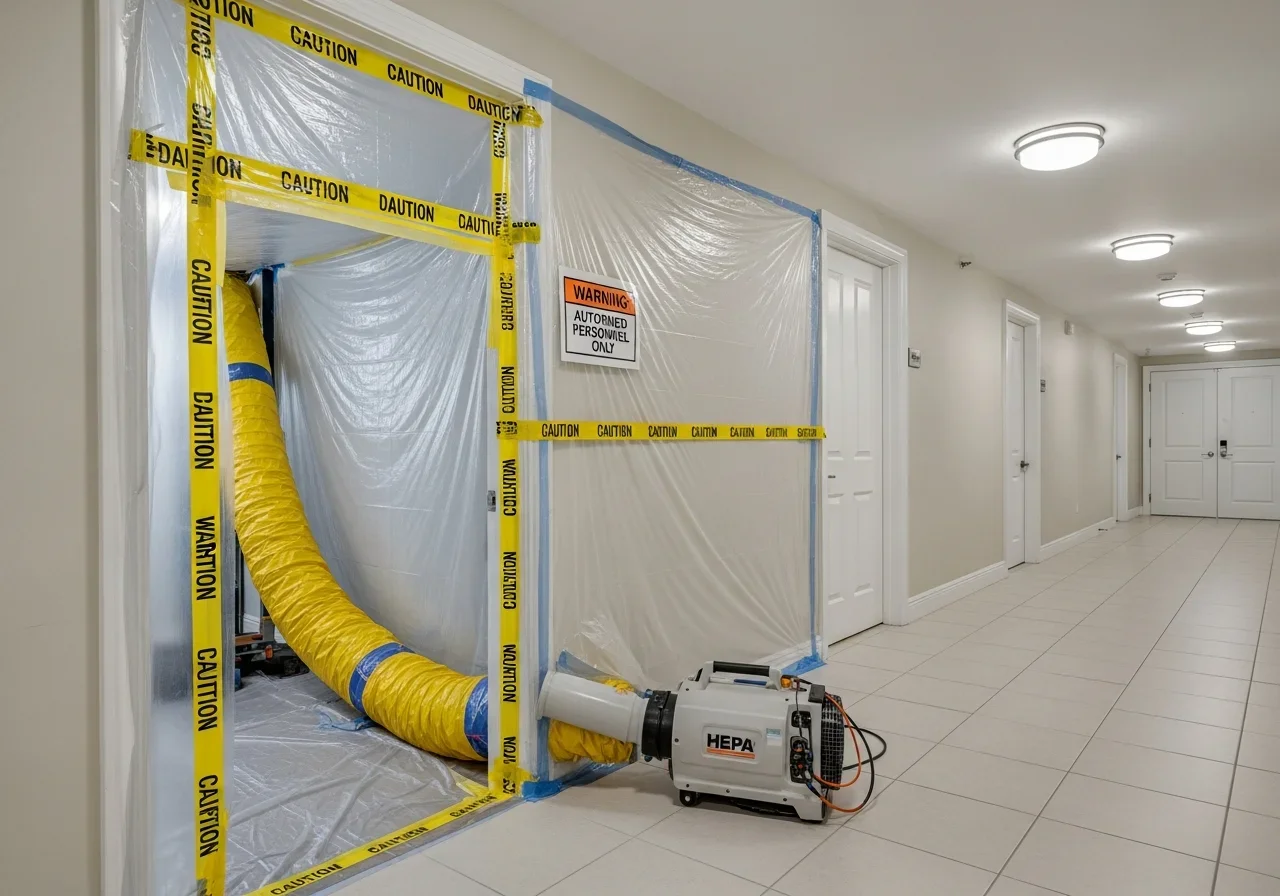
Sealed polyethylene containment barriers isolate affected areas, including CBS wall cavities and HVAC system components. In Oakland Park's persistent tropical humidity, containment must account for elevated moisture pressure that accelerates spore dispersal outside the work zone. HEPA air scrubbers create negative air pressure to prevent migration to unaffected areas — critical in condos with shared walls.
03
HEPA Air Filtration
Continuous
HEPA filtration runs throughout the project, capturing airborne spores down to 0.3 microns. In Oakland Park homes with HVAC contamination — one of the city's most common mold sources — the entire duct system is isolated and filtered separately to prevent recontamination of cleaned areas. In condo settings, additional containment prevents spore migration to adjacent units.
04
Removal & Cleaning
Days 2-4
Contaminated materials are removed using controlled demolition. Affected drywall on CBS walls, contaminated HVAC components (evaporator coils, drip pans, ductwork sections), impacted insulation, and mold-damaged flooring from slab moisture are removed. Salvageable CBS block surfaces are HEPA-vacuumed and media blasted to remove embedded mold from block pores.
05
Antimicrobial Treatment
Days 4-5
EPA-registered antimicrobial agents are applied to all treated surfaces. For CBS construction, this includes interior block wall faces, window bucks, slab edges, and any areas where moisture intrusion was identified. HVAC components receive specialized coil and duct treatment. All applications follow IICRC S520 guidelines for antimicrobial application in occupied structures.
06
Clearance Verification
Day 5-6
Post-remediation air quality testing by an independent DBPR-licensed mold assessor confirms spore counts have returned to acceptable levels. Florida's conflict-of-interest rule requires clearance from a different licensed assessor than the remediator. Complete documentation is provided for your records, insurance carrier, and HOA if applicable.
Why Containment Matters in Oakland Park's Climate
Disturbing mold without proper containment sends billions of spores airborne. In
Oakland Park's tropical humidity, those spores find viable growth surfaces within
hours — and the HVAC system can distribute them to every room within minutes. In condo
buildings, uncontained spores migrate through shared walls to adjacent units.
1
Sealed Barriers
Polyethylene sheeting floor-to-ceiling on CBS walls
2
Negative Pressure
HEPA scrubbers pull air through containment zone
3
HVAC Isolation
AC system sealed to prevent spore distribution
4
Condo Protection
Adjacent unit containment prevents cross-contamination
Unlike northern cities where winter freezing halts mold growth, Oakland Park never drops
below mold-favorable conditions. The risk ranges from elevated to critical — it is never
low. Understanding the seasonal peaks helps time preventive maintenance and recognize
when emergency response is most likely needed.
January - April
Elevated RiskDry Season
Oakland Park's dry season still averages 60-70% humidity — above the 60% mold growth threshold. Lower rainfall reduces new moisture intrusion, but existing moisture inside CBS walls and HVAC systems continues feeding active colonies. This is the best window for planned remediation and preventive HVAC maintenance before the rainy season amplifies every moisture problem.
May - June
High RiskRainy Season Onset
Daily afternoon thunderstorms begin dumping 6-10 inches of rain per month. Humidity spikes to 75-85%. HVAC condensate volume surges as AC systems work harder against rising heat and humidity. Clogged drain lines that survived the dry season overflow under increased load. Stucco cracks that were dormant begin actively wicking rainwater into CBS wall cavities. This is when dormant mold colonies in Oakland Park homes explode into visible contamination.
July - October
Critical RiskPeak Hurricane & Mold Season
Maximum mold risk. Hurricane season brings wind-driven rain that penetrates stucco at angles normal rainfall cannot. Power outages disable AC, causing indoor humidity to spike above 80% within hours — critical in Oakland Park's older homes without backup dehumidification. Flooding from canal overflow or overwhelmed drainage saturates slab-level construction. HVAC systems at maximum capacity generate the most condensation. Post-storm mold blooms appear within 48-72 hours.
November - December
Moderate RiskTransition Season
Rainfall decreases but humidity remains 60-70%. Mold colonies that established during the rainy season continue growing — they do not die when rain stops. Temperature drops slightly reduce HVAC runtime, slowing new condensate production. This is a secondary window for remediation, but any mold that grew during May-October must be professionally removed — it will not resolve on its own in Oakland Park's climate.
Mold Does Not Die in Oakland Park's "Dry Season"
Active mold colonies that established during the rainy season continue growing
through winter — Oakland Park's humidity never drops low enough or long enough to
kill established mold. The dry season slows new colony formation but does not
reverse existing contamination. Professional remediation is required to eliminate
mold regardless of season.
Mold in Oakland Park Homes
Oakland Park Mold Remediation: What We See
These are the most common mold presentations we encounter in Oakland Park's mid-century
CBS homes and condo buildings — from hidden wall cavity mold and HVAC system
contamination to active growth in bathrooms and kitchens.
Hidden mold behind drywall — invisible until materials are removed, this is what decades of moisture cycling inside CBS wall cavities produces
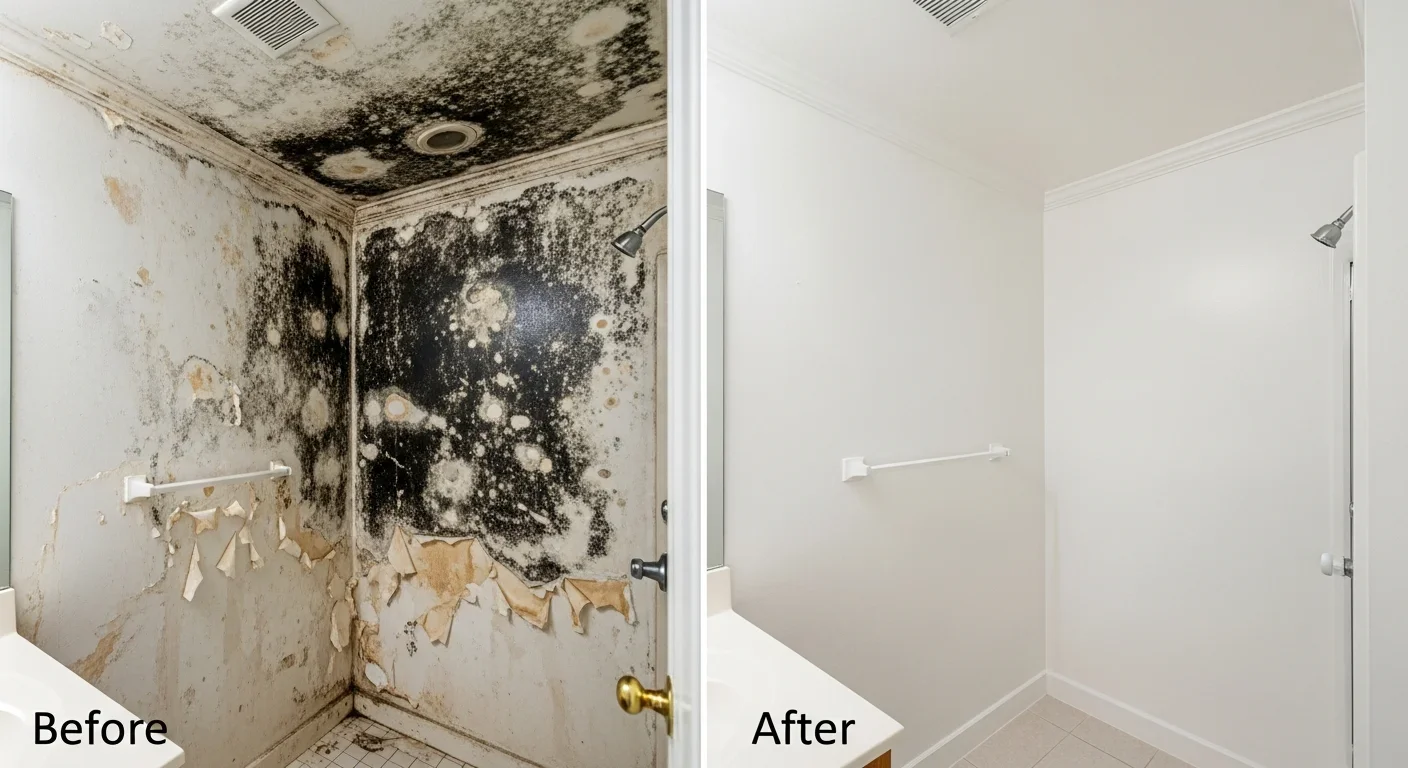
Full bathroom mold remediation — from active growth to clearance-verified clean in an Oakland Park condo unit
Infrared thermal imaging reveals moisture patterns inside CBS walls without destructive investigation — mapping the full extent before opening any walls
Independent clearance testing confirms successful remediation — required by Florida law from a separate licensed assessor
Oakland Park Pricing
Mold Remediation Costs in Oakland Park
Costs vary by contamination extent, materials affected, and whether HVAC system or
multi-unit condo work is needed. Early detection and intervention dramatically reduce
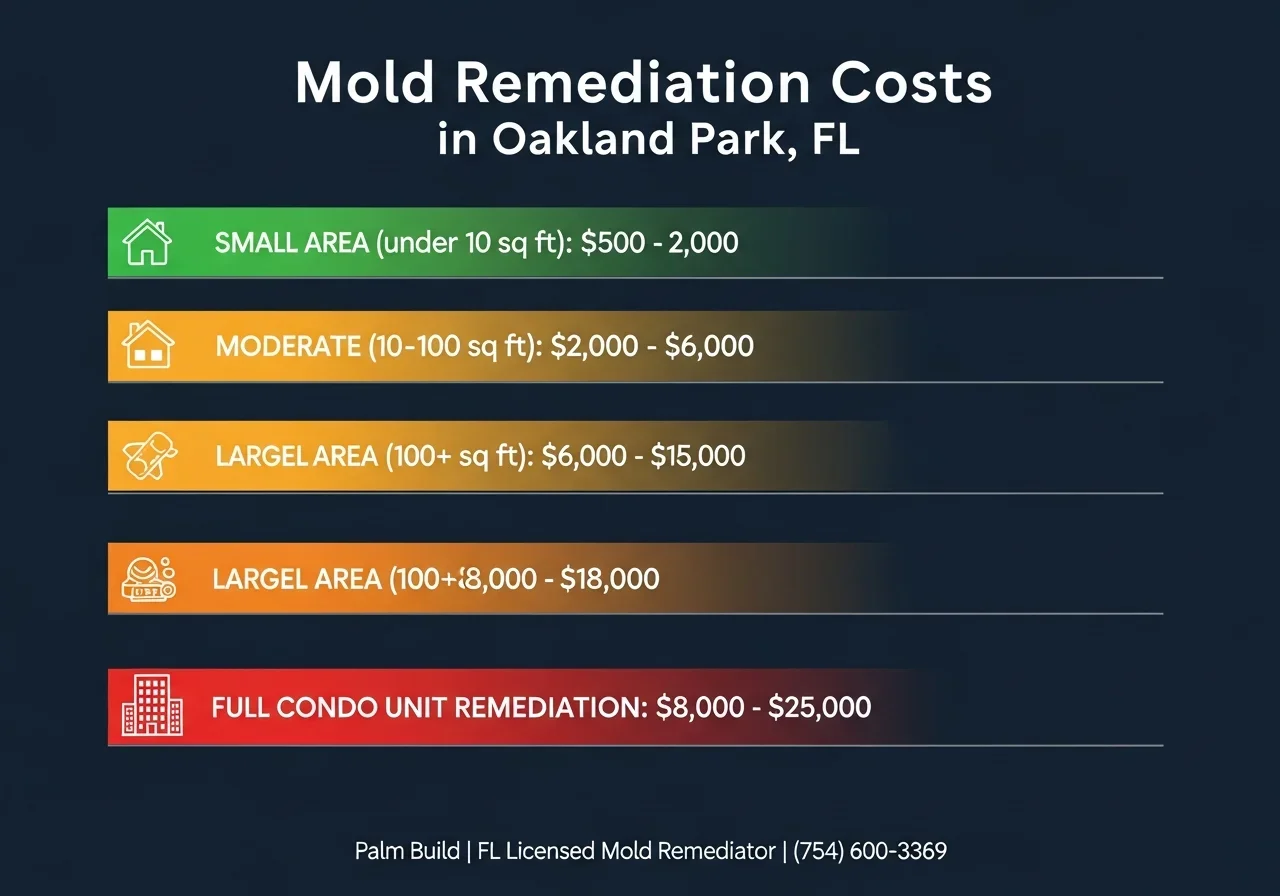
scope and cost — a $500 bathroom mold cleanup becomes a $15,000 condo remediation when
left unaddressed for months.
Small / Contained Area
Bathroom, under-sink, closet, single wall section, window frame
Multi-room or full unit remediation, extensive containment, reconstruction
$6,000 - $25,000
Timeline: 5-14 days
Why Oakland Park Condo Mold Costs Run Higher
Condo mold remediation in Oakland Park frequently costs more than single-family projects
due to several factors: containment must protect adjacent units through shared CBS walls,
HOA coordination adds project management complexity, multi-party insurance claims require
additional documentation, and shared HVAC infrastructure may need system-wide assessment.
Florida's mandatory separate-assessor requirement adds independent testing costs at both
pre- and post-remediation phases. However, proper remediation prevents far more expensive
structural damage, health consequences, and property value losses.
Early detection and intervention dramatically reduce remediation scope and cost.
Insurance Navigation
Mold Insurance Claims in Oakland Park
Mold coverage in Florida is limited and has become more restrictive following recent
insurance reforms. Understanding your coverage — including typical $10,000-$25,000
sublimits, covered vs. excluded moisture sources, the 1-year filing deadline, and
Citizens-specific requirements — can save Oakland Park property owners thousands.
Mold resulting from a covered sudden water event (burst pipe, appliance failure) is typically covered up to your policy's mold sublimit
Most Florida policies cap mold coverage at $10,000-$25,000 — HVAC mold and CBS wall remediation in Oakland Park frequently exceed these limits
Mold from gradual moisture, humidity, HVAC condensation, slab vapor transmission, or long-term stucco intrusion is almost always excluded
Some Florida carriers offer mold endorsements for additional premium — ask your agent about expanded coverage before you need it
Florida's 1-year claim filing deadline (Fla. Stat. 627.70132) is strictly enforced — delayed reporting can void otherwise valid claims
Citizens Property Insurance — Oakland Park's insurer of last resort — has specific mold sublimits and documentation requirements that differ from private carriers
Professional documentation connecting mold to a covered water event remains critical for successful claims — Palm Build provides this from day one
Palm Build's Approach to Oakland Park Mold Claims
When mold results from a covered water event, our documentation connects the mold to the
original loss — moisture maps, infrared thermal images, air quality reports, and
remediation scope all formatted for the adjuster. We understand Florida's strict 1-year
claim deadline, Broward County-specific claim patterns, and the documentation
requirements for both private carriers and Citizens Property Insurance. For mold not
covered by insurance (HVAC condensation, humidity, gradual moisture), we provide
transparent pricing and financing options.
Why Oakland Park Property Owners Choose Palm Build for Mold
FL DBPR Licensed Mold Remediator
Palm Build holds a Florida DBPR mold remediation license and complies fully with Chapter 468, Part XVI requirements. We coordinate with independent DBPR-licensed assessors for the conflict-of-interest separation Florida law mandates — the same company cannot assess and remediate on the same property within 12 months.
IICRC S520 Certified Protocols
Every Palm Build crew lead carries current IICRC Applied Microbial Remediation Technician (AMRT) certification — the industry gold standard for mold remediation. Our protocols follow IICRC S520 standards for professional mold remediation in every Oakland Park project.
Condo & Multi-Unit Expertise
Oakland Park's substantial condo housing stock requires specialized remediation — multi-unit containment, HOA coordination, shared-wall protocols, and multi-party insurance documentation. We understand the unique challenges of remediation in buildings where your mold problem can affect your neighbor's unit and vice versa.
HVAC Mold Specialists
Oakland Park's #1 mold source is the HVAC system. We remediate air handlers, evaporator coils, drip pans, and duct systems, then address the root cause — drain line blockage, pan corrosion, unit sizing, condensation patterns — so mold does not return after remediation.
Independent Clearance Testing
We don't clear our own work. Post-remediation air quality testing is performed by an independent DBPR-licensed mold assessor — as Florida law requires. Complete documentation is provided for your records, insurance carrier, and HOA. You know the job was done right because an independent party verified it.
Independent post-remediation air quality testing — required by Florida law from a
separate DBPR-licensed assessorPalm Build's Florida-licensed team in full PPE inside sealed containment — every
Oakland Park project follows IICRC S520 protocols
Deerfield Beach Hub — ~6 Miles
Our South Florida Operations Hub at 786 S Military Trail, Deerfield Beach is
approximately 6 miles from Oakland Park — same-day mold assessments for urgent
situations. We serve all Oakland Park neighborhoods including North Andrews Gardens,
Lloyd Estates, Lake Emerald, Oakland Forest, Royal Palm Acres, Sleepy River, and every
condo community in between.
Common Questions
Oakland Park Mold Remediation FAQ
Does Florida require licensing for mold remediation?
Yes. Florida requires specific licensing for both mold assessors and mold remediators under Chapter 468, Part XVI of Florida Statutes, administered by the DBPR. Anyone performing mold remediation in Oakland Park must hold this license. Palm Build's technicians are Florida-licensed and IICRC S520 certified. Verify any contractor's license at myfloridalicense.com before hiring.
How much does mold remediation cost in Oakland Park?
Costs depend on the affected area and scope. Small areas (under 10 sq ft) typically cost $500-$2,000. Moderate projects involving wall cavities or HVAC systems run $2,000-$6,000. Full condo unit or multi-room projects range $6,000-$25,000. Condo remediation in Oakland Park often costs more due to containment requirements and HOA coordination.
Does insurance cover mold remediation in Oakland Park?
Florida policies typically include limited mold coverage — sublimits of $10,000-$25,000 are common — but only when mold results from a covered water loss. Mold from chronic humidity, HVAC condensation, or gradual leaks is usually excluded. Remember Florida's 1-year notice deadline applies to mold claims too. Palm Build documents the moisture source from day one to support your filing.
Why is HVAC mold so common in Oakland Park?
Most of Oakland Park's homes were built in the 1950s-1980s with HVAC systems that have been replaced without upgrading ductwork or insulation. In our tropical climate (60+ inches of rain, persistent humidity above 70%), aging systems can't remove enough moisture. Condensate line clogs, duct insulation deterioration, and supply register sweating create hidden moisture that feeds mold growth behind walls and in duct systems.
Can I stay in my condo during mold remediation?
For small, contained projects in one room, yes — our containment and negative air prevent spore migration. For larger projects or HVAC-involved remediation that affects the whole unit's air system, temporary relocation is recommended, especially for anyone with respiratory conditions. We discuss this during the initial assessment and can help coordinate with your HOA.
How long does mold remediation take in Oakland Park?
Small projects take 1-2 days. Moderate remediation with containment and wall cavity work takes 2-4 days. Full condo unit or multi-room projects require 5-14 days. Post-remediation air quality verification adds 1-2 days for lab analysis. Oakland Park's tropical humidity can extend drying phases — we adjust equipment accordingly.
What areas of Oakland Park does Palm Build serve for mold?
We serve all of Oakland Park including North Andrews Gardens, Lloyd Estates, Lake Emerald, Oakland Forest, Sleepy River, Middle River Homes, Royal Palm Acres, East and West Lakeside, Central Oakland Park, Prospect Gardens, Harlem McBride, and all condo communities. We also serve neighboring Fort Lauderdale, Wilton Manors, and Pompano Beach.
How do I know if I have mold in my Oakland Park home?
Common signs include musty odors (especially near HVAC vents), visible dark spots on walls or ceilings, condensation on supply registers, peeling paint, unexplained allergies or respiratory symptoms, and water stains that never fully dried. In Oakland Park's mid-century homes, mold is frequently hidden behind walls, above ceilings, or in HVAC ductwork — professional thermal imaging assessment is the only way to know for sure.
Trusted Vendors
Trusted local pros in Oakland Park
Outside our restoration scope, these are the vetted, licensed contractors we trust
alongside our work. Personally evaluated, reference-checked, and recommended by Palm
Build.
Mold in Your Oakland Park Property? Get Licensed Help.
Palm Build's Florida-licensed mold remediators bring professional containment, HEPA filtration, and verified clearance testing to every Broward County project. In a state that requires mold licensing, anything less is a risk.