Mold Remediation in Hallandale Beach, Florida
Hallandale Beach averages over 60 inches of rainfall per year — and with sea level rise increasing tidal flooding frequency 5–10 times since the 1960s, moisture in CBS stucco buildings has become a near-constant reality. In the city's dense high-rise corridor, a single HVAC condensate overflow can seed mold colonies across multiple floors within 48 hours. Palm Build's DBPR-licensed team provides same-day assessments, professional containment, complete remediation, and post-clearance air quality testing — with documentation your Florida insurer accepts.
Same day
Emergency Response
24/7
Dispatch Available
IICRC
Certified Technicians
Trusted local pros in Hallandale Beach
Outside our restoration scope, these are the vetted, licensed contractors we trust alongside our work. Personally evaluated, reference-checked, and recommended by Palm Build.
F1 Plumbing Corp
Miami, FL
The only Latina-owned, SBA-WOSB-certified plumber on Palm Build's directory — Niurka Muñoz's Miami-Dade-and-Broward shop carries DOT DBE certification, federal SAM.gov registration, and bilingual English/Spanish dispatch as published baseline.
John the Plumber, Inc.
Pompano Beach, FL
John the Plumber is the oldest vendor on Palm Build's directory — John Krobatsch's 1979 third-generation Pompano Beach family shop carries three active Florida CFC licenses (CFC057705/057318/057704), 1,975 Google reviews at 4.9 stars (the largest absolute sample on our list), a BuildZoom score of 116 placing it in the top 2% of 191,428 FL contractors, and BBB A+ Accredited since 9/7/2022.
Mainline Plumbing Service, Inc.
Pompano Beach, FL
Mainline Plumbing, AC & Electrical is the only multi-trade vendor on Palm Build's directory — three active Florida state licenses under one entity (plumbing CFC1429264, air conditioning CAC1823791, electrical EC13003477), one truck dispatched for all three scopes, 4.8 stars across 854 Google reviews, and a 24/7 live-answering line behind the standard Monday–Saturday 8:00 AM – 7:00 PM dispatch window.
West End Plumbing
Sunrise, FL
West End Plumbing has been BBB A+ Accredited since January 14, 2011 — fifteen unbroken years — and operates from a Sunrise HQ that puts every truck within a 30-minute drive of central Broward and the Palm Beach county line. Founded in 1980 and run today by Adam Stricker as A & I West End Plumbing, Inc. under Florida CFC1427334, they cover all of Broward and most of Palm Beach — the widest single-trade footprint of any plumber on the Palm Build directory.
Mold Problem in Hallandale Beach? Get a DBPR-Licensed Assessment.
Palm Build's DBPR-licensed mold remediation team provides same-day inspections, professional containment, complete remediation, and post-clearance air quality testing — with documentation your Florida insurance carrier accepts.
Why Mold in Hallandale Beach High-Rises Requires a Different Approach
Hallandale Beach's condo density, year-round AC operation, tidal flooding exposure, and aging high-rise building stock create mold scenarios that simply don't exist in single-family markets. Understanding these patterns is the difference between treating a symptom and eliminating the source.
24–48h
Mold Growth Window
CDC/EPA — faster in South FL heat
45,000+
Residents, 4.4 sq mi
One of Broward's densest condo markets
10–11 mo
AC Runtime per Year
Continuous condensation = mold fuel
80%+
Wet Season Humidity
Exceeds mold growth threshold
DBPR Chapter 468 Licensed: Florida requires separate licensing for mold assessors and remediators. The same contractor cannot assess and remediate the same property within 12 months. Palm Build holds current DBPR mold remediator licenses and coordinates with independent licensed assessors for compliant, conflict-free remediation.
Condo-Specific Scenarios
The 4 Mold Scenarios Unique to Hallandale Beach High-Rises
HVAC Condensate Overflow — Multi-Floor Migration
Most CommonWhen an AC condensate drain line backs up in a high-rise, the overflow migrates down through floor/ceiling assemblies to the unit below. In CBS construction, moisture travels further and faster than in wood-frame buildings. By the time a tenant notices ceiling stains, mold may already be established in the wall cavity two floors up.
Requires tracing the moisture migration path through multiple floors before containment setup.
Post-Tidal Flooding: Ground Floor and Parking Garages
Growing RiskNOAA documents tidal flooding increasing 5–10x since the 1960s in South Florida cities. Ground-floor units and parking garages in Hallandale Beach see periodic saltwater intrusion that accelerates mold growth — saltwater introduces organic matter that serves as a nutrient base for black mold colonization faster than freshwater events.
Category 3 remediation protocol required. Enhanced antimicrobial and materials disposal.
Balcony Door Seal Failure — Wall Cavity Mold
Common in 1970s–1980s BuildingsHallandale Beach's high-rise corridor includes buildings constructed in the 1970s–1980s with original or once-replaced balcony door seals. Over decades of sun exposure, salt air, and storm cycling, seals deteriorate and allow wind-driven rain to intrude behind interior drywall — creating hidden mold behind finish surfaces.
Thermal imaging required to locate hidden moisture before remediation scope can be set.
Shared HVAC Return Plenum — Cross-Unit Contamination
High-Rise SpecificSome older Hallandale Beach high-rise buildings use shared return-air plenum spaces above corridor ceilings. When mold establishes in one unit's air handler, spores can distribute to adjacent units through shared plenum pathways. This is one of the scenarios that makes multi-unit coordination essential — treating one unit alone does not solve the source.
Building management coordination required. HEPA negative-pressure containment across affected units.
HVAC Mold — South Florida's #1 Source
Air Conditioning Mold in Hallandale Beach Condos
Air conditioners run 10–11 months per year in Hallandale Beach. Every AC unit generates continuous condensation inside the air handler. When drainage is compromised, that moisture becomes the most efficient mold distribution system in your building.
5 Signs Your Hallandale Beach Condo Has HVAC Mold
Musty odor when the AC turns on
Spores are being distributed from the air handler through ductwork into your living space. The smell intensifies with the blower speed.
Dark spots or rings near air vents
Surface mold colonizing around supply registers — indicates airborne spore deposition from an active source in the air handler or ductwork.
Visible staining inside the air handler cabinet
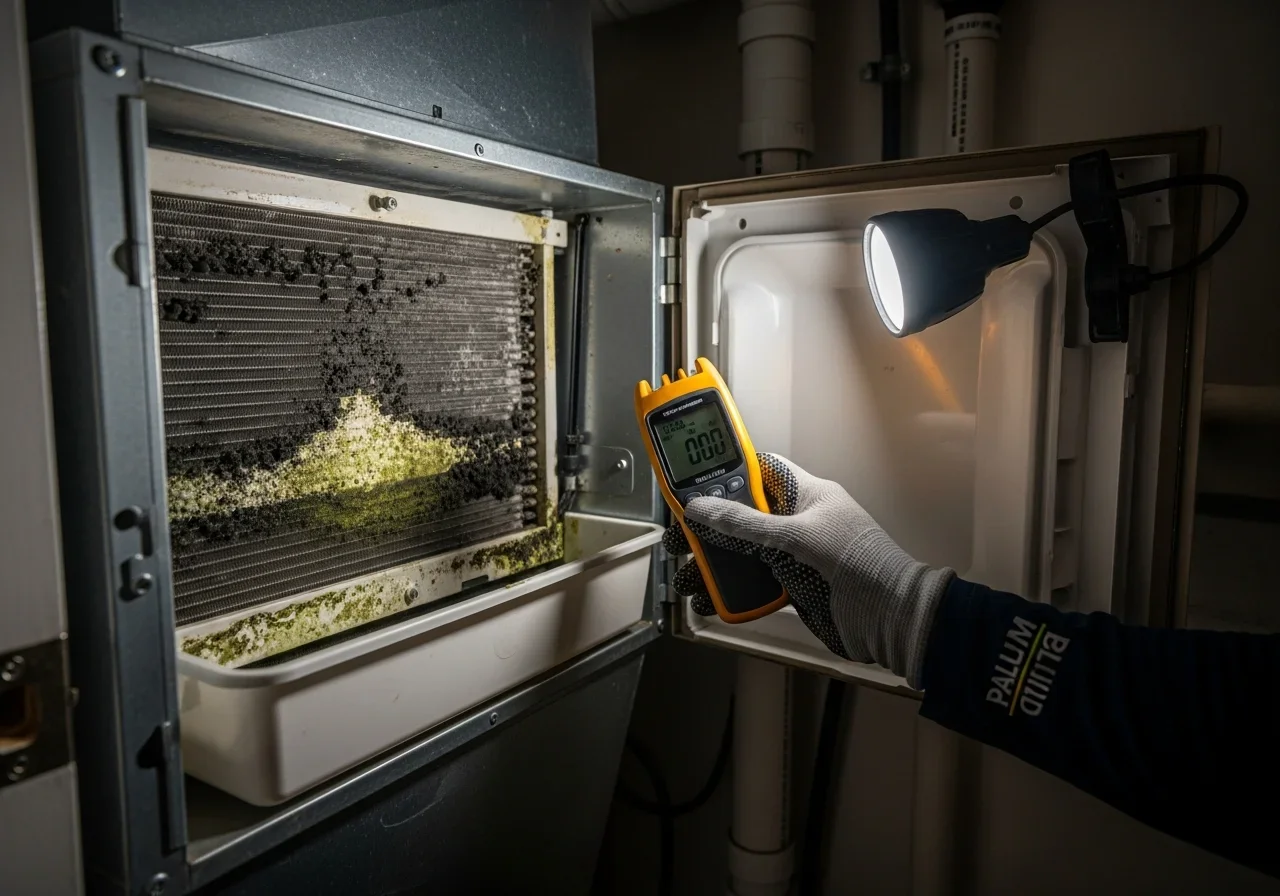
When you open the AC closet and see black, green, or gray discoloration inside the unit — this is active mold on the evaporator coil, drip pan, or housing.
Water stains on ceiling below air handler
Condensate pan overflow. In high-rises, this moisture migrates down into the unit below. The ceiling stain you see is often the least of the mold problem above.
Increased allergy symptoms only while home
If symptoms improve when you leave and worsen when you return — especially near vents — active HVAC mold distribution is a likely cause in Hallandale Beach's year-round AC environment.
Our HVAC Mold Remediation Process
Air Handler Inspection
Full interior access — evaporator coil, drip pan, blower wheel, supply plenum. Moisture and mold assessment before scope.
Ductwork Assessment
Visual and probe inspection of accessible ductwork for mold colonization and spore accumulation.
Source Isolation
System shut-off and containment. HEPA filtration running before disturbing any mold to prevent cross-contamination.
Remediation
HEPA vacuum, antimicrobial application to coil, pan, housing, and affected duct sections. All contaminated materials removed per IICRC S520 protocol.
Clearance Test
Independent post-remediation air quality test by licensed assessor confirms spore counts below pre-remediation baseline.
Annual HVAC inspection tip: Schedule condensate drain cleaning every 12 months — before the wet season starts in May. A $150 preventive flush is cheaper than a $5,000–$18,000 HVAC mold remediation project.
Neighborhood Mold Risk
Where Mold Risk Is Highest in Hallandale Beach
Your neighborhood's construction era, proximity to the coast, and type of building determine which mold pathways are most likely in your property.
Saltwater tidal intrusion + direct Atlantic coastal humidity. Repeated NFIP claims indicate recurring moisture events — cumulative mold risk in wall cavities is high in older CBS homes where moisture histories span decades.
Man-made islands surrounded by canals. Post-storm moisture events from multiple flood directions. Cluster townhomes share wall assemblies — a mold colony in one shared wall affects adjacent units simultaneously.
1970s–1980s high-rise condo complex. Aging galvanized plumbing, shared HVAC risers, and original condensate drainage systems. HVAC mold is the dominant loss type — units share air-handling infrastructure.
Salt air accelerates stucco cracking and window seal degradation in oceanfront towers. Wind-driven rain intrusion behind interior drywall creates hidden mold behind finish surfaces. Older towers (1970s–1980s) more vulnerable.
1950s–1970s CBS residential stock. Flat or low-slope roofs accumulate ponding water. Stucco cracks from age allow moisture behind walls. Post-storm humidity under ceiling materials produces rapid mold bloom.
Mixed-use redevelopment creates drainage disruption. Older residential blocks surrounding Gulfstream Park have aging building envelopes. HVAC condensate failures during peak cooling season are primary indoor mold source.
Inland position reduces tidal flood exposure but wet season humidity is identical. HVAC condensate overflow and post-storm window intrusion are primary mold drivers. Deferred maintenance on aging stucco and caulk is the leading contributing factor.
Florida Mold Licensing
What Florida Law Requires for Mold Work in Hallandale Beach
Florida's DBPR Chapter 468 mold licensing requirements protect homeowners from unqualified contractors. Here's what you need to know before hiring anyone for mold work in Hallandale Beach.
DBPR Chapter 468, Part XVI — Florida Law
Florida is one of the most strictly regulated states for mold services. Both mold assessors and mold remediators must hold separate, current state licenses issued by the Florida Department of Business and Professional Regulation. Unlicensed mold work is a legal violation — and undetectable if you don't ask.
Always verify license status at MyFloridaLicense.com before any contractor begins mold work.
The Separation Rule: Assessor ≠ Remediator
The same contractor who performs your mold assessment cannot remediate the same property within 12 months. This rule exists to prevent conflicts of interest — a remediator who also assesses has a financial incentive to find more mold. Licensed assessment and remediation must be performed by separate entities.
Palm Build performs remediation and coordinates with an independent licensed assessor for pre- and post-remediation testing.
Post-Remediation Clearance Testing Required
Legitimate mold remediation in Florida ends with a clearance test — an independent air quality sample taken by the licensed assessor after work is complete. The test confirms spore counts have returned to normal or below pre-remediation levels. Without this, you have no documented proof the mold was eliminated.
Palm Build includes coordination with the independent assessor for clearance testing in every project scope.
Warning Signs of Unlicensed Work
Unlicensed mold contractors are common in South Florida after hurricane or flood events. Warning signs: contractor quotes remediation without a separate assessment, no mention of clearance testing, pressure to sign quickly, cash-only pricing, no COI (certificate of insurance). If you can't verify a DBPR license number, walk away.
Ask for DBPR license numbers for both the assessor and remediator before signing anything.
Palm Build's Florida Mold Credentials
Palm Build holds current DBPR mold remediator licenses and maintains general liability insurance and workers' compensation as required by the City of Hallandale Beach contractor registration. We coordinate with independent licensed assessors for all pre- and post-remediation testing — keeping assessment and remediation appropriately separated.
Schedule Assessment — (754) 600-3369Remediation Process
How Palm Build Handles Mold Remediation in Hallandale Beach
Six steps from licensed assessment to clearance documentation — with condo-specific protocol at every stage.
Step 01
DBPR-Licensed Assessment
An independent licensed mold assessor (separate from the remediator, per Florida law) inspects the affected area using visual inspection, moisture meters, and air sampling. The assessment identifies mold species, extent, and moisture source before any remediation scope is set.
Florida law: assessor and remediator must be separate licensed entities.
Step 02
Containment Setup
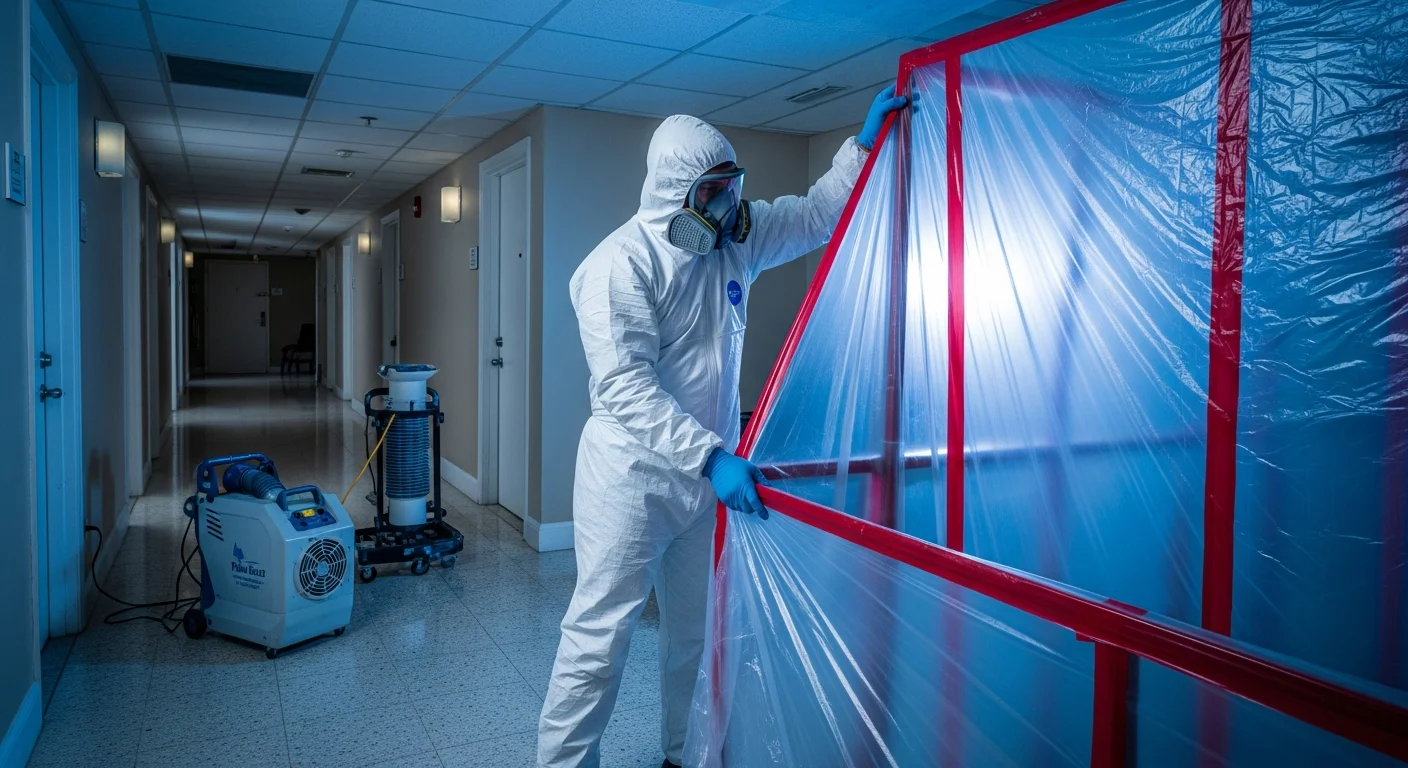
Before any disturbing begins, Palm Build establishes a negative air pressure containment zone using plastic sheeting, sealed barriers, and HEPA air scrubbers. In Hallandale Beach high-rises, this includes elevator protection, corridor barriers, and neighbor notification as required by building management.
HEPA air scrubbers run continuously throughout remediation — spores are captured before they can spread.
Step 03
Source Moisture Elimination
The moisture source driving mold growth must be addressed before remediation — otherwise mold returns. We coordinate plumbing repair, HVAC condensate line clearing, or stucco/window seal repair as part of the scope. Drying equipment runs to bring affected materials to dry standard.
Remediating mold without fixing the moisture source guarantees recurrence.
Step 04
IICRC S520 Remediation
Affected materials are remediated following IICRC S520 Standard and Reference Guide for Professional Mold Remediation. Porous materials with deep mold colonization (drywall, insulation) are removed and disposed of properly. Non-porous surfaces are HEPA-vacuumed and treated with EPA-registered antimicrobial agents.
Category 3 contaminated materials (from tidal flooding) require full disposal, not surface treatment.
Step 05
Post-Remediation Clearance Test
After remediation and before containment is removed, the independent licensed assessor returns for post-remediation verification testing. Air samples confirm spore counts have returned to or below pre-remediation levels. Clearance is documented in writing — required for Florida insurance claims.
No clearance document = no proof the mold is gone. Always require this.
Step 06
Reconstruction
Palm Build coordinates full reconstruction of removed materials: drywall, insulation, paint, trim, and flooring. Hallandale Beach permits are filed when required. Your final documentation package includes the assessment report, remediation scope, daily logs, clearance test results, and reconstruction photos.
One contractor from containment through final coat of paint — no handoff gaps.
Cost Guide
Mold Remediation Costs in Hallandale Beach
Costs vary significantly by mold type, location, and building complexity. Here is what Hallandale Beach homeowners and condo owners typically see.
Localized Surface Mold (1 room/closet)
$2,500 – $8,000Bathroom mold, closet mold, localized HVAC vent area. Containment, HEPA vacuum, antimicrobial, clearance test.
Most common type in Hallandale Beach condos — HVAC area mold, bathroom tile grout.
HVAC System Mold Contamination
$5,000 – $18,000Air handler, ductwork, supply plenum. Scope depends on extent of contamination and duct accessibility. Coil cleaning, pan replacement, duct remediation.
The most common source in South Florida condos — cost varies significantly by ductwork extent.
Post-Water-Event Mold (1–2 rooms)
$8,000 – $25,000Mold established in wall cavities after water damage event. Requires drywall removal, structural drying, antimicrobial treatment, reconstruction.
Post-flooding or above-unit leak that was not dried quickly enough — 48-hour window missed.
Full Property / Multi-Unit Remediation
$15,000 – $50,000+Extensive mold after tidal flooding, hurricane, or long-term hidden moisture. Multiple rooms or multiple units. Full demolition and rebuild of affected assemblies.
Tidal flooding or storm surge events in ground-floor or parking-level units. Multi-floor HVAC contamination.
Florida Mold Insurance — What to Know in Hallandale Beach
- Florida homeowners policies typically include a mold sublimit of $10,000–$25,000
- Mold from a sudden covered event (burst pipe) has stronger claim viability than maintenance-related mold
- Standard homeowners insurance does NOT cover mold from flooding — requires separate flood policy
- Florida Statute 627.70132: 1-year deadline from date of loss to file; 18 months for supplemental claims
- HO-6 unit owner policies and association master policies must both be documented separately in condos
These are typical ranges. Actual cost depends on mold species, extent, materials affected, and permit requirements. Palm Build provides a written estimate after assessment — no surprises.
Our Work in Hallandale Beach
Hallandale Beach Mold Remediation — Before & After
From HVAC mold in high-rise condos to post-flooding remediation — this is what professional DBPR-licensed mold remediation looks like in Hallandale Beach.
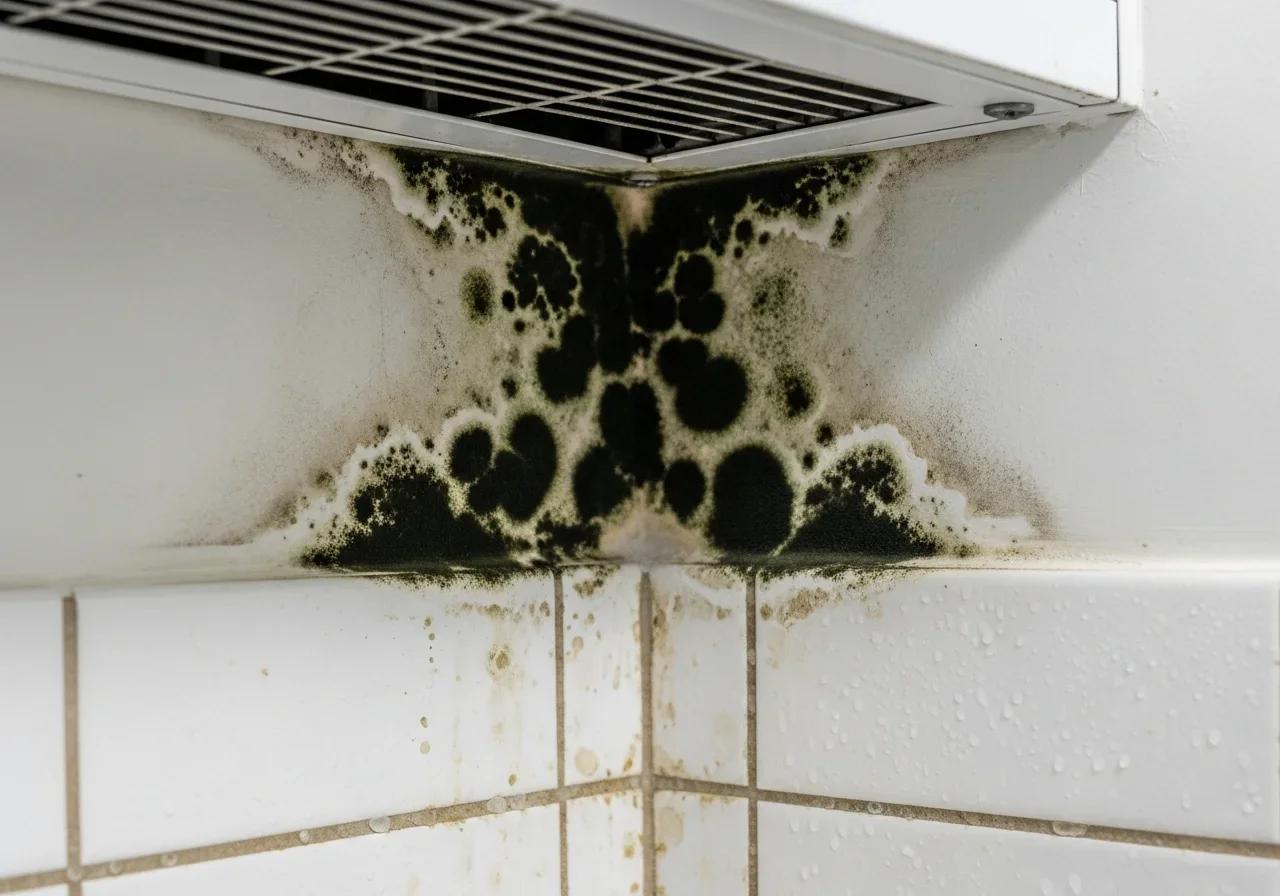 BEFORE
Hallandale Beach condo bathroom — black mold from HVAC condensate overflow, migrated into wall corner and baseboard
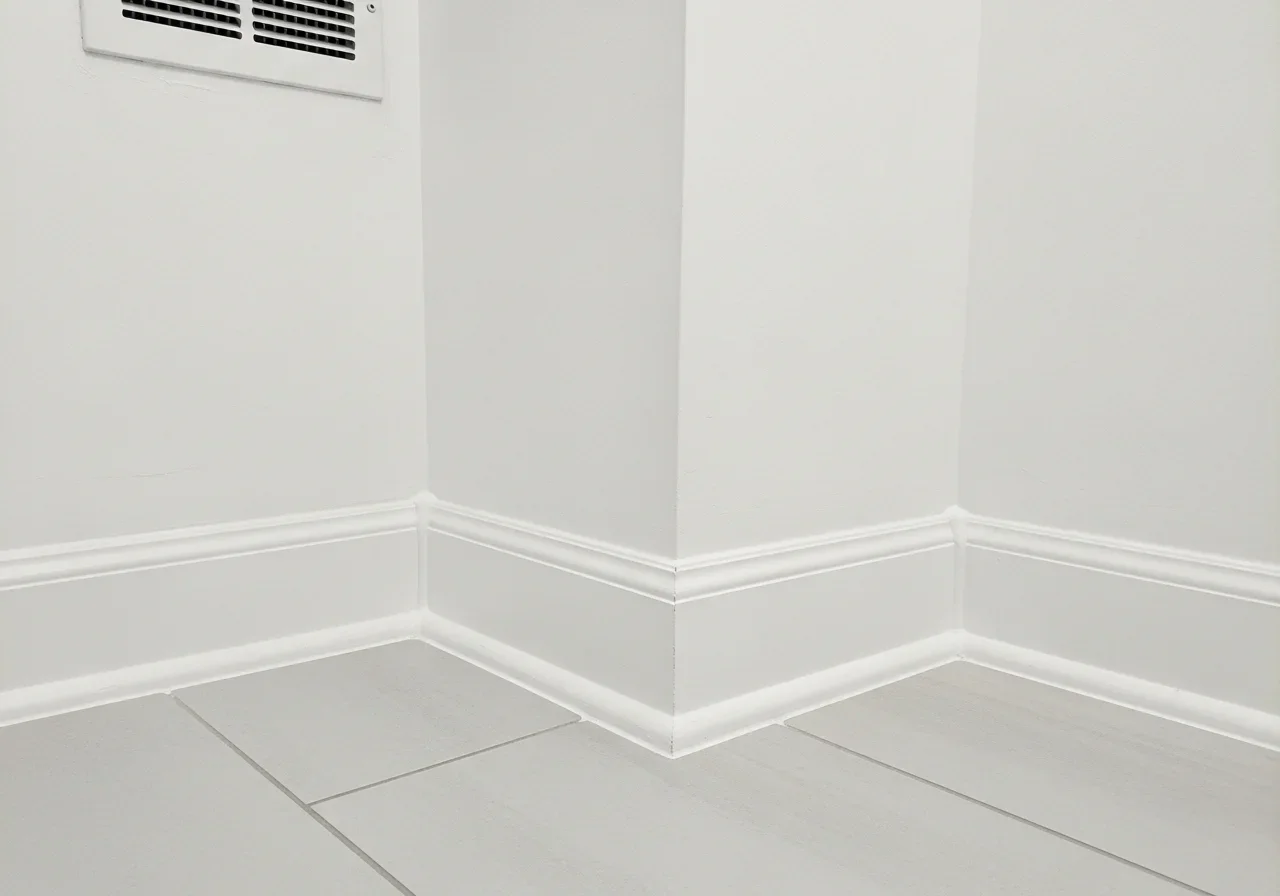 AFTER
AFTERFully remediated — fresh paint, clean grout, clearance test passed. Post-remediation air quality verified by independent licensed assessor.
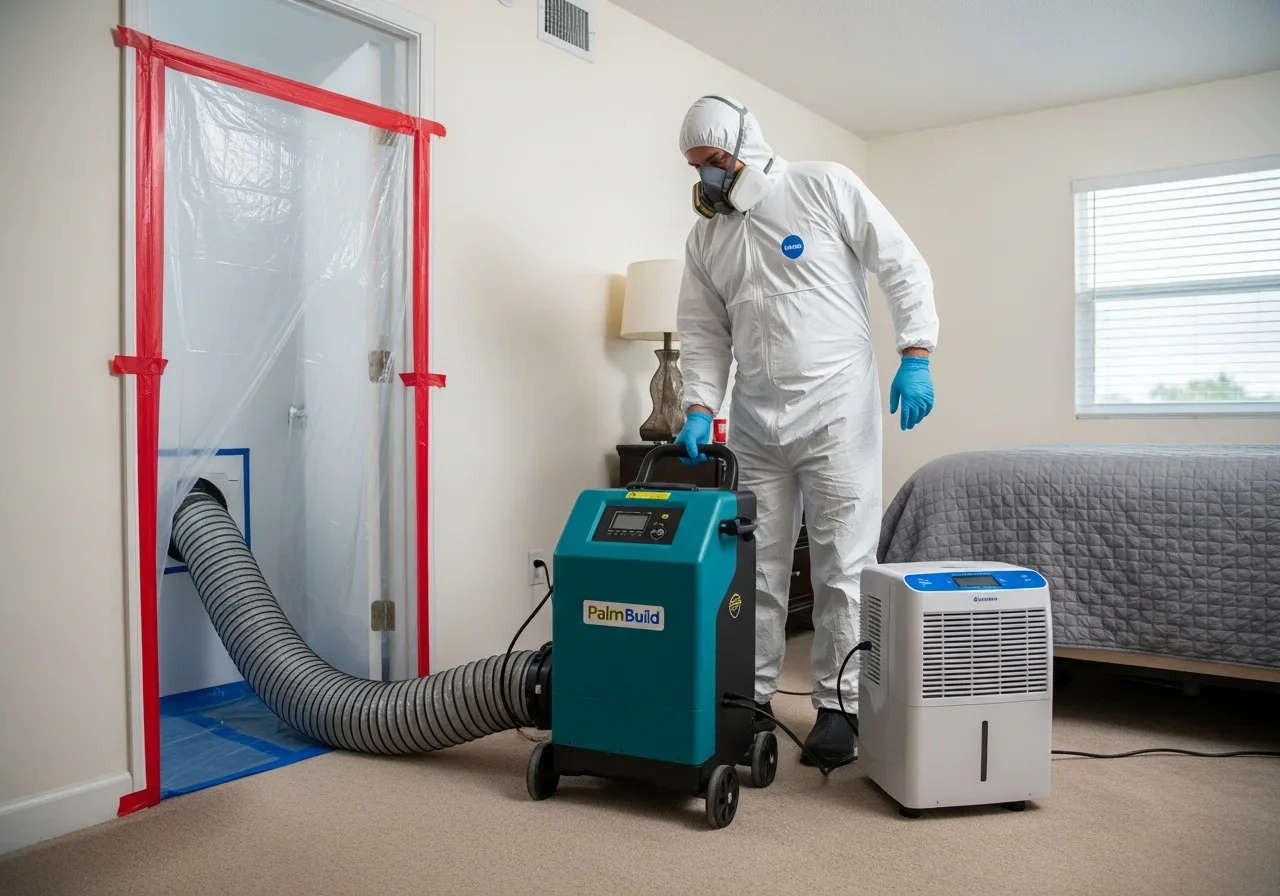 CONTAINMENT
HEPA air scrubber and negative-pressure containment in place — Hallandale Beach condo bedroom. Spores contained before disturbance begins.
HVAC MOLDHVAC air handler inspection — evaporator coil and drip pan mold assessment. South Florida condos run AC 10–11 months per year.
Mold problem in Hallandale Beach? Our Deerfield Beach team provides same-day assessments — 24/7.
Call (754) 600-3369 — Same DayWhy Palm Build
Why Hallandale Beach Condo Owners Choose Palm Build for Mold Remediation
In Hallandale Beach's complex condo market, mold remediation requires more than spray and paint. Here's what makes Palm Build different.
DBPR Chapter 468 Licensed
Palm Build holds current Florida DBPR mold remediator licenses — required by state law. We coordinate with independent licensed assessors for all pre- and post-remediation testing, maintaining the legal separation required between assessment and remediation.
High-Rise Condo Experience
We've handled multi-unit mold remediation in South Florida's densest condo corridors. Elevator protection, building management coordination, HOA approvals, and multi-policy insurance documentation are built into our standard protocol.
Same-Day Assessment in Hallandale Beach
Our Deerfield Beach operations hub is 15 miles from Hallandale Beach. In South Florida's warm, humid climate where mold can establish within 24 hours, same-day assessment is not a selling point — it's a necessity.
Clearance Documentation for Insurance
Every Palm Build mold project ends with a written clearance report from the independent licensed assessor. This document is required for Florida insurance claims and gives you documented proof the mold was eliminated — not just painted over.
Source-to-Clearance in One Project
Palm Build identifies the moisture source, performs IICRC S520-compliant remediation, and reconstructs all removed materials. One contractor, one scope, one point of accountability — from containment to final coat of paint.
Bilingual Team — English & Spanish
With over 64% of Hallandale Beach households speaking a language other than English at home, our bilingual capability ensures clear communication with you, your property manager, and building management throughout a complex project.
Frequently Asked Questions
Mold Questions from Hallandale Beach Condo Owners
The questions we hear most often from Hallandale Beach homeowners, condo unit owners, and property managers about mold identification, remediation, and insurance.
Have a question about mold in your Hallandale Beach property? Call us — we'll assess your situation honestly.
More in Hallandale Beach
Other Restoration Services in Hallandale Beach, FL
Helpful Resources