HOA & Condo Restoration in Hallandale Beach, Florida
Hallandale Beach is Broward County's barrier-island high-rise condo corridor — Three Islands, Golden Isles, and Village on the Green anchor a dense vertical community where multi-floor water migration, tidal flooding, salt-air corrosion, and post-Surfside milestone inspection requirements converge. Palm Build's Deerfield Beach team dispatches in approximately 30-40 minutes with freight-elevator-capable crews, multi-unit coordination, and master-plus-HO-6 insurance documentation for every floor and every carrier.
Deerfield Beach — approximately 15 miles from Hallandale Beach 30-40 min Response IICRC Certified
Why Hallandale Beach Demands Specialized HOA Restoration
Hallandale Beach is one of Broward County's most condo-dense coastal cities — 45,000
residents packed into 4.4 square miles of flat, low-lying barrier-island terrain. The
Three Islands, Golden Isles, and Village on the Green condo corridor means nearly
every multi-unit restoration project involves association governance, shared concrete
structures, and multi-party insurance. General contractors who treat this like
single-family work create billing disputes, compliance violations, and scope gaps.
Three Islands and Hallandale Beach's High-Rise Condo Corridor
Three Islands — Hallandale Beach's flagship barrier-island community — anchors a dense high-rise and mid-rise condo corridor that extends through Golden Isles, Village on the Green, and the oceanfront and Intracoastal towers along E Hallandale Beach Blvd. These are post-tensioned concrete towers with concrete and membrane roofing, shared plumbing risers serving stacked units, and freight-elevator access that general contractors have never coordinated. In this corridor, water damage never stays in one unit — vertical stack migration through concrete slab assemblies is the standard loss pattern, not the exception.
Every Property in Hallandale Beach Answers to an Association
From the oceanfront high-rise towers of Three Islands to the condo associations of Village on the Green to the mixed-use corridors of the Gulfstream Park area, virtually every multi-unit property in Hallandale Beach operates under HOA or condo association governance. Even inland CBS single-family neighborhoods are HOA-governed. Restoration here requires working within association rules, governing documents, and board approval processes — not around them.
Post-Surfside Milestone Inspections — High-Rise Towers Are Squarely in Scope
Following the 2021 Champlain Towers South collapse, Florida enacted milestone inspections at 25 and 40 years for buildings over three stories, alongside Broward County's existing 40-year recertification program. The high-rise condo towers along Hallandale Beach's barrier-island corridor — concrete structures built from the 1970s onward — fall squarely in this inspection window. Salt-air corrosion on rebar, post-tensioned slab exposure, and waterproofing membrane failure are being identified in these buildings. This is not a future issue — it is happening now.
~15 Miles from Our Deerfield Beach Hub — 30–40 Min Response
Palm Build's South Florida Operations Hub in Deerfield Beach is approximately 15 miles from Hallandale Beach — a 30 to 40 minute drive. When water crosses unit boundaries in a Three Islands high-rise or king-tide flooding reaches a Golden Isles ground-floor unit, our teams arrive with multi-unit coordination capabilities, truck-mounted extraction, and commercial drying equipment. In high-rise condo emergencies, every minute of delay means more units affected — and in Hallandale Beach's 70-75% humidity, mold colonization begins within 24-48 hours.
Hallandale Beach's barrier-island high-rise corridor — Three Islands, Golden Isles,
and Village on the Green — creates one of the most complex HOA restoration
environments in Broward County.
HOA Community Profiles
Hallandale Beach HOA Communities: Restoration Risk Profiles
Every HOA community in Hallandale Beach has a distinct restoration dynamic — shaped by
building age, coastal exposure, construction type, and governance structure. Here is
what drives HOA restoration complexity in each.
Three Islands
Barrier-Island High-Rise Condo Corridor Critical
Built: 1970s-1990sGovernance: Individual tower boards and master corridor associationsComposition: Oceanfront and Intracoastal high-rise and mid-rise towers
The most complex HOA restoration environment in Hallandale Beach. Concrete towers with post-tensioned slabs and shared plumbing risers face vertical stack water migration as the standard loss pattern. Salt-air corrosion on rebar, rails, and garage decks, tidal and storm surge exposure, freight-elevator access logistics, and post-Surfside milestone inspection windows all converge in this corridor. A single water event triggers one master policy claim plus multiple HO-6 claims spanning several floors.
Built: 1960s-1980sGovernance: Individual condo associations and single-family HOAsComposition: Low-rise to mid-rise condos and waterfront single-family homes
Golden Isles combines Intracoastal-facing condo associations with waterfront single-family HOA neighborhoods. Tidal and king-tide flooding reach ground-floor units and coastal-facing homes regularly. Older condo buildings face Broward County's 40-year recertification program. HOA approval is required for all exterior restoration, and FEMA Zone AE flood insurance exposure adds claims complexity.
Primary risk: Tidal flooding, aging plumbing, FEMA Zone AE exposure, HOA approval
Village on the Green
Condo HOA Community High
Built: 1970s-1980sGovernance: Condo association governanceComposition: Mid-rise condominiums
Village on the Green is a condo community with mid-rise construction and shared-wall, shared-floor assemblies that create inter-unit water migration pathways. HVAC condensate overflow is the leading damage source — aging air handler units running 10-11 months per year produce standing moisture that feeds mold in South Florida's humidity. Board approval is required before reconstruction begins, and the association's declaration governs the master-vs-HO-6 boundary.
Primary risk: HVAC condensate, inter-unit migration, aging building envelope
Gulfstream Park Area Mixed-Use Condos
High-density mixed-use condo corridor High
Built: 2000s-2020sGovernance: Individual condo associationsComposition: High-rise and mid-rise condominiums
The Gulfstream Park and E Hallandale Beach Blvd corridor includes newer high-rise condo towers with complex association governance structures. While newer construction reduces aging-infrastructure risk, vertical stack water migration through shared plumbing stacks, roof membrane failures, and balcony waterproofing issues remain. Board approval and multi-carrier insurance coordination are the primary restoration complexity drivers.
Oceanfront and Intracoastal-facing towers face the most direct storm surge, tidal flooding, and salt-air corrosion exposure in Hallandale Beach. Hurricane wind-driven rain penetrates balcony door seals and window joints across dozens of units simultaneously. Salt-air corrosion accelerates building envelope deterioration. Post-Surfside milestone inspections and Broward County's 40-year recertification program are identifying concrete spalling and waterproofing membrane failures requiring immediate association action.
Built: 1970s-1990sGovernance: Neighborhood HOAsComposition: CBS block and stucco single-family homes
Inland Hallandale Beach single-family neighborhoods are built on flat terrain with limited storm-drain capacity. Heavy rainfall floods streets and enters CBS homes through garage doors and low-grade openings. HOA approval governs all exterior restoration. Aging barrel-tile roofing with deteriorating underlayment and 1970s-80s plumbing approaching end of life are leading damage sources.
How Water Crosses Unit Boundaries in Hallandale Beach Condos
In Hallandale Beach's high-rise condo corridor — Three Islands, Golden Isles, Village on
the Green — water damage never stays in one unit. Concrete slab assemblies, shared wall
cavities, stacked plumbing, and HVAC chases create migration pathways that turn a
single-unit problem into a multi-party insurance event. Each affected unit has a
different owner, a different carrier, and a different claim.
Vertical Migration Through Concrete Slab Assemblies
3+
Insurance claims per vertical event
A pipe burst in Unit 5A of a Three Islands high-rise sends water through the post-tensioned concrete slab to Unit 4A below — and potentially to 3A and 2A as well. Water penetrates through plumbing penetrations, construction joints, and slab cracks. The owner of 5A has one insurance carrier. The owner of 4A has another. The association's master policy covers the shared structural elements between them. Three or more separate claims, separate adjusters, one unified restoration project.
Horizontal Migration Through Shared Walls
2-4
Adjacent units at risk
Hallandale Beach condos are built with CBS (concrete block and stucco) construction. Shared walls between adjacent units are not waterproof — they are block walls with drywall on each side. Water from one unit's leak migrates horizontally through the block to adjacent units. In the dense high-rise towers of Three Islands and Golden Isles, a single wall failure can affect two or three adjacent units before anyone notices the spread.
HVAC Cross-Contamination
24-48 hrs
Until mold colonization
Aging HVAC systems in Hallandale Beach's older condo towers are a leading source of water damage calls. Air conditioning units running 10-11 months per year produce significant condensate. When condensate drain lines clog or drip pans crack, standing water feeds mold in shared ductwork chases — distributing mold spores to neighboring units. In South Florida's 70-75% humidity, mold colonizes within 24-48 hours, turning a single-unit HVAC failure into a multi-unit mold remediation project.
Freight-Elevator Shaft and Common Area Pathways
All
Floors at risk via elevator shaft
Elevator shafts act as vertical channels spanning the full height of a high-rise. Water entering the shaft from any floor migrates to every level — including the elevator pit, mechanical rooms, and lobby. In the Hallandale Beach high-rise corridor, tidal and storm surge saltwater intrusion through the building envelope reaches common areas that every unit owner funds through HOA dues. Freight-elevator scheduling and lobby protection are essential for any multi-floor restoration project.
Real Scenario: Pipe Burst in Unit 5A
Unit 5A
Source unit — HO-6 policy covers interior damage and liability
Unit 4A (below)
Victim unit — separate HO-6 carrier, separate adjuster, separate claim
Shared wall/floor
Common element — master policy claim, association responsibility
Hallway/common area
Association property — master policy, all owners share cost via dues
This is a standard water event in Hallandale Beach high-rise condos. Palm Build coordinates all parties as a single integrated project — separate documentation
for each carrier, unified restoration execution, one team managing the complexity.
Common HOA Property Damage
Damage Types Driving HOA Restoration in Hallandale Beach
Hallandale Beach's coastal high-rise corridor, subtropical climate, and dense HOA
governance create damage patterns that require multi-party coordination from the first
hour. These are the six most common damage types we restore in Hallandale Beach HOA
communities.
Most Common
Inter-Unit Water Migration
The #1 HOA restoration trigger in Hallandale Beach. A pipe burst, toilet overflow, or appliance failure in one unit sends water through shared concrete slab assemblies and CBS walls into adjacent and lower units. In the Three Islands and Golden Isles high-rise corridor, a single event can affect multiple floors. Each unit files a separate HO-6 claim while the association handles common element damage through the master policy.
Affected communities: Three Islands, Golden Isles, Village on the Green, all multi-story buildings
Very Common
HVAC Condensation in Aging Buildings
HVAC condensate overflows are a leading source of water damage calls in Hallandale Beach condos. Air conditioning systems running 10-11 months per year produce significant condensate. In older condo buildings, aging drain lines, cracked drip pans, and oversized units create standing moisture in air handlers — water that feeds mold colonies distributed through shared ductwork chases to multiple units simultaneously.
Affected communities: Village on the Green, Golden Isles condos, all buildings with aging HVAC
Common
Shared Plumbing Riser Failures
Hallandale Beach's older condo towers have shared plumbing risers — vertical supply and waste lines serving stacked units from bottom to top. When a riser fails, water enters every unit along that stack simultaneously. The riser itself is a common element covered by the master policy, but interior damage in each unit is an individual HO-6 claim. In post-tensioned concrete towers, riser access and repair must also account for structural constraints.
Affected communities: Three Islands towers, Golden Isles condos, Intracoastal high-rises
Seasonal (June-November)
Hurricane Wind-Driven Rain and Storm Surge
Hurricane and tropical storm wind-driven rain breaches building envelopes through window seals, balcony doors, and exterior wall joints — while storm surge from the Atlantic and Intracoastal adds saltwater intrusion risk at ground and lower levels. In a hurricane event, dozens of units in a single high-rise can experience water intrusion simultaneously, creating a mass restoration event requiring immediate multi-unit mitigation and coordinated master policy claims.
Affected communities: Three Islands, Golden Isles, oceanfront and Intracoastal towers throughout Hallandale Beach
Recurring / Tidal Events
Tidal and King-Tide Street Flooding
Hallandale Beach's low-lying barrier-island terrain makes tidal and king-tide flooding a recurring reality. Sunny-day flooding occurs when high astronomical tides push water through storm drains and into streets without any storm at all. Ground-floor condo units, garage levels, and lobby areas in Three Islands and Golden Isles absorb tidal intrusion that begins as a nuisance and escalates to structural moisture damage. Sea level rise has increased tidal flooding frequency significantly in recent decades along the South Florida coast.
Affected communities: Three Islands, Golden Isles, oceanfront and Intracoastal ground-floor units
Increasing (Post-Surfside)
Concrete Spalling and Salt-Air Corrosion
Post-Surfside milestone inspections and Broward County's 40-year recertification program are identifying concrete spalling, rebar corrosion, and waterproofing membrane failure in Hallandale Beach's high-rise condo towers. Salt-air corrosion from the oceanfront and Intracoastal environment accelerates rebar oxidation, balcony rail deterioration, and garage deck breakdown. These structural issues allow ongoing water infiltration into occupied units. Repair requires HVHZ-compliant materials and Broward County building department approvals.
Affected communities: All high-rise and mid-rise buildings 3+ stories near the coast
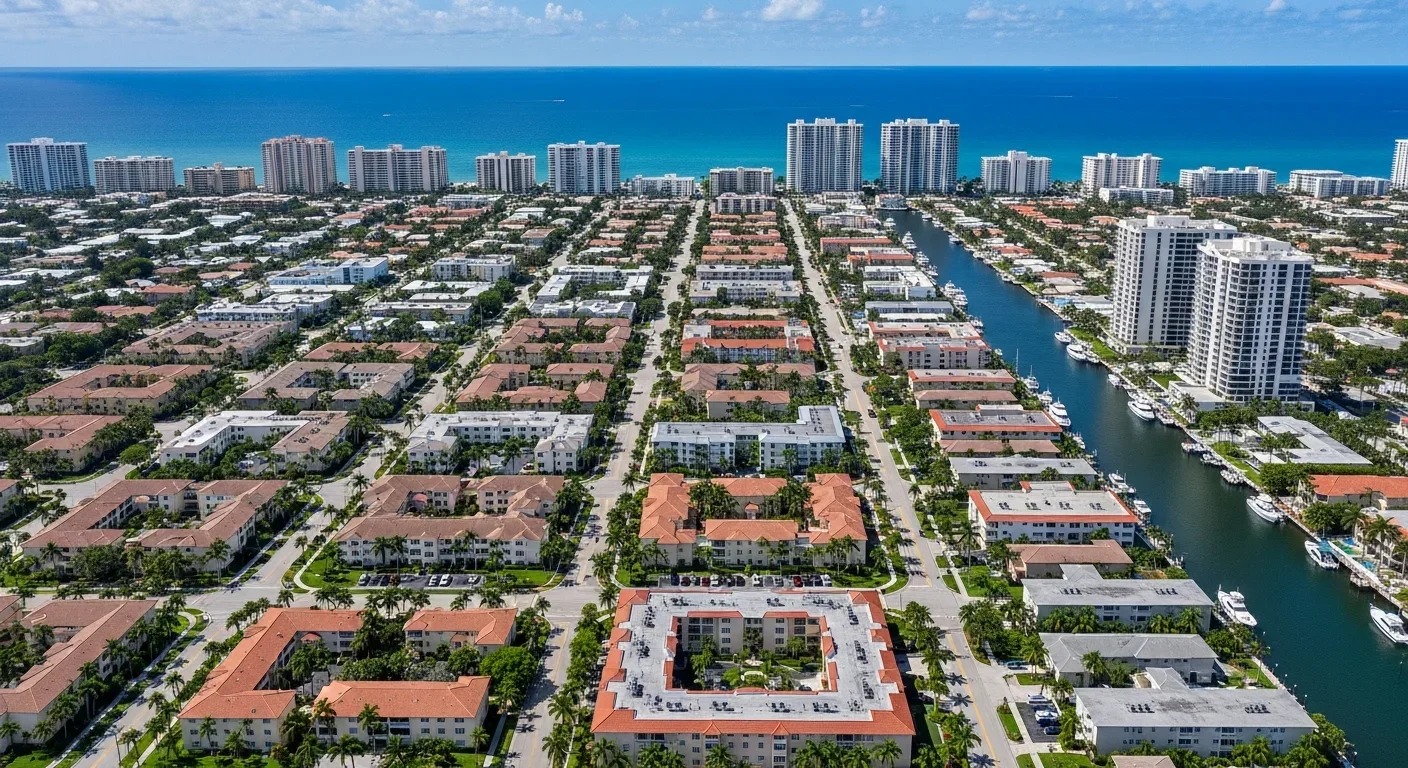
Three Islands and the Hallandale Beach barrier-island corridor — concrete high-rise
towers with salt-air exposure, tidal flooding risk, and post-Surfside milestone
inspection requirements.
Barrier-island high-rise towers
Oceanfront and Intracoastal-facing condo corridor
Built 1970s onward
Concrete towers in milestone inspection windows
Concrete slab construction
Post-tensioned slabs, stack water migration is standard
Multiple association structures
Individual tower boards and master corridor governance
Post-Surfside milestone scope
Buildings over 3 stories — squarely in 25 & 40-yr window
Salt-air corrosion risk
Rebar, rails, garage decks, and membrane roofs all affected
Featured Community
Three Islands: High-Rise Stack Migration at the Barrier Coast
Three Islands anchors the most complex HOA restoration environment in Hallandale Beach
— a barrier-island high-rise and mid-rise condo corridor alongside Golden Isles and
Village on the Green. Concrete tower construction, tidal and storm surge exposure,
salt-air corrosion, and post-Surfside milestone inspection requirements converge here.
There is no standard Three Islands restoration — every tower requires its own
approach.
Vertical Stack Migration Through Concrete Assemblies
Three Islands high-rise towers are post-tensioned concrete structures. When water enters from above — through a failed waterproofing membrane, a burst supply line, or an HVAC overflow — it migrates through concrete slab assemblies and plumbing penetrations to multiple floors below. Each unit at each level may have a different owner and a different insurance carrier. A single event generates multiple HO-6 claims coordinated against one master policy, all requiring unified documentation.
Freight-Elevator and Lobby Access Logistics
High-rise restoration in Hallandale Beach is not like restoring a house. Crew access requires freight elevator scheduling, lobby floor protection, and coordination with building management — often through a property management company with its own approval process. During active water events, multiple floors may require simultaneous drying, meaning crews must move extraction and dehumidification equipment through shared corridors between occupied units. This requires a team experienced in high-rise access protocols.
Salt-Air Corrosion Compounds Every Loss
Hallandale Beach's oceanfront and Intracoastal-facing towers face salt-air corrosion on an ongoing basis. Rebar within concrete structures, balcony railings, garage deck surfaces, and waterproofing membranes all degrade faster in this coastal environment. When a water intrusion event occurs — whether from storm surge, tidal flooding, or a mechanical failure — the underlying structure is often already compromised. Restoration that does not account for salt-air damage misses the root cause and leads to recurrence.
Milestone Inspections Are Driving Urgent Repairs
Post-Surfside legislation (SB 4-D and SB 154) requires milestone inspections at 25 and 40 years for buildings over three stories. Broward County's existing 40-year recertification program adds another layer. The concrete high-rise towers of Three Islands and the broader Hallandale Beach barrier-island corridor fall squarely within these windows. Inspections are identifying concrete spalling, rebar corrosion, and waterproofing membrane failures that require immediate association action and restoration expertise meeting Broward County building department standards.
How We Manage HOA & Condo Restoration in Hallandale Beach
HOA restoration in Hallandale Beach requires steps that single-family projects don't:
multi-unit assessment, governing document review, board approval, multi-carrier
coordination, HVHZ compliance, high-rise access logistics, and resident communication
across dozens of stakeholders.
01
Emergency Response & Board Notification
Hours 1-4
Immediate dispatch from our Deerfield Beach hub — approximately 30-40 minutes from Hallandale Beach — for mitigation: water extraction, board-up, or mold containment. Simultaneous notification to the property management company and HOA/condo board president. Florida law and most governing documents authorize emergency mitigation without board vote. For Three Islands and Golden Isles high-rise towers, we coordinate with building management for freight elevator access and lobby entry from the start.
02
Multi-Unit Damage Assessment
Days 1-3
Systematic assessment of all potentially affected units — not just the unit where damage is visible. In Hallandale Beach's stacked high-rise towers, water migrates vertically through concrete slab assemblies, horizontally through shared CBS walls, and through HVAC chases. We use thermal imaging and moisture mapping to identify every affected space before hidden moisture creates mold in Hallandale Beach's 70-75% humidity. Each unit receives individual documentation for its HO-6 claim.
03
Insurance Coordination (Master + Unit Policies)
Days 2-10
We review the association's declaration and Florida Statute 718 to determine the responsibility split between master policy and individual HO-6 coverage. In Hallandale Beach's condo towers, each building may define this boundary differently based on its governing documents — getting it wrong means billing the wrong carrier. We prepare separate documentation packages for the master policy carrier and each affected unit owner's HO-6 carrier, coordinating multiple simultaneous claims as one project.
04
Board Approval & Reconstruction Planning
Days 5-15
Most Hallandale Beach condo and HOA boards must approve restoration work exceeding dollar thresholds in their governing documents. Florida's condo law imposes specific notice requirements: 48-hour notice for regular meetings, 14-day notice for special meetings at certain expenditure levels. Palm Build prepares board-ready documentation — detailed scopes, estimates, timelines, and compliance certifications — and coordinates with property managers to secure approval at the earliest legally permissible meeting.
05
Restoration with Minimal Resident Disruption
Weeks 2-8
Phased restoration within the community's allowed work hours. For Three Islands, Golden Isles, and Intracoastal corridor high-rises: freight elevator scheduling, common area floor protection, and noise management for occupied units. For coastal towers with salt-air corrosion findings: HVHZ-compliant materials including Florida/Broward Product Approval or Miami-Dade NOA-rated products for any exterior work. All reconstruction meets Broward County building department standards.
06
Walkthrough, Claims Closeout & Board Report
Project Completion
Walk-through with property manager, board representative, and each affected unit owner. Separate completion documentation for the master policy carrier and all individual HO-6 carriers. Broward County building department final inspections completed. HVHZ compliance verified. Warranty documentation provided to both the association and individual unit owners. Board meeting presentation of completed work available upon request — including before/after documentation and cost reconciliation.
Florida Condo Insurance Structure
Master Policy vs. HO-6: The Hallandale Beach Condo Insurance Guide
This is the question every Hallandale Beach condo owner asks after damage. In Three
Islands, Golden Isles, and Village on the Green, each association may define the
boundary between "common element" and "unit" differently. Florida Statute 718 provides
baseline definitions, but your association's declaration can modify them. For high-rise
towers with post-tensioned slabs and shared plumbing risers, getting this determination
right is critical — Palm Build reviews both the declaration and statute before work
begins.
Master Policy (Association Responsibility)
Covers common elements and building structure per F.S. 718 and your declaration
Roof, exterior walls, and building envelope (CBS structure and high-rise concrete)
Shared plumbing risers, main water supply lines, fire suppression
Common areas: lobbies, hallways, pools, clubhouse, parking, and elevator systems
Structural framing, post-tensioned slabs, and load-bearing elements
Building HVAC systems, mechanical rooms, and elevator equipment
Waterproofing membranes, balcony structural elements, and building envelope
Coastal/salt-air corrosion repairs to common structural elements
HO-6 Policy (Unit Owner Responsibility)
Covers unit interior and personal property per declaration and HO-6 policy terms
Interior drywall, paint, and finishes (studs-in per most declarations)
Unit-specific plumbing fixtures and supply lines from shutoff
Improvements and upgrades beyond original spec
Loss assessment coverage (for HOA special assessments)
Critical for Hallandale Beach condo owners: Florida Statute 718.111(11) requires associations to maintain property insurance on common elements.
However, the exact boundary varies by declaration. Some buildings use "bare walls-in" coverage
(owner responsible for everything inside the studs); others use "all-in" coverage (master policy
covers interior finishes to original spec). In Hallandale Beach's high-rise corridor, each tower
association may define this boundary differently. Post-Surfside legislation (SB 4-D and SB 154)
has imposed mandatory structural reserve studies and milestone inspections for buildings over
three stories — meaning Three Islands and Intracoastal tower associations must fund reserves
for structural repairs, which affects special assessment exposure for every unit owner. Always verify your declaration's coverage boundary and reserve status. Palm Build reviews both the declaration and Florida statute before beginning work to ensure
the correct carrier is billed for each scope item.
HOA Restoration Costs
Who Pays for What in Hallandale Beach HOA Restoration
The most contentious question in every Hallandale Beach condo restoration project: who
pays? The answer depends on Florida Statute 718, your specific declaration, and whether
the damaged element is a "common element" or "unit." Getting this determination wrong
means the wrong insurance carrier gets billed — and someone pays out of pocket for work
that should have been covered.
Personal property and contentsVaries by coverage limits
Covered by individual HO-6 policy up to coverage limits; deductible applies per event
Disputed / Declaration-Dependent
Drywall between studs and unit boundaryDepends on "bare walls-in" vs "all-in"
Original-spec fixtures vs. upgradesMaster policy vs HO-6
Balcony structural vs. surface finishesVaries by declaration
HVAC components in shared mechanical spaceUnit vs common element
The exact split depends on your association's declaration — Hallandale Beach's condo towers each have their own governing documents and coverage definitions. Palm Build reviews the governing documents before work begins.
Need a cost determination for your Hallandale Beach HOA project?
Call (754) 600-3369 — we review your
declaration and provide carrier-specific scope breakdowns before work begins.
Multi-Party Insurance Navigation
Navigating HOA Insurance Claims in Hallandale Beach
HOA insurance claims in Hallandale Beach are fundamentally different from single-family
claims. Multiple carriers, disputed coverage boundaries, board transparency
requirements, and special assessment exposure create a claims environment where a wrong
determination costs thousands. Palm Build manages the insurance complexity so the board
and unit owners can focus on recovery.
3-8+
Carriers per event
Multi-Carrier Coordination
A single water event in a Hallandale Beach high-rise condo can involve the master policy carrier (potentially Citizens Property Insurance), plus multiple different HO-6 carriers for individual unit owners across several floors. Each carrier sends different adjusters, requires different documentation formats, operates on different timelines, and uses different pricing databases. Without a single coordinating party, the project fractures into disconnected repairs that don't align at shared boundaries.
Each
Tower has its own declaration
Coverage Boundary Disputes
The most contentious issue in Hallandale Beach condo restoration: where does the association's responsibility end and the unit owner's begin? Florida Statute 718 provides baseline definitions, but each declaration modifies them. "Bare walls-in" versus "all-in" coverage determines who pays for drywall, original-spec flooring, and standard fixtures. In the Three Islands, Golden Isles, and Intracoastal high-rise corridor, each tower association may have different declarations — getting this wrong is expensive.
6+
Adjusters on complex events
Multiple Adjusters, One Project
When the master policy carrier sends one adjuster and five HO-6 carriers each send their own, you have six adjusters viewing the same multi-floor damage from different angles with different scopes. Without unified project management, each adjuster approves different work, creating scope gaps at boundaries (nobody pays for the drywall between units) and scope overlaps (both carriers paying for the same plumbing repair). Palm Build provides a single unified scope with carrier-specific breakdowns.
Citizens
Common master carrier
Citizens Property Insurance Complexities
Many Hallandale Beach condo associations carry their master policy through Citizens Property Insurance — Florida's insurer of last resort. Citizens has specific documentation requirements, pricing guidelines, and approval timelines that differ from private carriers. When the master policy is through Citizens and individual HO-6 policies are through private carriers, the documentation burden doubles. Palm Build maintains carrier-specific documentation templates for efficient claims processing.
$$$
Special assessment risk
Special Assessment Exposure
When master policy coverage is insufficient or the association's deductible is high, the board levies a special assessment on all unit owners. Post-Surfside reserve requirements have increased this pressure — Three Islands and Intracoastal tower associations must now fund structural reserves, reducing available funds for damage claims. Unit owners may face both their HO-6 deductible and a special assessment from the same event. Loss assessment coverage on the HO-6 policy can offset this, but many owners don't carry adequate limits.
Full
Board documentation
Documentation for Board Transparency
Florida condo law requires financial transparency. Board members must be able to demonstrate that restoration expenditures were reasonable, competitively priced, and properly authorized. Palm Build provides detailed documentation packages for board records: itemized scopes, competitive pricing justification, progress photos, change order documentation, and final cost reconciliation — protecting board members from unit owner challenges and future audit questions.
HOA Restoration Gallery
HOA & Condo Restoration Work in Hallandale Beach
From multi-unit water extraction in Three Islands high-rise towers to moisture mapping
in Golden Isles condos, every image below represents the specialized HOA restoration
work Palm Build performs in Hallandale Beach's association-governed communities.
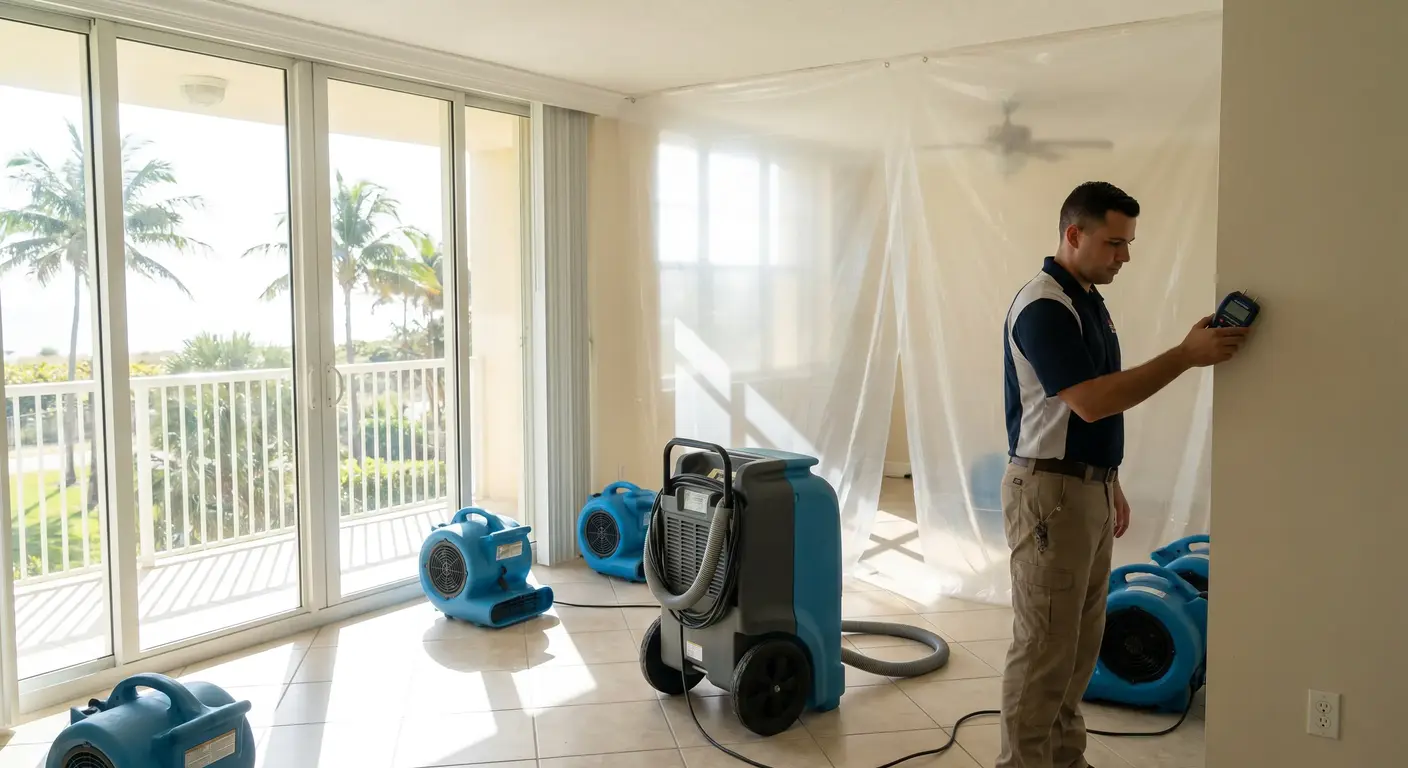
Multi-unit water extraction in a Hallandale Beach high-rise condo — coordinating drying across shared concrete slab assemblies between stacked units.
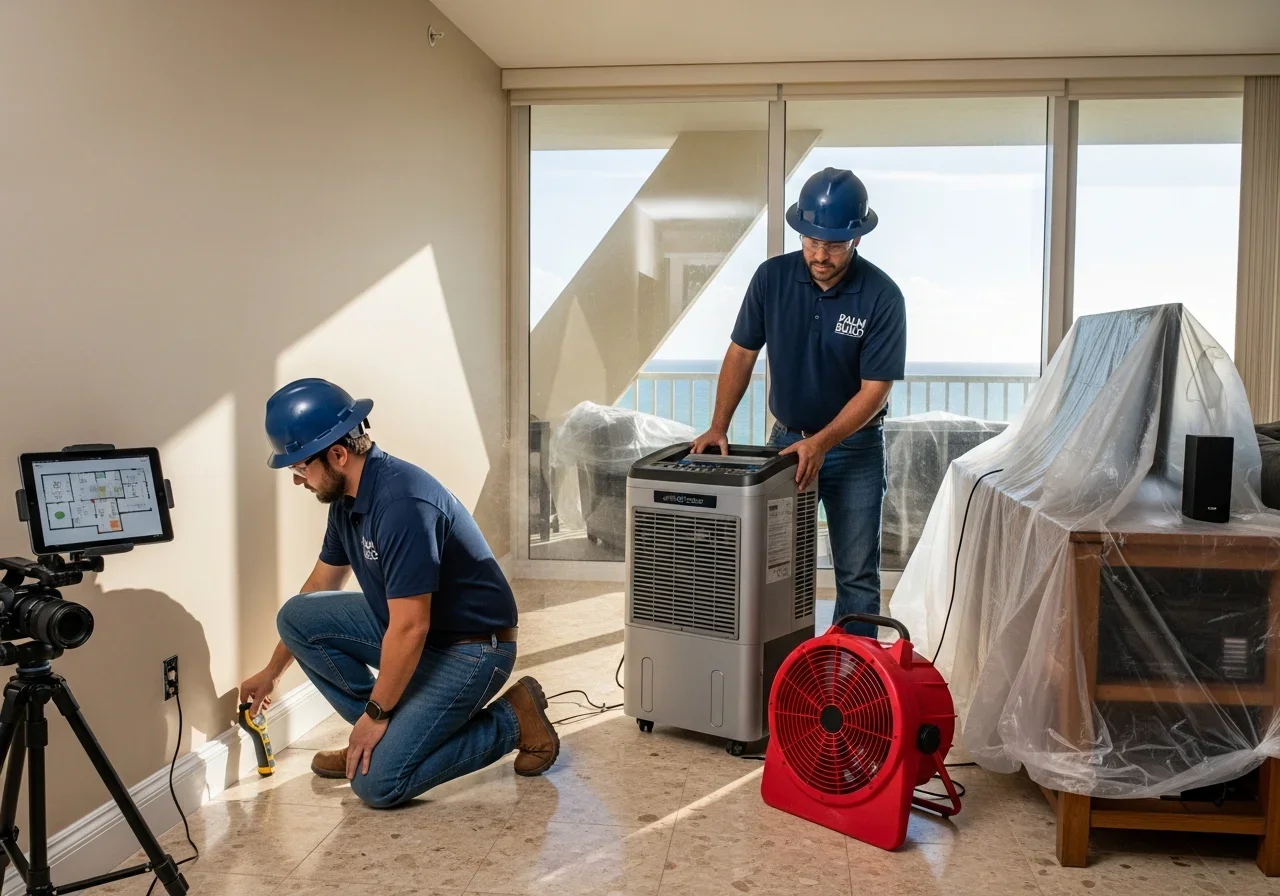
Commercial LGR dehumidifiers and air movers deployed in a Hallandale Beach condo unit — pulling 15-30 gallons of moisture per day in Broward County's South Florida humidity.
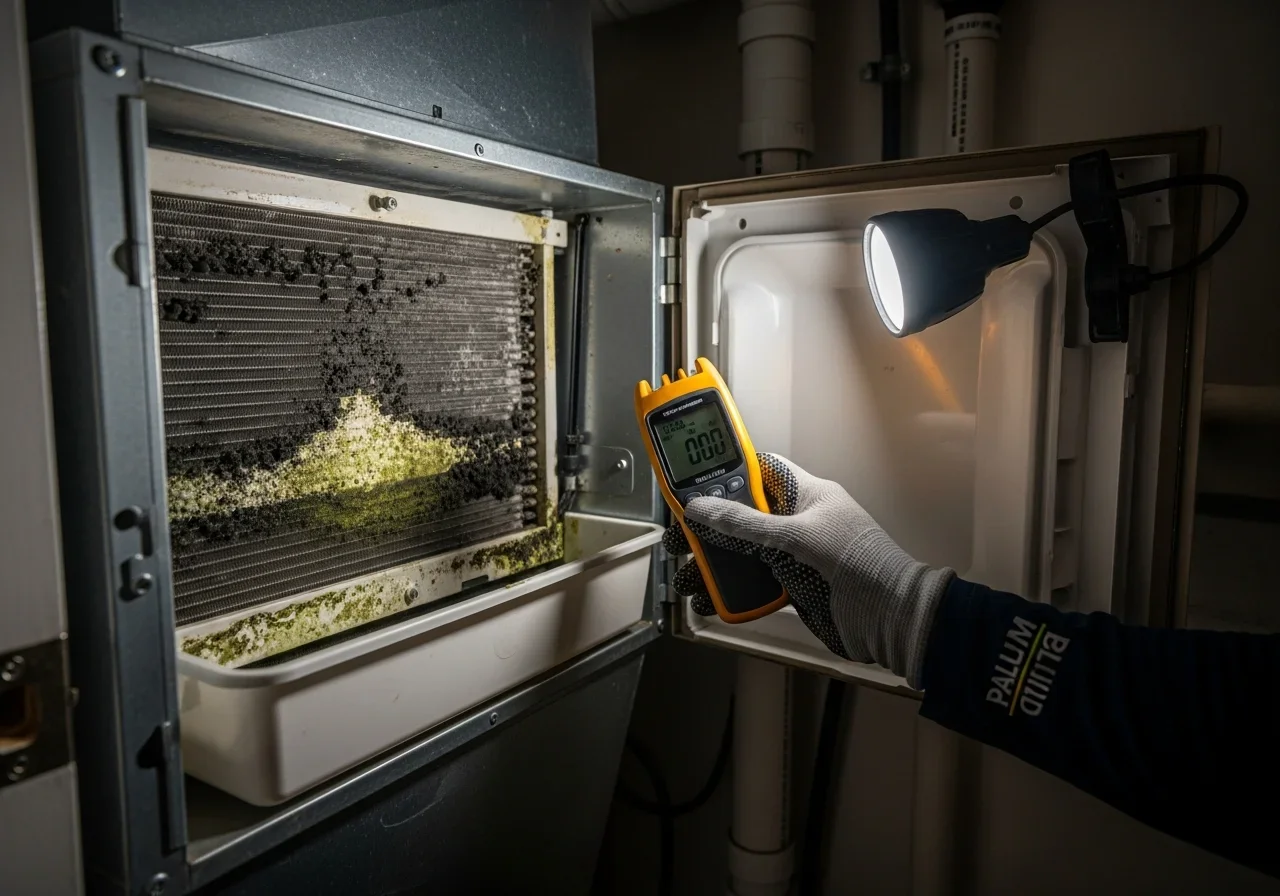
HVAC condensate overflow in a Hallandale Beach condo — a leading source of water damage and mold growth in older multi-unit buildings throughout the city.
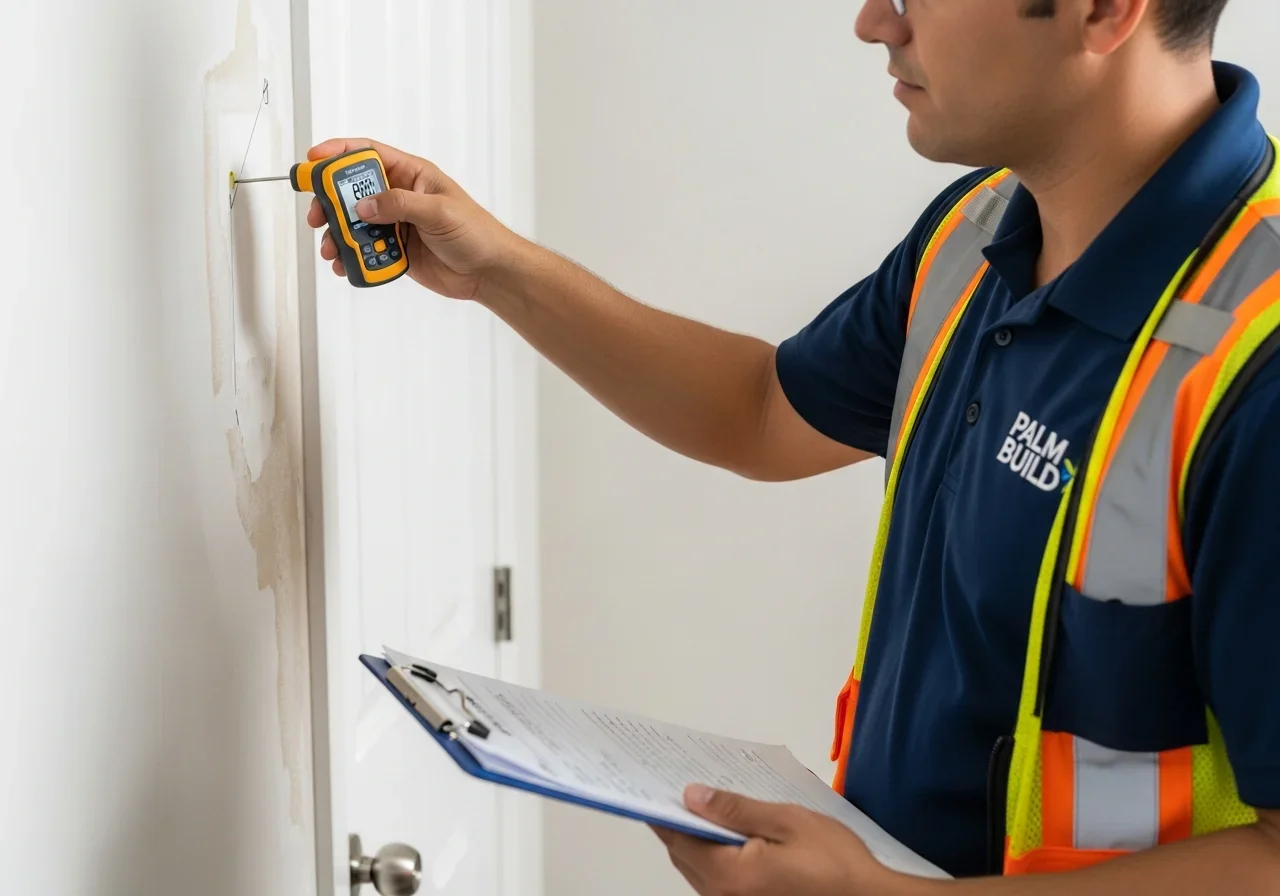
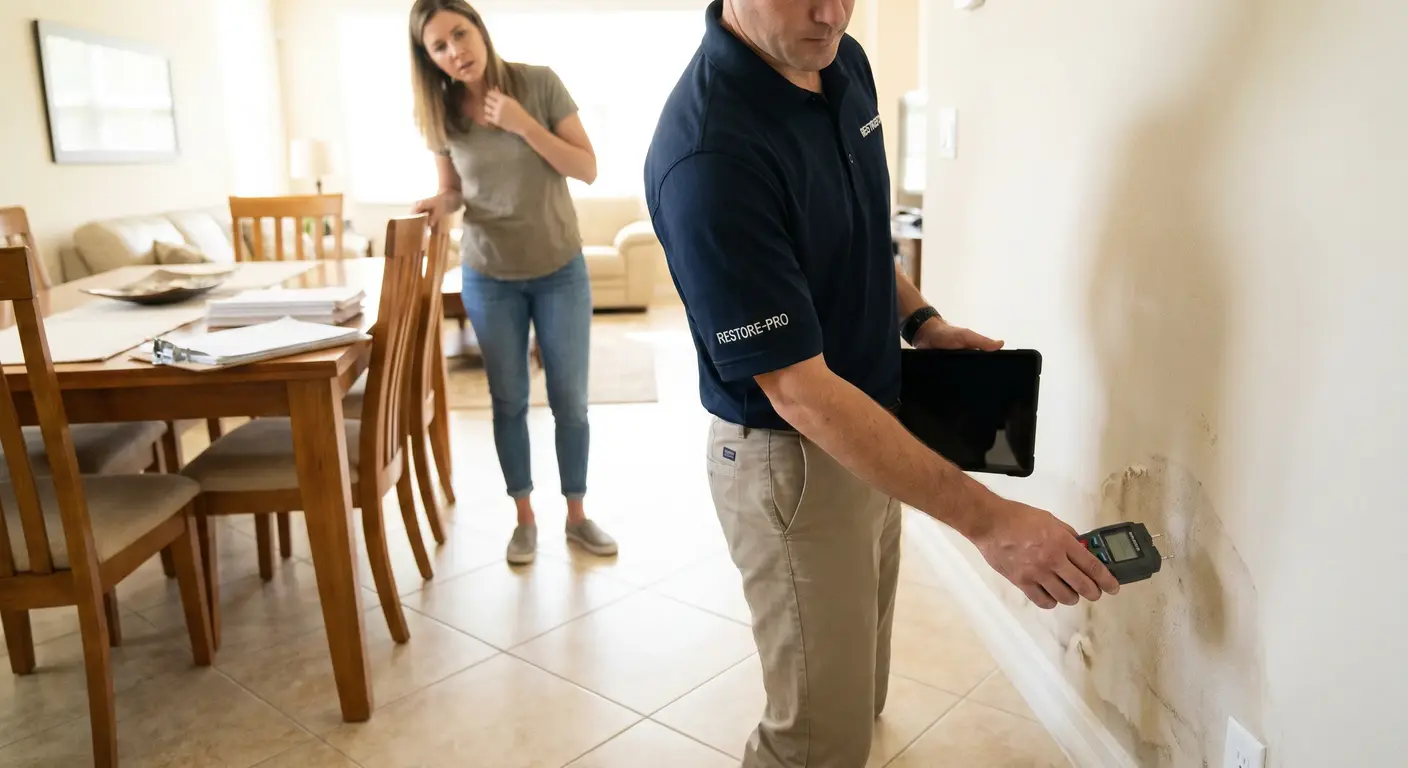
Moisture mapping and documentation in a Hallandale Beach condo — thermal imaging identifies hidden moisture in concrete and CBS assemblies before mold colonizes in South Florida's humidity.
Completed restoration in a Hallandale Beach condo — documented for both the master policy carrier and the unit owner's HO-6 claim after multi-unit water damage.
Insurance claims consultation in Hallandale Beach — preparing carrier-specific documentation for the master policy and individual HO-6 claims simultaneously.
The Palm Build Difference
Why Hallandale Beach HOA Communities Choose Palm Build
Hallandale Beach's high-rise condo corridor needs a restoration partner that understands
board governance, multi-carrier insurance, post-Surfside compliance, high-rise access
logistics, and the unique coastal dynamics of Three Islands, Golden Isles, and the
Intracoastal towers. Here is what distinguishes Palm Build.
Board Communication Experience
We understand how Hallandale Beach condo and HOA boards operate — statutory notice requirements, meeting procedures, expenditure approval thresholds, and the documentation formats boards need. From Three Islands individual tower boards to Golden Isles association management to the Gulfstream Park corridor, we prepare board-ready packages, attend meetings when requested, and coordinate with property management firms throughout the project.
High-Rise Multi-Unit Coordination
When water damage affects multiple floors in a Three Islands or Intracoastal tower, Palm Build serves as the single point of contact for the property manager, building management, master policy carrier, and all affected unit owners. We deploy simultaneous crews to all affected floors, coordinate freight elevator scheduling, manage access for occupied and vacant units, and keep every stakeholder informed through regular progress updates.
Dual Insurance Navigation
We manage both the master policy claim and all individual HO-6 claims as one unified project. Each carrier receives carrier-specific documentation — separate scopes, separate photos, separate communication — while the physical restoration is coordinated as a single project. When the master carrier is Citizens Property Insurance and unit owners have policies through multiple different private carriers, this coordination is essential.
HVHZ & Post-Surfside Compliance
All of Broward County — including Hallandale Beach — falls within the High Velocity Hurricane Zone. Every reconstruction project must meet HVHZ code requirements using Florida/Broward Product Approval or Miami-Dade NOA-rated materials. For the high-rise towers facing milestone inspections at 25 and 40 years under post-Surfside legislation, we coordinate with the association's structural engineer to ensure restoration addresses inspection items while meeting Broward County building department standards.
High-Rise & Coastal Access Protocols
Three Islands towers, Golden Isles condo buildings, and Intracoastal high-rises each have building management, freight elevator reservations, and lobby access procedures that general contractors are not equipped to navigate. Palm Build coordinates with building management companies for scheduled access, emergency freight elevator priority, and lobby floor protection on day one. Our crews arrive with all required identification and building credentials.
~15 Miles from Our Deerfield Beach Hub
Our South Florida Operations Hub in Deerfield Beach is approximately 15 miles from Hallandale Beach — a 30 to 40 minute drive. We respond to HOA and condo emergencies with truck-mounted extraction, commercial drying equipment, and the high-rise multi-unit coordination capabilities that Hallandale Beach's condo corridor requires. In water events affecting multiple floors, early response limits the number of units affected and the insurance claims generated.
Common Questions
Hallandale Beach HOA & Condo Restoration FAQ
Answers to the questions we hear most from Hallandale Beach HOA boards, property
managers, and condo unit owners about restoration in association-governed communities.
Who pays for restoration in a Hallandale Beach condo — the unit owner or the HOA?
Under Florida Statute 718, the condo association's master policy covers common elements — roof, exterior walls, shared plumbing risers, concrete slab assemblies, and common areas — while unit owners cover interior finishes through their HO-6 policy. However, the exact boundary depends on your association's declaration. In Hallandale Beach's high-rise corridor — Three Islands, Golden Isles, Village on the Green — each building may define this boundary differently. Some use 'bare walls-in' coverage (owner responsible for everything inside the studs) while others use 'all-in' coverage (master policy covers interior finishes to original spec). Palm Build reviews your specific governing documents and Florida Statute 718 before work begins to ensure the correct party pays for each scope item.
Is Hallandale Beach under Broward County or Miami-Dade County building codes?
Hallandale Beach is in Broward County, even though the city borders Aventura and Miami-Dade County. This matters for restoration: all permits go through the City of Hallandale Beach Building Division with a Broward County Notice of Commencement. The applicable 40-year recertification program is Broward County's — not Miami-Dade's. Design wind speed is approximately 170 mph (HVHZ, ASCE 7-22), and exterior products require Florida/Broward Product Approval or Miami-Dade NOA certification (a product-approval label). Post-Surfside milestone inspections at 25 and 40 years apply to buildings over three stories — the high-rise towers throughout Hallandale Beach are squarely in scope.
How does water spread between units in Three Islands and other Hallandale Beach high-rise condos?
In Hallandale Beach's concrete high-rise towers — Three Islands, Golden Isles, and the Intracoastal corridor — water migrates through four primary pathways: vertically through post-tensioned concrete slab assemblies to units below, horizontally through shared CBS walls to adjacent units, through HVAC ductwork and chases connecting multiple units, and through freight elevator shafts spanning the building height. A supply line failure on the 12th floor can damage units on the 11th, 10th, and below before it is detected. In South Florida's 70-75% humidity, mold colonization begins within 24-48 hours. Palm Build deploys thermal imaging and moisture mapping to find every affected space before hidden moisture becomes hidden mold.
Does Palm Build coordinate with HOA boards in Hallandale Beach before beginning restoration?
Yes. We understand that Hallandale Beach condo and HOA restoration requires board approval before significant reconstruction begins. The Three Islands corridor, Golden Isles associations, and Gulfstream Park area condo boards each have distinct governance structures, governing documents, and expenditure approval thresholds. We prepare board-ready scopes, cost estimates, compliance certifications, and timelines. For emergencies, Florida law authorizes immediate mitigation — water extraction, mold containment, board-up — without a board vote. We begin protecting the property immediately while preparing the documentation package for reconstruction approval.
How do post-Surfside milestone inspection requirements affect Hallandale Beach high-rise condos?
Post-Surfside legislation (SB 4-D and SB 154) requires milestone structural inspections at 25 and 40 years for buildings over three stories. Broward County's existing 40-year recertification program adds a parallel requirement. The concrete high-rise towers throughout Hallandale Beach's barrier-island corridor — built primarily from the 1970s onward — fall squarely within these windows. Inspections are identifying concrete spalling, rebar corrosion from salt-air exposure, post-tensioned slab deterioration, and waterproofing membrane failures. These findings require immediate association action. Palm Build works with associations and their structural engineers to address restoration items identified during milestone and recertification inspections.
How do tidal flooding and storm surge affect HOA restoration in Hallandale Beach?
Hallandale Beach is a low-lying barrier-island city with documented repetitive-loss properties under FEMA's NFIP program. Sunny-day king-tide flooding occurs when astronomical tides push water through storm drains without any storm event. Storm surge from the Atlantic and Intracoastal adds a second vector. Ground-floor condo units, garage levels, and lobby areas in Three Islands and Golden Isles absorb tidal intrusion that can damage both association common elements (master policy) and individual unit interiors (HO-6). Sea level rise has increased tidal flooding frequency significantly along the South Florida coast in recent decades. Palm Build documents saltwater intrusion damage separately from freshwater losses — the two have different drying protocols and different insurance treatment.
How quickly can Palm Build respond to a condo emergency in Hallandale Beach?
Our South Florida Operations Hub in Deerfield Beach is approximately 15 miles from Hallandale Beach — a 30 to 40 minute drive under normal conditions. We operate 24/7/365, including during and after storm events. For high-rise emergencies in Three Islands or the Intracoastal corridor, we coordinate with building management for freight elevator access and lobby protection on arrival. In multi-unit water events, the first crew focuses on source mitigation and extraction while documentation and moisture mapping begin simultaneously — limiting the spread to adjacent units and reducing total insurance claims.
What HOA communities in Hallandale Beach does Palm Build serve?
We serve all HOA-governed communities in Hallandale Beach including the Three Islands high-rise and mid-rise condo corridor, Golden Isles condo associations and single-family HOAs, Village on the Green, the Gulfstream Park area mixed-use condo towers, oceanfront and Intracoastal high-rises throughout the city, and inland CBS single-family HOA neighborhoods. From the barrier-island high-rise corridor to the inland single-family associations, we handle the access, board approval, and multi-carrier insurance requirements of each community type.
Trusted Vendors
Trusted local pros in Hallandale Beach
Outside our restoration scope, these are the vetted, licensed contractors we trust
alongside our work. Personally evaluated, reference-checked, and recommended by Palm
Build.
HOA or Condo Damage in Hallandale Beach? We Handle the High-Rise Complexity.
From Three Islands and Golden Isles to the Intracoastal tower corridor, Palm Build navigates master policy coordination, board approvals, multi-floor water migration, salt-air corrosion, and post-Surfside milestone compliance. One team manages it all — dispatching from Deerfield Beach in approximately 30-40 minutes.