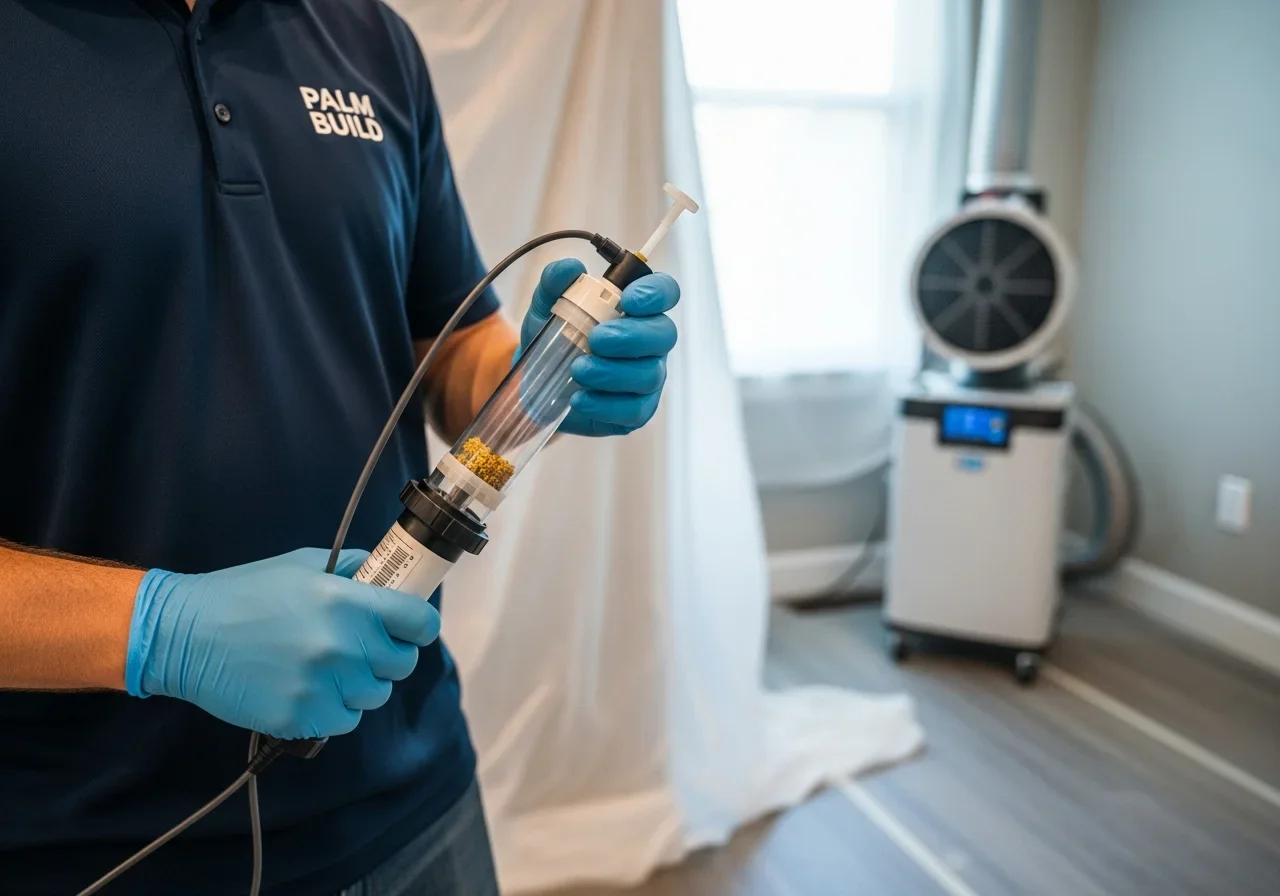
From crawl space mold in East Gaffney's older homes to hidden growth behind Northgate brick veneer, Palm Build's IICRC S520-certified team eliminates mold at the source — with containment, HEPA filtration, and post-remediation verification Cherokee County homeowners can trust.
Charlotte Office — ~55 miles to Gaffney Same day Response IICRC Certified
Gaffney sits in the upper Piedmont foothills where humid subtropical climate meets aging
residential construction. The combination creates some of Cherokee County's highest
baseline mold risk. Understanding these factors is the first step toward permanent
remediation — not just cosmetic cleanup. Learn how fast mold grows after water damage.
Chronic Crawl Space Humidity
70-90%
Typical crawl space RH
Gaffney's 1970s-80s housing boom left hundreds of homes with vented crawl spaces that pull humid outdoor air under the structure. Warm, moist air contacts cooler surfaces beneath the floor and condenses — feeding mold colonies on joists, subfloor panels, and insulation year-round.
Aging Housing Stock
1975
Median construction year
With a median construction year of 1975, Gaffney's housing stock has endured decades of moisture cycling. Original vapor barriers have degraded, foundation vents have shifted, and crawl space drainage systems — if they ever existed — have long since failed.
No State Mold Licensing
None
SC mold inspector license
South Carolina has no state mold remediation license requirement. Anyone can advertise mold services regardless of training or experience. IICRC certification — specifically the S520 standard — is the only reliable safeguard homeowners have when hiring.
Year-Round Moisture Input
47.91 in
Annual rainfall
Gaffney receives 47.91 inches of annual rainfall in a humid subtropical climate. Summer relative humidity regularly exceeds 70%, and even winter months rarely drop below 50% RH. This constant moisture input means there is no natural 'dry season' to interrupt mold growth cycles.
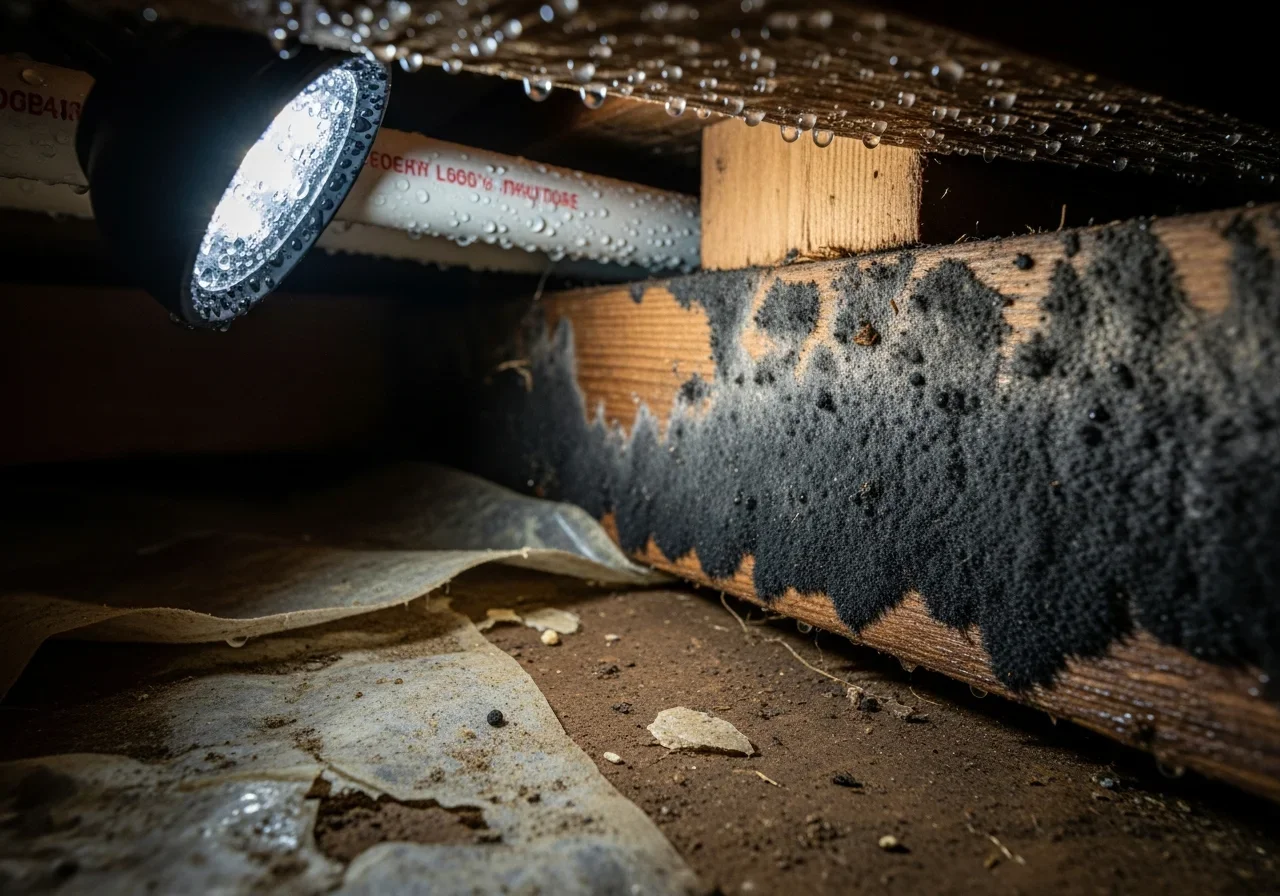
Crawl space mold colonization on floor joists — a common finding in Gaffney homes built
with vented crawl space foundations during the 1970s-80s construction boom.
Neighborhood-Level Intelligence
Gaffney Neighborhood Mold Risk Profiles
Mold risk in Gaffney varies significantly by neighborhood based on housing age,
construction type, proximity to water features, and maintenance patterns. Here is what
our crews encounter across Cherokee County's most affected areas.
East Gaffney
Critical
Primary risk: Older housing with deferred maintenance
Common locations: Crawl spaces, bathrooms, behind wall finishes
Gaffney City Center
Critical
Primary risk: Pre-1950s buildings with repeated moisture cycling
Common locations: Basements, older wall cavities, behind plaster
Common locations: Behind veneer, wall cavities, flashing failures
Lake Whelchel Area
High Risk
Primary risk: Lake-adjacent humidity amplifying crawl space moisture
Common locations: Subfloor, floor joists, foundation walls
Tiffany Park
High Risk
Primary risk: Townhome shared walls, single leak affects multiple units
Common locations: Behind shared drywall, HVAC ductwork
Laurelwood
Moderate
Primary risk: Standard stock with aging crawl space systems
Common locations: Crawl spaces, bathrooms, laundry areas
Bent Tree
Moderate
Primary risk: Newer but energy-tight with HVAC humidity issues
Common locations: HVAC systems, condensate failures, attic spaces
Cobblestone Crossing
Moderate
Primary risk: HOA exterior maintenance coordination delays
Common locations: Behind siding, window penetrations, roof-wall junctions
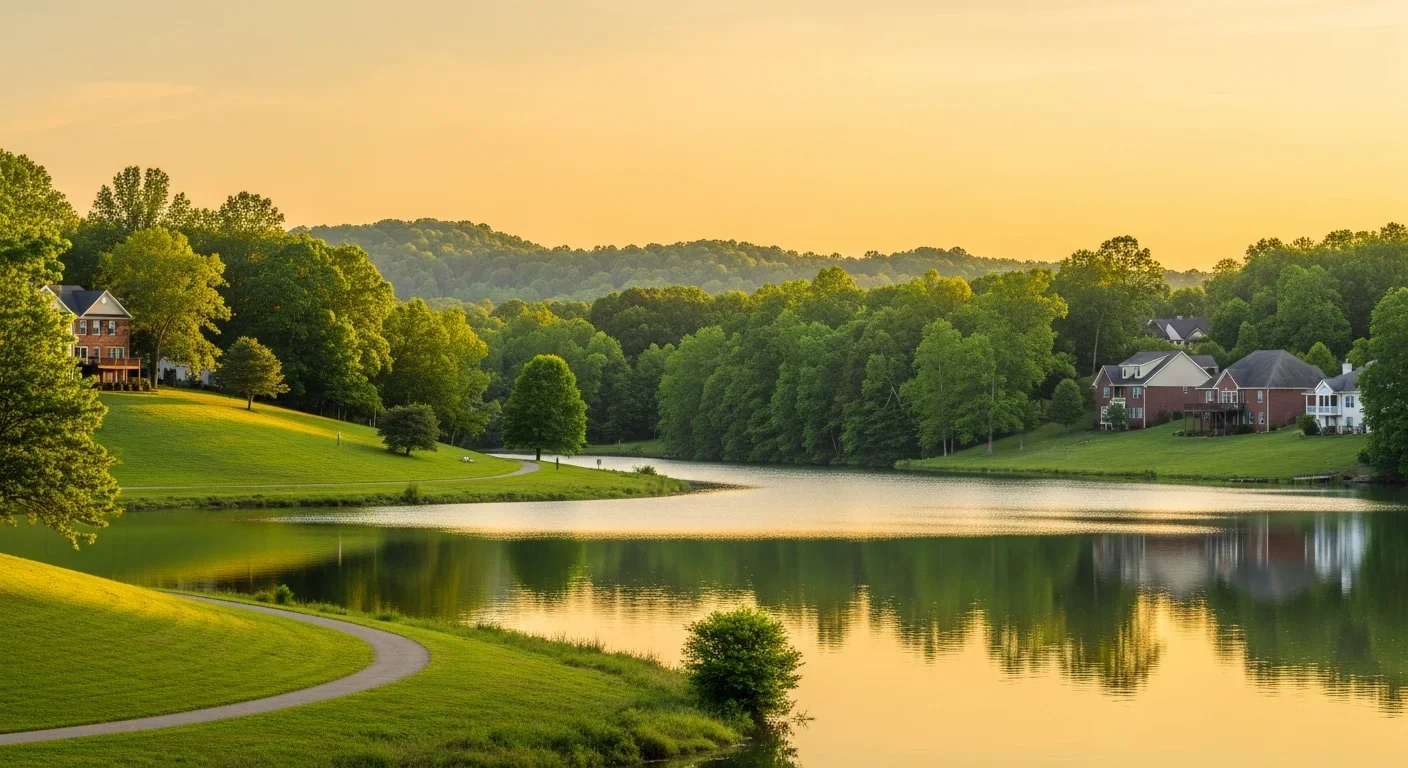
Homes near Lake Whelchel face elevated crawl space humidity due to proximity to open
water — a consistent factor in Gaffney mold assessments.
Gaffney's #1 Mold Problem
Crawl Space Mold: The Hidden Crisis Under Gaffney Homes
The majority of Gaffney homes built before 1990 sit on vented crawl spaces — a design
once considered best practice that building science has since proven counterproductive.
Warm, humid outdoor air enters through foundation vents, contacts cooler surfaces
beneath the floor, and condenses directly onto your joists, ductwork, and insulation.
Research shows that up to 50% of your indoor air originates
from the crawl space through the stack effect — rising through floor penetrations, plumbing
chases, and HVAC returns. If mold is growing below, you are breathing it above.
Original vapor barriers in Gaffney crawl spaces have degraded over decades — torn by
service visits, displaced by rodents, and undermined by ground moisture. Without an
intact Class I vapor barrier and mechanical dehumidification, the crawl space becomes a
perpetual mold incubator.
Crawl space inspection revealing active mold colonization on floor joists in a vented
foundation — typical of Gaffney's 1970s-80s housing stock.
Warning Signs of Crawl Space Mold
Musty or earthy smell rising through floor registers or along baseboards
Allergy symptoms that worsen indoors — sneezing, congestion, watery eyes
Visible condensation on crawl space ductwork or cold water pipes
Sagging or bouncy spots in hardwood or laminate flooring
Dark staining on floor joists or subfloor panels visible from crawl space entry
Insulation hanging loose or falling from between floor joists
Higher than expected humidity readings on indoor hygrometer (above 55%)
Recurring mold in bathrooms despite regular cleaning — often fed from below
SC Regulatory Landscape
Mold Licensing in South Carolina: What Gaffney Homeowners Need to Know
South Carolina has no state mold remediation license requirement.
Unlike states such as Florida, Texas, and Louisiana that require specific mold assessor
and remediator licenses, SC allows anyone to advertise and perform mold removal services
with no regulatory oversight, no minimum training, and no state examination.
This regulatory gap means your only safeguard when hiring a mold company in Gaffney is
verifying voluntary industry certifications. The accepted benchmark is the IICRC S520 Standard for Professional Mold Remediation — a comprehensive protocol
covering assessment, containment, removal, and verification procedures.
2025-2026 Legislative Update
A bill has been introduced in the SC General Assembly proposing a voluntary
certification program for mold assessors and remediators. If passed, it would create a
state-administered registry — but participation would remain optional.
Until mandatory licensing passes, IICRC certification remains the only reliable
indicator of competence. Even under the proposed voluntary framework, IICRC S520
compliance would be the minimum threshold.
Why IICRC S520 Is the Standard
The IICRC S520 standard defines professional mold remediation procedures including
contamination classification, containment requirements, removal techniques,
antimicrobial application, and post-remediation verification criteria.
Insurance adjusters, industrial hygienists, and courts throughout South Carolina
reference S520 as the benchmark for determining whether remediation was performed
correctly. Without S520 compliance, there is no standard to measure against.
What to Ask When Hiring a Mold Company in Gaffney
Do you hold current IICRC S520 (Mold Remediation) certification?
Can you provide your IICRC certification number for verification?
Will you use full containment barriers and HEPA air filtration?
Do you carry general liability insurance and workers compensation?
Will you provide post-remediation air quality testing by a third party?
Do you hold a SC general contractor license for any structural repair needed?
Licensed SC general contractor for structural repairs
Full general liability and workers compensation coverage
Third-party post-remediation clearance testing on every project
Written scope of work and photographic documentation standard
Red Flags to Watch For
No IICRC certification or refuses to provide proof
Offers to "spray and seal" without physical removal of contamination
Will not set up containment barriers or HEPA filtration
Same company does testing AND remediation (conflict of interest)
Quotes a price without ever inspecting the affected area
Cannot provide references from Cherokee County or the upstate
IICRC S520 Protocol
Our Gaffney Mold Remediation Process
Professional mold remediation follows a strict sequence defined by the IICRC S520
standard. Here is exactly what happens when Palm Build's certified team arrives at your
Gaffney home.
01
Assessment & Moisture Mapping
Day 1
02
Containment & Negative Air
Day 1-2
03
HEPA Vacuuming & Removal
Days 2-4
04
Antimicrobial Treatment
Days 4-5
05
Drying & Humidity Control
Days 5-7
06
Post-Remediation Verification
Day 7-8
01
Assessment & Moisture Mapping
Day 1
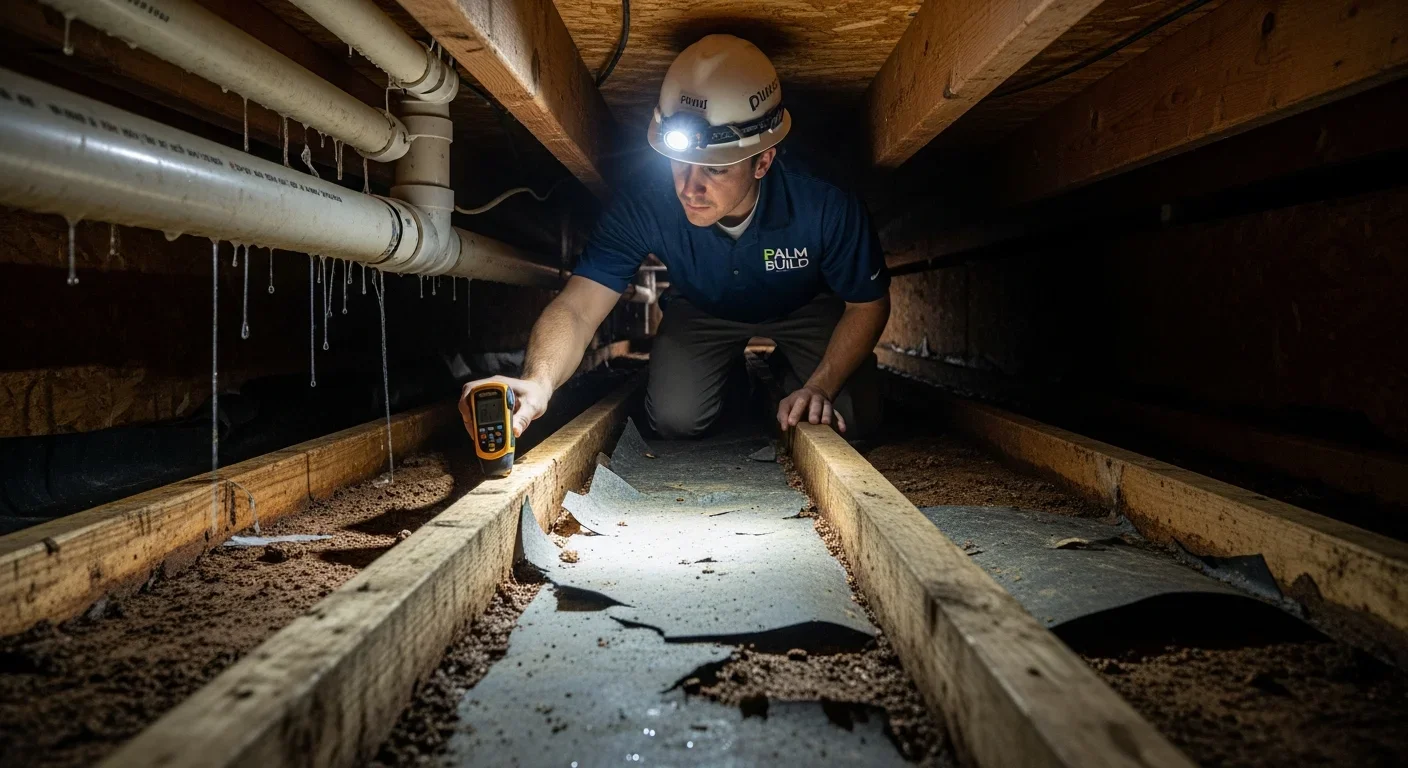
Comprehensive visual inspection with infrared thermal imaging and moisture mapping. We identify every moisture source — not just the visible mold — and classify contamination level per IICRC S520 protocols. Air quality sampling establishes baseline spore counts.
02
Containment & Negative Air
Day 1-2
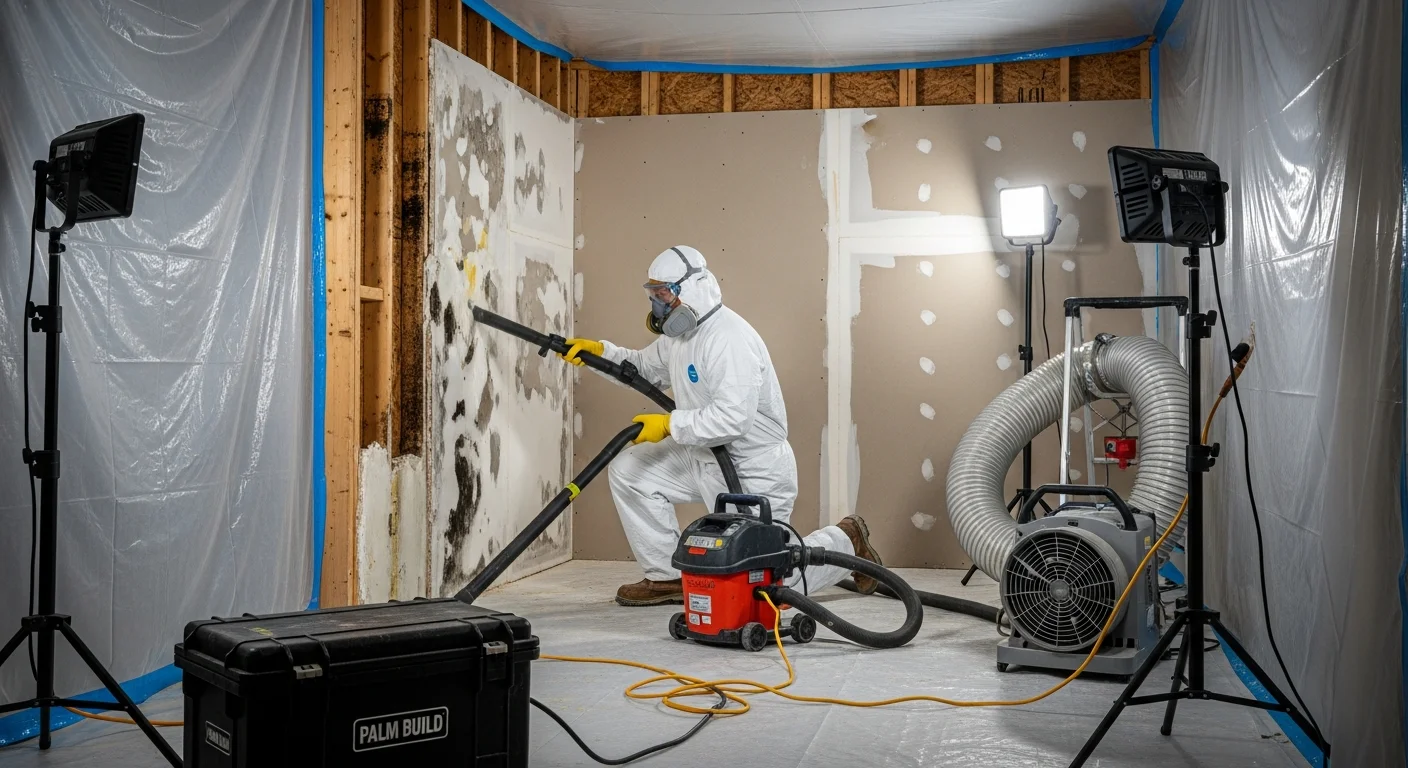
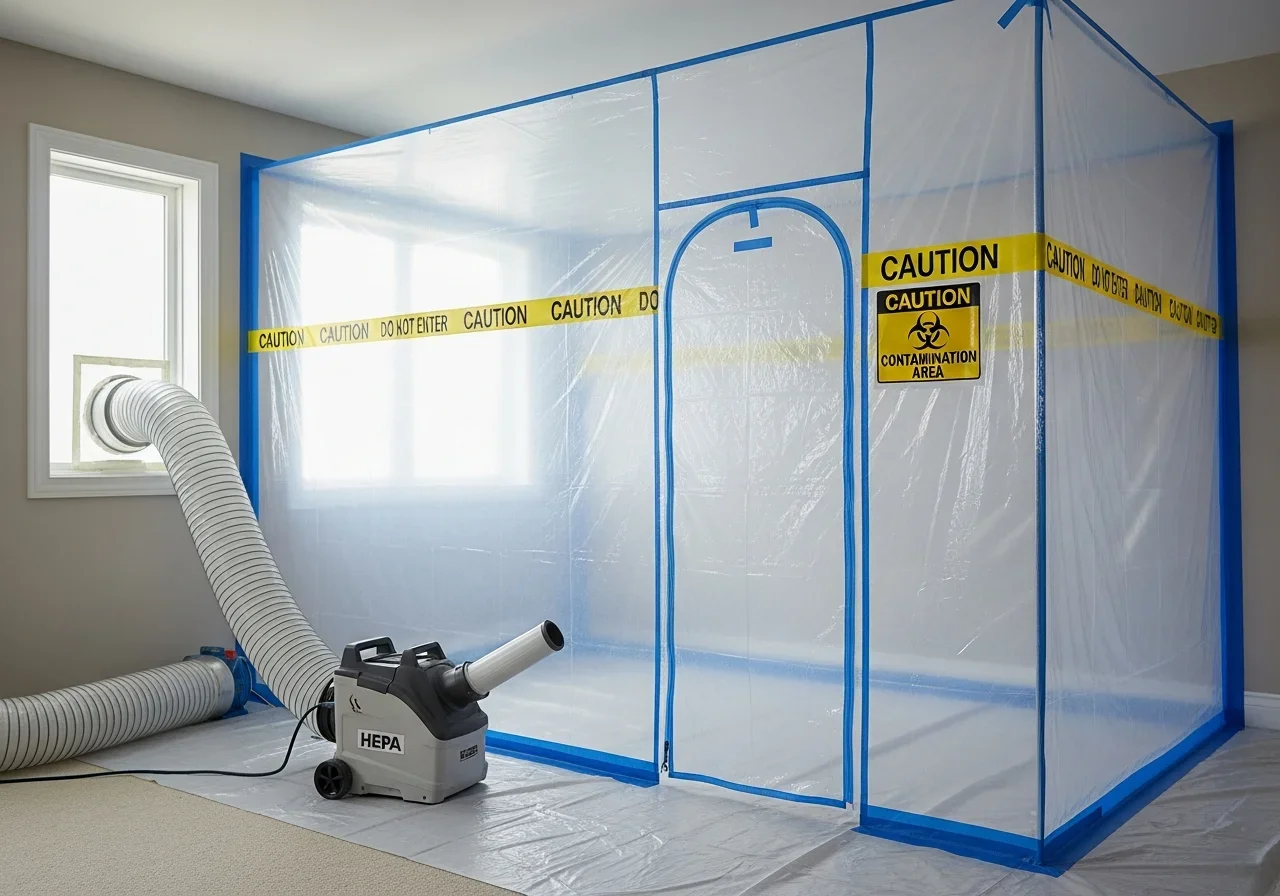
Sealed polyethylene containment barriers isolate affected areas from the rest of your home. HEPA air scrubbers create negative air pressure inside the containment zone, ensuring disturbed mold spores cannot migrate to clean areas during removal.
03
HEPA Vacuuming & Removal
Days 2-4
Contaminated materials are HEPA-vacuumed before removal. Non-salvageable drywall, insulation, and wood are cut away using controlled demolition techniques and double-bagged for disposal. Salvageable structural members are wire-brushed and media-blasted as needed.
04
Antimicrobial Treatment
Days 4-5
EPA-registered antimicrobial agents are applied to all treated surfaces including joist faces, subfloor panels, and foundation walls. For Gaffney crawl spaces, this includes the full perimeter and all structural framing within the containment zone.
05
Drying & Humidity Control
Days 5-7
Commercial dehumidifiers and air movers bring moisture levels below safe thresholds. For crawl space projects, we verify wood moisture content drops below 15% before releasing containment. This step prevents immediate recolonization.
06
Post-Remediation Verification
Day 7-8
Independent air quality testing confirms spore counts have returned to acceptable levels. Visual inspection verifies all contamination has been addressed. Clearance documentation is provided for your records and insurance — the project is not complete until we pass.
Why Containment Matters
Disturbing mold without proper containment sends billions of spores airborne —
potentially contaminating previously clean areas of your home. Our containment
protocol ensures mold stays isolated during removal.
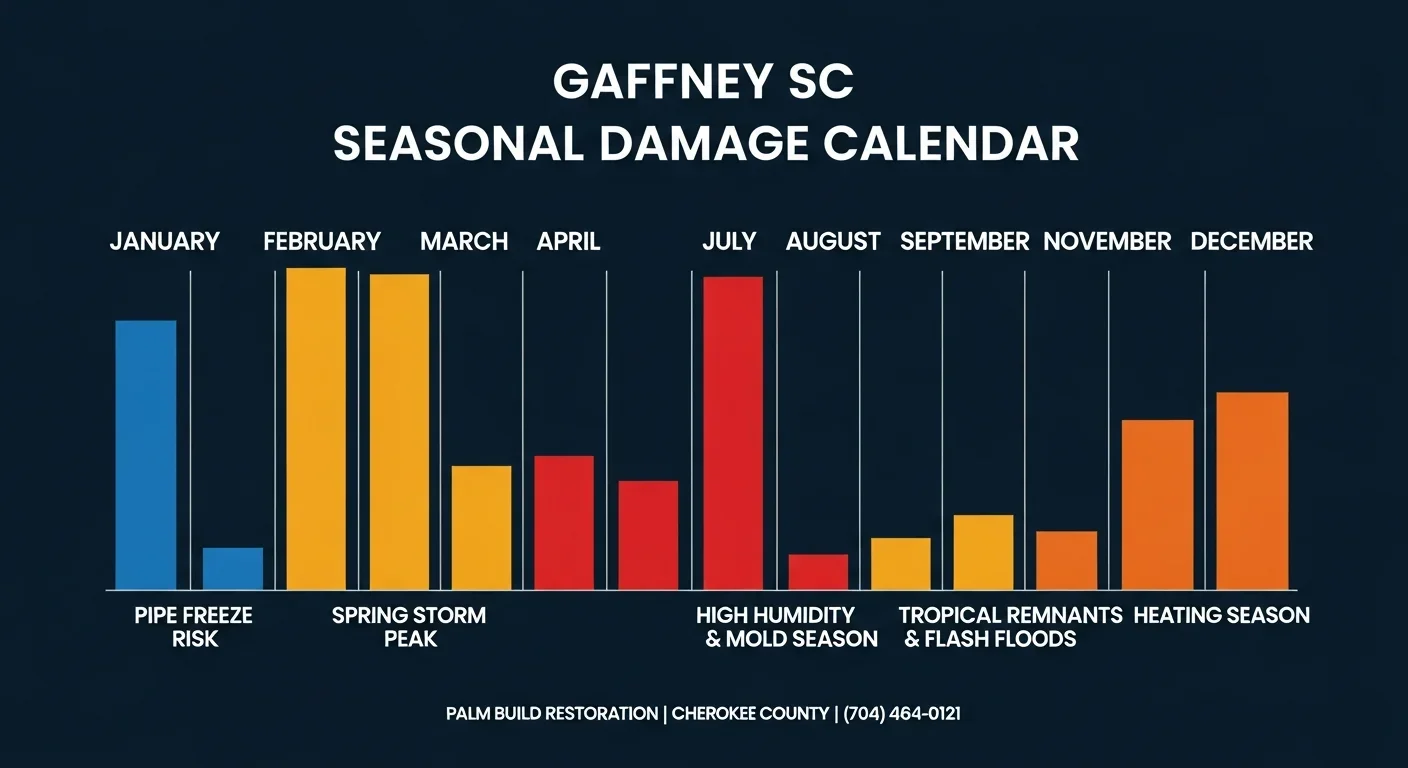
Mold risk in Gaffney follows a predictable annual cycle driven by humidity, temperature,
and rainfall patterns. Understanding this timeline helps homeowners take proactive steps
before damage compounds.
Winter
Dec – Feb
Moderate
Reduced outdoor humidity but indoor heating creates condensation on cold crawl space surfaces. Pipe freeze risk adds sudden water intrusion events. Average RH: 50-65%.
Avg temp:38-52°F
Rainfall:3.6 in/mo
Spring
Mar – May
High
Temperature swings create heavy condensation cycles. Spring rains saturate soil, raising crawl space moisture. Dormant mold colonies reactivate rapidly. Average RH: 60-75%.
Avg temp:50-75°F
Rainfall:4.2 in/mo
Summer
Jun – Aug
Critical
Peak mold growth season. Hot, humid air floods vented crawl spaces, sustained condensation on all cool surfaces. Mold can colonize new surfaces within 24-48 hours. Average RH: 70-90%.
Avg temp:72-90°F
Rainfall:4.5 in/mo
Fall
Sep – Nov
High
Summer moisture damage becomes visible as conditions shift. Falling leaves clog gutters, directing water toward foundations. Hurricane season brings potential flooding events. Average RH: 55-75%.
Avg temp:48-78°F
Rainfall:3.8 in/mo
Our Work
Gaffney Mold Remediation: Before and After
Every mold project is documented from initial assessment through post-remediation
clearance. These images show the scope of work our crews perform across Cherokee County
homes.
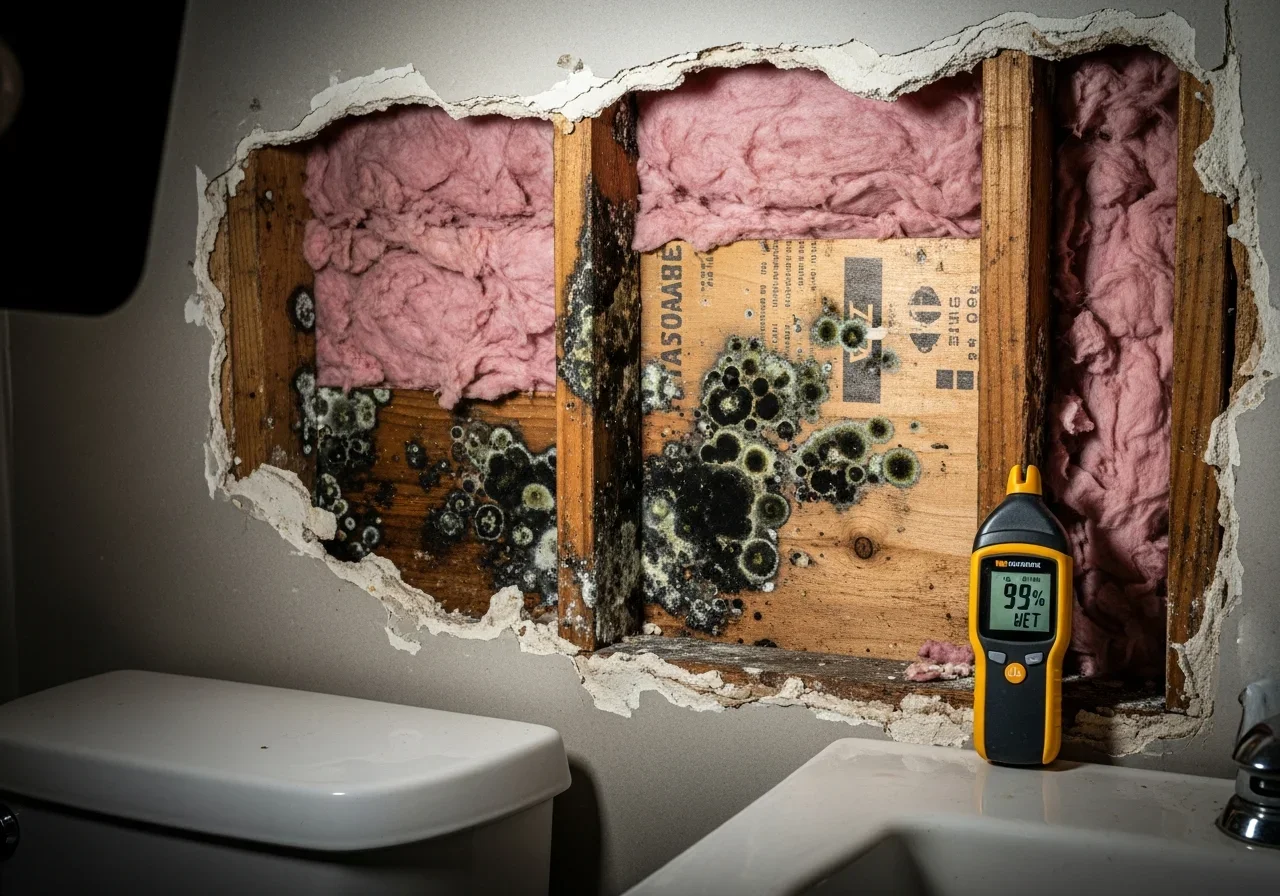
Hidden mold behind drywall — this growth was invisible from the living side of the wall until removal revealed extensive colonization on the backside of the sheathing.
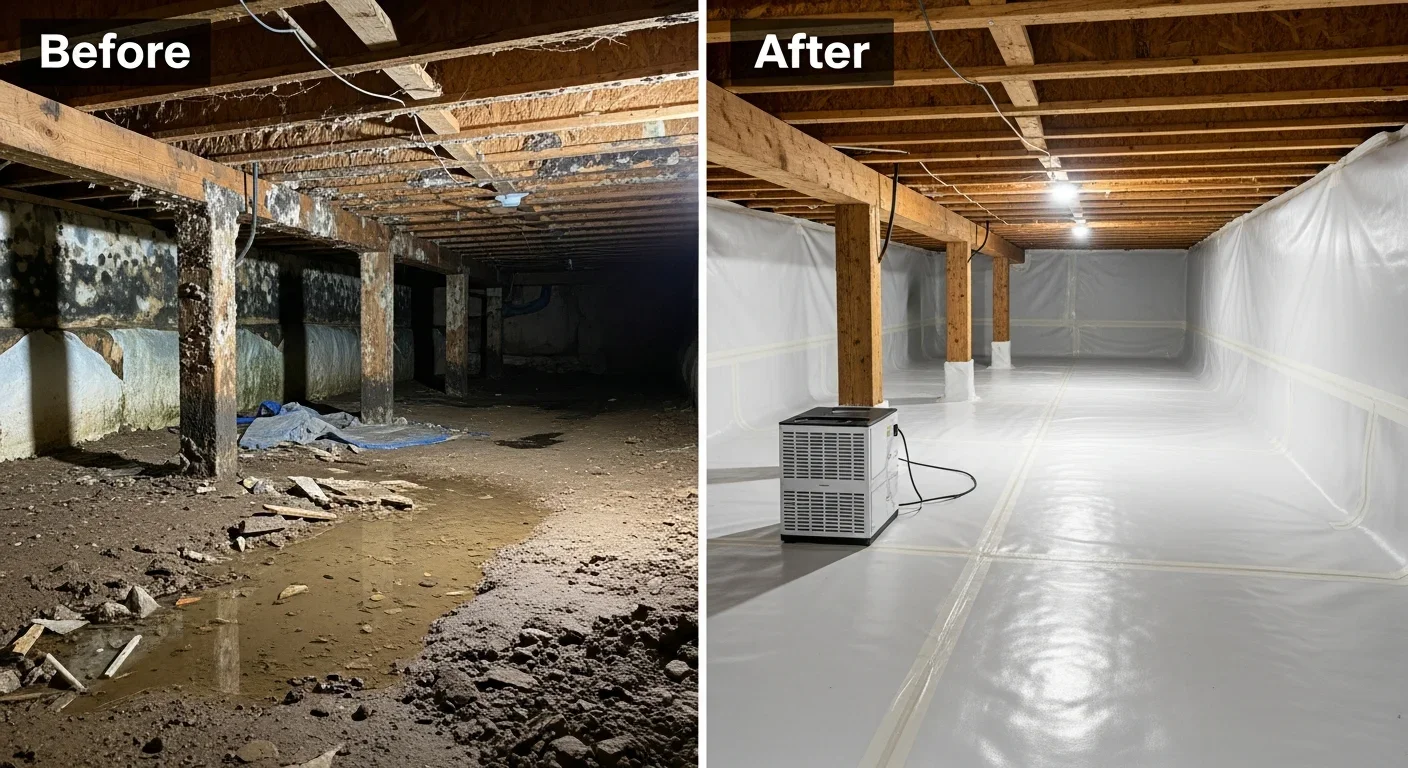
Crawl space remediation: contaminated floor joists and subfloor treated, antimicrobial applied, and full encapsulation installed with mechanical dehumidification.
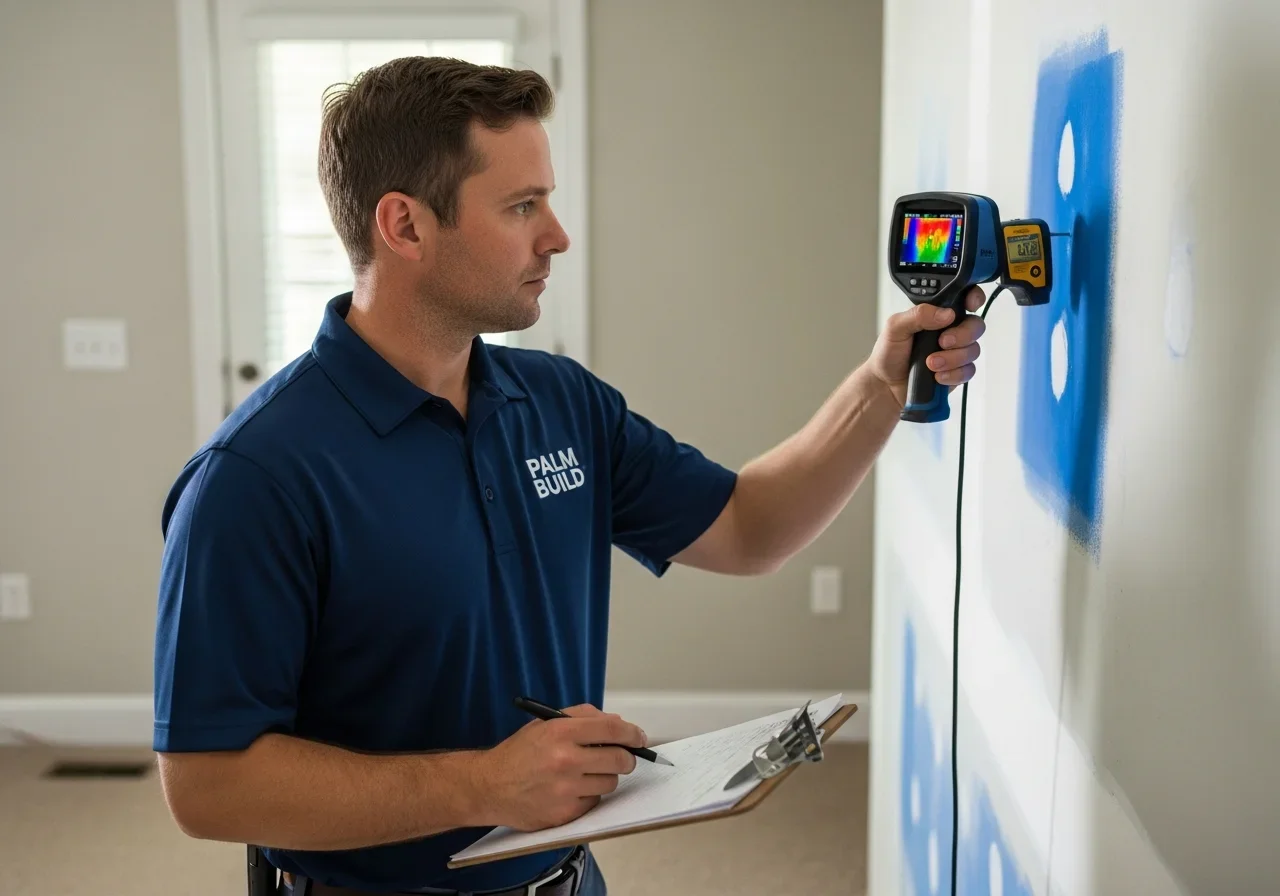
Infrared moisture mapping identifies hidden moisture sources behind finished surfaces — critical for defining the full scope of remediation before containment setup.
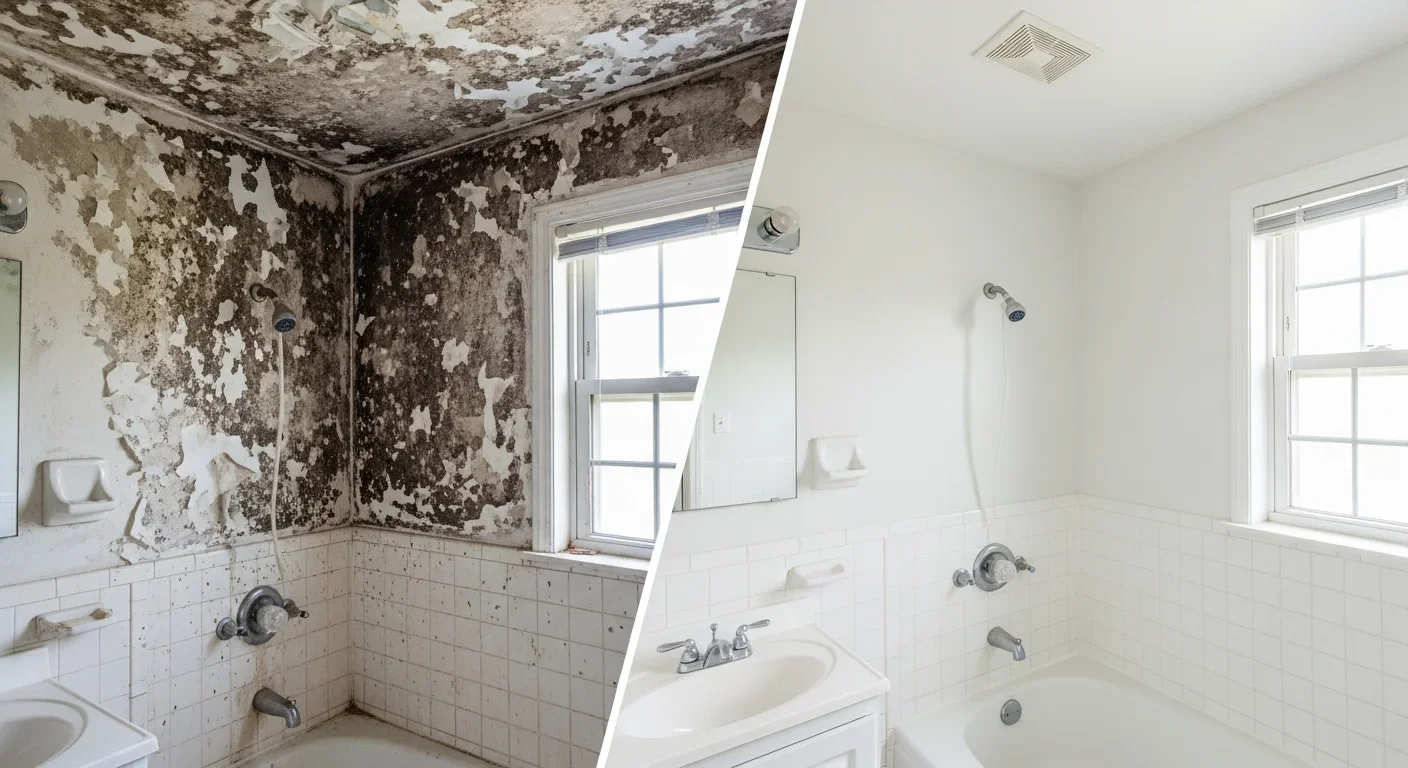
Bathroom mold remediation: contaminated drywall removed, framing treated with antimicrobial, and surfaces restored to pre-loss condition.
Gaffney Pricing
Mold Remediation Costs in Gaffney, SC
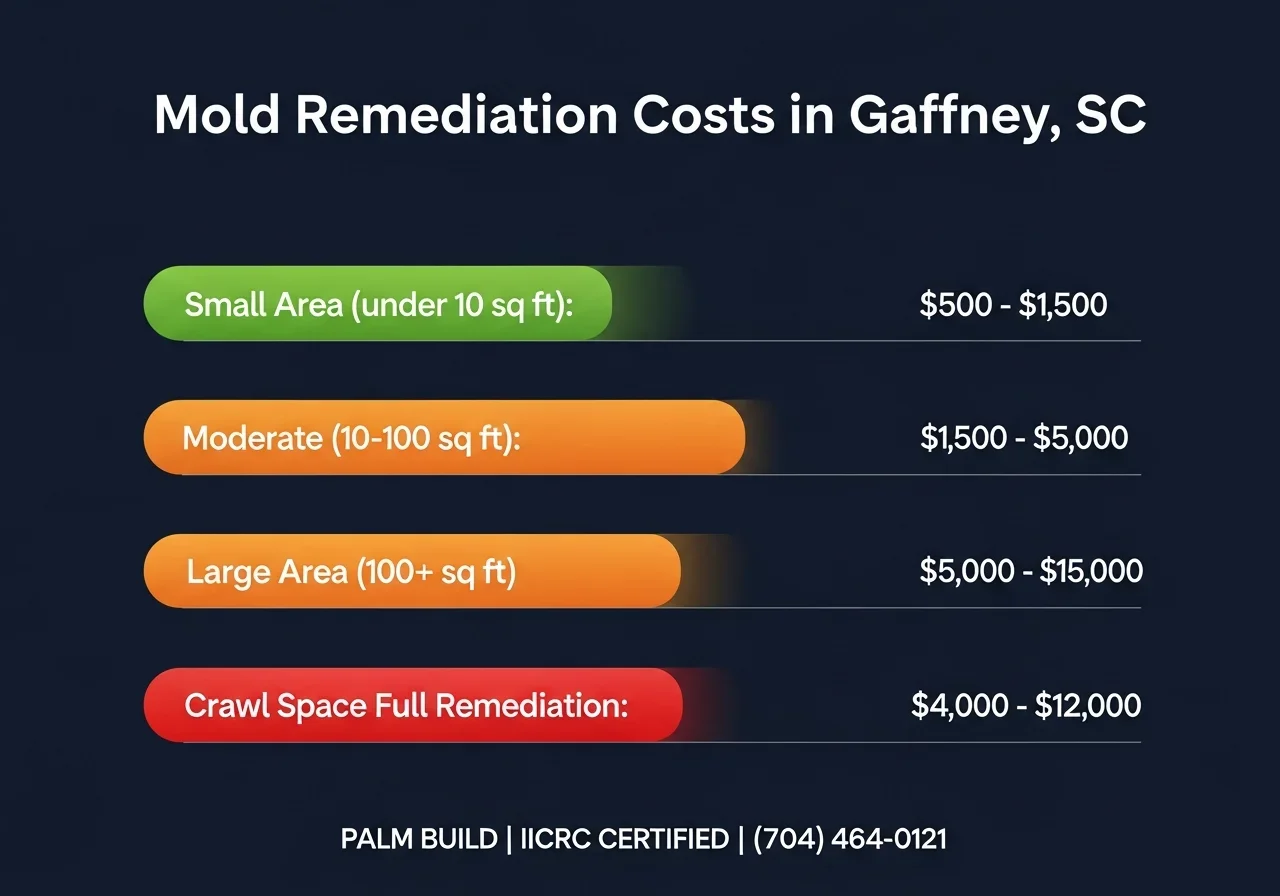
Mold remediation costs vary by contamination size, materials affected, and whether crawl
space work is involved. Gaffney's lower cost of living translates to remediation pricing
below Charlotte metro averages — but crawl space projects still represent significant
investment.
Small Area
Bathroom, closet, window frame — under 50 sq ft
$500 – $1,500
Surface-level mold on accessible materials. Typically a single-day project with basic containment.
Moderate Area
Bedroom wall, multi-room, HVAC system — 50-200 sq ft
$1,500 – $5,000
Requires full containment, HEPA filtration, and multi-day remediation. May include partial drywall removal and antimicrobial treatment.
Large / Crawl Space
Full crawl space, multiple rooms, structural damage
$4,000 – $15,000
Complete crawl space remediation, structural repair, and encapsulation. Cherokee County crawl space projects typically fall in the $6,000-$12,000 range depending on square footage and damage severity.
Insurance Coverage Note
SC homeowner policies typically cap mold coverage at $5,000-$10,000 as a sublimit. Crawl space projects frequently exceed this cap. When mold results from a covered
water event (burst pipe, appliance failure), our documentation connects the mold to the original
loss to maximize your coverage.
Insurance Navigation
Mold Insurance Claims in Gaffney, SC
Mold coverage in South Carolina is limited and varies significantly by carrier and
policy. Most Gaffney homeowners are surprised by how little their standard policy
covers. Understanding your coverage before you need it can save thousands.
Mold resulting from a covered sudden water event (burst pipe, water heater failure, appliance malfunction) is typically covered up to your policy mold sublimit
Some SC carriers offer mold endorsements for additional premium — ask your State Farm, Auto-Owners, Allstate, or Farmers agent about expanded mold coverage options
SC standard homeowner policies typically cap mold coverage at $5,000-$10,000 as a sublimit — Gaffney crawl space remediation frequently exceeds this cap
Mold from gradual moisture intrusion, humidity, or long-term crawl space conditions is almost always excluded as a maintenance issue
Pre-existing mold discovered during a renovation, home inspection, or real estate transaction is not covered under any standard policy
The Key to Mold Coverage: Proving the Water Source
The single most important factor in a mold insurance claim is documenting that the mold
resulted from a sudden, accidental water event — not from
gradual moisture or neglect. If you can prove the mold grew because a pipe burst, a water
heater failed, or an appliance malfunctioned, your claim is significantly stronger. If the
adjuster determines the mold is from long-term humidity or deferred maintenance, the claim
will be denied.
Palm Build's Mold Claims Documentation
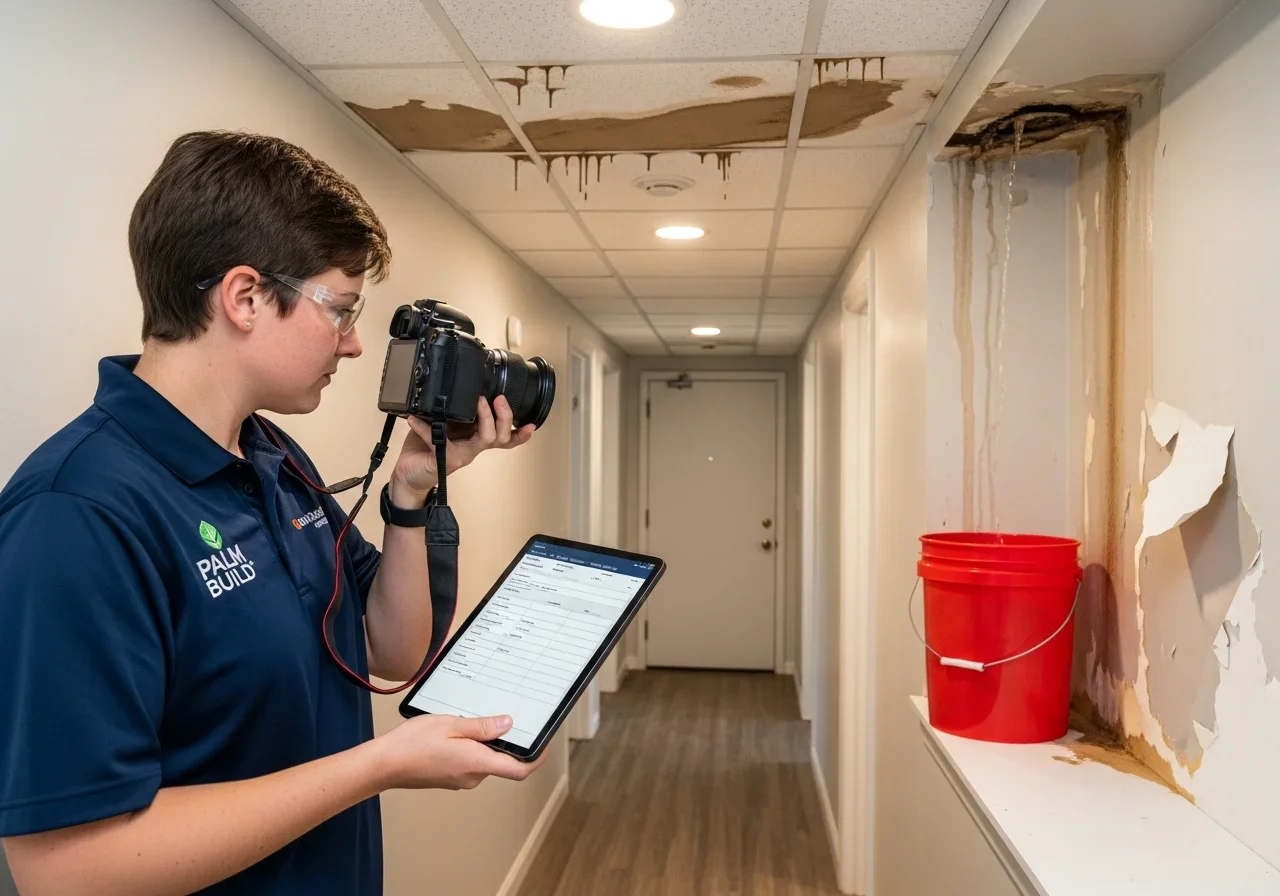
When mold results from a covered water event, our documentation connects the mold to the
original loss — moisture maps, timeline photos, air quality testing results, and
remediation scope formatted for your adjuster. We work with State Farm, Auto-Owners,
Allstate, Farmers, and all other SC carriers.
Every Palm Build mold project includes comprehensive documentation formatted for
insurance adjusters — moisture maps, timeline photos, and clearance testing results.
The Palm Build Difference
Why Gaffney Homeowners Choose Palm Build for Mold
In a state with no mold licensing requirement, credentials and local expertise are
everything. National franchises dominate the upstate market by volume — but none of them
build their protocols around Cherokee County's specific clay soils, crawl space designs,
and aging housing stock.
IICRC S520 Certified
Every crew lead holds current Mold Remediation Specialist (MRS) certification. We follow the S520 standard for containment, removal, and clearance verification — the industry benchmark in a state with no licensing requirement.
Full Containment Protocol
Sealed polyethylene barriers, HEPA air scrubbers creating negative pressure, PPE for all crew members, and air lock entry/exit. We never skip containment — even on "small" projects where other companies cut corners.
Post-Remediation Verification
Every project includes independent air quality testing to confirm spore counts have returned to acceptable levels. The project is not complete until we pass clearance — no exceptions.
Crawl Space Expertise
We understand Cherokee County's clay soil, vented crawl space construction, and the specific mold species common in this region. Our remediation protocols account for Gaffney's unique moisture dynamics — not generic national franchise procedures.
Insurance Documentation
When mold results from a covered water event, our documentation connects the mold to the original loss. Moisture maps, timeline photos, air quality testing, and scope of work — all formatted for your adjuster at State Farm, Auto-Owners, Allstate, or Farmers.
Post-remediation air quality testing confirms spore counts have returned to acceptable
levels — every Palm Build project includes independent clearance verification.
Common Questions
Gaffney Mold Remediation FAQ
Answers to the most common questions we receive from Cherokee County homeowners about
mold assessment, remediation, and prevention.
Does South Carolina require mold remediation licensing?
No. South Carolina does not currently license mold inspectors or remediators statewide. A 2025-2026 bill has proposed voluntary certification frameworks, but nothing is in effect yet. This means anyone can advertise mold services. Look for IICRC S520 certification as your quality standard — Palm Build's technicians hold this certification and follow the complete IICRC remediation protocol.
How much does mold remediation cost in Gaffney?
Costs depend on the affected area and scope. Small areas (under 10 sq ft) typically cost $500-$1,500. Moderate projects involving wall cavities or partial crawl spaces run $1,500-$5,000. Full crawl space remediation or multi-room projects range $4,000-$15,000. We provide detailed estimates before work begins.
Does insurance cover mold remediation in Cherokee County?
It depends on the cause. Most homeowners policies include limited mold coverage ($5,000-$10,000 sublimit) when mold results from a covered water loss — like a burst pipe or storm damage. Mold from gradual conditions like chronic humidity or deferred maintenance is typically excluded. Palm Build documents the moisture source from day one to support your claim.
Why is crawl space mold so common in Gaffney homes?
Gaffney's median home construction year is 1975, and most homes from that era have vented crawl space foundations. These vented designs pull humid outdoor air into the enclosed space under your home, where it condenses on cooler surfaces and feeds mold growth. After 40-50 years, original vapor barriers have degraded, and the problem compounds. Up to 50% of your indoor air comes from the crawl space.
How long does mold remediation take in Gaffney?
Small projects take 1-2 days. Moderate remediation requiring containment and wall cavity work takes 2-4 days. Full crawl space remediation or multi-room projects require 4-10 days. Post-remediation air quality verification adds 1-2 days for lab analysis. We provide a timeline estimate during the initial assessment.
Can I stay in my home during mold remediation?
For small, contained projects, yes — our containment and negative air setup prevents spore migration to unaffected areas. For larger projects involving multiple rooms or the crawl space, we may recommend temporary relocation, especially if household members have respiratory conditions or allergies. We discuss this during the assessment.
What areas of Gaffney does Palm Build serve for mold remediation?
We serve all of Gaffney and Cherokee County including East Gaffney, Northgate, Bent Tree, Creekside Estates, Cobblestone Crossing, Lake Whelchel area, Tiffany Park, Hampton Place, Laurelwood, and City Center. We also serve Blacksburg, Cowpens, and surrounding Cherokee County communities.
How do I know if I have mold in my Gaffney home?
Common signs include musty or earthy odors (especially from floor vents or crawl space access), visible dark spots on walls or ceilings, peeling paint, buckled flooring, unexplained allergies, and condensation on crawl space pipes. If your home was built before 2000 and you haven't inspected the crawl space recently, a proactive assessment is wise given Gaffney's climate and construction patterns.
Mold in Your Gaffney Home? Get Certified Help.
Palm Build's IICRC S520-certified team brings professional containment, HEPA filtration, and verified clearance testing to every Cherokee County mold project. In a state with no mold licensing, certification is your safeguard.