Crawl Space Cleanup in Mooresville, North Carolina
The majority of Mooresville's pre-2005 homes sit on vented crawl space foundations over Piedmont red clay -- the Cecil series soil that drains at barely six centimeters per hour. Add Lake Norman's amplified humidity and five months of dew points above 65 degrees Fahrenheit, and the result is predictable: standing water, mold on floor joists, rotting subfloor, and musty air rising into every room above. Palm Build delivers encapsulation, mold remediation, structural repair, and dehumidification from our Charlotte operations hub 30 miles south.
30 miles -- Mooresville, NC 40-60 min Response IICRC Certified
Why Mooresville Crawl Spaces Fail: Clay Soil, Lake Norman, and Vented Design
If you own a home in Mooresville built before 2005, there is a strong chance your house
sits on a vented crawl space foundation over Piedmont red clay. The conditions
underneath are working against you every single day -- not because of a construction
defect, but because of a collision between Mooresville's geology, Lake Norman's
humidity, and the building practices that were standard when your home was built.
Cecil Series Clay Soil
6-15 cm/hr
Clay drainage rate
Mooresville sits on the Cecil soil series -- dense Piedmont red clay with 35-60% clay content in the subsoil horizon. This microscopic particle structure traps water molecules between particles with a drainage rate of only 6-15 cm/hr under ideal conditions. After rain, the clay beneath your crawl space stays saturated for days or weeks, continuously pushing moisture vapor upward through bare ground or deteriorated vapor barriers. Unlike sandy soils that drain freely, Cecil clay never gives your crawl space a break from moisture pressure.
Lake Norman Humidity Overlay
32,510 acres
Lake surface area
Lake Norman's 32,510-acre surface area creates a local microclimate with measurably higher humidity than areas even ten miles from shore. Homes in Waterlynn, The Harbour at the Pointe, and Morrison Plantation's western sections sit where Lake Norman's evaporative moisture and the clay soil's ground moisture converge inside crawl spaces that were never designed to handle either source alone. Foundation vents facing the lake deliver this amplified humidity directly into the crawl space.
Vented Crawl Space Design
Pre-2005
Vented design era
Mooresville's residential boom ran from the late 1980s through the mid-2000s, and nearly every home built in that era used vented crawl space foundations. Those vents were supposed to allow airflow to dry the space. In practice, they deliver warm humid air directly across cool crawl space surfaces for five continuous months -- May through October -- when outdoor dew points routinely exceed 65 degrees Fahrenheit. Advanced Energy NC field research measured vented crawl spaces in the Piedmont exceeding 80% relative humidity during this window.
5-Month Humidity Window
80%+ RH
Spring/summer humidity
From May through October, Mooresville's outdoor dew points regularly exceed 65 degrees Fahrenheit. Every cubic foot of warm humid air entering through foundation vents deposits condensation on cooler crawl space surfaces -- floor joists, ductwork, plumbing, and subfloor panels. Combined with the clay soil's refusal to drain and Lake Norman's humidity amplification, Mooresville crawl spaces face the most aggressive and sustained moisture pressure in the Charlotte metro region. At 80%+ humidity, mold growth is not a risk -- it is an inevitability.
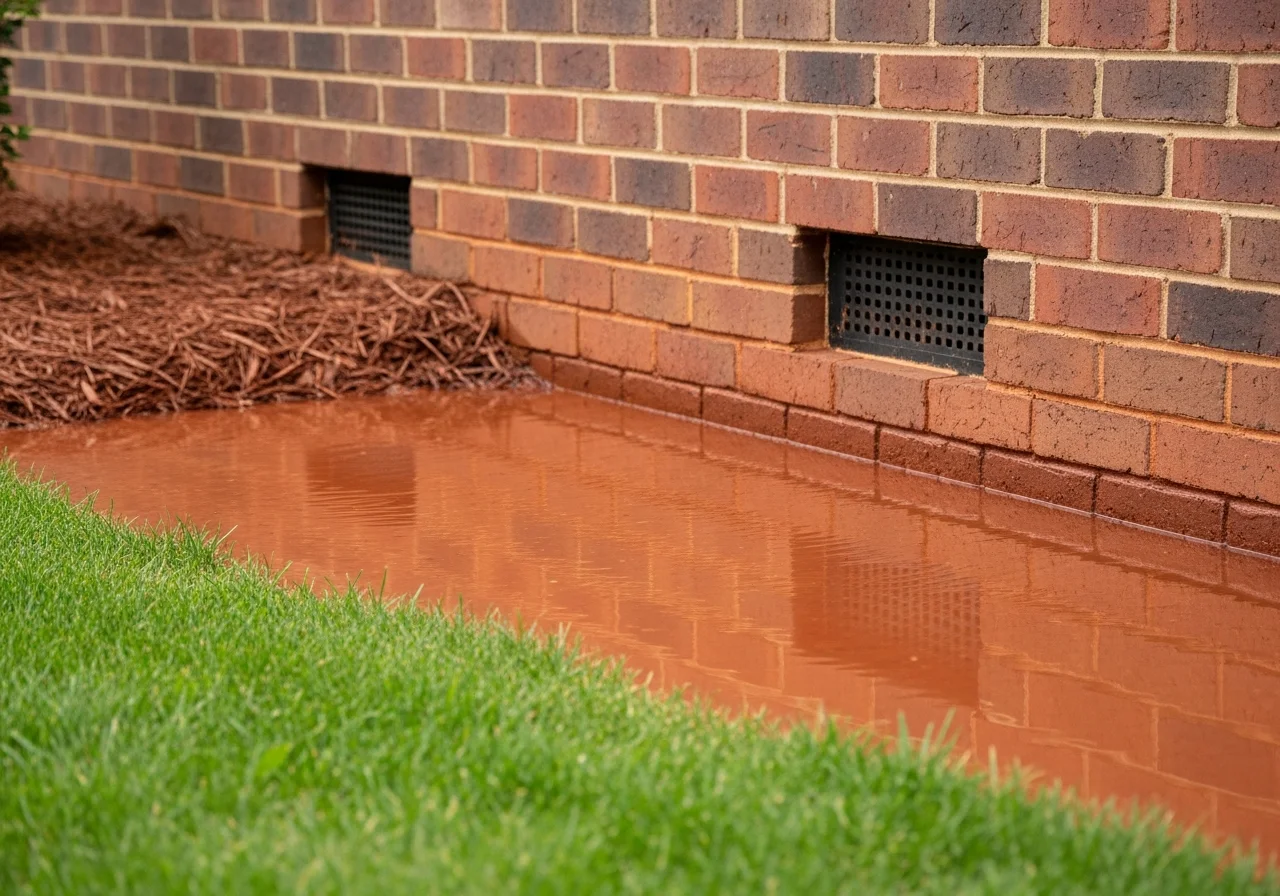
Cecil series clay soil along a Mooresville foundation -- this dense, nearly impermeable
soil retains rainfall for days and pushes moisture vapor upward into the crawl space
continuously.
What We Find Under Mooresville Homes
Common Crawl Space Problems in Mooresville
These conditions exist in the majority of pre-2005 vented crawl spaces our technicians
enter in Mooresville. The progression is predictable: initial moisture from clay soil
and humid air compounds over months and years into structural and health concerns.
Critical
Standing Water
Pooling on clay soil after rain events -- sometimes present year-round in low spots and near foundation walls where Cecil clay saturation is highest
Critical
Mold on Structural Wood
Visible mold colonies on floor joists, sill plates, rim joists, and subfloor panels -- Cladosporium, Penicillium, and Aspergillus species thriving in 80%+ humidity
High
Sagging Insulation
Fiberglass batt insulation saturated with moisture, compressed, sagging from joists, or fallen to the ground in contaminated piles
High
Vapor Barrier Failure
Original 6-mil polyethylene sheeting torn, displaced, or degraded after 20-30 years of ground contact with Cecil clay
Critical
Wood Rot
Softening of structural joists and sill plates where sustained moisture content exceeds 28% for extended periods -- compromises structural integrity
High
Pest Intrusion
Termites, carpenter ants, rodents, and other moisture-attracted pests exploiting the warm, humid crawl space as habitat
Moderate
Musty Odors in Living Space
The stack effect draws 40-50% of first-floor air from the crawl space -- mold spores, moisture, and odors enter through every gap and HVAC run
Moderate
Foundation Efflorescence
White mineral deposits on block or poured concrete walls -- a visual indicator of chronic water migration through the foundation
High
HVAC Condensation
Cold ductwork and plumbing surfaces in warm humid air create continuous dripping that accelerates insulation failure and feeds mold
Moderate
Indoor Air Quality Decline
Elevated indoor humidity, allergy symptoms, respiratory irritation, and congestion with no obvious cause -- often traced to crawl space contamination
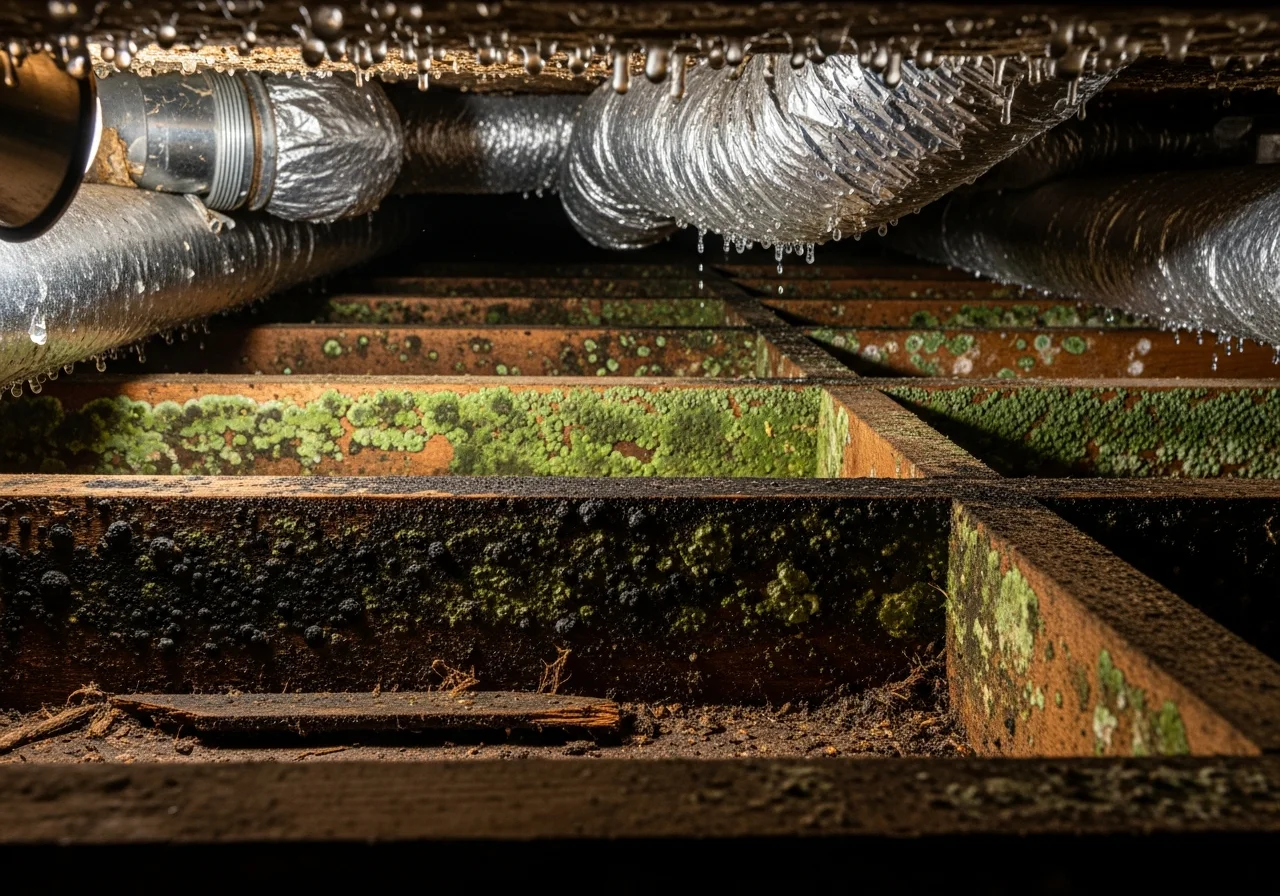
Mold colonization on floor joists in a Morrison Plantation crawl space -- sustained
humidity above 60% creates ideal conditions for Aspergillus, Penicillium, and
Cladosporium growth on untreated structural wood.
The Science Is Settled
Vented vs. Sealed Crawl Spaces: Why Mooresville Needs Encapsulation
Advanced Energy NC conducted the most comprehensive field study of crawl space
performance in the Southeast. Their findings are unambiguous: vented crawl spaces in
humid climates like the Piedmont routinely exceed 80% relative humidity in spring and
summer. Sealed crawl spaces in the same study maintained humidity below 65% year-round.
For Mooresville -- with its Lake Norman humidity overlay -- the gap is even wider.
Vented Crawl Space
Pre-2005 standard -- proven to fail at Lake Norman
80%+ RH
Spring/summer relative humidity
80%+ relative humidity in spring/summer (Advanced Energy NC data)
Foundation vents deliver warm humid air directly across cool surfaces
Condensation on floor joists, ductwork, and plumbing year-round
Mold colonization threshold exceeded 5-6 months per year
Fiberglass insulation absorbs moisture, sags, and falls
HVAC ducts sweat continuously from May through October
Wood moisture content routinely exceeds 19% -- the rot threshold
Lake Norman proximity compounds outdoor humidity levels
Sealed / Encapsulated
Modern building science -- proven effective
<55% RH
Year-round relative humidity
Below 55% RH year-round with commercial dehumidifier
All foundation vents permanently sealed with rigid foam
20-mil reinforced vapor barrier over Cecil clay soil
HVAC operates in a controlled, conditioned environment
Wood moisture stabilizes below 15% -- well below rot threshold
Lake Norman humidity is excluded from the crawl space entirely
Every day your vents remain open adds moisture
When outdoor dew points exceed 65 degrees Fahrenheit from late May through October --
five full months in Mooresville -- every cubic foot of warm humid air entering through
foundation vents deposits condensation on cooler crawl space surfaces. The vents are
not drying the space. They are the primary moisture delivery system. Lake Norman
amplifies this effect for every neighborhood within a mile of the shoreline.
7-Step Crawl Space Restoration for Mooresville Homes
Crawl space restoration in Mooresville is not a single-step service -- it is a
systematic process that addresses every moisture pathway, every contamination source,
and every structural concern before sealing the space permanently.
01
Inspection & Moisture Assessment
Day 1
02
Standing Water Removal
Days 1-2
03
Debris & Insulation Removal
Days 2-3
04
Mold Remediation (S520)
Days 3-6
05
Vapor Barrier & Encapsulation
Days 6-8
06
Dehumidifier & Monitoring
Days 7-9
07
Final Walkthrough & Documentation
Day 9-10
01
Inspection & Moisture Assessment
Day 1
A technician enters the crawl space and documents conditions comprehensively: pin-type and pinless moisture meter readings on floor joists and subfloor, relative humidity measurements, thermal imaging for hidden moisture, visual assessment of vapor barrier condition, mold presence, structural integrity of joists and girders, insulation condition, plumbing and HVAC status, and evidence of pest activity. For Mooresville's Cecil clay crawl spaces, we also assess standing water depth, soil saturation, and foundation wall moisture migration. You receive a written report with photos, moisture data, and a recommended scope of work.
02
Standing Water Removal
Days 1-2
If standing water is present -- common in Mooresville crawl spaces near Lake Norman during the wet season -- extraction happens first. Submersible pumps remove bulk water, followed by wet vacuums for remaining puddles and saturated soil pockets. We identify the source: groundwater intrusion through clay, surface water through open vents, or a plumbing leak. The source determines whether drainage modifications or a sump pump will be part of the scope.
03
Debris & Insulation Removal
Days 2-3
Mooresville crawl spaces built before 2005 almost universally contain deteriorated fiberglass batt insulation -- sagging from joists or fallen to the ground in wet, compressed, mold-contaminated piles. Our crew removes all fallen insulation, old vapor barrier fragments, construction debris, and organic material. The crawl space floor must be clean, graded, and clear before the new vapor barrier goes down.
04
Mold Remediation (S520)
Days 3-6
In Mooresville crawl spaces, mold remediation is the rule, not the exception. Our IICRC S520-compliant protocol includes containment barriers to prevent spore migration, HEPA air filtration running continuously, mechanical surface removal of mold colonies, EPA-registered fungicide application to all affected structural wood, and antimicrobial sealant. Post-remediation air quality testing confirms spore counts have returned to acceptable levels.
05
Vapor Barrier & Encapsulation
Days 6-8
A 20-mil reinforced vapor barrier is installed across the entire crawl space floor and extends up foundation walls with mechanical fastening. Every seam is overlapped 12 inches minimum and sealed with rated tape. Piers, columns, and penetrations are individually wrapped and sealed. Foundation vents are permanently closed with rigid foam board and spray-foam sealant. The finished installation creates a complete moisture envelope between the Cecil clay soil and the living space above.
06
Dehumidifier & Monitoring
Days 7-9
A commercial-grade crawl space dehumidifier -- sized for the specific volume and moisture load of your Mooresville home -- is installed with automatic drainage. The humidistat maintains 50-55% relative humidity year-round. Remote monitoring tracks conditions continuously and alerts both you and our team if thresholds are exceeded. Your crawl space becomes a clean, dry, controlled environment.
07
Final Walkthrough & Documentation
Day 9-10
We conduct a final walkthrough documenting completed work: before-and-after photos, post-remediation moisture readings, humidity baseline data, equipment details, warranty information, and a maintenance schedule. This documentation package is formatted for insurance records, HOA files, and future real estate disclosures.
Mooresville Neighborhoods Most Affected by Crawl Space Problems
Crawl space issues in Mooresville follow predictable patterns based on neighborhood age,
proximity to Lake Norman, and the specific Cecil clay conditions on each parcel. These
are the communities where our technicians see the highest concentration of crawl space
work.
Morrison Plantation
1998-2012Crawl space; some walk-outHigh
Large footprint homes on Cecil clay. Chronic moisture intrusion, floor joist mold, and deteriorated vapor barriers. Highest volume of crawl space calls in Mooresville due to neighborhood size and home age. Western sections closest to Lake Norman face amplified humidity.
Blackberry Creek
2000-2010Crawl spaceHigh
Mature tree canopy and low-lying lots compound clay drainage issues. Standing water in crawl spaces after heavy rain is common. Recurring mold on subfloor and joists. Original fiberglass insulation has largely failed in homes from the early 2000s.
Huntington Woods
1985-2005Crawl space (mixed ages)Very High
Contains some of the oldest crawl space homes in the Mooresville area. Homes from the late 1980s and 1990s are 30-40 years into the moisture cycle with original vapor barriers completely degraded. Wood rot and structural issues are more prevalent here than in newer subdivisions.
The Harbour at the Pointe
1995-2005Crawl spaceVery High
Less than one mile from the Lake Norman shoreline in most sections. Lake-amplified humidity compounds Cecil clay moisture pressure. Foundation vents facing prevailing winds carry lake moisture directly into crawl spaces. Among the most aggressive moisture environments in the Mooresville market.
Waterlynn
1990-2008Crawl space; some slabVery High
Directly adjacent to Lake Norman with the closest shoreline proximity of any major Mooresville subdivision. Lake-effect humidity is measurably higher than inland neighborhoods. Crawl spaces in the original 1990s sections face the most aggressive moisture exposure in the area. Many homes are 30+ years old with original crawl space components.
Mooresville's Lake Norman neighborhoods face amplified crawl space moisture from both
Cecil clay soil saturation below and lake-effect humidity from above -- the combination
drives the highest crawl space failure rates in the Charlotte metro.
Mooresville Pricing
Crawl Space Cleanup & Encapsulation Costs in Mooresville
Crawl space costs in Mooresville vary significantly based on size, existing damage, and
whether the project is encapsulation only, remediation plus encapsulation, or full-scope
with structural repair. These ranges reflect real project costs in the Mooresville and
Lake Norman market -- not national averages.
Encapsulation Only
Vapor barrier, vent sealing, dehumidifier -- no active mold
Encapsulation-only applies to crawl spaces with elevated moisture but no active mold or structural damage. We find this condition in fewer than 20% of Mooresville homes we inspect. Most crawl spaces near Lake Norman have progressed beyond this stage by the time homeowners call.
Remediation + Encapsulation
Mold removal, insulation replacement, full encapsulation
Mold remediation (IICRC S520)$3,000 - $15,000
Contaminated insulation removal$1,000 - $3,000
Floor joist repair / sistering$2,000 - $8,000
Complete encapsulation system$4,000 - $8,000
Post-remediation air testing$300 - $500
Total remediation + encapsulation$8,000 - $25,000
This is the most common scope for Mooresville crawl space projects. The majority of homes in Morrison Plantation, Blackberry Creek, Huntington Woods, and lakeside neighborhoods require mold remediation before encapsulation can proceed.
Full Scope + Structural
Drainage, extensive joist repair, remediation, full seal
Full-scope projects are most common in Huntington Woods and Waterlynn homes that are 30+ years old with decades of unaddressed moisture damage. Large Morrison Plantation homes with 2,000+ sq ft crawl spaces can reach this range when structural deterioration is extensive.
Every Mooresville crawl space is different. Call (704) 464-0121 for a free inspection and detailed scope-of-work estimate.
We document exactly what your crawl space needs -- and what it does not -- so you know
where every dollar goes before any work begins.
Our Mooresville Work
Crawl Space Restoration in Mooresville Homes
From active mold on Cecil clay soil to fully sealed, dehumidified environments -- here
is what our crawl space work looks like in Mooresville's Lake Norman neighborhoods.
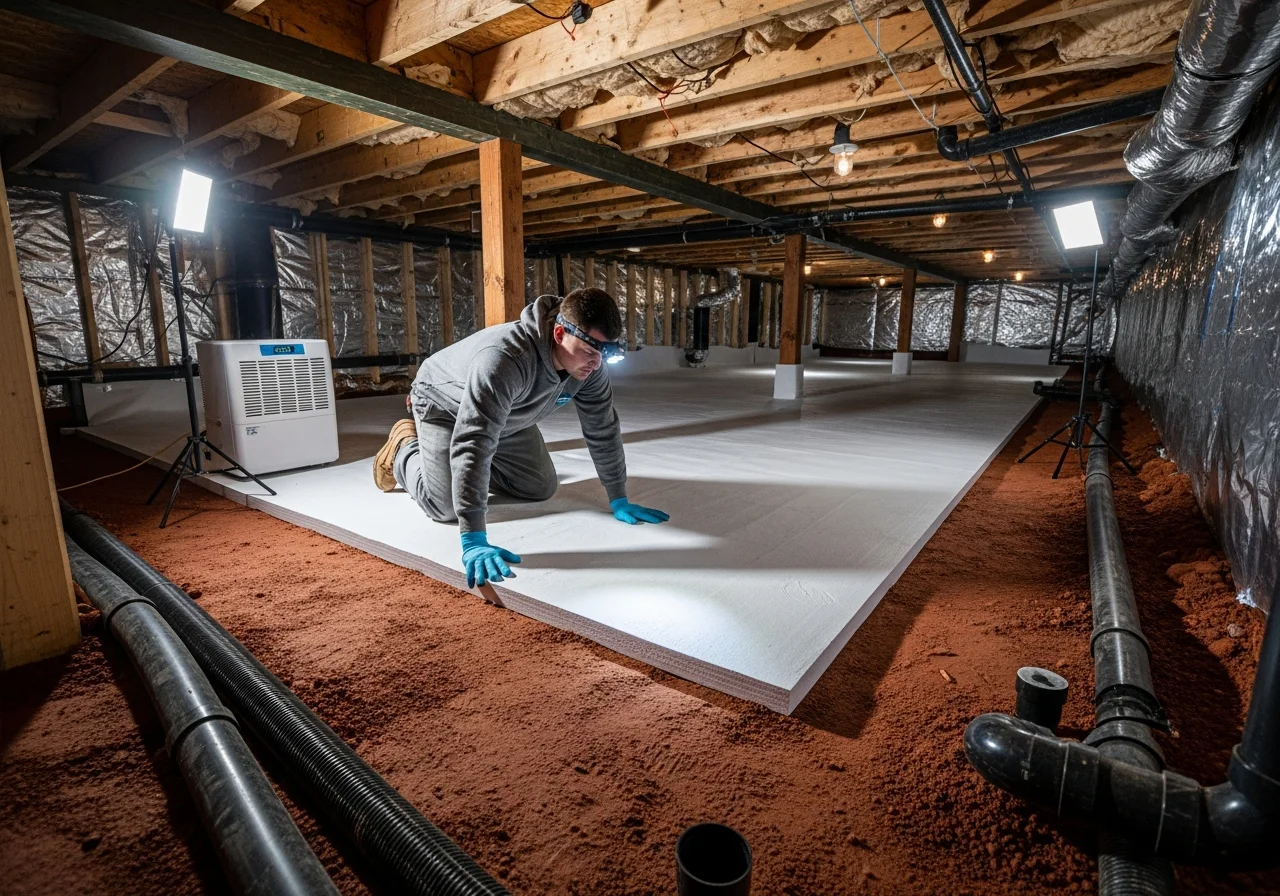
Full encapsulation in progress -- 20-mil reinforced vapor barrier being sealed to foundation walls in a Morrison Plantation crawl space
Mold colonization on floor joists before remediation -- sustained humidity above 60% drives Aspergillus and Penicillium growth on structural wood
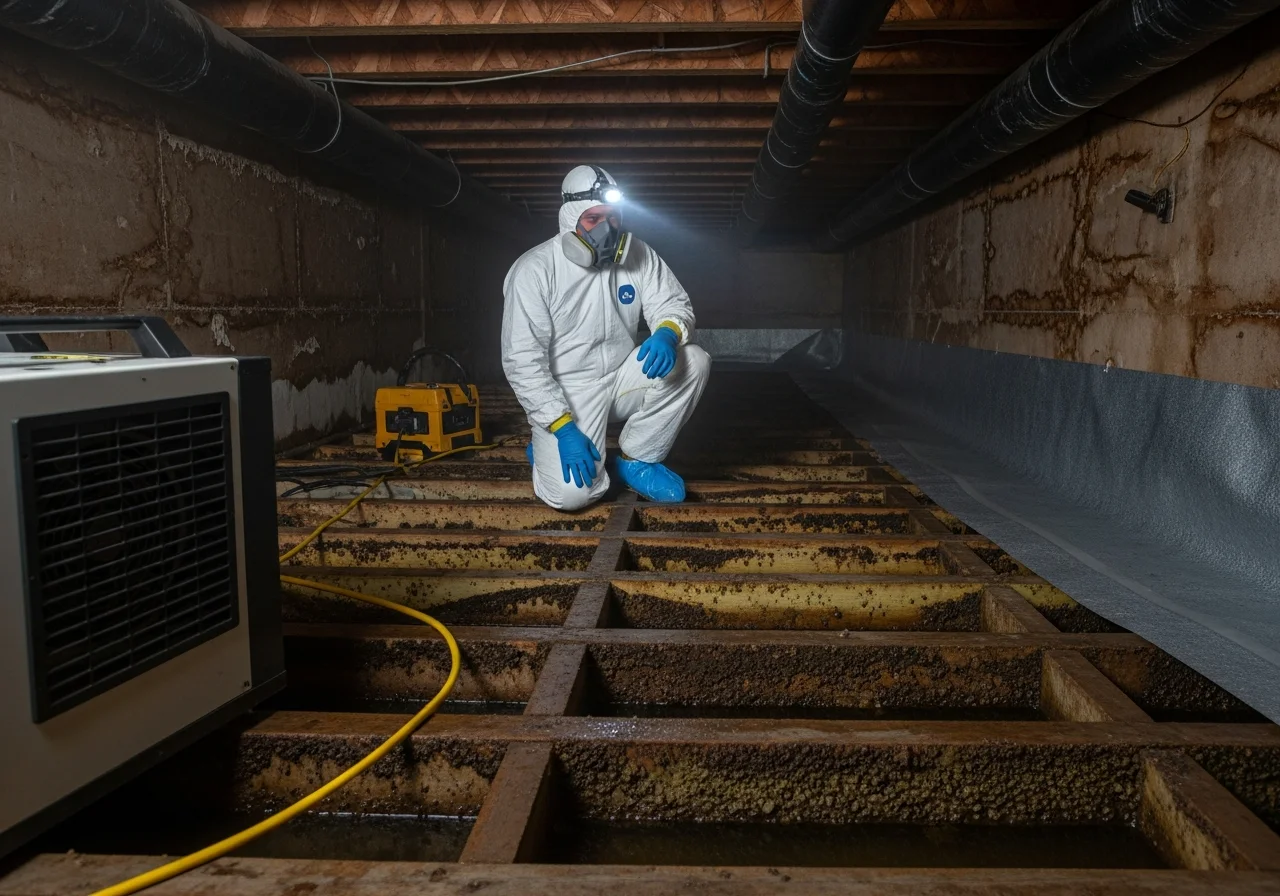
IICRC S520-compliant mold remediation -- containment barriers, HEPA filtration, and antimicrobial treatment on affected joists
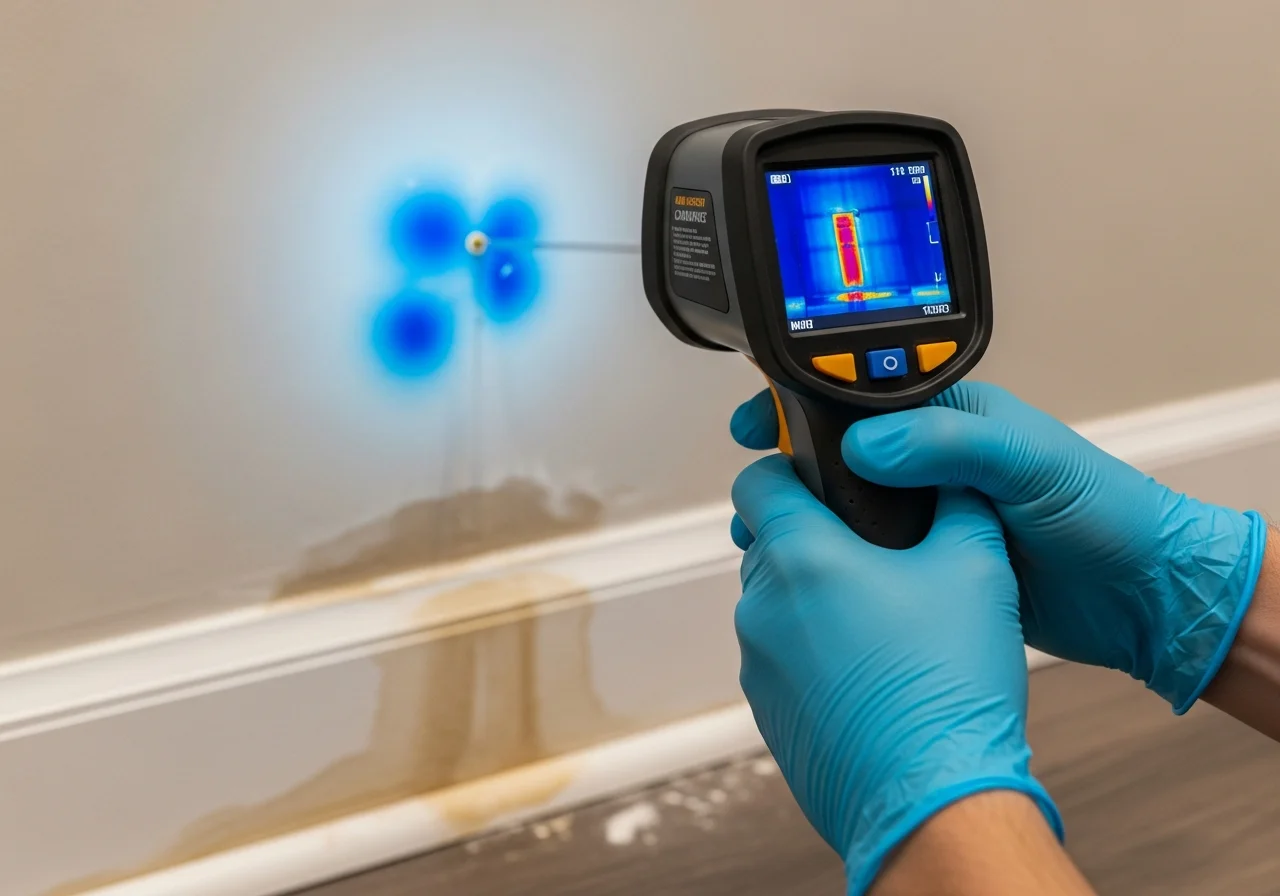
Thermal imaging reveals hidden moisture patterns invisible to the naked eye -- temperature differentials indicate active moisture migration
The Palm Build Difference
Why Mooresville Homeowners Choose Palm Build for Crawl Space Work
Crawl space encapsulation is a growing industry in the Lake Norman market, and
Mooresville homeowners have no shortage of contractors making promises. Here is what
sets Palm Build apart from franchise operations and general contractors offering crawl
space work as a sideline.
IICRC Certified Technicians
Every crew lead holds current IICRC certification for Water Damage Restoration (WRT), Applied Microbial Remediation (AMRT), and Applied Structural Drying (ASD). Crawl space mold remediation requires S520 protocol knowledge that general contractors and waterproofing-only companies typically lack.
Remediation and Encapsulation Under One Scope
Many companies do encapsulation but subcontract mold remediation, or vice versa. Palm Build handles both in-house, eliminating coordination gaps and ensuring the remediation-first, encapsulation-second sequence is followed correctly. One team. One scope. One accountability.
Mooresville and Lake Norman Experience
We know the Cecil clay conditions, the neighborhood-by-neighborhood construction patterns, and the Lake Norman humidity overlay that makes Mooresville crawl spaces uniquely challenging. Our proposals reference your specific conditions -- from Morrison Plantation's large footprints to Waterlynn's lakeside moisture exposure.
NC Licensed & Insured
Palm Build holds all required North Carolina licensing for crawl space work including general contractor licensing and mold remediation credentials. We carry comprehensive general liability and workers' compensation coverage for every crew member entering your crawl space.
Honest Assessment -- Not Overselling
Not every crawl space needs full encapsulation. If your crawl space needs a vapor barrier replacement and a dehumidifier but does not have mold or structural damage, we will tell you that -- and scope the work accordingly. We document exactly what the crawl space needs so you know where every dollar goes.
40-60 Minute Response from Charlotte Hub
Our Crompton Street operations center puts us 30 miles from Mooresville with dedicated crews available for Lake Norman area inspections and project work. When a pipe bursts in your crawl space at 2 AM, our emergency crew can extract standing water and establish drying equipment the same night.
Common Questions
Mooresville Crawl Space Cleanup FAQ
Answers to the most common questions Mooresville homeowners ask about crawl space
cleanup, mold remediation, and encapsulation in the Lake Norman area.
How do I know if my Mooresville home has a crawl space?
If your home was built before 2005 in neighborhoods like Morrison Plantation, Blackberry Creek, Huntington Woods, The Harbour at the Pointe, or Waterlynn, there is a strong chance it has a crawl space. Look for a small access door on the exterior foundation wall or inside a first-floor closet.
How much does crawl space encapsulation cost in Mooresville?
Full encapsulation typically ranges from $4,000 to $12,000. If mold remediation is also needed, add $3,000 to $15,000. Total remediation-plus-encapsulation projects usually fall between $8,000 and $25,000.
Does homeowners insurance cover crawl space encapsulation?
No. Encapsulation is considered a home improvement. Insurance may cover mold remediation from a sudden covered water event, but mold sublimits on NC policies are typically $5,000 to $10,000. Gradual moisture damage is excluded.
How long does crawl space encapsulation take in Mooresville?
Encapsulation alone typically takes 2 to 4 days. If mold remediation and structural repair are needed first, the full project may take 5 to 12 days.
Does Lake Norman make crawl space problems worse?
Yes. Lake Norman's 32,510-acre surface area creates elevated local humidity. Homes in Waterlynn, The Harbour at the Pointe, and lakeside sections of Morrison Plantation experience an additional moisture load that inland neighborhoods do not.
Is crawl space mold in Mooresville dangerous?
Crawl space mold produces spores drawn into living spaces by the stack effect. Aspergillus, Penicillium, and Cladosporium -- the species most common in Mooresville crawl spaces -- can trigger allergic reactions and respiratory symptoms. Mold on structural wood also actively degrades it.
What about radon in Mooresville crawl spaces?
North Carolina has elevated radon risk -- 77 of 100 counties exceed the EPA action level. We recommend radon testing before and after encapsulation. A sub-membrane depressurization system can be integrated during encapsulation for $800 to $1,500 if needed.
How often should I have my crawl space inspected?
Annually, ideally in spring before the May-through-October humidity window. Annual inspections include moisture readings, humidity data, dehumidifier verification, vapor barrier inspection, and mold assessment.
Concerned About Your Mooresville Crawl Space? Get Answers.
Palm Build inspects and restores crawl spaces across Mooresville's Lake Norman neighborhoods. A professional inspection with moisture data and a written report takes less than two hours and gives you the objective facts about your home's condition. Call our local line to schedule.