Crawl Space Cleanup & Encapsulation in Cornelius, NC
Cornelius' Lake Norman humidity, late-1990s vented crawl space construction, and clay-influenced Piedmont soils create crawl space conditions that deteriorate faster than most homeowners realize. Palm Build provides complete crawl space remediation — mold removal, moisture control, encapsulation, and structural repair — addressing the root cause, not just the symptoms.
25 minutes from Charlotte office 30-45 min Response IICRC Certified
Why Cornelius Crawl Spaces Fail: Clay Soil, Lake Moisture, and Vented Design
If you own a home in Cornelius built before 2010, there is a strong chance your house
sits on a crawl space foundation. And if it does, the conditions underneath it are
working against you — not because of a construction defect, but because of a collision
between the Lake Norman corridor's geology, its climate, and the building practices that
were standard when your home was built.
Vented Crawl Space Legacy
60%+
Homes with vented crawl
Over 60% of Cornelius homes built before 2010 sit on vented crawl space foundations — a construction standard that was code-compliant when these homes were built but is now recognized as a primary moisture failure point in the Piedmont climate. Those foundation vents that were supposed to dry the crawl space are actively wetting it. In Cornelius's humid summers — where dew points regularly climb into the upper 60s and 70s — warm, moisture-laden air enters through vents and condenses on cool crawl space surfaces: floor joists, ductwork, plumbing, and subfloor panels.
Lake Norman Ground Moisture
43.6 in
Annual rainfall
Cornelius sits along the western shore of Lake Norman with the water table influenced by the lake's presence. Combined with 43.6 inches of average annual rainfall and Piedmont clay soil that drains at less than 0.2 inches per hour, the ground beneath Cornelius homes is never fully dry. Even during the driest months, soil moisture levels remain high enough to generate vapor through uncovered crawl space floors. This means Cornelius crawl spaces never get a break from moisture pressure — the clay holds it, the lake raises it, and the rain replenishes it.
Aging Vapor Barriers
20-25 yrs
Vapor barrier age
Most Cornelius crawl space homes were built with a 6-mil polyethylene vapor barrier on the ground — the minimum code requirement at the time. After 20 to 25 years, these thin barriers have degraded: torn by foot traffic during maintenance, perforated by settling debris, and deteriorated by UV exposure from the sun entering through open vents. A compromised vapor barrier provides essentially no moisture protection. What was adequate in 2000 is failing in 2026.
Stack Effect & Indoor Air
40%+
Air from crawl space
The stack effect — warm air rising through your home and pulling air upward from the crawl space — means that 40% or more of the air you breathe on the first floor originated in the crawl space below. If that crawl space has active mold, elevated humidity, or decomposing organic material, those contaminants enter your living space through floor penetrations, ductwork connections, and the natural pressure difference between below-grade and above-grade spaces.
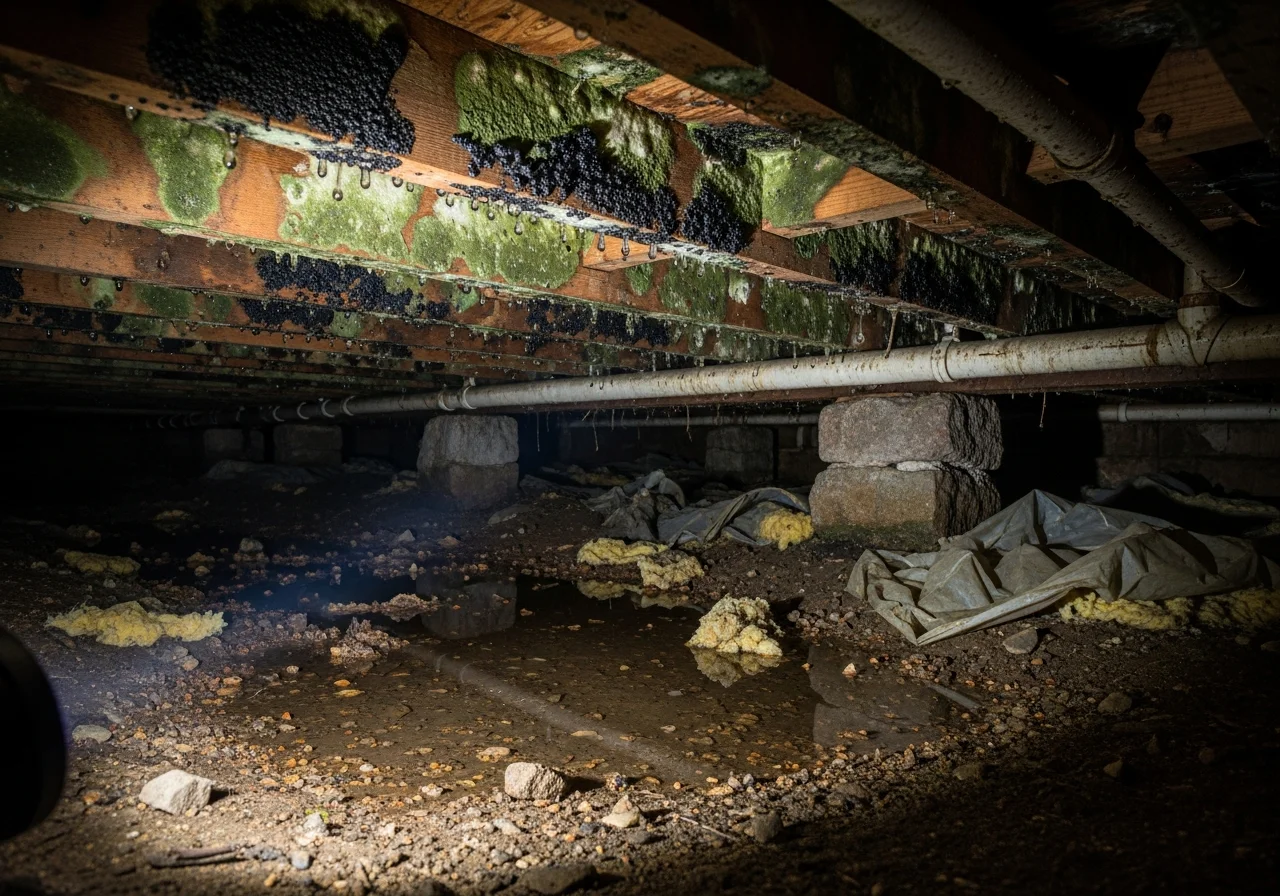
Active mold on floor joists in a Cornelius crawl space — the combination of clay soil,
Lake Norman moisture, and vented design creates persistent conditions for biological
growth.
Warning Signs
Signs Your Cornelius Crawl Space Needs Attention
Most Cornelius homeowners don't check their crawl spaces regularly — and they shouldn't
have to. But the crawl space will tell you it's failing through symptoms that show up in
the living space above. If you notice any of the following, it's time for a professional
inspection.
Musty, earthy, or damp odors on the first floor — especially noticeable when the HVAC system kicks on or when you first enter the home
Buckling, bouncy, or sagging floors — indicating moisture damage to subfloor panels or floor joists beneath
Condensation on windows, pipes, or ductwork in the crawl space or on first-floor surfaces
Higher-than-normal utility bills — a wet crawl space forces HVAC systems to work harder to condition the humid air drawn upward by the stack effect
Pest activity — termites, carpenter ants, and rodents are attracted to the moisture-rich crawl space environment
Visible mold on crawl space surfaces — floor joists, subfloor, rim joists, or the vapor barrier itself, often discovered during home inspections
One symptom is enough to warrant inspection
Crawl space problems are progressive. By the time you notice musty odors or soft
floors, moisture damage has typically been developing for months or years. A
professional crawl space inspection with moisture meter readings, humidity data, and
structural assessment takes less than two hours. Call (704) 464-0121 to schedule your free inspection.
Restoration Process
The Cornelius Crawl Space Cleanup Process
From inspection through encapsulation and ongoing monitoring — here's how Palm Build
restores and protects your Cornelius crawl space from the moisture cycle that causes
damage.
01
Inspection & Assessment
1-2 hours
Comprehensive crawl space inspection with moisture meter readings on every accessible surface, relative humidity measurement, thermal imaging, structural assessment of floor joists and subfloor, vapor barrier condition evaluation, and photographic documentation. We identify the specific moisture sources affecting your Cornelius crawl space — ground vapor, vent infiltration, plumbing leaks, or drainage issues — and quantify the damage severity.
02
Debris Removal
1-2 days
Remove all contaminated materials: deteriorated vapor barriers, fallen fiberglass insulation, organic debris, construction waste, pest waste, and any standing water. This phase exposes the actual condition of the crawl space floor, foundation walls, and structural members — often revealing damage that was hidden under insulation or debris. Everything removed is properly disposed of.
03
Mold Treatment
1-3 days
IICRC S520-compliant mold remediation on all affected surfaces — floor joists, subfloor panels, rim joists, and foundation walls. We use HEPA-filtered negative air machines to contain spores during treatment. Antimicrobial treatment of all structural wood surfaces prevents regrowth. Heavily damaged structural members — soft joists, delaminated subfloor — are repaired or replaced.
04
Vapor Barrier Installation
1-2 days
Install 20-mil reinforced vapor barrier covering the entire crawl space floor and extending up foundation walls to grade level. All seams are sealed and the barrier is mechanically fastened. Foundation vents are permanently sealed — converting the crawl space from a vented design to a conditioned, encapsulated space. Drainage matting is installed if the crawl space has a history of liquid water intrusion.
05
Dehumidifier Setup
1 day
Install a commercial-grade crawl space dehumidifier sized for your space volume. The unit maintains relative humidity below 55% year-round, permanently breaking the moisture cycle that caused the original damage. Condensate drains to a sump pump or gravity drain. The dehumidifier is the ongoing defense that keeps the encapsulation system effective through Cornelius's humid summers and rainy seasons.
06
Monitoring & Documentation
Ongoing
Post-installation humidity and moisture readings confirm the system is performing correctly. We provide complete documentation — before and after photos, moisture data, material specifications, and warranty information. Annual maintenance checks ensure the dehumidifier, vapor barrier, and drainage system continue operating as designed.
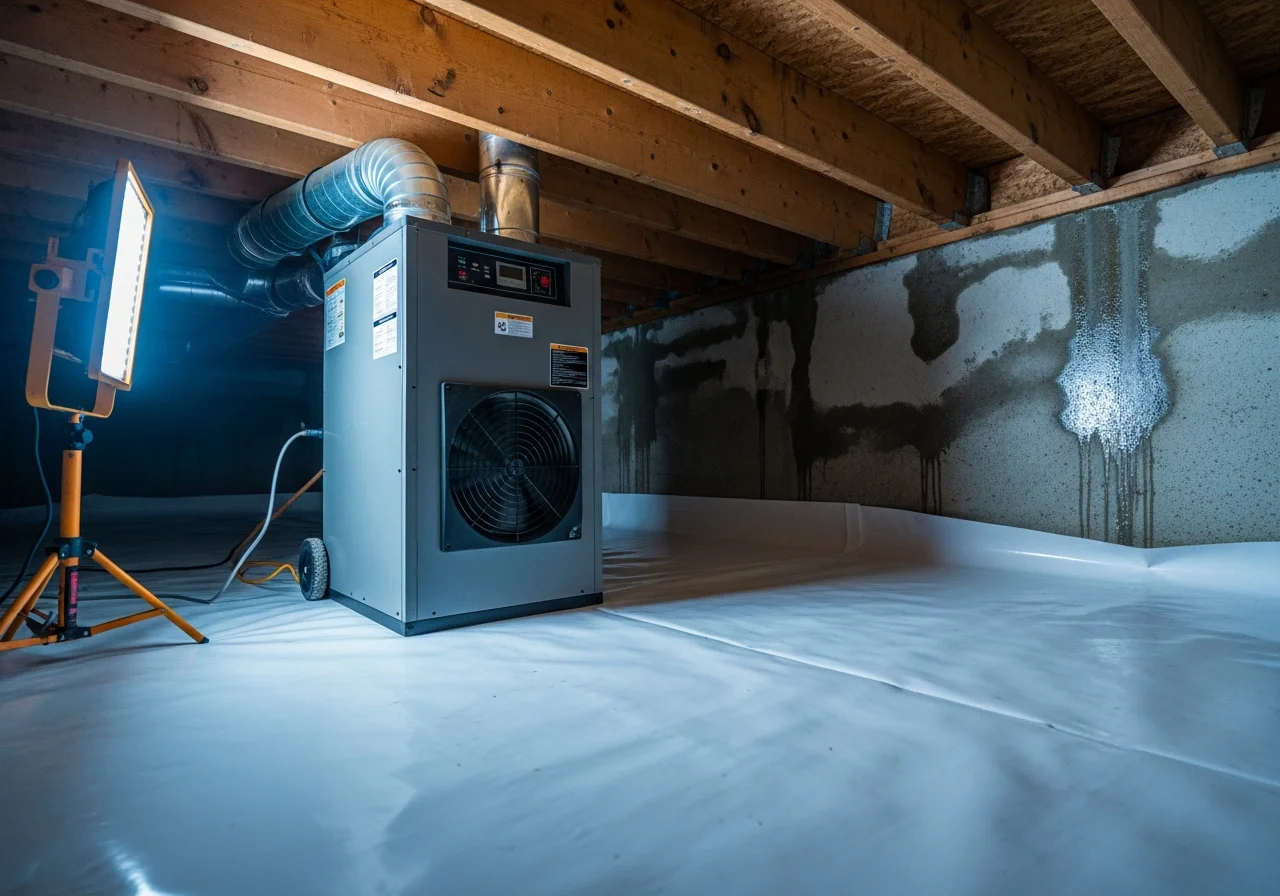
Commercial dehumidifier installed in a Cornelius crawl space — maintaining humidity
below 55% year-round to permanently break the moisture cycle.
Know the Difference
Vented Crawl Space vs. Encapsulated: The Cornelius Comparison
The vented crawl space design that was standard when your Cornelius home was built is
the primary cause of the moisture, mold, and structural damage underneath it.
Encapsulation converts the crawl space from an uncontrolled outdoor environment into a
conditioned, protected space.
Vented Crawl Space
Current condition in most Cornelius homes
80%+ Humidity
Typical summer readings
Foundation vents draw humid summer air into cool crawl space — causes condensation
6-mil vapor barrier degraded after 20-25 years — minimal moisture protection
HVAC ductwork operates in conditioned space — improved efficiency
Clean air beneath home enters living space through stack effect
Closed-cell spray foam or rigid board insulation on crawl space walls
Relative humidity controlled regardless of outdoor conditions
Pest entry points sealed — moisture environment eliminated
Encapsulation without remediation seals contamination inside
If your crawl space has active mold, the correct sequence is always remediate first, then encapsulate. Encapsulating over active mold creates a sealed environment where contamination
continues growing unchecked. Conversely, remediation without encapsulation is
temporary — the conditions that grew the mold are still present.
How Piedmont Clay Affects Your Cornelius Crawl Space
The red clay beneath your Cornelius home is the foundation of the crawl space moisture
problem. Understanding how soil conditions, the Lake Norman water table, and drainage
patterns work together explains why your crawl space stays wet — and what it takes to
fix it permanently.
Piedmont Clay Composition
Cornelius sits on deep Piedmont red clay — the same distinctive soil visible at every construction site in Mecklenburg County. This clay has microscopic particle structure that traps and holds moisture rather than allowing it to drain. After rainfall, water doesn't percolate down and away from your foundation. It sits. For days. Sometimes weeks. NC State Extension research confirms that Piedmont clay causes slow water movement, sometimes measured in fractions of an inch per hour.
Lake Norman Water Table Influence
Cornelius's proximity to Lake Norman elevates the local water table, particularly in neighborhoods closest to the shoreline like The Peninsula. This elevated water table means the ground beneath your home never fully dries — even during the driest months. Combined with clay's refusal to drain, this creates constant hydrostatic pressure pushing moisture vapor upward through bare crawl space floors and deteriorated vapor barriers.
Grading & Surface Drainage Issues
Many Cornelius homes were built on lots where grading directs surface water toward the foundation rather than away from it. Over time, settlement around foundations, landscape changes, and hardscape additions alter the original grading. Downspouts that discharge too close to the foundation, impervious driveways that channel water toward the house, and negative grading all contribute to water pooling against foundation walls.
Drainage Solutions We Implement
When exterior drainage contributes to crawl space moisture, we address it as part of the encapsulation project: interior French drain installation along the crawl space perimeter, sump pump installation for active water management, downspout extension to direct roof runoff away from the foundation, and crawl space drainage matting beneath the vapor barrier. These solutions work with the encapsulation system to manage both vapor and liquid water.
A proper crawl space solution in Cornelius must address both vapor moisture (through
encapsulation) and liquid water (through drainage). Encapsulation alone won't solve a
crawl space with active water intrusion.
Neighborhood-Level Risk
Crawl Space Risk by Cornelius Neighborhood
Crawl space issues in Cornelius follow predictable patterns based on neighborhood age,
construction era, proximity to Lake Norman, and soil conditions. These are the
communities where we see the highest volume of crawl space work.
Westmoreland
2000s-2010sCrawl space; some slab
Full-brick Georgian colonials and craftsman homes on clay soil. Vented crawl space design with original 6-mil vapor barriers now 15-20+ years old. Mature tree canopy retains moisture and prevents sun-drying of soil. HOA coordination required for any exterior foundation work.
High
Antiquity
2000sCrawl space
Traditional and craftsman homes built on Piedmont clay with standard vented crawl spaces. Common findings: mold on floor joists, saturated original vapor barriers, falling fiberglass insulation. Homeowners report musty first-floor odors and soft spots in hardwood floors.
High
Oakhurst
2000s-2010sMix: crawl space + slab
Newer construction with many crawl space foundations. Clay soil retention and original vented design create the same moisture cycle as older neighborhoods. Continuous hardwood flooring throughout open floor plans means moisture damage to subfloor affects entire living areas.
High
Bailey's Glen (55+)
2000s-2010sCrawl space; ranch style
Single-level ranch homes with crawl space foundations. Entire living space sits over crawl space — no slab sections to buffer. Accessibility considerations for aging residents mean crawl space air quality directly impacts health. Low-clearance crawl spaces common in ranch designs complicate access for remediation.
High
The Peninsula
1990s-2010sMix: walk-out + crawl space
Lakefront properties with walk-out basements and crawl space sections. Elevated water table from Lake Norman proximity adds hydrostatic pressure. Premium homes where crawl space moisture translates to significant hardwood floor and finish damage above. HOA strictly controls exterior foundation modifications.
Moderate
Cornelius Townhome Communities
2000s-2020sMix: crawl space + slab
Shared-wall construction where crawl space moisture in one unit can migrate to adjacent units. HOA governs structural elements — crawl space encapsulation affecting shared foundation walls requires HOA approval. Coordination between unit owners for shared crawl space areas.
Moderate
If your Cornelius home was built before 2010 and has a crawl space foundation, the crawl
space needs professional evaluation — regardless of whether you've noticed symptoms inside
the home yet.
Crawl Space Cleanup & Encapsulation Costs in Cornelius
Crawl space costs in Cornelius depend on the space size, current condition, moisture
sources, and whether mold remediation or structural repair is needed. These ranges
reflect actual project costs in the Cornelius and Lake Norman market.
Vapor Barrier Only
20-mil barrier, vent sealing, basic install
$3,500 - $7,000
Minimum protection — may not include dehumidifier or wall insulation
Full Encapsulation
Barrier + dehumidifier + vent seal + insulation
$5,000 - $14,000
Complete system — 20-mil barrier, dehumidifier, wall insulation, vent sealing
Mold Remediation Add-On
IICRC S520 mold treatment + structural repair
$3,000 - $15,000
Depends on mold extent, structural damage, and joist repair needs
Drainage System
Interior French drain + sump pump
$3,000 - $8,000
Required when liquid water intrusion is present — not just vapor
Commercial crawl space dehumidifier$1,800 - $3,500
Foundation vent sealing (per vent)$50 - $150
Crawl space wall insulation (spray foam)$1,500 - $4,000
Mold remediation — floor joists (per LF)$8 - $20
Joist sistering / structural repair$200 - $500 per joist
Subfloor replacement (per SF)$5 - $12
Interior French drain (per LF)$25 - $50
Sump pump installation$800 - $2,000
Debris and old insulation removal$500 - $2,000
The Palm Build Difference
Why Cornelius Homeowners Choose Palm Build for Crawl Space Restoration
Most crawl space companies sell encapsulation. Palm Build solves the moisture problem —
from structural repair and mold remediation through encapsulation and ongoing
protection.
Single-Source: Remediation + Encapsulation
Most crawl space companies either remediate mold or install encapsulation — not both. Palm Build does both under one contract, one project manager, and one timeline. There's no gap between removing the existing damage and installing the system that prevents recurrence. This eliminates the most common failure point in crawl space restoration.
NC Licensed General Contractor
When crawl space damage extends to structural repair — joist sistering, subfloor replacement, foundation repair — you need a licensed General Contractor, not a waterproofing company. Palm Build holds the NC GC license required for structural work, ensuring your crawl space restoration is performed by a contractor qualified to handle every scope of work discovered during the project.
IICRC-Certified Mold Remediation
Our mold remediation follows IICRC S520 protocols — the industry standard for safe, effective mold removal. HEPA-filtered negative air machines contain spores during treatment. Antimicrobial treatment of structural surfaces prevents regrowth. Post-remediation air quality testing confirms the space is safe before encapsulation.
Insurance Claims Expertise
When crawl space mold originates from a covered peril — a plumbing leak, HVAC condensate failure, or appliance discharge — insurance may cover remediation up to your mold sublimit. Palm Build documents the origin, prepares Xactimate estimates, and coordinates with your carrier. Our documentation frequently proves covered origins that homeowners might otherwise miss.
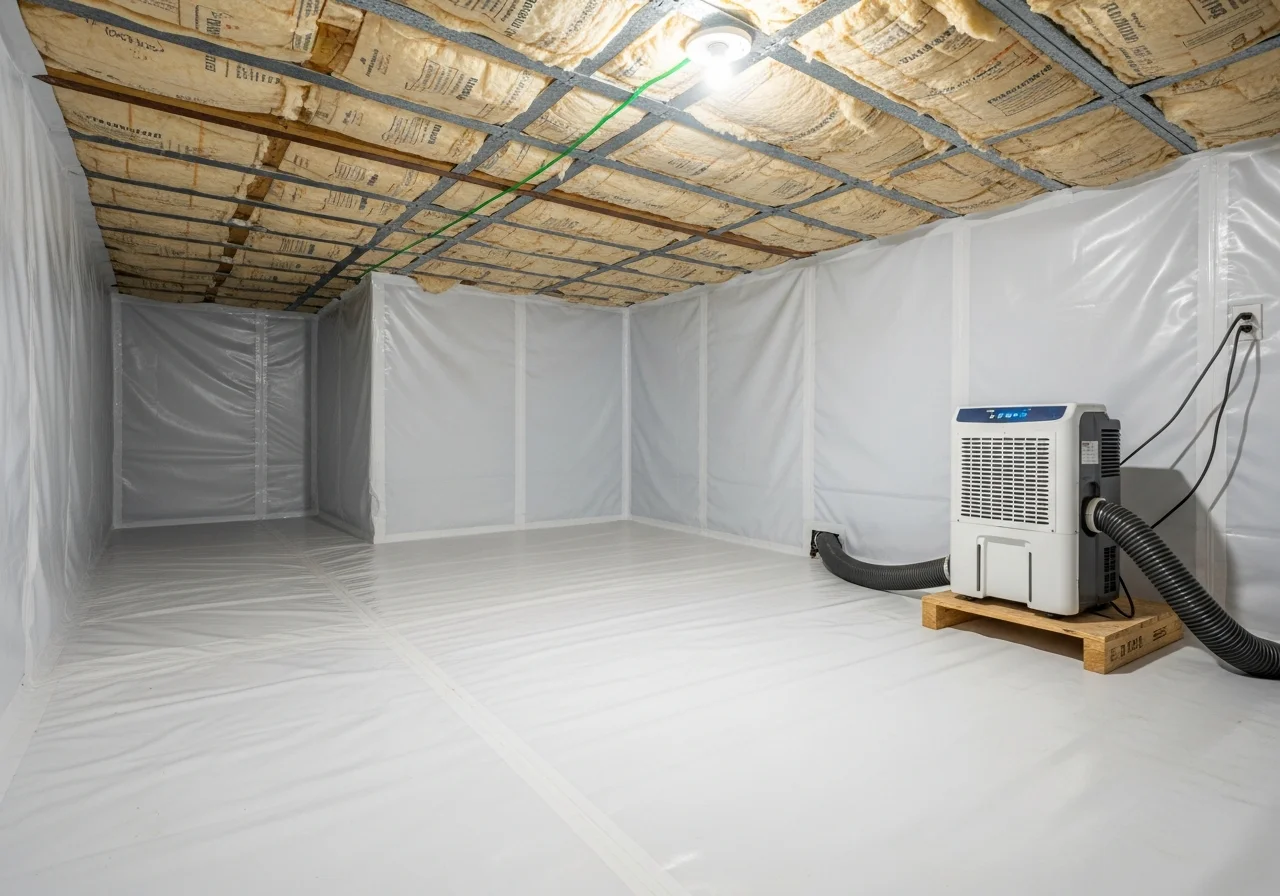
Completed crawl space encapsulation in a Cornelius home — 20-mil reinforced vapor
barrier, sealed vents, wall insulation, and commercial dehumidifier providing permanent
moisture protection.
Common Questions
Cornelius Crawl Space Cleanup FAQ
Why are Cornelius crawl spaces worse than other Charlotte suburbs?
Proximity to Lake Norman elevates ambient humidity significantly above the Charlotte metro baseline. Cornelius' crawl space homes — concentrated in neighborhoods like Bailey's Glen, Antiquity, Olde Mill Village, Westmoreland, and Beverly — sit in a microclimate where warm, moisture-laden air off the lake enters vented crawl spaces, condenses on cooler framing, and feeds mold growth. The 1997-2008 building era used vented crawl space designs and 6-mil vapor barriers that are now degraded and ineffective after 25 years of continuous moisture exposure.
How much does crawl space encapsulation cost in Cornelius?
Basic encapsulation — Class I vapor barrier, vent sealing, dehumidifier installation — typically ranges from $5,000 to $8,000 in Cornelius depending on crawl space square footage. Complete moisture remediation including mold removal, drainage correction, insulation replacement, and structural joist repair can range from $12,000 to $25,000+. Cornelius homes with active mold on structural framing require S520-compliant remediation before encapsulation can begin, which adds $3,000 to $12,000 depending on extent.
Does crawl space encapsulation address radon in Cornelius?
Encapsulation addresses radon entry pathways through sub-membrane depressurization — sealing the same soil-to-floor interface that both moisture and radon travel through. While Mecklenburg County has an EPA-assigned Radon Zone 3 (predicted low risk), residential measurements in the Lake Norman corridor have occasionally exceeded the EPA action level of 4 pCi/L. If radon testing shows elevated levels, the encapsulation vapor barrier provides the sealed foundation for a radon mitigation fan system to be added.
How do I know if my Cornelius crawl space needs attention?
Common warning signs include: musty or earthy odors on the first floor (especially noticeable in closets and bathrooms), cupping or buckling hardwood floors, indoor humidity above 60% even with the HVAC running, visible condensation on windows during summer, higher-than-expected cooling bills, and allergy symptoms that worsen indoors. Homes in Bailey's Glen, Antiquity, Olde Mill Village, Robbins Park, and Smithville — neighborhoods built during the late 1990s to early 2000s with vented crawl spaces — should have a professional inspection every 2-3 years.
Is crawl space work covered by insurance in Cornelius?
It depends on the cause. Crawl space damage from a covered sudden event — such as a burst pipe flooding the crawl space or storm-driven water intrusion — is typically covered under your homeowners policy. Gradual moisture damage, condensation, long-term humidity, and mold growth from environmental conditions are generally excluded. If your crawl space moisture has caused structural damage — rotted joists, failed subfloor — the structural implications may have coverage implications. Palm Build documents the cause-of-loss to determine which costs may be claimable.
Does North Carolina require permits for crawl space encapsulation?
Yes — NC requires permits for most vented-to-closed crawl space conversions. The encapsulated crawl space must meet NC building code requirements including a Class I vapor barrier (minimum 12-mil reinforced), mechanical dehumidification or conditioned air supply maintaining relative humidity below 60%, and a mandatory 3-4 inch termite inspection gap at the foundation perimeter. Palm Build handles all Mecklenburg County LUESA permitting and inspections as part of our encapsulation scope.
How long does crawl space encapsulation take in Cornelius?
Encapsulation only (no mold present): 2-4 days. Mold remediation plus encapsulation: 1-2 weeks. Full remediation with drainage correction, joist repair, and encapsulation: 2-4 weeks. Cornelius' clay-influenced soil can complicate drainage work if heavy rains occur during the installation period, particularly during the wettest months of August, June, and March.
What areas around Cornelius does Palm Build serve for crawl space work?
We serve all of Cornelius and the greater Lake Norman corridor including Bailey's Glen, Antiquity, Olde Mill Village, Westmoreland, Beverly, Robbins Park, Smithville, and all other neighborhoods with crawl space construction. We also serve nearby Davidson, Huntersville, and Mooresville. Our Charlotte operations hub is approximately 25 minutes from central Cornelius.
Cornelius Crawl Space Problems? We Fix the Root Cause.
Palm Build addresses crawl space moisture, mold, and structural damage at the source — not just the symptoms. Encapsulation, drainage, mold remediation, and joist repair, all managed as one coordinated project with Mecklenburg County permitting included.