Key takeaways
- Indian Land is in Lancaster County, South Carolina — not Charlotte, and not North Carolina. SC LLR contractor licensing is mandatory, and NC-only contractors cannot legally perform restoration work on your home.
- Population has jumped from 17,742 in 2010 to 37,629 in 2024 — an 85% growth surge driven by Charlotte metro spillover into master-planned communities.
- The dominant housing cohort was built 2010–2019 (7,789 homes), which means PEX supply line failures, builder-grade plumbing defects, and aggressive retention pond drainage are the modal water damage claim types.
- Sun City Carolina Lakes (Del Webb 55+), Walnut Creek, Bridgemill, Edgewater, The Palisades, and Riverchase Estates all face different water risk profiles depending on proximity to the Catawba River and Sugar Creek watersheds.
- The IICRC S500 standard defines three categories of water contamination — and the category drives the entire restoration scope, not the visible water volume.
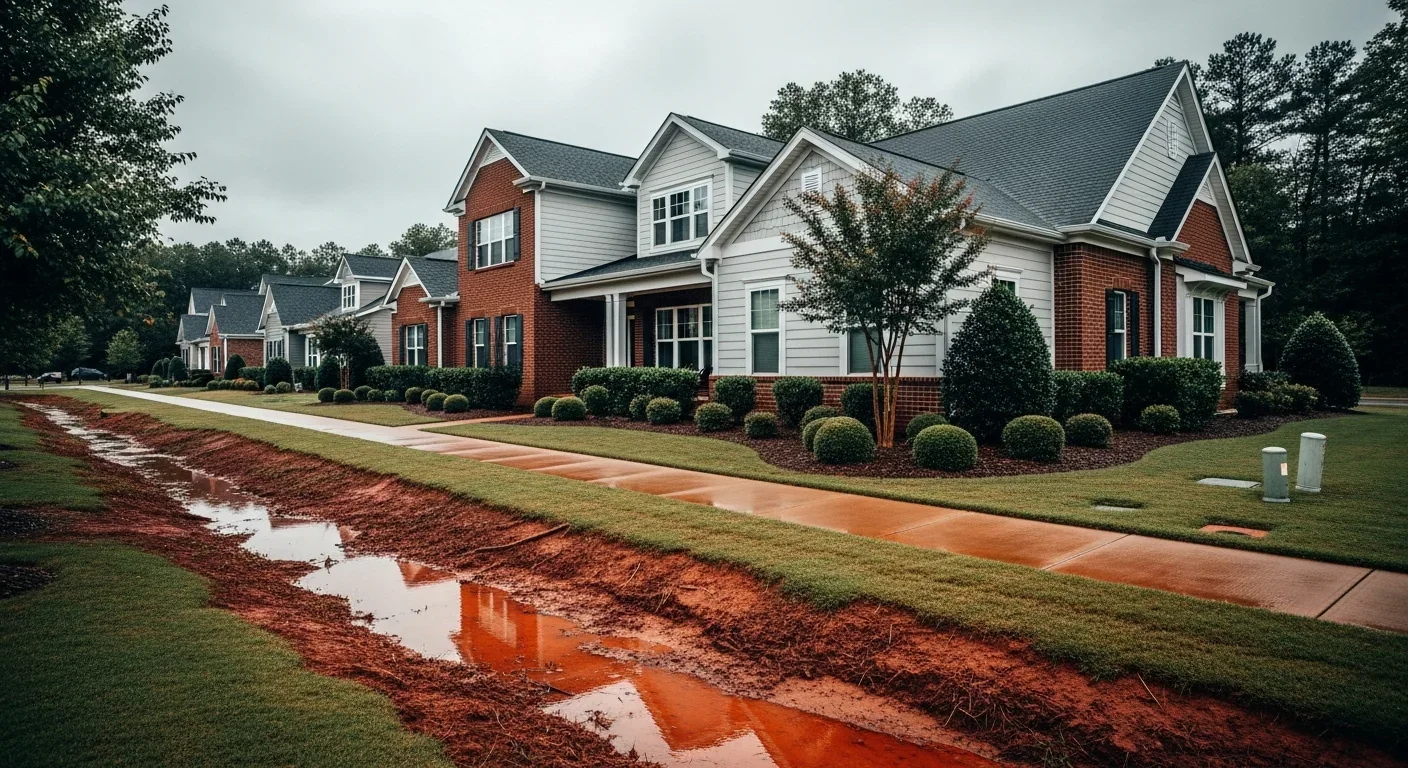
Indian Land is one of the fastest-growing places in America, and almost nobody who lives there understands that it's in a different state than Charlotte. The ZIP code 29707 sits in Lancaster County, South Carolina, on the southern lip of the Catawba River watershed — across the state line from Mecklenburg County and the Charlotte metro economy that fills its master-planned communities every weekday at six in the morning. The practical consequence, when your washing machine supply line fails at 2 a.m. on a Tuesday, is that most of the restoration companies you find on a Google search are Charlotte-based North Carolina contractors who cannot legally perform the work on your home. This guide is the honest version — which companies can work in Indian Land, why the 2010s-era housing stock fails the way it does, what Catawba watershed drainage actually looks like during a heavy rain event, and how to make sure your insurance claim doesn't stall because the contractor you called doesn't hold the license the state of South Carolina requires.
Population growth
+85%
From 17,742 (2010) to 37,629 (2024) — one of the fastest growth rates in the Southeast
Median household income
$118,295
Charlotte spillover demographic — higher than Charlotte city proper
Dominant housing era
2010–2019
7,789 homes built in that window — the PEX supply line failure generation
SC HO insurance avg
$3,205
Annual premium March 2026 (NerdWallet) — rate pressure driving claim scrutiny
- **Lancaster County, SC** — NOT Charlotte, NOT Mecklenburg, NOT NC. SC LLR contractor license mandatory.
- **Catawba River watershed** — Sugar Creek, Twelve Mile Creek, Long Branch stream; retention pond overflow common during 10-year storms
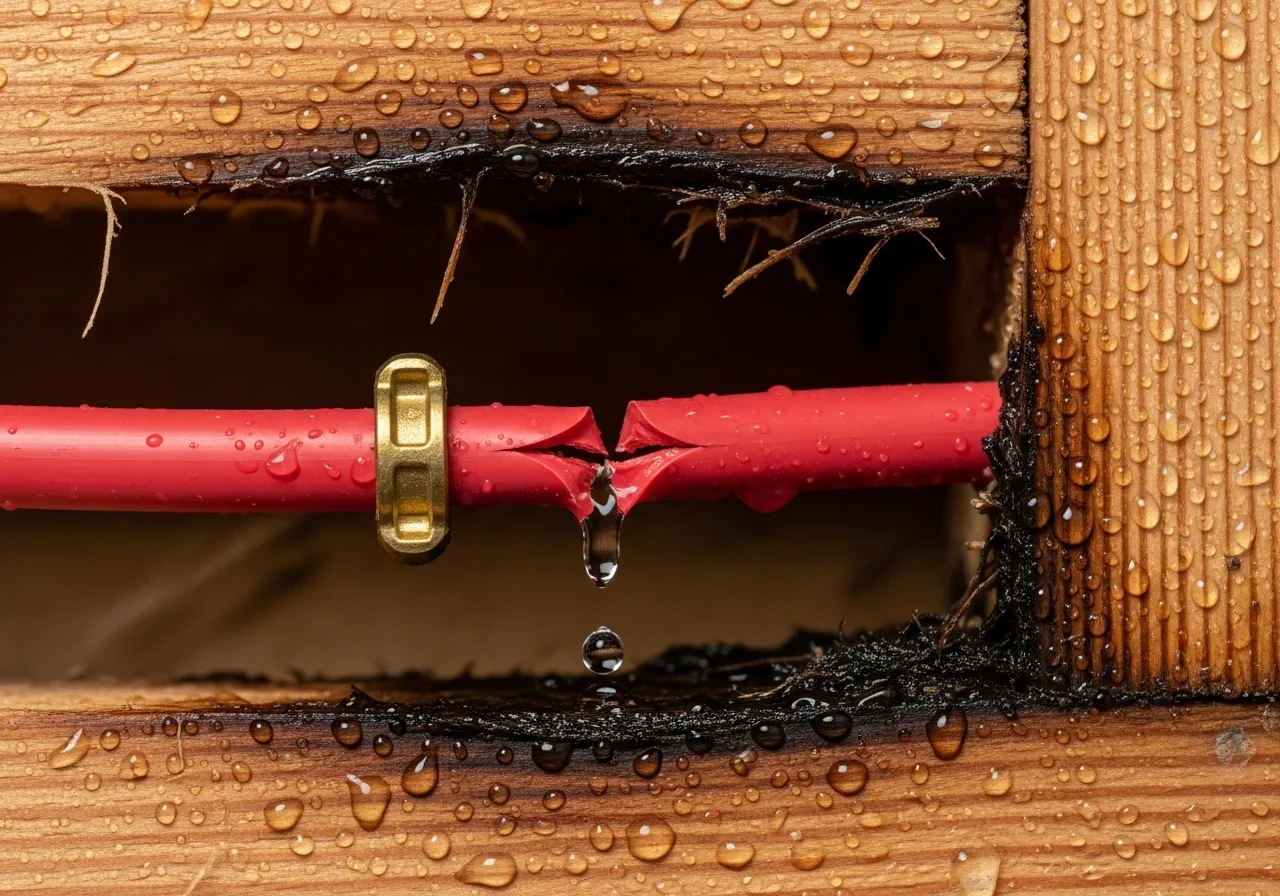
- **New construction defects** — PEX kink failures, washer supply hose ruptures, builder-grade plumbing, undersized traps
- **Master-planned communities** — Sun City Carolina Lakes (Del Webb 55+), Walnut Creek, Bridgemill, Edgewater, The Palisades, Riverchase Estates, Doby's Bridge
- **Piedmont red clay** — 55% moisture capacity by volume, poor infiltration, foundation perimeter saturation after extreme rain
- **No state mold remediator license in SC** — IICRC S520 certification is the only credential you can verify
The Cross-Border Reality: Why Most Charlotte Restoration Companies Can't Legally Work in Indian Land
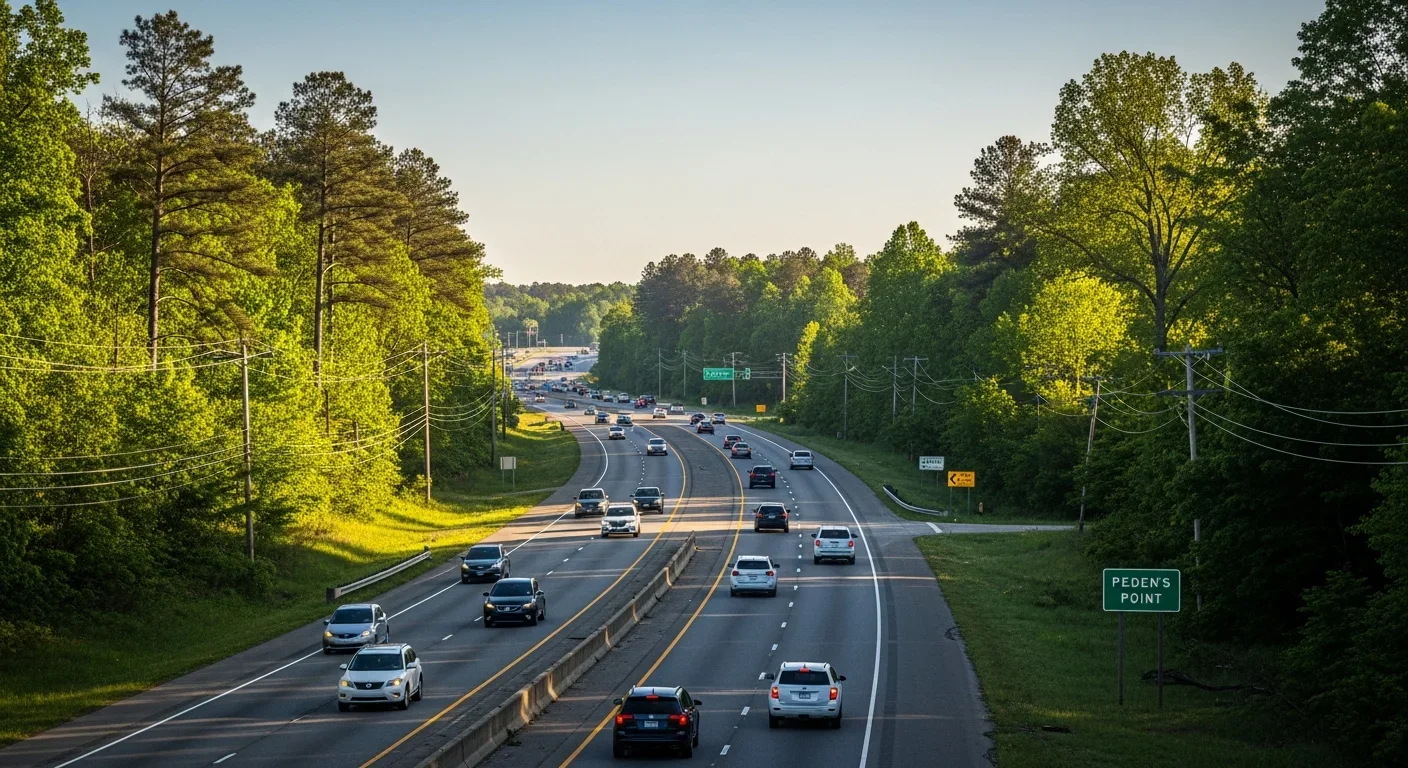
Indian Land sits on US-521 about two miles south of the SC/NC state line. From the driver's seat, the transition from Charlotte suburbs into Lancaster County is invisible — same shopping centers, same housing styles, same commuter culture. From the contractor-licensing perspective, the transition is a concrete wall. South Carolina's Department of Labor, Licensing, and Regulation (SC LLR) requires mandatory contractor licensing for all residential restoration work performed in the state. A North Carolina general contractor license does not carry over. A North Carolina IICRC certification is portable — the technical credentials travel — but the business license is not. A company operating from a Charlotte zip code that does not also hold an SC LLR license and maintains its Lancaster County compliance cannot legally quote, scope, or perform your water damage restoration project, regardless of how fast they answer the phone.
"All residential general contractors performing work in South Carolina valued over $5,000 are required to hold a current SC LLR residential builders license or residential specialty contractor license. Work performed by unlicensed contractors is not only a violation of state law but may jeopardize the homeowner's insurance claim and contractual protections."
How to Verify SC Contractor Licensing in 30 Seconds
The SC LLR public license lookup is free, fast, and the single most valuable 30-second investment you can make before authorizing any restoration work on your Indian Land home. Here's the exact sequence — you can do this from your phone while the dehumidifiers are humming in the background.
- 1
Navigate to llr.sc.gov
The South Carolina Department of Labor, Licensing, and Regulation public portal. From the home page, find the 'License Lookup' or 'Licensee Lookup' link — usually in the main navigation.
- 2
Select Residential Builders Commission
From the dropdown of licensing boards, choose Residential Builders Commission. This is the board that governs general residential restoration contractors in South Carolina.
- 3
Search by company name or license number
Enter the company name exactly as it appears on their quote or marketing materials. If the contractor gave you a license number, enter that instead — it's the fastest match.
- 4
Verify the license is ACTIVE
The lookup result shows license status. It must say 'Active' — not 'Expired,' not 'Suspended,' not 'Delinquent.' Any other status means the contractor cannot legally work on your home.
- 5
Check the license classification
Residential Builders License covers general restoration. Residential Specialty Contractor may cover specific trades. Make sure the classification matches the scope of work you need — a roofing-only license doesn't cover water damage mitigation.
- 6
Screenshot the result and keep it with your claim file
Save the LLR lookup result alongside your insurance documentation. If the claim is ever disputed, proof that you verified the license on the date of authorization is a material fact that protects you.
Indian Land Water Risk: Three Distinct Profiles
Water damage in Indian Land falls into three distinct risk categories based on housing era and subdivision geography. New-construction supply line failures dominate the 2010–2019 cohort, which is the largest housing bucket in the city. Catawba River watershed flooding concentrates along the western edge of the Indian Land service area. And retention pond failures — the quiet risk that master-planned communities introduce — cluster in the 2000s-era gated subdivisions. Each profile has its own failure mode and its own IICRC S500 category treatment.
The reason the housing-era signal matters so much in Indian Land is that the 2010s cohort was built during a construction labor crunch that followed the Great Recession recovery. Builders rushed, inspections were variable, and supply chains pushed PEX plumbing, engineered wood, and builder-grade fixtures into homes that should have had longer service lives. A decade and a half later, those shortcuts are failing in predictable places — first the washer hoses, then the icemaker lines, then the PEX fittings under bathroom vanities. If your Indian Land home was built between 2010 and 2019 and you haven't replaced the original appliance supply hoses, you are statistically overdue.
Sun City Carolina Lakes: 55+ lakefront risk
Sun City Carolina Lakes is Del Webb's Indian Land active adult community, built starting in the mid-2000s around a network of community lakes and walking trails. The risk profile is specific: a 55+ demographic with slower response time to overnight supply-line failures, common-area stormwater drainage that backs up during heavy rain, and a housing stock that is just now crossing the 15-year mark where original appliance supply lines start failing in clusters. The typical Sun City claim is a washer or icemaker line that lets go during the night and runs for six or eight hours before anyone notices.
Walnut Creek, Bridgemill, Edgewater: retention pond failures
The 2000s–2010s master-planned communities in Walnut Creek, Bridgemill and Edgewater rely on retention ponds to manage stormwater runoff during intense rain events. During normal storms, the system works fine. During the multi-day tropical remnant events that increasingly characterize Piedmont summers — Debby 2024, Helene 2024 — the retention systems overflow, drainage ditches back up, and foundation perimeters get saturated. This is the mechanism that creates crawl space seepage and low-point basement flooding in homes that are nominally 'not in a flood zone.' Homeowners are genuinely surprised. The engineering wasn't designed for the intensity we're seeing now.
The Palisades & Riverchase Estates: Catawba River corridor
The western edge of Indian Land's service area — The Palisades along the Lake Wylie corridor and Riverchase Estates with its large wooded homesites — adds a fourth risk to the mix: Catawba River watershed flooding. Duke Energy manages the Catawba hydroelectric dam system, and controlled releases during synchronized rain events can create rapid water level fluctuations downstream. Hurricane Helene in September 2024 caused controlled releases that raised water levels four to five feet in parts of the corridor and flooded homes along Mountain Island Lake and Lake Wylie. Riverchase Estates' wooded homesites are beautiful — and they're also pathways for wind-driven rain through the tree canopy onto roofs and into foundations.
IICRC S500 Water Categories: What Determines Your Scope
The IICRC S500 standard defines three categories of water damage based on the source of the water and its contamination level. The category — not the square footage, not the visible volume — drives the restoration protocol. Understanding the difference is how you interview a prospective contractor and separate the licensed professionals from the unlicensed operators. Category designation is not a marketing term; it is a protocol gate that dictates PPE, drying equipment, disposal stream, and whether porous materials must be demolished.
| IICRC Category | Source | Typical Indian Land examples | Scope |
|---|---|---|---|
| Category 1 | Clean potable water | Supply line failure, washer hose, icemaker line, water heater tank rupture | Dry in place, salvage most porous materials, minimal demolition |
| Category 2 | Gray water with contaminants | Dishwasher discharge, aquarium overflow, long-dwell Category 1 (>48 hours) | Demolish saturated porous materials, antimicrobial, moderate drying |
| Category 3 | Black water — sewage, floodwater, Catawba overflow | Sewer backup, toilet supply flush, creek flooding, retention pond overflow | Full demolition of porous materials, hazmat protocol, structural drying |
Your category changes with time: a Category 1 event that sits for more than 48 hours becomes Category 2. A Category 2 that sits for more than 72 hours becomes Category 3. Speed matters more than visible volume.
The First 48 Hours: An Emergency Response Timeline
Water damage restoration is a race against mold. IICRC S500 and CDC indoor air quality guidance both agree that mold amplification begins within 24 to 48 hours of sustained moisture on porous building materials. In Indian Land's humid subtropical climate, the clock runs faster — especially during the May through September window when ambient humidity hovers above 70%. Here is the sequence a competent crew follows when the phone rings.
Hour 0–1
Source control and safety
The first step is always to stop the water. Main shutoff, supply line shutoff, pump-out from standing water. The crew documents the source, photographs everything, and verifies electrical safety before starting extraction.
Hour 1–4
Water extraction and content protection
Truck-mounted or portable extractors pull standing water out of carpet pad, subfloor, and wall cavities. Contents are lifted onto blocks, moved to unaffected rooms, or pack-outed to climate-controlled storage.
Hour 4–12
Category determination and scope drafting
A certified technician determines IICRC S500 category based on source and duration. The scope becomes a written document that the insurance adjuster can review.
Hour 12–24
Structural drying equipment deployment
Commercial dehumidifiers and air movers are positioned based on a drying plan. Moisture readings on wood framing, drywall and subfloor establish baseline measurements.
Hour 24–48
Mold growth threshold — critical decision point
At the 48-hour mark, any porous material still above mold-growth moisture content has to be demolished, not dried. This is where Category 1 projects become Category 2 if response was delayed — and where cheap operators pretend it's still salvageable.
Day 3–7
Controlled drying to spec
Daily moisture readings track progress against IICRC S500 drying targets. Commercial dehumidifiers maintain indoor humidity below 50%. When all materials read below the mold-growth threshold for a consecutive 48-hour period, drying is complete.
Day 7+
Final documentation and handoff
Pre- and post-drying photos, moisture logs, scope of work, and invoices are compiled into a claim package for the SC LLR-licensed contractor's submission to the carrier. This documentation is what keeps the claim paid at full scope.
South Carolina Insurance & Licensing: A Glossary
- SC LLR
- South Carolina Department of Labor, Licensing, and Regulation. Administers the Residential Builders Commission, which licenses all residential contractors performing work valued over $5,000 in the state. Verification at llr.sc.gov.
- Residential Builders License
- The SC LLR license category required for general residential restoration work. Carries specific bonding, insurance, and continuing education requirements.
- Residential Specialty Contractor License
- SC LLR license for specific trades (plumbing, electrical, HVAC, etc.) performed inside residential restoration projects. Restoration companies often hold both the general builders license and one or more specialty licenses.
- IICRC S500
- The Institute of Inspection, Cleaning and Restoration Certification standard for professional water damage restoration. Defines Categories 1, 2, and 3 and the corresponding drying, demolition, and containment protocols.
- IICRC WRT / ASD
- Water Restoration Technician and Applied Structural Drying certifications. The portable technical credentials that a restoration technician carries regardless of which state they work in.
- SC mold licensing (none)
- South Carolina does not license mold remediators statewide. SC House Bill 3203 proposed a voluntary framework, but as of early 2026 it remains in committee. IICRC S520 is the only credential a homeowner can verify.
- Lancaster County Building Services
- The county department that issues building permits, performs inspections, and manages floodplain development in unincorporated Indian Land. Permit requirements vary by renovation type and dollar value.
- Catawba River / Duke Energy
- The Catawba River hydroelectric system is managed by Duke Energy. Controlled releases during synchronized rain events can raise downstream water levels rapidly — a factor in Helene 2024 flooding along Mountain Island Lake and Lake Wylie.
What a legitimate SC-licensed restoration company provides
- Current SC LLR Residential Builders license verifiable at llr.sc.gov
- IICRC WRT and ASD certifications for assigned technicians in writing
- Written IICRC S500 category determination before scope is finalized
- Daily moisture readings and drying logs maintained through completion
- Documentation package supporting the homeowner's insurance claim
- Direct coordination with Lancaster County Building Services on permit-triggering work
- Post-drying verification of structural moisture content below mold-growth threshold
What an unlicensed Charlotte operator provides
- A phone quote over the phone with no SC license verification offered
- Generic 'we handle water damage' marketing with no S500 category language
- A single dehumidifier running for two days without moisture logs
- No written scope, no daily readings, no clearance confirmation
- An invoice with minimal documentation your carrier will not accept
- No permit coordination — and no legal authority to pull a permit in Lancaster County
- Potentially voided insurance claim if the adjuster discovers unlicensed work
Your Indian Land Water Damage Checklist
- Verify SC LLR Residential Builders license number at llr.sc.gov before accepting any restoration quote. This takes 30 seconds and eliminates the biggest claim risk in Indian Land.
- Shut off the main water supply the moment you notice a leak. Every hour the source runs, your category creeps up and your scope expands.
- Photograph everything — source, damage, contents, structure — before any cleanup begins. Documentation is how you keep a claim at full scope.
- Turn off the HVAC system until a technician has verified the ductwork was not affected. Running HVAC during a water event distributes moisture through otherwise dry parts of the house.
- Pull your FEMA flood zone at msc.fema.gov for your specific address. Lancaster County properties near Sugar Creek, Twelve Mile Creek, Long Branch or the Catawba River may have SFHA designation you did not know about.
- Notify your HOA property manager if you live in Sun City, Walnut Creek, Bridgemill, The Palisades, Riverchase Estates or similar — some HOAs require board approval for any exterior-visible work.
- Do not sign a contractor contract before verifying the license and IICRC certifications in writing.
- Call the local NC line for SC-licensed emergency response — 24/7 deployment across the Charlotte metro including Indian Land, Fort Mill, Rock Hill and Lake Wylie.
Frequently Asked Questions
Is my Indian Land home in a FEMA flood zone, and do I need flood insurance? +
Why can't a Charlotte water damage company legally work on my Indian Land home? +
What does IICRC S500 Category 1 versus Category 2 versus Category 3 mean, and why does it matter? +
My washing machine supply line failed — is this a homeowners insurance claim? +
How long does water damage restoration take in Indian Land? +
Does my homeowners insurance cover mold remediation after water damage in Indian Land? +
Do I need a Lancaster County permit to repair water damage? +
Indian Land SC Water Restoration
Our dedicated Indian Land water damage restoration pillar page with SC LLR license info, service area detail, and 24/7 emergency response.
Indian Land SC Mold Remediation
Post-water-damage mold remediation for Indian Land's humid Piedmont climate.
Fort Mill SC — Water Damage & Crawl Space Guide
Sibling Charlotte-metro SC blog — the companion Piedmont cross-border water damage guide for Fort Mill.
Rock Hill SC — Fire & Smoke Odor Removal Guide
Sibling SC blog — the same SC LLR licensing reality applied to fire & smoke work in Rock Hill.
Water Damage Categories and Classes Explained
The site-wide IICRC S500 pillar blog with 13,000+ monthly impressions — the authoritative category reference.
Charlotte NC — Emergency Water Damage Neighborhood Guide
The NC-side sibling blog — same metro, different state, different licensing reality.
Indian Land Water Damage Emergency? Call the Line That's Licensed On Both Sides of the Border
Palm Build Restoration holds both North Carolina and South Carolina contractor licenses and runs 24/7 emergency response across Indian Land, Fort Mill, Rock Hill, Lake Wylie and the full Charlotte metro. IICRC S500-certified, SC LLR compliant, Lancaster County coordinated. Visit the Indian Land water restoration pillar page or call the local line now.
Found this helpful? Send it to someone who needs it.