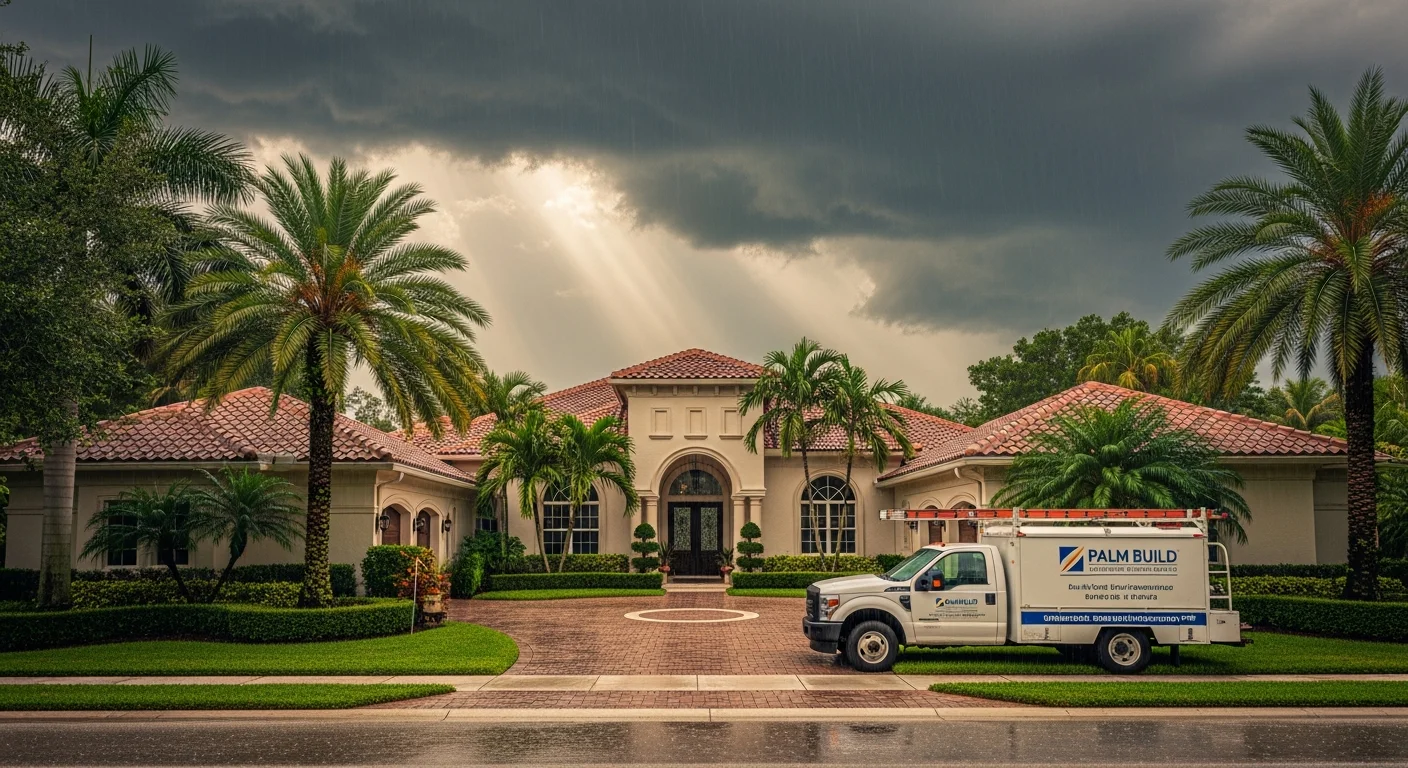
From Olympia's lakefront estates to Sugar Pond Manor's 1980s homes, Palm Build's South Florida team responds fast with truck-mounted extraction, commercial drying, and the insurance documentation Florida carriers demand — because in Wellington's 61 inches of annual rainfall, mold starts in 24 hours.
40 miles — Deerfield Beach, FL 45-60 min Response IICRC Certified
Why Wellington Faces Unique Water Damage Challenges
Wellington's affluent planned communities, equestrian estates, and aging CBS housing stock
create a convergence of water damage risks that require specialized knowledge to address.
Understanding these factors is the first step toward protecting your property.
61.75 in
Annual rainfall
Subtropical Rainfall Intensity
Wellington receives over 61 inches of rain annually, with June through September concentrating 65%+ of that total into daily afternoon thunderstorms. Combined with ambient humidity regularly exceeding 75%, every structure in the village faces relentless moisture exposure — particularly CBS homes where block cavities trap condensation invisible from either side of the wall.
30–45 yrs
Oldest homes aging
1980–2009 CBS Housing Stock
Wellington's housing stock was built primarily between 1980 and 2009 — CBS (concrete block structure) slab-on-grade construction with stucco exteriors and tile roofs. Homes from the 1980s and 1990s are now well past the point where stucco sealant fails, roof underlayment deteriorates, and original plumbing connections fatigue. Each failure point becomes a hidden water entry path.
$599K
Median home value
Equestrian Estate Complexity
Wellington is internationally recognized for its equestrian facilities. Estate properties with barns, wash stalls, riding arenas, and extensive irrigation have water systems far more complex than standard residential homes. Supply line runs to barns, outdoor wash station plumbing, and irrigation controllers that run overnight create water damage scenarios that standard restoration companies aren't equipped to handle.
24–48 hrs
Mold colonization
Year-Round Mold Risk
Wellington's combination of 80°F+ temperatures and 75%+ humidity during wet season creates ideal mold colonization conditions. After any water intrusion event, mold growth begins within 24-48 hours — behind drywall, under baseboards, and inside CBS block cavities where it spreads undetected for weeks. Fast extraction and professional drying are the only defense.
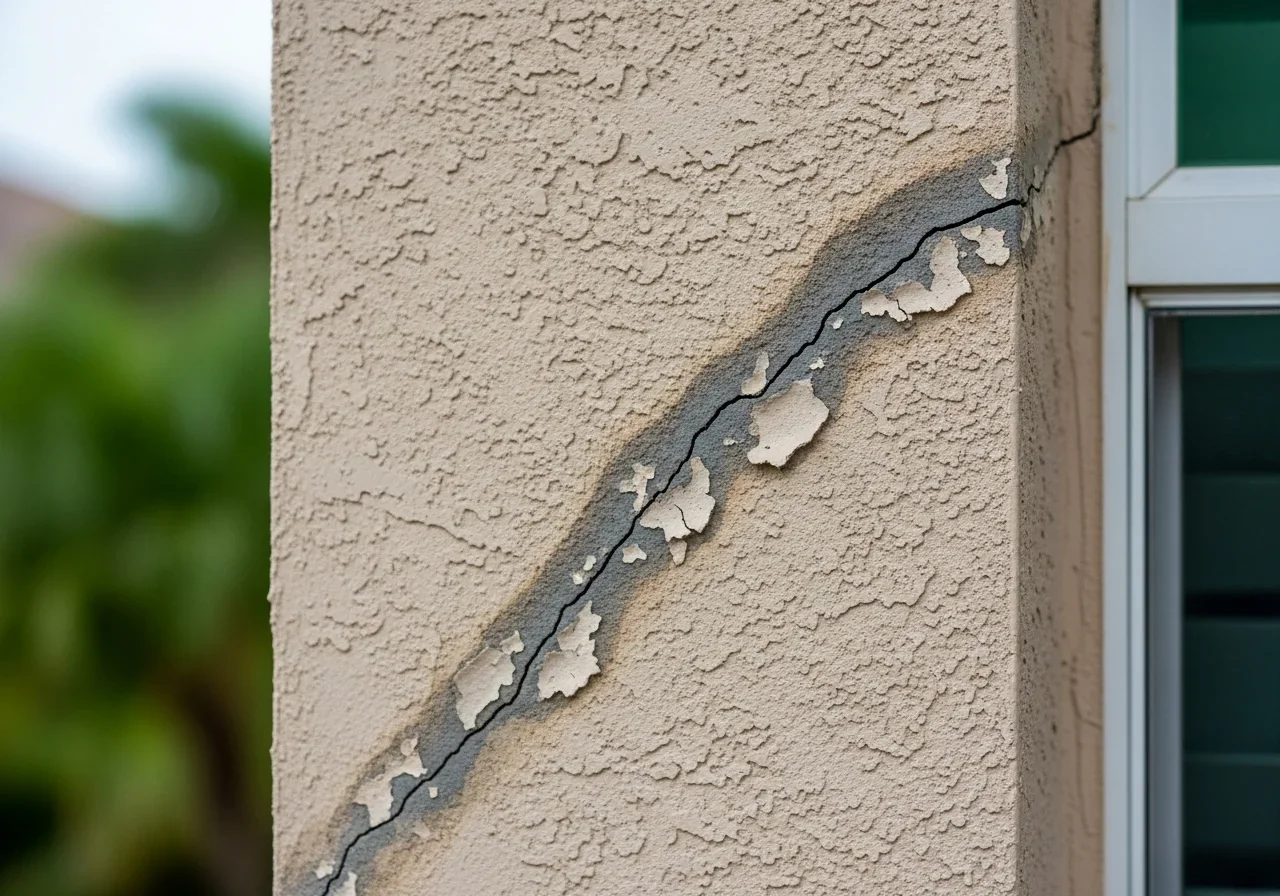
Stucco cracks around windows in Wellington's CBS homes are invisible water entry points
— damage often isn't discovered until mold appears inside the wall cavity.
Neighborhood Risk Assessment
Wellington Community-by-Community Risk Guide
Every Wellington community has its own construction era, building type, and drainage
exposure — all of which determine your specific water damage vulnerabilities.
Community
Era
Construction
Key Risks
Level
Olympia
2001–2006
CBS/Stucco, SFH
Lakefront wind-driven rain, premium finish damage, second-story-to-first-story water migration, supply line failures behind dual-sink vanities
high
VillageWalk
2003–2005
CBS, TH/Attached
Shared wall water migration, HOA coordination delays, appliance supply line bursts in utility areas, high-density plumbing failures
Oldest housing stock in Wellington, cast iron drain failures, tile roof end-of-life leaks, AC condensate overflow in original air handler closets
Binks Forest
medium
2004–2007CBS/Stucco, Estate
Multi-valley tile roof leak points, second-floor bathroom failures, extensive irrigation supply line runs, complex roof systems
Aero Club
medium
1990s–2000sCBS/Stucco, SFH
Long plumbing runs to detached structures, irrigation system failures, pool equipment room flooding, airport-adjacent larger lots
Palm Beach Polo
high
1985–1995CBS/Stucco, Estate
Barn supply line failures, wash stall drainage issues, 30+ year stucco and roof systems, extensive irrigation water events
The Isles / Wellington Shores
high
1980s–2000sCBS/Stucco, SFH
Canal-adjacent lake systems, slab-edge water intrusion during heavy rain, aging CBS with original stucco, cast iron drain deterioration
Don't see your community? Call (754) 600-3369 and our local team can assess your specific property risks. We service all of Wellington and
surrounding Palm Beach County communities.
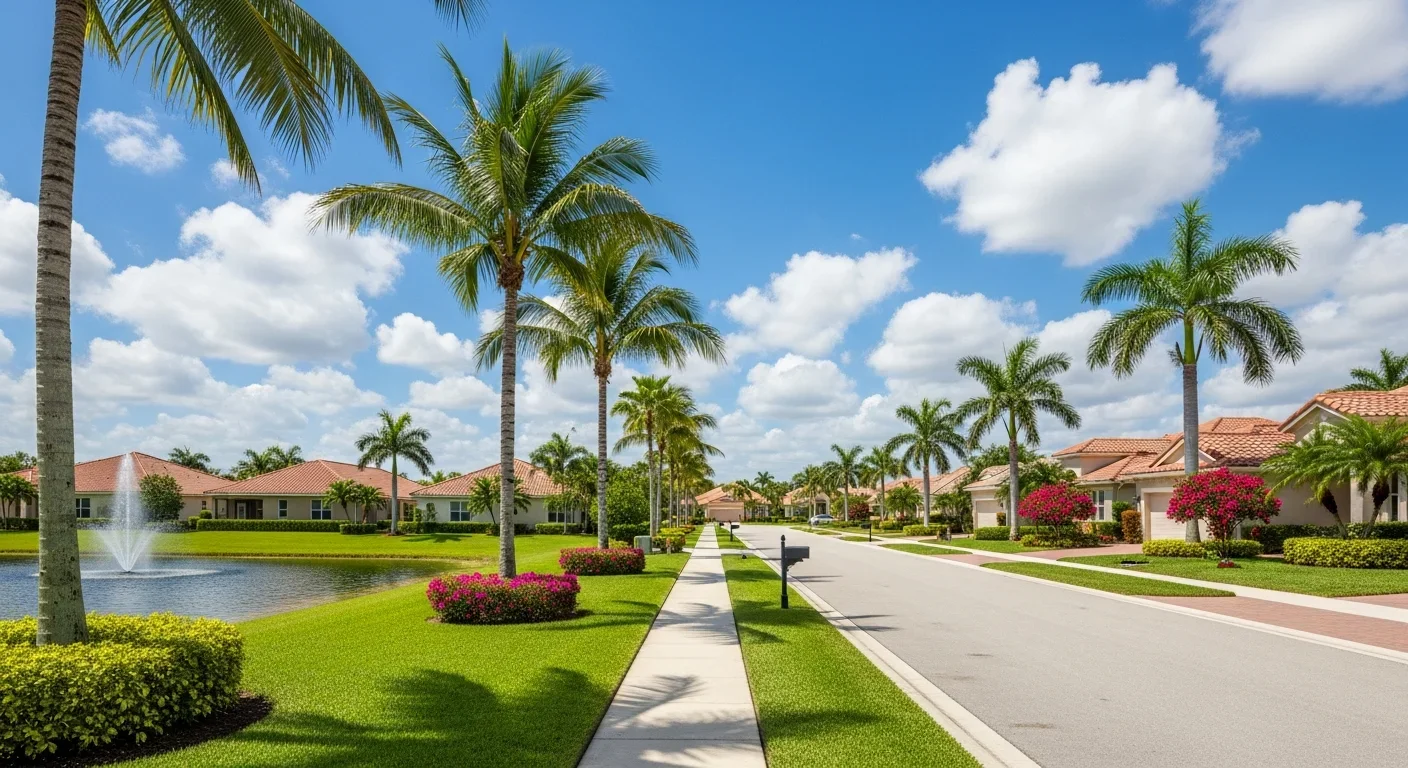
Olympia is Wellington's largest master-planned community — lakefront lots and premium
finishes mean water damage restoration stakes are high in this 2000s-era development.
Our Process
6 Steps to Restore Your Wellington Property
Every water damage event in Wellington follows a proven restoration sequence — adapted for
CBS slab-on-grade construction, equestrian estates, and South Florida's extreme humidity.
All work complies with Fla. Stat. 627.70132 documentation requirements.
Step 01
Emergency Dispatch
45–60 Minutes
Your call reaches our South Florida team 24/7/365. We dispatch a fully equipped truck to Wellington — carrying truck-mounted extractors, commercial dehumidifiers, air movers, and thermal imaging cameras. Response time to Wellington averages 45-60 minutes from our Deerfield Beach operations hub. For equestrian properties, we dispatch additional equipment for barn and outbuilding water events.
Step 02
Assessment & Documentation
Hours 1–3
Using infrared thermal imaging and pin-type moisture meters, we map every affected surface in your Wellington home — behind stucco walls, under tile and hardwood on slab foundations, and through ceilings between floors. In Wellington's estate homes with premium finishes, this moisture map becomes the foundation of your insurance claim and guides targeted extraction to preserve salvageable materials.
Step 03
Water Extraction
Hours 1–6
Truck-mounted extraction removes standing water down to the slab. For Wellington's high-value homes with hardwood floors, natural stone, and custom cabinetry, we use targeted extraction techniques that minimize secondary damage to materials that can potentially be saved — saving homeowners thousands in replacement costs. Equestrian properties may require multi-structure extraction.
Step 04
Structural Drying
3–5 Days
Commercial LGR dehumidifiers pulling 15-30 gallons per day and high-velocity air movers create controlled drying conditions. In Wellington's 75%+ ambient humidity during wet season, natural drying is impossible — professional equipment is the only path to reaching IICRC S500 target moisture levels in CBS wall cavities and slab-on-grade foundations.
Step 05
Mold Prevention
Days 3–7
EPA-registered antimicrobial treatment on all affected surfaces prevents mold colonization during the drying process. In Wellington's subtropical climate, mold begins growing within 24-48 hours of water exposure. We treat every affected cavity, surface, and structural member. If pre-existing mold is discovered, we recommend a separate mold remediation scope.
Step 06
Restoration & Reconstruction
Days 7–21+
Once moisture readings confirm dry conditions, we rebuild — matching your home's existing finishes. Wellington homes with hardwood, marble, and custom cabinetry require careful material matching. All reconstruction requiring permits goes through Wellington's Building Department via ProjectDox. HOA architectural review boards in Olympia, Binks Forest, and other managed communities have specific requirements we manage end-to-end. FL Statute 627.70132 sets a 1-year claim deadline — we ensure all documentation meets this timeline.
Step 0145–60 Minutes
Emergency Dispatch
Your call reaches our South Florida team 24/7/365. We dispatch a fully equipped truck to Wellington — carrying truck-mounted extractors, commercial dehumidifiers, air movers, and thermal imaging cameras. Response time to Wellington averages 45-60 minutes from our Deerfield Beach operations hub. For equestrian properties, we dispatch additional equipment for barn and outbuilding water events.
Step 02Hours 1–3
Assessment & Documentation
Using infrared thermal imaging and pin-type moisture meters, we map every affected surface in your Wellington home — behind stucco walls, under tile and hardwood on slab foundations, and through ceilings between floors. In Wellington's estate homes with premium finishes, this moisture map becomes the foundation of your insurance claim and guides targeted extraction to preserve salvageable materials.
Step 03Hours 1–6
Water Extraction
Truck-mounted extraction removes standing water down to the slab. For Wellington's high-value homes with hardwood floors, natural stone, and custom cabinetry, we use targeted extraction techniques that minimize secondary damage to materials that can potentially be saved — saving homeowners thousands in replacement costs. Equestrian properties may require multi-structure extraction.
Step 043–5 Days
Structural Drying
Commercial LGR dehumidifiers pulling 15-30 gallons per day and high-velocity air movers create controlled drying conditions. In Wellington's 75%+ ambient humidity during wet season, natural drying is impossible — professional equipment is the only path to reaching IICRC S500 target moisture levels in CBS wall cavities and slab-on-grade foundations.
Step 05Days 3–7
Mold Prevention
EPA-registered antimicrobial treatment on all affected surfaces prevents mold colonization during the drying process. In Wellington's subtropical climate, mold begins growing within 24-48 hours of water exposure. We treat every affected cavity, surface, and structural member. If pre-existing mold is discovered, we recommend a separate mold remediation scope.
Step 06Days 7–21+
Restoration & Reconstruction
Once moisture readings confirm dry conditions, we rebuild — matching your home's existing finishes. Wellington homes with hardwood, marble, and custom cabinetry require careful material matching. All reconstruction requiring permits goes through Wellington's Building Department via ProjectDox. HOA architectural review boards in Olympia, Binks Forest, and other managed communities have specific requirements we manage end-to-end. FL Statute 627.70132 sets a 1-year claim deadline — we ensure all documentation meets this timeline.
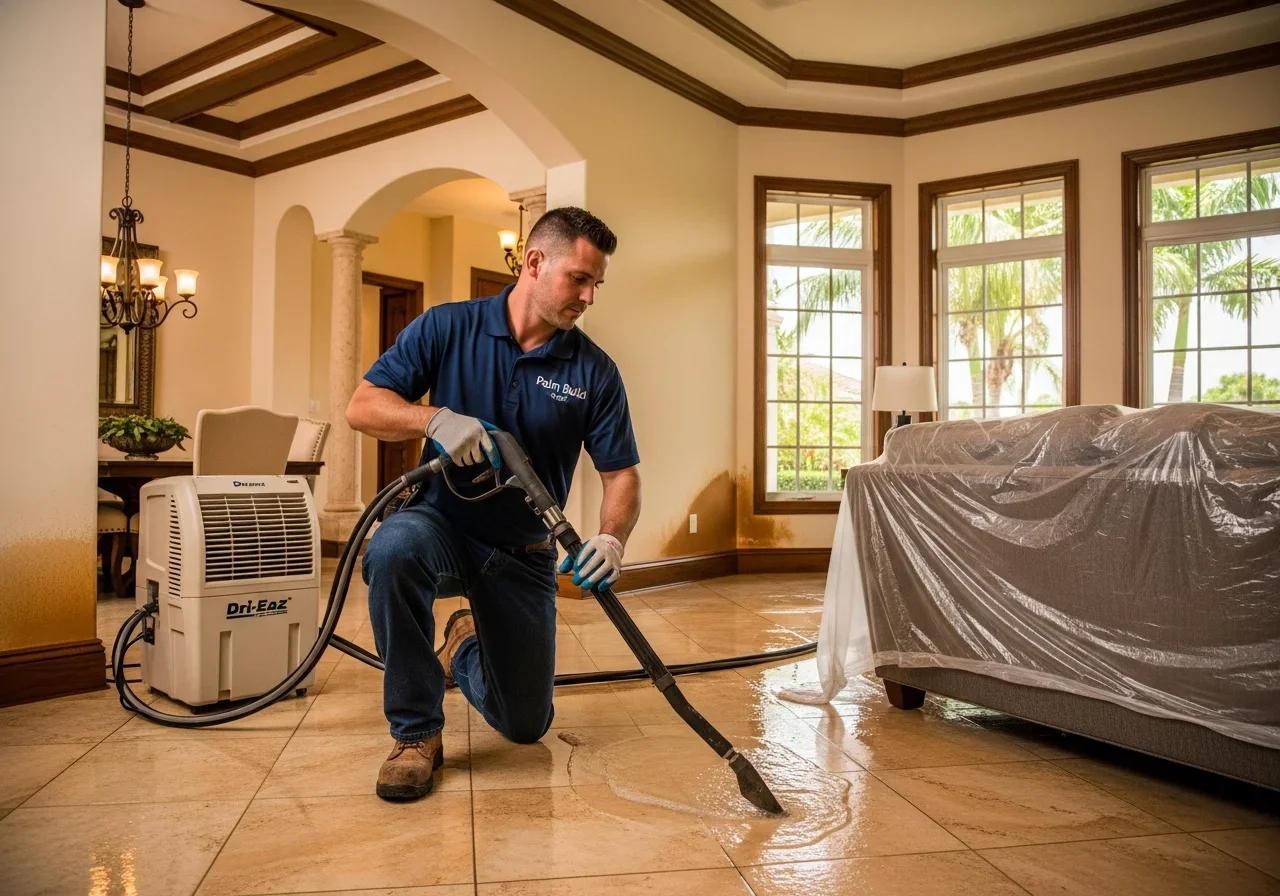
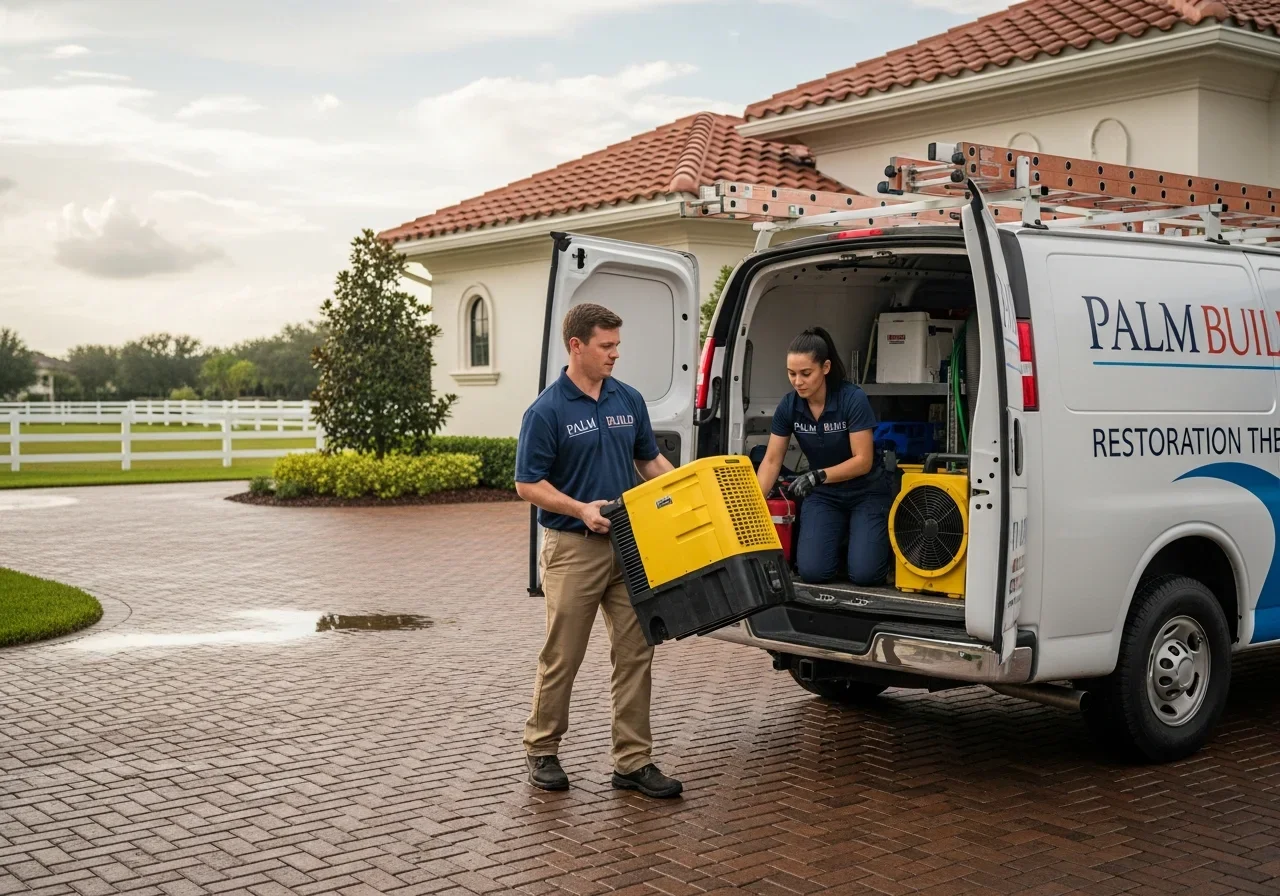
Palm Build's restoration team deploying truck-mounted extraction in a Wellington home —
fast water removal is critical in South Florida's humidity to prevent mold colonization
within 24-48 hours.
Cost Transparency
Water Damage Restoration Costs in Wellington
Restoration costs in Wellington reflect the village's high-value housing stock and premium
finishes. Homes with hardwood floors, natural stone, and custom cabinetry cost more to
restore because materials must be matched to pre-loss condition. Equestrian properties add
additional scope.
Standard Residential
$8,500 – $27,500 typical range
Emergency Extraction
Burst pipe, appliance leak, or HVAC condensate overflow
$1,500 – $4,500
Structural Drying (3–5 Days)
LGR dehumidifiers and air movers, daily moisture monitoring
Second-floor-to-first-floor damage in two-story Wellington homes
$6,000 – $22,000
Premium Finish Restoration
Hardwood, marble, custom cabinetry matching to pre-loss condition
$5,000 – $25,000
Equestrian Structure Damage
Barn supply line failures, wash stalls, multi-structure events
$3,000 – $12,000
Cost per Square Foot by Water Category
Category 1 (Clean Water)
$3.50 – $4.50/sq ft
Supply line burst, AC condensate overflow
Category 2 (Gray Water)
$4.50 – $6.00/sq ft
Appliance discharge, washing machine overflow
Category 3 (Black Water)
$6.00 – $7.50/sq ft
Sewage backup, storm flooding
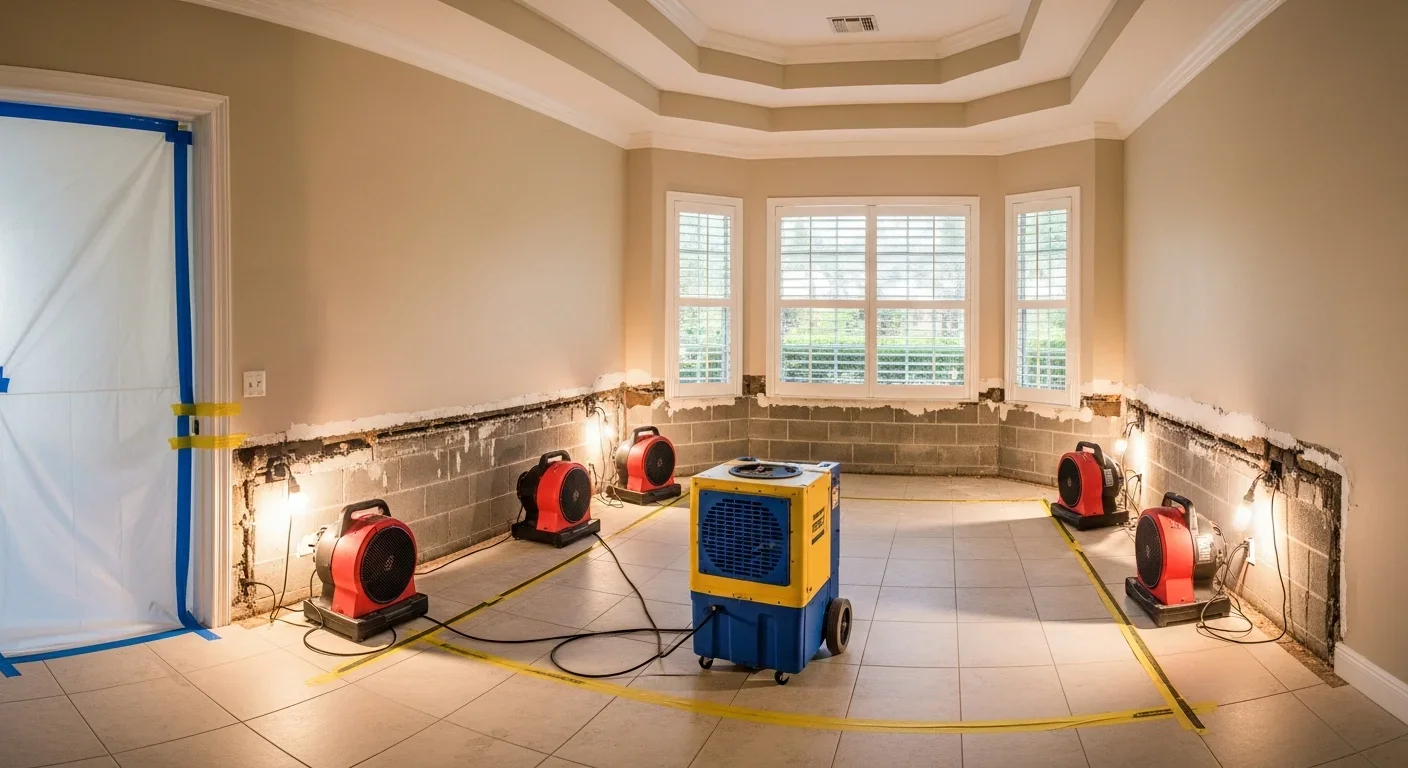
Structural drying in a Wellington master bedroom — Wellington's premium finishes
(hardwood, natural stone, custom cabinetry) drive higher material matching costs.
Most homeowner insurance policies cover professional water damage restoration.
Palm Build documents every step in Xactimate format — giving your insurance carrier
exactly what they need to process your claim. Call (754) 600-3369 for a free assessment.
When Damage Strikes
Wellington Seasonal Water Damage Calendar
Understanding when your Wellington property is most vulnerable helps you prepare — and
respond faster when damage occurs. This calendar reflects NOAA climate data and Palm
Build's actual service call patterns in western Palm Beach County.
Wellington's equestrian season peaks in spring. As temperatures climb, HVAC systems run harder. AC condensate drain line clogs are a leading cause of sudden water damage — the air handler is typically in a closet or garage, and a clogged line sends water into ceilings and walls. Equestrian properties see increased irrigation usage as arenas and paddocks need watering.
Wet Season: Daily Thunderstorms
high risk
Jun – Jul
June and July bring daily afternoon thunderstorms with intense short-duration rainfall. Wellington averages over 9 inches of rain in June alone. These storms test every roof tile, window flashing joint, and stucco sealant line. The Acme drainage system processes heavy volumes through its 2,000+ catch basins and 9 pump stations.
Peak Hurricane & Rainfall
high risk
Aug – Sep
August and September are peak hurricane risk months. Wellington's 2022 experience with Hurricane Ian and Hurricane Nicole — back-to-back storms within weeks — demonstrated compounding damage. The Acme drainage system is under maximum stress. Power outages disable HVAC dehumidification, allowing humidity to saturate building materials unchecked.
Late Storm Season & Mold Discovery
moderate risk
Oct – Nov
Hurricane Milton's EF3 tornado in October 2024 proved late-season storms can be devastating. Post-storm mold is typically discovered 2-4 weeks after water events — October and November are when Wellington homeowners discover damage from peak season. Seasonal residents departing after equestrian season may not discover damage for months.
Dry Season & Winter Visitors
low risk
Dec – Feb
Lower humidity reduces mold risk. Wellington's seasonal residents return for polo season, reactivating homes that may have had slow leaks developing unoccupied. NFPA data shows December among leading months for home fires — holiday cooking and heating events include water damage from suppression. Dry season reveals roof and stucco failures masked during active rain.
June through November accounts for 70%+ of Palm Build's Wellington emergency calls.
Don't wait for the storm — call (754) 600-3369 to schedule a pre-season inspection.
Local Infrastructure
Wellington's Acme Drainage District: Why Flooding Happens Here
Wellington's water management infrastructure is unlike any other community in Palm Beach
County. The Acme Improvement District — the village's special taxing district — manages
an extensive drainage network designed to move water from Wellington's low-lying
interior westward to the county's C-51 canal and ultimately to tidewater.
The system works well under normal conditions. But during multi-hour downpours, the
volume of water can exceed the system's capacity. When the detention lake reaches
capacity and pump stations are running at maximum output, water backs up through the
catch basin network. Streets flood first, then water moves toward homes at the lowest
points in each neighborhood.
2,000+ Catch Basins
Wellington's Acme Improvement District operates over 2,000 catch basins throughout the village — the intake points where stormwater enters the underground conveyance system. During intense rainfall, these basins process enormous volumes. When the downstream system reaches capacity, water backs up through the basins and onto streets and properties at the lowest elevations.
91 Miles of Canals
The Acme district manages 91 miles of conveyance and treatment canals that move stormwater from Wellington's interior westward to the county's C-51 canal and ultimately to tidewater. Canal-adjacent properties in communities like Wellington Shores, Stonegate, and Palm Beach Polo see elevated water levels during sustained rain events — preventing yard drainage from flowing outward and creating reverse-flow conditions.
9 Stormwater Pump Stations
Nine pump stations supplement gravity flow throughout the drainage network. When rainfall exceeds the system's gravity capacity, these stations activate to move water through the canal network. During multi-hour downpours — the kind Wellington experiences regularly from June through September — all nine stations can reach maximum output. Any mechanical failure during peak demand immediately impacts surrounding neighborhoods.
270-Acre Detention Lake
The system's 270-acre detention lake serves as the primary buffer — holding excess stormwater until it can be discharged downstream. When the detention lake reaches capacity during extreme events, the entire system operates under pressure. Water backs up through every connected canal and catch basin, creating the sheet-flow flooding pattern that affects Wellington's lowest-lying areas.
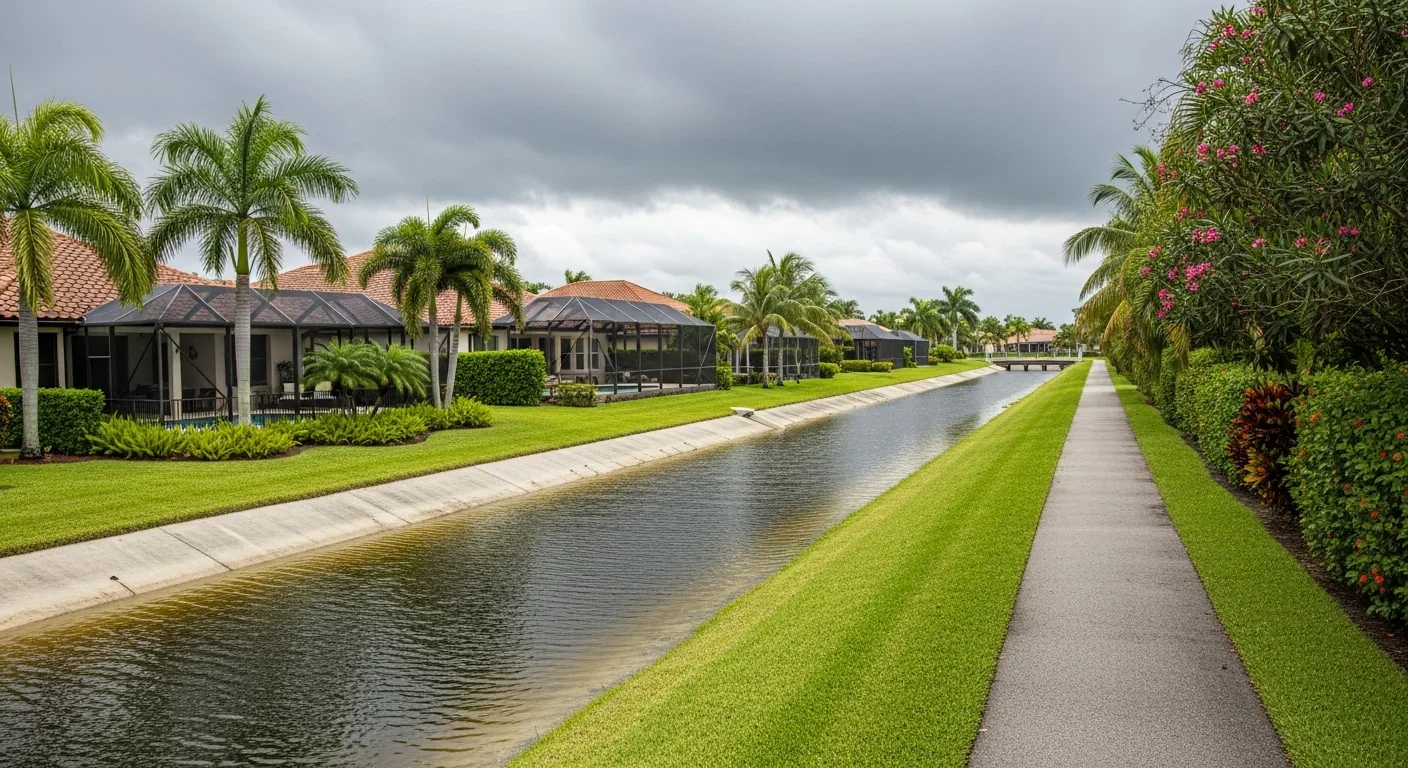
Wellington's Acme Improvement District manages 91 miles of canals — but during extreme
rainfall, the system can reach capacity and water backs up into adjacent properties.
Recent Storm Events in Wellington
Hurricane Ian (September 2022) brought tropical-storm-force winds and heavy rain.
Hurricane Nicole (November 2022) caused additional wind-driven rain intrusion just
weeks later. In October 2024, Hurricane Milton spawned an EF3 tornado that caused
significant damage in the Wellington area.
Each of these events generated water damage claims across Wellington neighborhoods and
stressed the Acme drainage system to capacity. Properties at the lowest elevations and
adjacent to canals experienced the most significant flooding.
Insurance Navigation
Navigating Water Damage Insurance in Wellington
Florida's insurance landscape is the most complex in the nation. These are the key facts
every Wellington homeowner needs to know when filing a water damage claim.
Immediate Claim Checklist
Report loss to your carrier within 24 hours
Do NOT discard damaged materials before documentation
Take photos/video of all visible damage immediately
Keep all receipts for emergency expenses (hotel, food)
Request a copy of your policy declarations page
Note your claim number and adjuster contact info
File within 1 year — Fla. Stat. 627.70132
Check if your policy has a separate flood exclusion
1-Year Filing Deadline
Florida Statute 627.70132 requires property insurance claims to be filed within 1 year of the date of loss. Supplemental claims must be filed within 18 months. Miss these deadlines and your claim is permanently barred — no exceptions.
AOB Reform (Since Jan 2023)
Florida's Assignment of Benefits reform means restoration contractors can no longer receive direct payment from your insurer. All payments flow through you — making thorough documentation and direct communication with your carrier more critical than ever.
Citizens Property Insurance
Many Wellington homeowners are insured through Citizens — Florida's insurer of last resort. Citizens claims require specific documentation formats and have stricter supplemental claim timelines. Palm Build formats all documentation to Citizens' requirements.
~$3,100 Avg Annual Premium (PBC)
Palm Beach County homeowners pay approximately $3,100 per year for property insurance — and that figure is rising. With premiums this high, proper documentation is critical to ensure your claim is processed fully and quickly. Wellington's high-value homes often carry additional coverage riders that must be properly documented.
Wellington Permitting via ProjectDox
Wellington's Building Department processes permits through the ProjectDox electronic system. Restoration work requiring permits — drywall replacement, electrical, plumbing — must go through this system. Palm Build manages the entire permitting process, including HOA architectural review submissions in communities like Olympia and Binks Forest.
Palm Build Documents From Hour One
We photograph, moisture-map, and document every affected surface before beginning work. Our Xactimate-formatted estimates match your carrier's preferred format — whether it's Citizens, Universal, Heritage, Slide, or any Florida carrier writing policies in Palm Beach County.
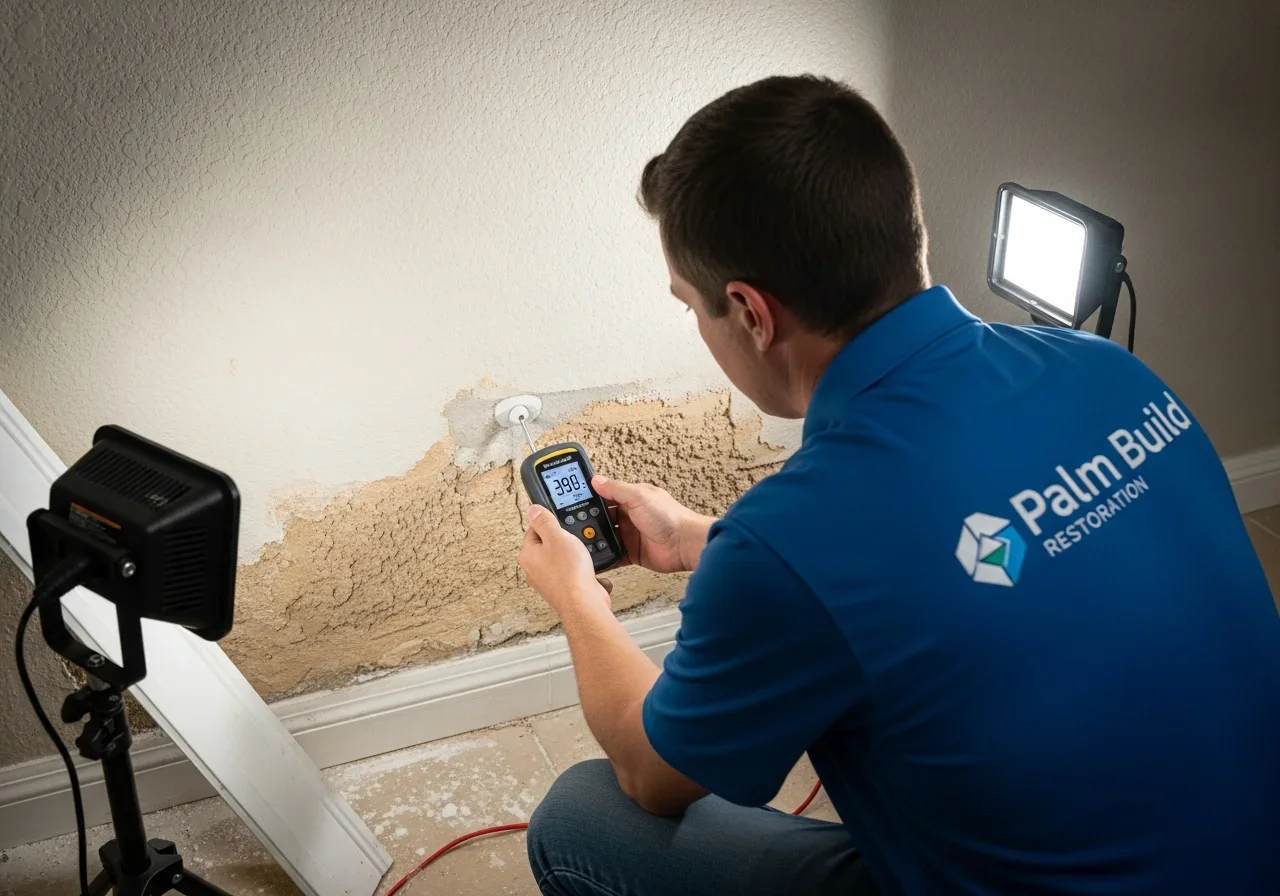
Moisture mapping with pin-type meters documents exactly how far water has traveled
behind Wellington's CBS walls — essential evidence for Florida insurance claims
formatted in Xactimate.
Our Work in Wellington
From Emergency to Restoration
Every image below represents a Wellington property where Palm Build responded, extracted,
dried, and restored — often within the same week. From Olympia estates to Sugar Pond Manor
originals, we handle every construction era and property type.
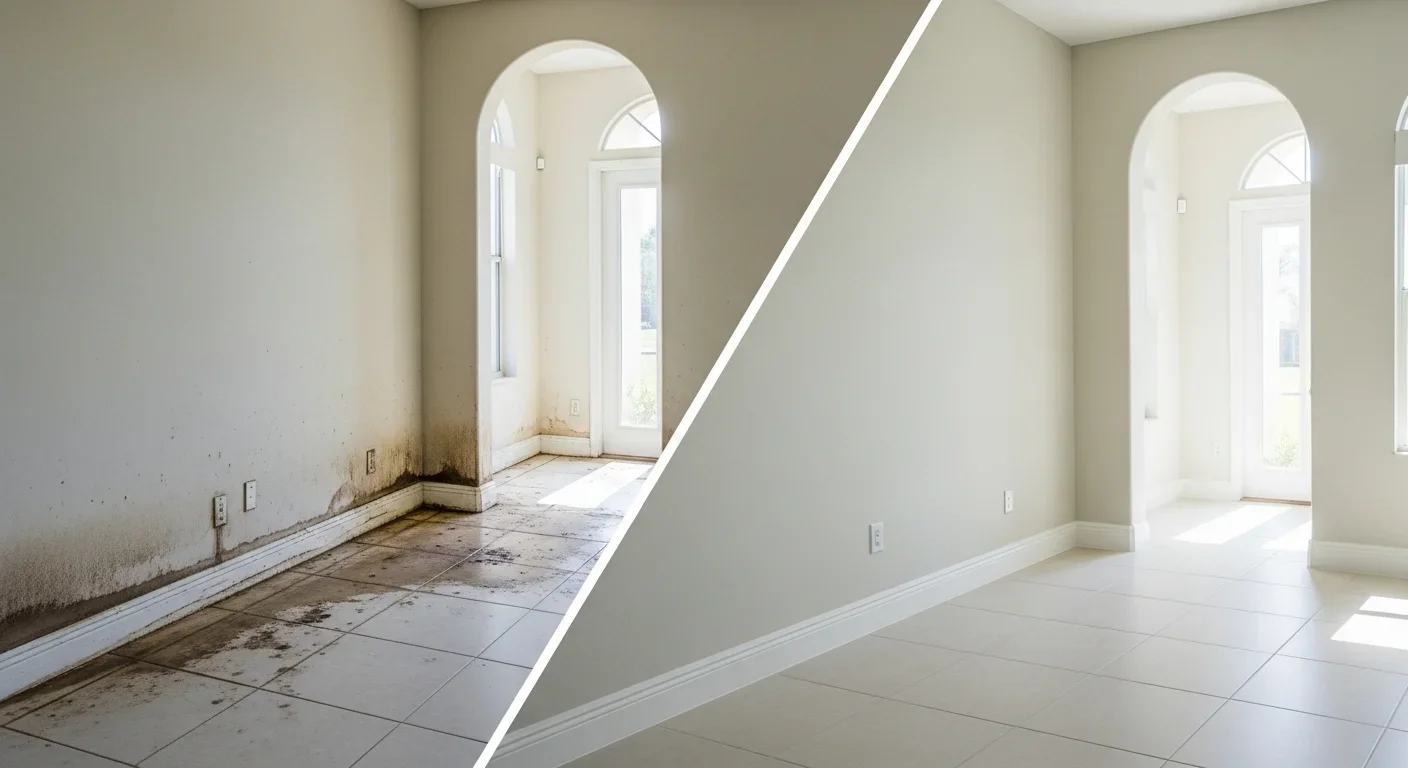
Complete restoration in a Wellington home — from saturated drywall and damaged flooring to full reconstruction with matched premium finishes and zero trace of water damage.
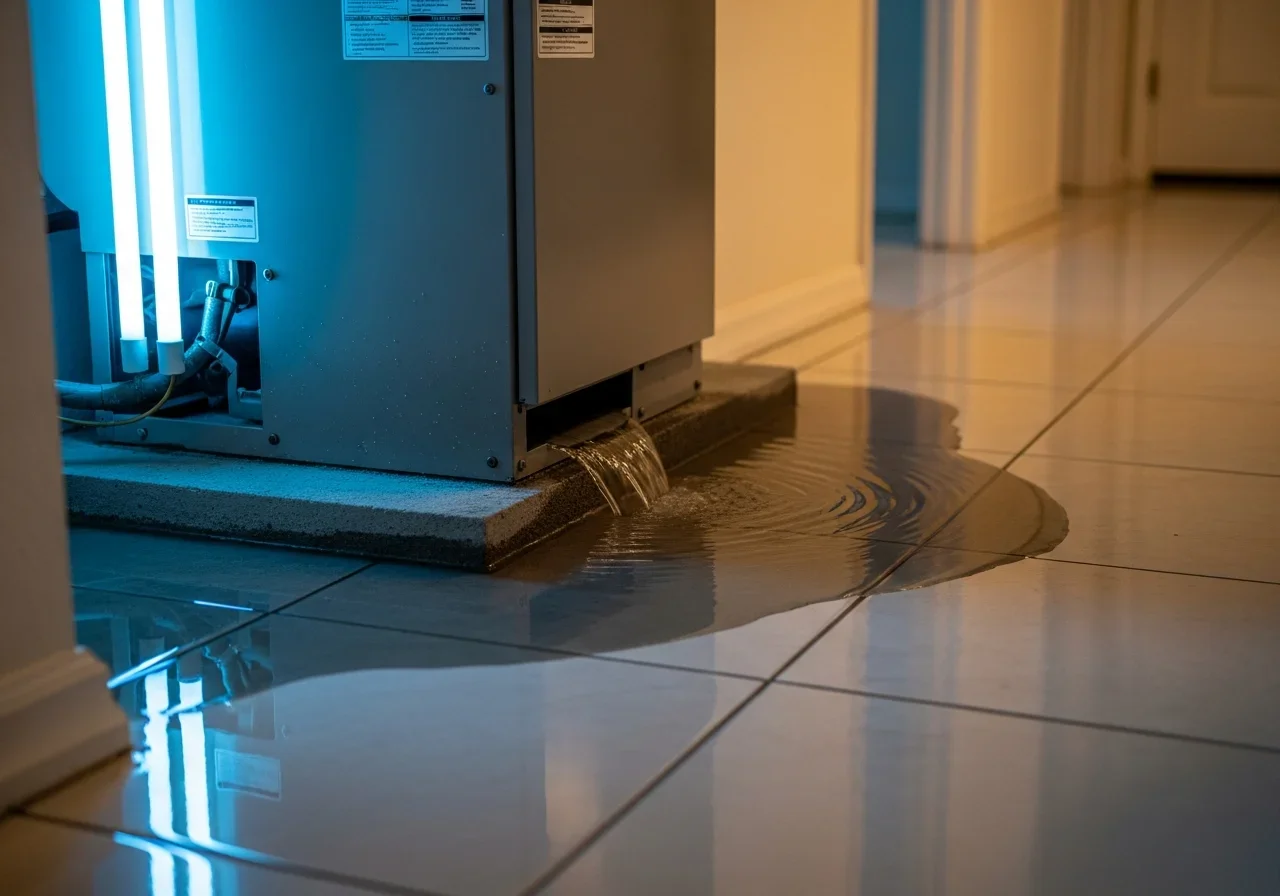
AC condensate overflow — one of Wellington's most common sudden water events. Year-round HVAC operation produces constant condensation that overwhelms aging drain lines.
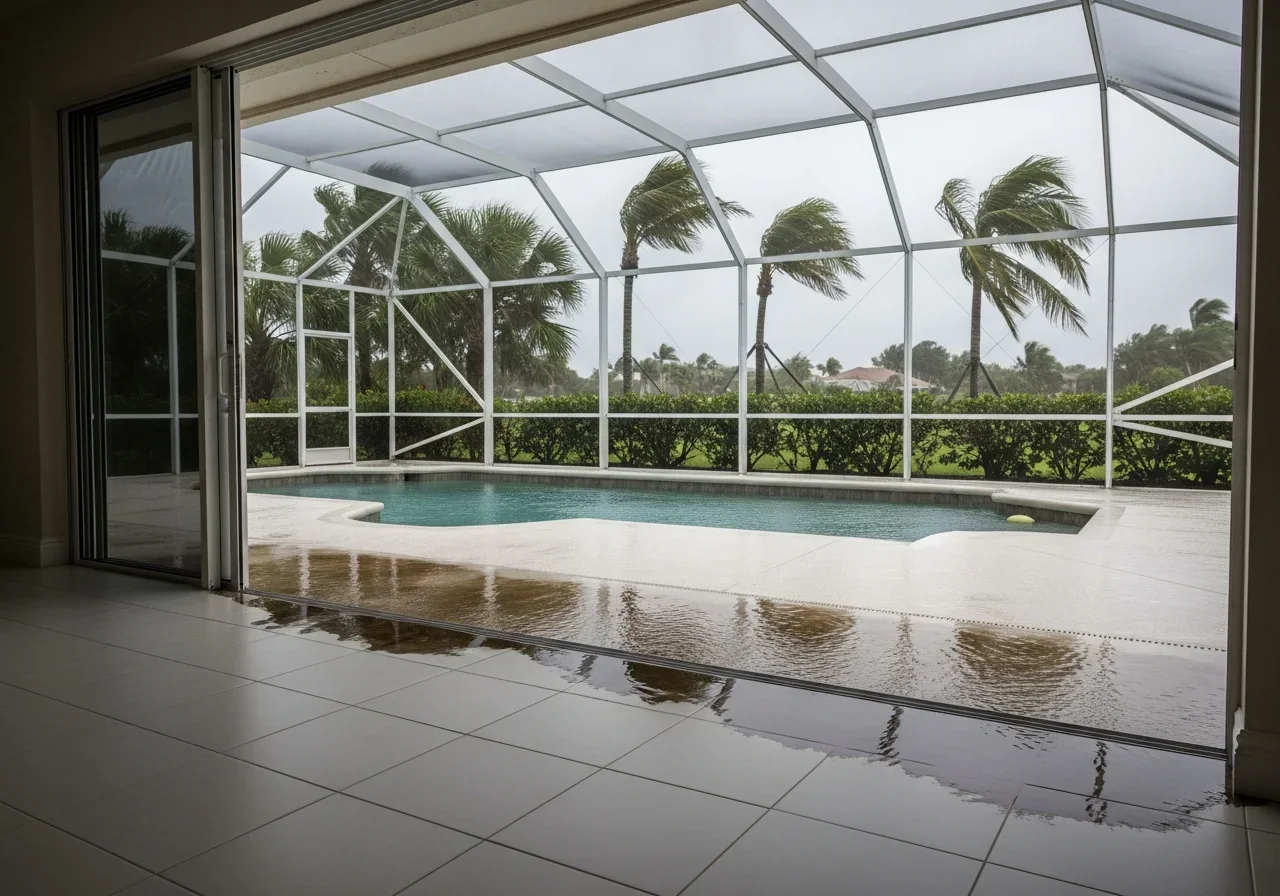
Pool enclosure rain intrusion — a common Wellington damage pattern during heavy afternoon thunderstorms. Water enters through screen enclosure joints and saturates adjacent interior rooms.
Wellington's equestrian properties have complex water systems — barn supply lines, wash stalls, and extensive irrigation create unique damage patterns requiring multi-structure restoration.
Common Damage Sources
Types of Water Damage in Wellington
The source of water determines the contamination category, restoration protocol, and cost.
Wellington's estate homes, equestrian properties, and planned community housing stock
create specific damage patterns different from other South Florida cities.
AC Condensate Overflow
One of Wellington's most common sudden water events. Year-round HVAC operation means condensate drain lines clog with algae and biofilm continuously. A blocked drain causes overflow behind the air handler — saturating drywall, subfloor, and insulation. In Wellington's heat, AC systems run nearly year-round, producing constant condensation that overwhelms aging drain lines.
Roof Leak & Storm Intrusion
Wellington receives 61.75 inches of rain annually. Wind-driven rain enters through aging stucco, deteriorating window flashing, soffit gaps, and tile roof failures. Lake-facing and canal-facing elevations in communities like Olympia and Stonegate take the worst exposure. Multi-valley roof systems on larger Wellington homes have more vulnerable penetration points.
Supply Line Burst
Water heaters, dishwashers, washing machines, and refrigerator ice maker supply lines fail without warning. In Wellington homes built in the 1980s and 1990s with original plumbing connections, these failures are increasingly common. A burst supply line in a second-floor bathroom can send hundreds of gallons through the first floor before anyone notices.
Appliance Failure
Washing machines, dishwashers, and water heaters connect to pressurized supply lines that fail after 5-8 years. Wellington's aging housing stock means many homes are on their second or third generation of appliance connections. Rubber supply hoses are the weakest link — they fail without warning and release pressurized water continuously until discovered.
Pool/Lanai Threshold Intrusion
A common Wellington damage pattern during heavy afternoon thunderstorms. Water enters through pool enclosure screen joints and at the threshold between lanai and interior living spaces. Improper drainage slope around pool decks and aging door thresholds allow wind-driven rain to penetrate into living areas — saturating flooring and baseboards in adjacent rooms.
HOA/Condo Cross-Unit Spread
In Wellington's attached housing communities like VillageWalk, water damage in one unit routinely spreads to adjacent units through shared walls and floor assemblies. Plumbing failures, appliance leaks, or HVAC overflow in one unit quickly penetrate shared structures — multiplying damage scope and complicating insurance claims between unit owner HO-6 policies and association master policies.
Every water damage event requires immediate professional assessment.
Mold colonization begins within 24-48 hours in Wellington's humidity. Call (754) 600-3369 for 24/7 emergency response.
Why Palm Build
Wellington's Trusted Restoration Partner
National franchises send you their nearest available crew. Palm Build sends you a team
that already knows Wellington's communities, equestrian estates, construction types, and
insurance carrier requirements.
South Florida Operations Center
Our Deerfield Beach operations hub puts us within 45-60 minute response range of Wellington 24/7/365. When you call at 2 a.m., we answer — and a fully equipped truck is rolling within minutes. No national call center, no delayed dispatch. For equestrian properties, we dispatch additional equipment for barn and outbuilding water events.
IICRC Certified Technicians
Every Palm Build technician holds current IICRC certifications in Water Restoration (WRT), Applied Structural Drying (ASD), and Applied Microbial Remediation (AMRT) — the gold standard in the restoration industry. For Wellington's high-value homes, this certification ensures restoration meets the standard that insurance carriers and homeowners expect.
Equestrian & Estate Expertise
We understand the unique water damage patterns on Wellington's equestrian properties — barn supply lines, wash stalls, arena drainage, and the multi-structure restoration scopes that these properties require. Estate homes with premium finishes demand careful material matching that franchise operations aren't equipped to deliver.
FL Insurance Documentation
We know the 1-year claim deadline, the 18-month supplemental deadline, Citizens' processes, and what Florida adjusters need. Our moisture maps, thermal images, and drying logs are formatted in Xactimate for the Florida carrier workflow. Every claim meets Fla. Stat. 627.70132 with comprehensive documentation.
Full-Service + Wellington Permits
Palm Build handles everything from emergency extraction through final reconstruction — including all permits through Wellington's Building Department via ProjectDox and HOA architectural review submissions. One company, one project manager, from water extraction to move-back day.
Ready for a free assessment?
Call (754) 600-3369 24/7 for immediate
response — or schedule a non-emergency inspection at your convenience.
Common Questions
Wellington Water Damage FAQ
How quickly can Palm Build respond to a water emergency in Wellington?
Our South Florida team typically arrives in Wellington within 45 to 60 minutes from our Deerfield Beach operations center. We dispatch 24/7/365.
What causes the most water damage in Wellington homes?
The most common causes are HVAC condensate overflow, supply line bursts in aging homes, storm-driven rain intrusion, and appliance failures. Equestrian properties see additional damage from barn supply lines and irrigation systems.
Does homeowners insurance cover water damage in Wellington, FL?
Standard Florida homeowners insurance typically covers sudden and accidental water damage. It does NOT cover flood damage. Florida law requires claim notice within 1 year and supplemental claims within 18 months of date of loss.
How much does water damage restoration cost in Wellington?
Standard restoration ranges from $8,500 to $27,500. Complex estate or equestrian property claims can range from $17,500 to $74,000+.
How does Wellington's Acme drainage system affect flooding risk?
The Acme Improvement District manages 2,000+ catch basins, 91 miles of canals, and 9 pump stations. During extreme rainfall, the system can reach capacity, causing water backup through catch basins and elevated canal levels.
Can you work with my HOA on water damage in Wellington condos?
Yes. We work with Wellington HOAs regularly — understanding shared-wall documentation, unit-to-unit liability, architectural review requirements, and building access protocols.
How fast can mold start after water damage in Wellington's climate?
EPA guidance confirms mold starts within 24-48 hours. Wellington's subtropical humidity above 75% in wet season can accelerate this timeline.
What documentation do I need for a Florida insurance claim?
Florida carriers require evidence of the water source, damage extent, moisture readings, and mitigation efforts. Palm Build provides moisture maps, thermal images, daily drying logs, and photo documentation formatted for the Florida carrier workflow.
Trusted Vendors
Trusted local pros in Wellington
Outside our restoration scope, these are the vetted, licensed contractors we trust
alongside our work. Personally evaluated, reference-checked, and recommended by Palm
Build.
Water damage in Wellington? Call now — we respond 24/7.
Palm Build's IICRC-certified crew responds to Wellington emergencies from our South Florida operations center. Truck-mounted extraction, commercial drying, and insurance-ready documentation — dispatched around the clock.