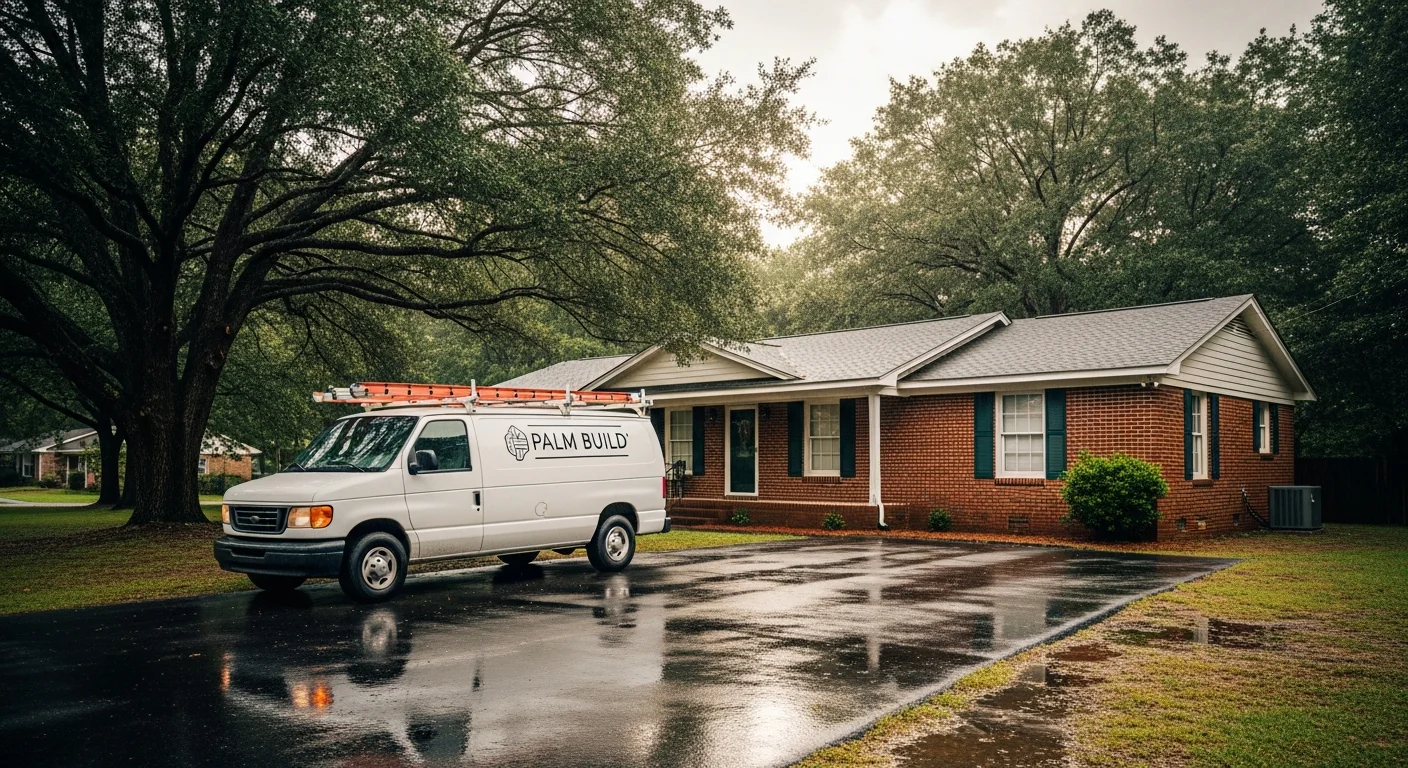
Water Damage Restoration in Blacksburg, South Carolina
Blacksburg is Cherokee County's Iron City — a small Upstate town where 24.7% of the housing stock was built in the 1970s, the Broad River runs just outside town limits, and 47 inches of annual rainfall falls on clay soil that holds moisture for weeks. When a supply line fails in your Garden Lakes crawl space or the Broad River backs water toward Cherokee Falls communities after a heavy storm, Palm Build responds from Charlotte with truck-mounted extraction, industrial dehumidifiers, and insurance documentation that gets your claim paid.
45-75 min
Emergency Response
24/7
Dispatch Available
IICRC
Certified Technicians
Why Blacksburg Homes Face Unique Water Damage Risks
Blacksburg's water damage profile is shaped by three converging forces: aging 1970s construction, Cherokee County clay soil that never fully drains, and a Broad River watershed that most restoration companies underestimate.
Blacksburg's 1970s Housing Stock
The median Blacksburg home was built in 1971. The largest single decade cohort is 1970–1979 at 24.7% of all units. Homes from that era share predictable vulnerabilities: galvanized or early copper supply lines approaching end of service life, original bath surrounds with failing grout, and vented crawl space foundations that were never designed to manage Upstate South Carolina humidity.
Cherokee County Clay Soil
Cherokee County's red-brown Piedmont clay drains at a fraction of an inch per hour. After any significant rain event, moisture saturates the soil surface and stays there for weeks — pressing against crawl space vents and block foundations with continuous hydrostatic pressure. Every rain adds to what was already there.
Broad River Watershed Risk
The Broad River runs just west of Blacksburg, with an active NOAA stream gauge approximately 4 miles from town. While the town's corporate limits have no defined Special Flood Hazard Areas, communities like Cherokee Falls and properties near river crossings face documented flooding risk during major storm events. Hurricane Helene (DR-4829-SC, September 2024) demonstrated this risk across Cherokee County.
21.8% Manufactured Homes
More than one in five Blacksburg homes is a manufactured unit — a construction type that saturates faster and dries differently than site-built homes. Thinner subfloor assemblies, under-floor HVAC ductwork, and vinyl siding create moisture traps that require specialized extraction and drying protocols. Most restoration companies in the area apply the same approach to every home — we don't.
Iron City reality check: Blacksburg's population is ~1,954 — small enough that most regional restoration franchises treat it as a low-priority afterthought. Palm Build dispatches from Charlotte with the same full crew and equipment sent to any city in our network.
Blacksburg Neighborhoods and Water Damage Risk
Blacksburg's water damage risks vary by neighborhood era, terrain, and proximity to the Broad River corridor. Here is what we see on the ground, by community.
| Neighborhood / Area | Build Era | Risk | Common Issues |
|---|---|---|---|
| Cherokee Falls | Mixed, legacy mill-community era | High | River-adjacent flooding — Broad River corridor. Post-flood mold and odor in older homes. Storm debris during Helene-type events. |
| Downtown Blacksburg (Central Grid) | Pre-1960 to mid-century | High | Oldest plumbing in the city. Hidden pipe leaks. Older wiring penetrations around chimneys. Layered flooring masking subfloor damage. |
| Garden Lakes Area | Example home c. 1989 | Medium | Crawl space moisture on larger lots. Aging HVAC condensate lines. Roof wear and flashing leaks. Mold risk after repeated humidity exposure. |
| Brown Burrough | Legacy subdivision, mixed era | Medium | Supply line failures in older bathrooms. Roof aging and flashing leaks. Water intrusion at crawl space vents after heavy rain. |
| Kings Creek Community | Mixed, rural | Medium | Basementless foundations and crawl spaces with moisture buildup. Duct sweating. Manufactured home subfloor saturation risk. |
| Antioch Community | Mixed, rural | Medium | Storm debris and roof damage from tree strikes. Power-outage secondary losses. Damp insulation in crawl spaces after storms. |
| Carolina Ridge Estates | Newer/active development | Lower | Newer builds still face appliance line failures and construction moisture. Poor lot grading can cause water intrusion in early years. |
| Cashion Crossroads | Mixed, rural | Medium | Drainage failure after heavy rain. Culvert backups. Water intrusion from grading issues on rural lots. |
Risk levels reflect documented damage patterns, construction era, and proximity to the Broad River watershed. Individual property risk depends on foundation type, plumbing age, and drainage.
The Broad River and Blacksburg's Flood Risk
Most restoration companies treat Blacksburg as flood-free because the town limits are Zone X. The real risk is at the river corridors just outside those limits — and that is where Cherokee County homeowners get caught without flood coverage.
NOAA Stream Gauge
NOAA maintains an active stream gauge at the Broad River at Shelby Highway (SC 18), approximately 4 miles west of Blacksburg, with documented flood impact stage thresholds. When this gauge rises, river-adjacent communities in Cherokee County see the effects directly.
Town Limits Are Zone X — River Corridors Are Not
As of the April 2022 Cherokee County floodplain update, the Town of Blacksburg's corporate limits do not have defined Special Flood Hazard Areas. Most in-town properties are mapped Zone X (minimal flood hazard). The risk is concentrated outside town limits — along the Broad River corridor, near low-lying road crossings, and in communities like Cherokee Falls.
Hurricane Helene — September 2024
Federal Emergency Management Agency declared SC disaster DR-4829-SC for Hurricane Helene with an incident period beginning late September 2024. The National Weather Service Greenville-Spartanburg office documented significant flash flooding in the region September 26–27, 2024 — the type of inland extreme-rain event that creates sudden water loss spikes for Cherokee County homeowners.
Flood Insurance vs. Homeowners Insurance
FEMA states directly that most homeowners insurance does not cover flood damage. If you live near the Broad River corridor, Cherokee Falls, or any low-lying rural crossing, a separate NFIP flood policy is the only coverage for flood-origin losses. Standard homeowners coverage only applies to sudden internal losses (burst pipes, appliance failures).
Cherokee Falls and river-corridor properties: If your home is adjacent to the Broad River or any tributary waterway in Cherokee County, verify your flood zone designation at FEMA's Flood Map Service Center before your next renewal. Many homeowners in these areas carry zero flood coverage.
When Does Water Damage Peak in Blacksburg?
Cherokee County's climate creates year-round damage risk — with different threats each season. March is historically the wettest month. September brings hurricane remnants. Summer amplifies any water event into a mold event.
Jan
Freeze
Feb
Freeze
Mar
Peak Rain
Apr
Spring Rain
May
Mold Risk
Jun
High Mold
Jul
High Mold
Aug
High Mold
Sep
Storm Season
Oct
Storm Risk
Nov
Fire Risk
Dec
Pipe Freeze
March — Wettest Month
~3.7 inches average. Clay soil drainage failure. Crawl space flooding peaks. Foundation seepage risk highest of the year.
June–August — Mold Season
Dew points above 70°F. Any unchecked water event from spring becomes a mold event. 24-hour response is the only way to prevent secondary damage.
September — Helene Risk
Hurricane Helene (DR-4829-SC, 2024) demonstrated Cherokee County's vulnerability to inland hurricane remnants. Flash flooding risk is documented in NOAA regional records.
Water Damage Restoration Process in Blacksburg
Six proven steps — adapted for Cherokee County clay soil, 1970s crawl space construction, and South Carolina insurance documentation requirements.
24/7 Emergency Dispatch
Call anytime — our Charlotte-based dispatch sends a crew to Blacksburg in 45-75 minutes. Truck-mounted extraction and industrial drying equipment on every run. No waiting for a callback.
Moisture Mapping & Assessment
Thermal imaging cameras and calibrated moisture meters map every affected area — including inside crawl space walls, under manufactured home subfloors, and behind 1970s-era plaster. We find hidden moisture before it becomes mold.
Truck-Mounted Extraction
Commercial-grade truck-mounted extraction removes standing water from all floor types — hardwood, carpet, concrete slab, and manufactured home subfloor. Faster and more powerful than portable units.
Structural Drying (IICRC S500)
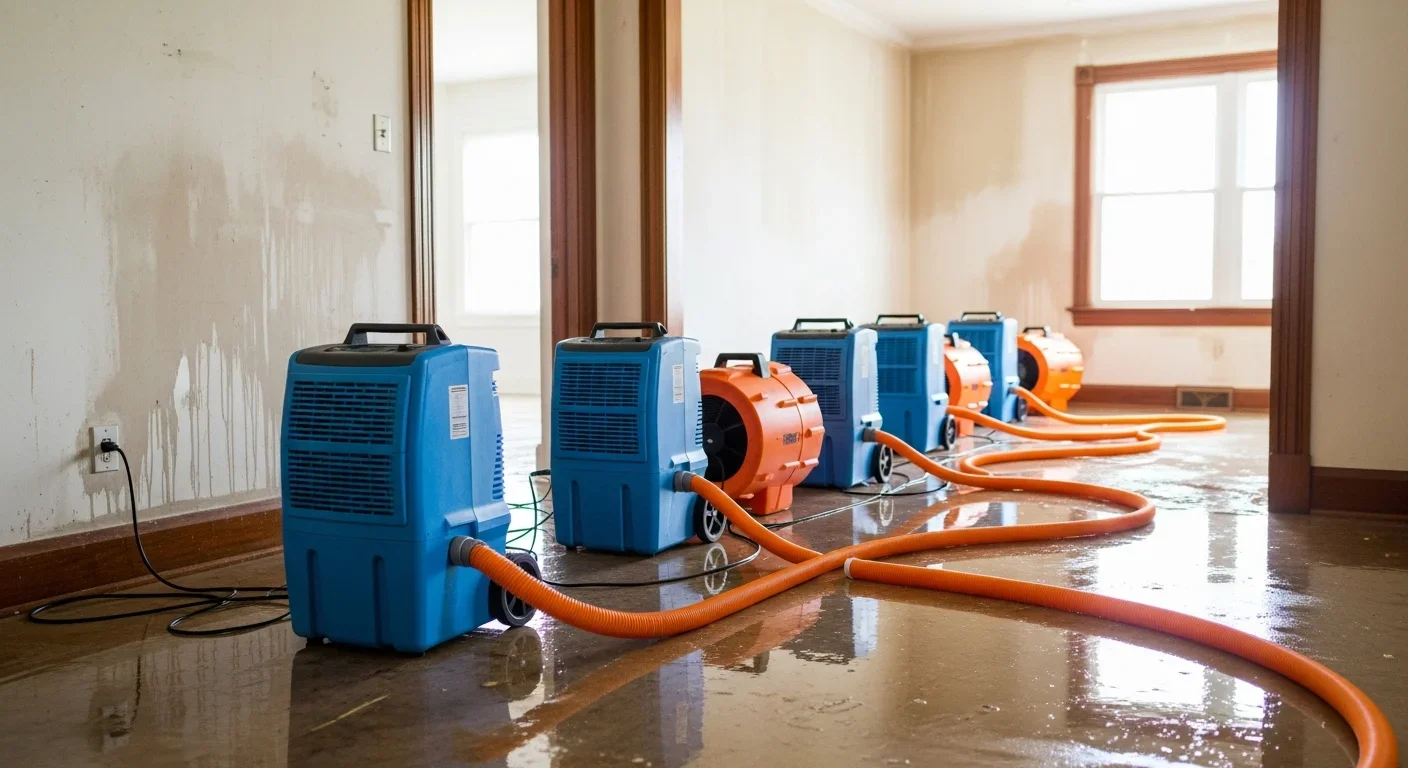
Industrial dehumidifiers and air movers are positioned per IICRC S500 drying standards. Daily moisture readings confirm drying progress. Equipment stays until verified dry — not until it looks dry.
Insurance Documentation
Every job produces a complete claims package: moisture maps, extraction logs, daily drying readings, before/after photos, and a signed completion report. Formatted to support South Carolina homeowners insurance claims with State Farm, USAA, SC Farm Bureau, and other major carriers.
Restoration & Rebuild
After drying verification, we coordinate or execute all necessary repairs — drywall, flooring, insulation, subfloor, and structural elements. Cherokee County permit requirements for restoration work inside Blacksburg town limits are handled as part of our scope.
Water Damage Restoration Costs in Blacksburg, SC
Cost depends on scope, construction type, and how quickly extraction begins. Blacksburg's median home value of ~$157,400 and mix of site-built and manufactured homes means cost varies significantly by property type.
Minor Water Damage
$1,200 – $3,500
Small appliance leak or supply line failure, limited to one room, no structural damage. Carpet extraction and drying only.
Crawl Space Flooding
$2,500 – $6,000
Standard crawl space remediation in a Blacksburg 1970s home. Clay soil drainage failure after storm events. Includes extraction, vapor barrier removal, and drying.
Structural Drying Required
$4,000 – $12,000
Multiple rooms or subfloor saturation requiring structural drying. Common in Blacksburg after burst pipe events or Broad River-adjacent flooding.
Full Reconstruction
$15,000+
Extended flooding with subfloor, joist, and wall assembly damage. Manufactured home total subfloor replacement. Full rebuild after major storm events.
All estimates are ranges based on typical Blacksburg job scope. Written estimates provided before any work begins. SC homeowners insurance documentation included on every job.
Navigating Water Damage Insurance Claims in Blacksburg
South Carolina averages $2,611–$2,668 per year for homeowners insurance. Knowing what your policy covers — and what it doesn't — before you call is the difference between a paid claim and a denied one.
Major SC Carriers We Work With
- State Farm
- USAA
- Allstate
- Travelers
- SC Farm Bureau
- Liberty Mutual
- Auto-Owners
- Orion180
- American Family
We provide documentation formatted for each carrier's claims process.
Typically Covered
- Burst pipe (sudden and accidental)
- Appliance failure (washing machine, water heater)
- Storm-driven rain intrusion through roof damage
- HVAC condensate line backup (most policies)
Typically NOT Covered
- Flood from outside the home (Broad River, storm runoff)
- Gradual leak from slow-dripping fitting
- Mold from deferred maintenance or long-running moisture
- Sewage backup (requires separate rider)
What Palm Build Provides
- 1 Day 1 moisture mapping with equipment calibration records
- 2 Extraction volume logs and daily drying moisture readings
- 3 Thermal imaging documentation of hidden moisture
- 4 Before/after photos at every stage
- 5 Signed drying completion certificate
- 6 Full claims-ready PDF package for your adjuster
Types of Water Damage We Restore in Blacksburg
From burst pipes in 1970s crawl space homes to Broad River flooding in Cherokee Falls — every water damage scenario requires a different response protocol.
Burst & Failed Pipes
The most common call in Blacksburg. 1970s copper and galvanized supply lines are at or past their service life. Freeze events in January–February accelerate failures in unheated crawl spaces. We handle Category 1 (clean water) pipe failures through full drying and documentation.
Crawl Space Flooding
Cherokee County clay soil holds water against crawl space foundations for weeks after rain. Vented crawl spaces in 1970s homes draw moisture in from every direction. Crawl space flooding is Blacksburg's most common recurring water damage scenario.
HVAC & Appliance Failures
Water heater failures, washing machine overflow, and HVAC condensate line backups are responsible for a large share of Category 1 water losses in Cherokee County. Fast extraction prevents secondary damage to subfloor assemblies — especially critical in manufactured homes.
Storm Water Intrusion
Roof damage from storm debris, gutter overflow at roofline, and failed window or door flashing drive water into wall cavities and attics. Cherokee County's storm season peaks September–October with inland hurricane remnants and severe thunderstorms.
Sewage Backup
Category 3 (black water) sewage backup is a biohazard requiring full containment, specialized PPE, and antimicrobial treatment. Older infrastructure in Downtown Blacksburg is most vulnerable during heavy rain events that overwhelm lateral drain lines.
Broad River Flooding
River-adjacent properties near Cherokee Falls and rural road crossings face flooding risk during major storm events. Note: standard homeowners insurance does NOT cover flood water from outside — a separate NFIP flood policy is required.
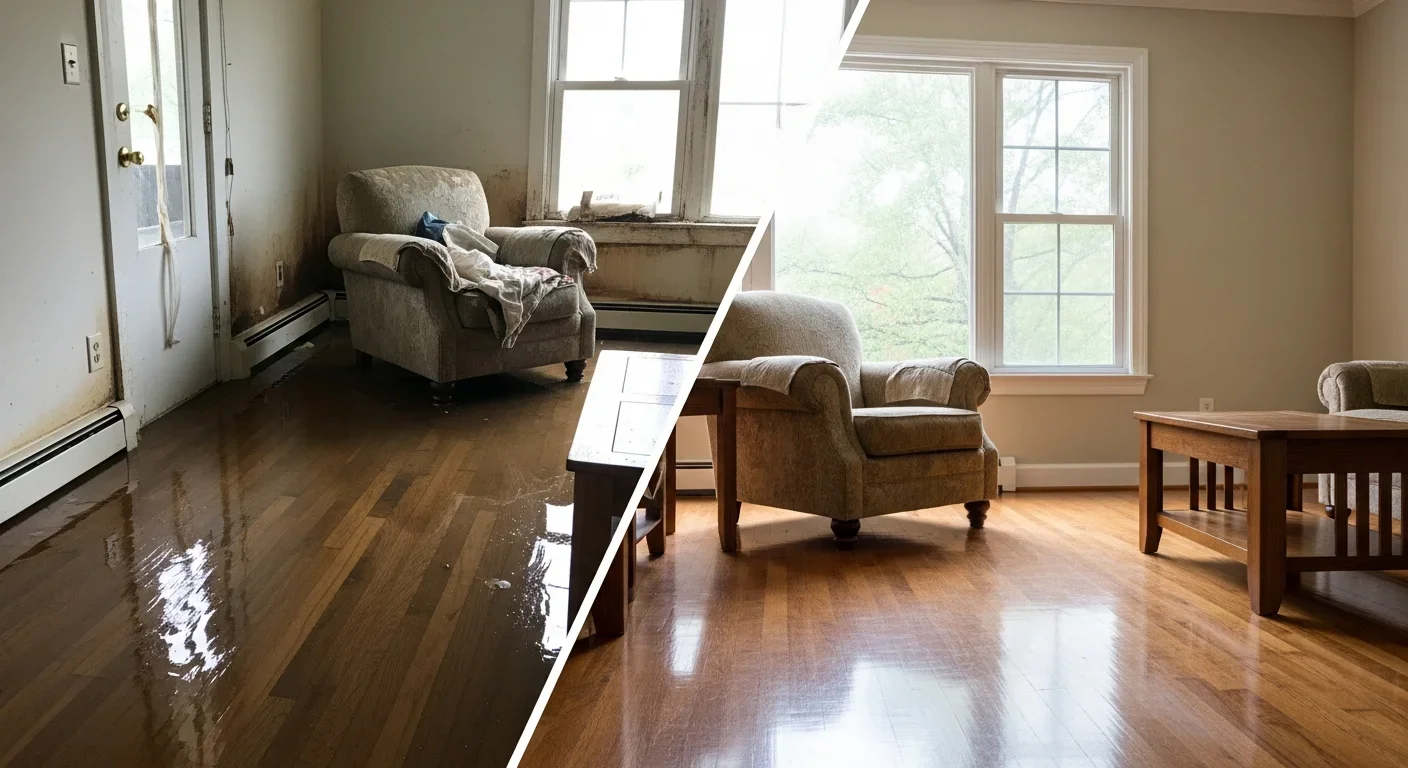
Before & After: Blacksburg Water Damage Restoration
45-75 min
Average response time to Blacksburg
IICRC
Certified technicians on every job
24/7
Emergency dispatch, no exceptions
100%
Jobs completed with signed moisture clearance
"After a supply line burst under our 1970s ranch home, Palm Build was on-site within the hour. They found moisture in the wall cavity we never would have caught — and their documentation got our State Farm claim approved without any pushback."
— Cherokee County homeowner
Why Blacksburg Homeowners Choose Palm Build
Six reasons — none of them generic marketing language. Every point reflects how we actually operate in Cherokee County.
45-75 Minute Response
Charlotte-based dispatch reaches Blacksburg in 45-75 minutes — with truck-mounted extraction and a full crew. Not a franchise answering service that routes to whoever is available.
IICRC Certified Technicians
Every Palm Build technician holds current IICRC certification. We follow ANSI/IICRC S500 water damage restoration standards on every Blacksburg job — the same protocol used on multi-million-dollar commercial losses.
Insurance Documentation From Day 1
We begin documenting the moment we arrive. Moisture maps, extraction logs, daily drying readings, and a claims-ready package formatted for South Carolina homeowners carriers — including State Farm, USAA, and SC Farm Bureau.
Cherokee County Knowledge
We understand Blacksburg's 1970s housing stock, Cherokee County clay soil drainage patterns, the Broad River watershed risk, and manufactured home drying protocols. Generic approaches that work in Charlotte don't always work here.
24/7 Emergency Dispatch
Supply lines fail at 2 a.m. Storms hit on Sundays. Our emergency line connects to a real person — not voicemail — at every hour. Every day of the year.
Full Restoration Scope
From initial extraction through final rebuild — drywall, flooring, insulation, subfloor, and structural repairs. We coordinate Cherokee County permit requirements for work inside Blacksburg town limits. One company, complete restoration.
Frequently Asked Questions — Blacksburg Water Damage
Specific answers for Cherokee County homeowners — not generic boilerplate.
Water Damage in Blacksburg? We Respond 24/7.
Cherokee County clay holds water for weeks. Every hour of delay increases damage and mold risk. Our Charlotte team reaches Blacksburg in 45-75 minutes — call now.