Port St. Lucie's subtropical humidity, 55+ inches of annual rainfall, and closed-up 2000s-era homes create ideal conditions for mold. Palm Build's Florida-licensed remediation team eliminates mold at the source — with containment protocols, HEPA filtration, and verification testing that meets Florida DBPR standards.
Serving Port St. Lucie from Deerfield Beach, FL 60-90 min Response IICRC Certified
Port St. Lucie's combination of year-round subtropical humidity, tightly sealed CBS
construction from the 2000s building boom, near-constant HVAC operation, and a large
seasonal population creates some of the highest residential mold risk on the Treasure
Coast. Understanding these factors is the first step toward permanent remediation.
Year-Round Subtropical Humidity
75-90%
Outdoor RH year-round
Port St. Lucie's subtropical climate maintains outdoor relative humidity between 75-90% for most of the year. This constant moisture pressure fights against indoor climate control — every time a door opens, every gap in the building envelope, and every HVAC shutdown pushes indoor humidity toward dangerous levels. Keeping interior RH below 60% requires a sealed envelope and properly functioning dehumidification.
Sealed 2000s-Era CBS Construction
85%+
Homes built post-2000
Most Port St. Lucie homes were built during the 2000s construction boom using CBS (concrete block and stucco) with modern energy-efficient windows and insulation. While this construction is hurricane-rated, it also creates a tightly sealed envelope. When that envelope is breached — a roof leak, stucco crack, or plumbing failure — moisture becomes trapped between the block wall and interior drywall with nowhere to dry. Mold colonizes these concealed spaces before any visible signs appear.
HVAC Running 10+ Months
10-11 mo
AC runs per year
Air conditioning systems in Port St. Lucie run nearly year-round, generating constant condensation on evaporator coils and drip pans. Condensate drain line failures are the single most common hidden moisture source in PSL homes — a clogged line can dump gallons of water into your air handler closet or attic before you notice. This is mold's preferred environment: dark, warm, and perpetually wet.
Wet Season Moisture Pressure
May-Oct
70% of annual rain
The May-October wet season delivers 70%+ of Port St. Lucie's annual rainfall, with afternoon thunderstorms producing heavy downpours. This six-month period creates relentless moisture pressure on building envelopes. Wind-driven rain finds every stucco crack and flashing gap, and the elevated water table pushes moisture through slab foundations — especially in low-lying areas near the St. Lucie Canal system.
Seasonal Vacancy Humidity Spikes
80%+ RH
In vacant homes
Port St. Lucie has a significant seasonal population. When snowbirds close up homes for the summer without maintaining adequate HVAC operation, indoor humidity quickly spikes past 60% and can exceed 80% within days. A home sealed up in Florida's wet season without climate control is essentially a mold incubator — and many owners return in the fall to find established colonies throughout the house.
The HVAC Factor
In Port St. Lucie, the air conditioning system is the single most common mold source.
Systems running 10+ months generate constant condensation, and when drain lines clog
or drip pans crack, that moisture feeds mold inside your air handler before you ever
see it. The blower fan then distributes spores to every room through the duct system.
Know The Signs
Warning Signs of Mold in Port St. Lucie Homes
Mold in Port St. Lucie homes rarely starts with a dramatic event. In sealed CBS
construction with central AC running nearly year-round, mold grows silently inside wall
cavities and HVAC systems for weeks or months before symptoms or visible damage appear.
Musty or Earthy Odor
Most Reported
The most common first indicator in Port St. Lucie homes. A persistent musty or earthy smell — especially noticeable when the AC cycles on — signals mold inside the HVAC system or wall cavities. Many homeowners become nose-blind to the odor over time and only notice it after returning from vacation.
Visible Discoloration on Surfaces
Advanced
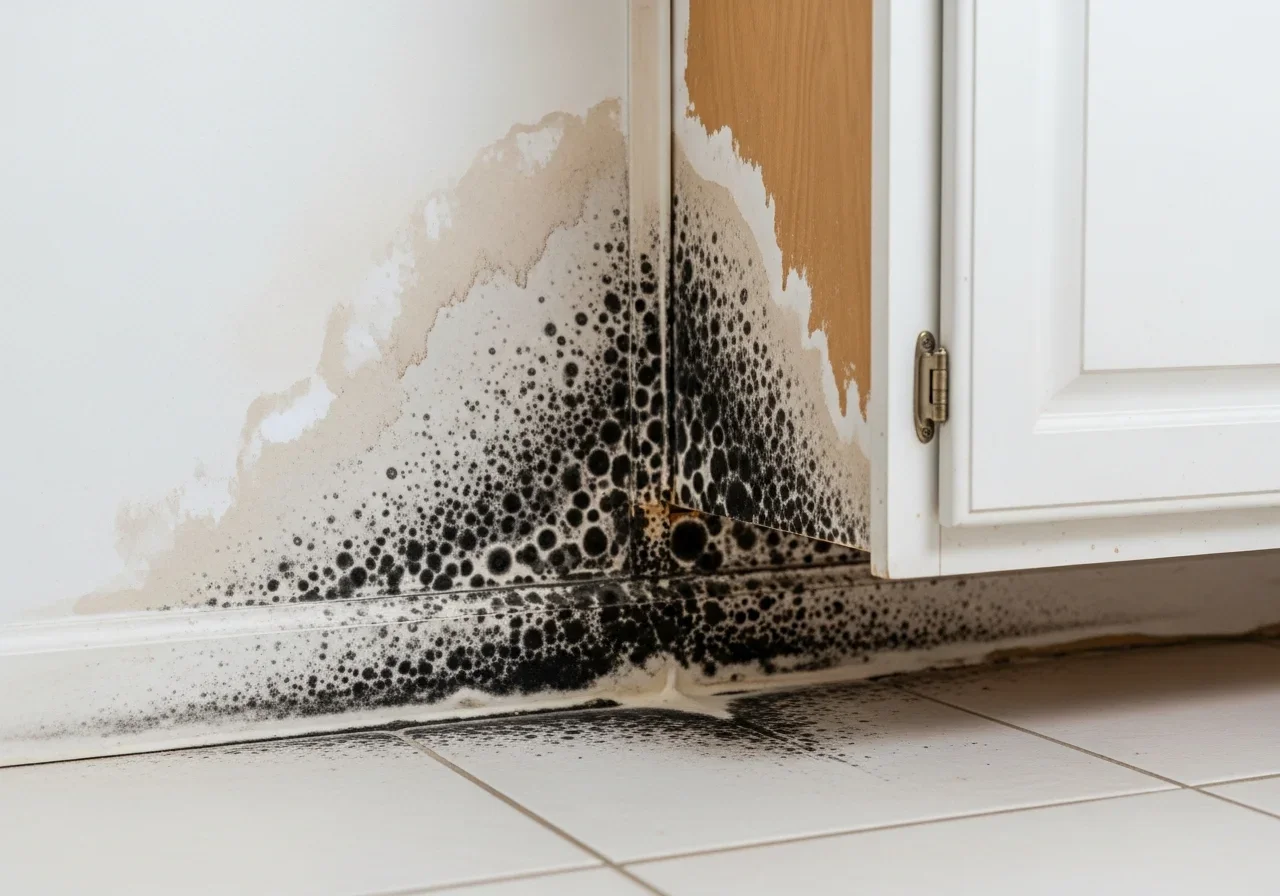
Dark spots, green-black patches, or fuzzy growth on walls, ceilings, bathroom grout, or window frames. In PSL homes, check where CBS walls meet the ceiling — moisture from roof leaks or stucco cracks often produces visible mold here first.
Persistent Allergy Symptoms Indoors
Health Risk
Chronic congestion, sneezing, itchy eyes, throat irritation, or respiratory issues that improve when you leave the house indicate airborne mold spore exposure. The CDC notes that mold can cause nasal stuffiness, coughing, and wheezing — symptoms that worsen with continuous exposure.
Condensation on Windows, Pipes, or Ductwork
Early Warning
Visible moisture droplets on windows, cold water pipes, or exposed ductwork indicate indoor humidity levels above safe thresholds. In Port St. Lucie homes, persistent condensation on AC supply vents is a red flag that the system is not adequately dehumidifying — creating conditions for mold throughout the duct system.
Water Stains on Ceilings or Walls
Structural
Even old, dried water stains signal that moisture penetrated the building envelope at some point. In CBS construction, the drywall behind a dried stain may still harbor mold — concrete block retains moisture long after the surface appears dry. Never assume an old stain means the problem is resolved.
Peeling Paint or Bubbling Wallpaper
Structural
Paint peeling off interior walls or wallpaper lifting at the edges indicates moisture trapped behind the surface. In Port St. Lucie CBS homes, this commonly signals stucco crack moisture intrusion or a slow plumbing leak feeding hidden mold between the block wall and drywall.
Dark Spots Inside HVAC Vents
Advanced
Black or dark green spotting on supply registers, return grilles, or the ceiling around vents is a late-stage indicator of extensive HVAC mold contamination. If mold is visible on the registers, contamination inside the air handler, evaporator coil housing, and ductwork is typically far more advanced.
When to Call Immediately
If you see mold covering more than 10 square feet, mold on AC registers or inside
air handlers, water staining on multiple walls, or persistent musty odor from every
vent — do not attempt DIY cleanup. Contact a DBPR-licensed mold remediation professional and document everything for your insurance claim.
IICRC S520 Protocol
Our Port St. Lucie Mold Remediation Process
Professional mold remediation follows a strict sequence defined by the IICRC S520
standard and Florida DBPR regulations. Here is exactly what happens when Palm Build's
licensed team arrives at your Port St. Lucie home.
01
Assessment & Air Sampling
Day 1
02
Containment Setup
Day 1-2
03
HEPA Vacuuming & Source Removal
Days 2-4
04
Antimicrobial Treatment
Days 4-5
05
Dehumidification & Climate Control
Continuous
06
Post-Remediation Clearance Testing
Day 5-7
01
Assessment & Air Sampling
Day 1
Comprehensive visual inspection, infrared moisture mapping, and air quality sampling conducted in coordination with an independent FL-licensed mold assessor (MRSA). We identify the moisture source — HVAC condensation, stucco intrusion, or plumbing failure — and classify contamination level per IICRC S520. Florida law requires the initial assessment come from a separately licensed assessor.
02
Containment Setup
Day 1-2
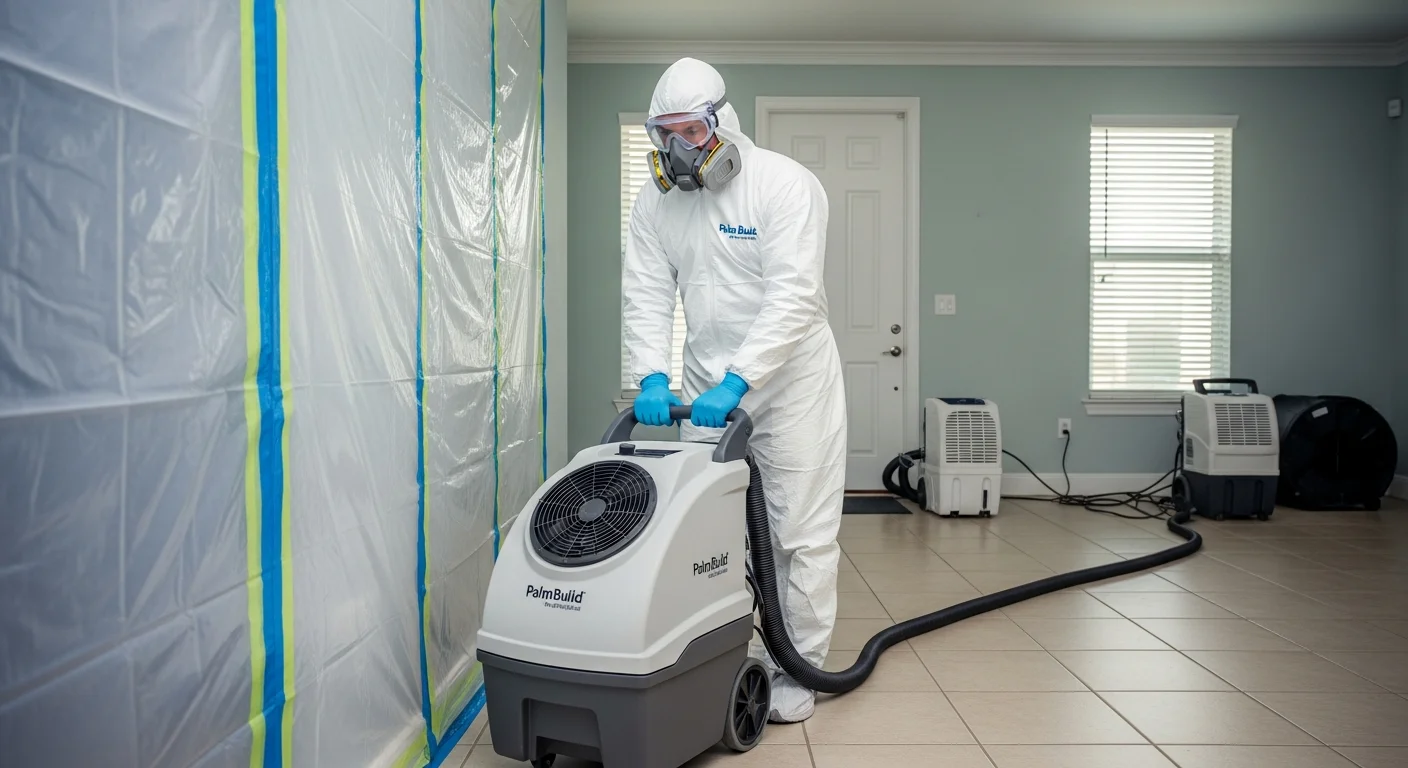
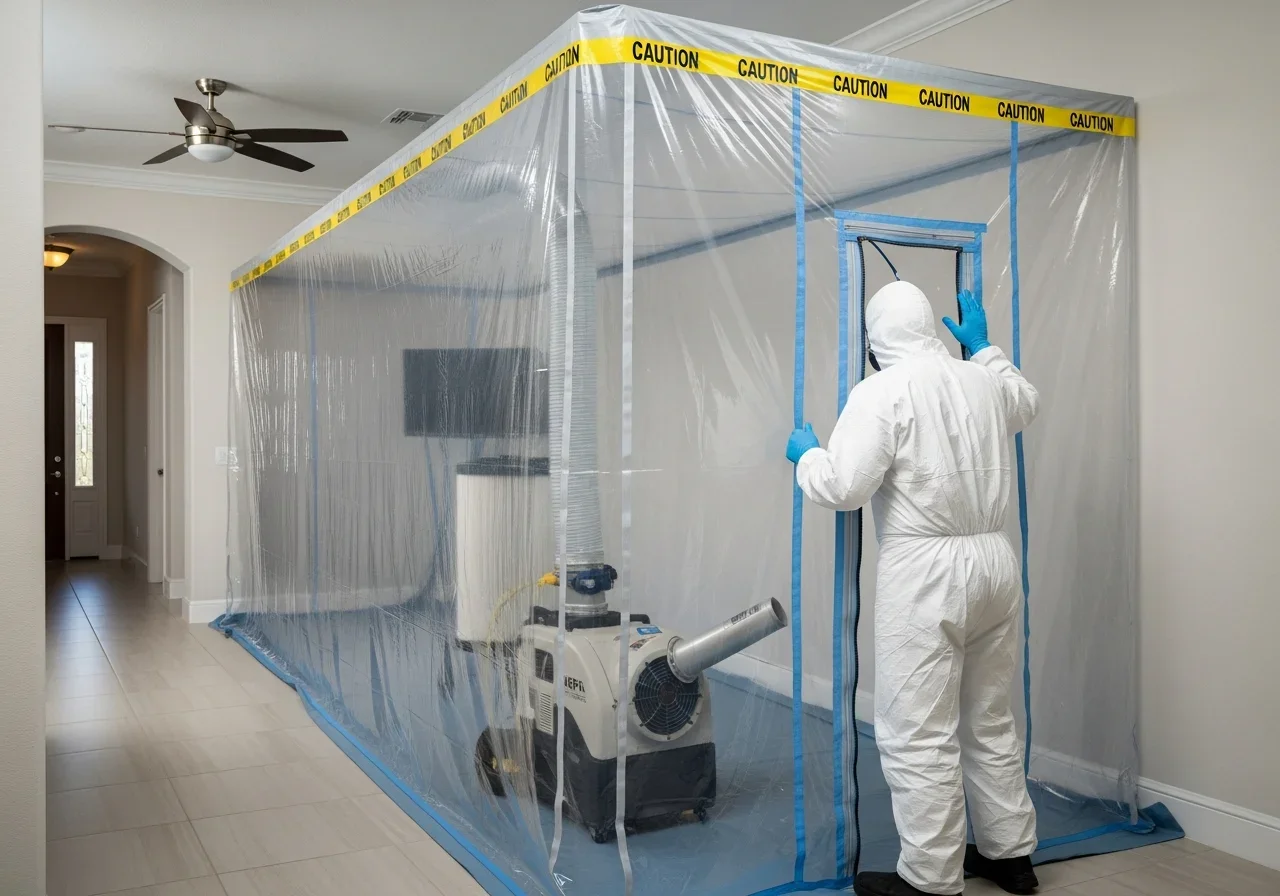
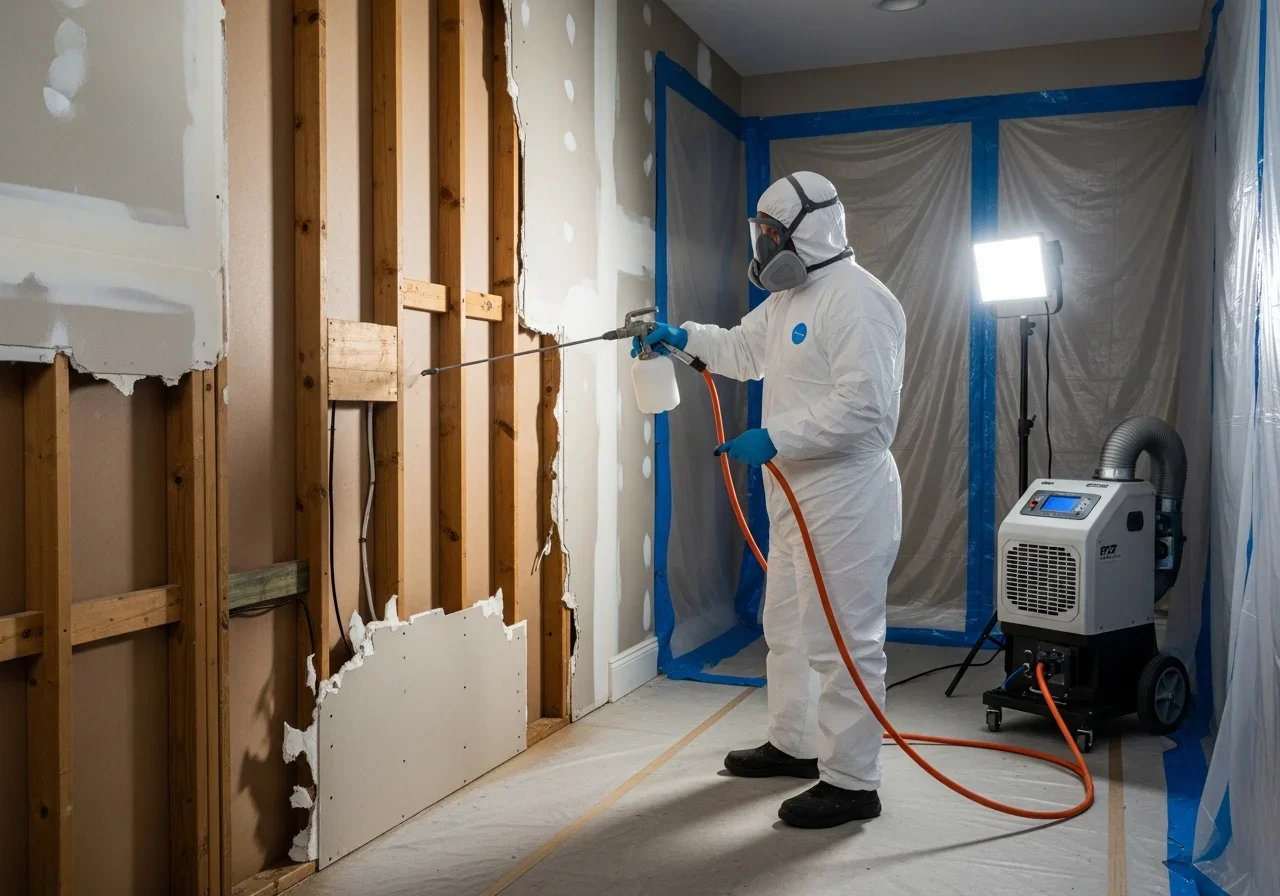
Sealed polyethylene barriers isolate affected areas from the rest of the home. HEPA air scrubbers establish negative air pressure within the containment zone to prevent spore migration. In Port St. Lucie CBS homes, containment includes sealing HVAC registers and isolating the air handler to prevent cross-contamination through the duct system.
03
HEPA Vacuuming & Source Removal
Days 2-4
Contaminated drywall, insulation, and non-salvageable materials are removed using controlled demolition techniques. All exposed surfaces receive HEPA vacuuming to capture settled spores. In CBS construction, affected drywall is removed to expose the block wall face, which is then HEPA-vacuumed and cleaned. Non-salvageable materials are double-bagged for disposal.
04
Antimicrobial Treatment
Days 4-5
EPA-registered antimicrobial products are applied to all treated structural surfaces — including concrete block wall faces, window bucks, framing members, and any areas where moisture intrusion was identified. HVAC components (evaporator coil housing, drip pan, and accessible ductwork) receive specialized antimicrobial treatment.
05
Dehumidification & Climate Control
Continuous
Commercial dehumidifiers maintain indoor relative humidity below 60% per FL DOH guidelines throughout the remediation process. In Port St. Lucie, where outdoor humidity regularly exceeds 80%, this requires industrial-grade equipment running continuously — not just the home HVAC system. Moisture levels are documented daily with calibrated meters.
06
Post-Remediation Clearance Testing
Day 5-7
An independent DBPR-licensed mold assessor (separate from our company, as required by Florida law) performs post-remediation air sampling and visual inspection. Clearance confirms spore counts have returned to acceptable levels and all visible contamination has been removed. Documentation is provided for your records and insurance carrier.
Why Containment Matters in CBS Homes
Disturbing mold without proper containment sends billions of spores airborne — and in
Port St. Lucie's CBS construction, the HVAC system can distribute those spores to
every room within minutes. Our containment protocol ensures mold stays isolated during
removal.
1
Sealed Barriers
Polyethylene sheeting floor-to-ceiling on CBS walls
In northern states, crawl spaces and basements drive mold problems. In Port St. Lucie, the
air conditioning system itself is the primary mold source. With HVAC running 10-11 months
per year generating constant condensation, your AC is simultaneously the tool that
controls humidity and the infrastructure most likely to feed mold growth.
Why Port St. Lucie's Climate Makes HVAC the Primary Mold Source
Port St. Lucie sits in USDA hardiness zone 10a with average annual humidity above 75%.
Air conditioning systems must run nearly continuously to maintain habitable indoor
conditions — not just for temperature comfort, but for moisture control. Every hour of
operation produces condensation on the evaporator coil, which drips into the pan and
drains through the condensate line.
When any component of this drainage path fails — a clogged line, a cracked pan, a
corroded fitting — water accumulates in a dark, warm environment filled with organic
material. Mold colonizes these spaces within 24-48 hours. The blower fan then
distributes spores to every room in the house through the supply ductwork, turning a
localized HVAC issue into a whole-home contamination event.
Indoor RH (AC failure / vacant home)75-85%+
FL DOH safe indoor target<60% RH
Properly maintained AC output45-55% RH
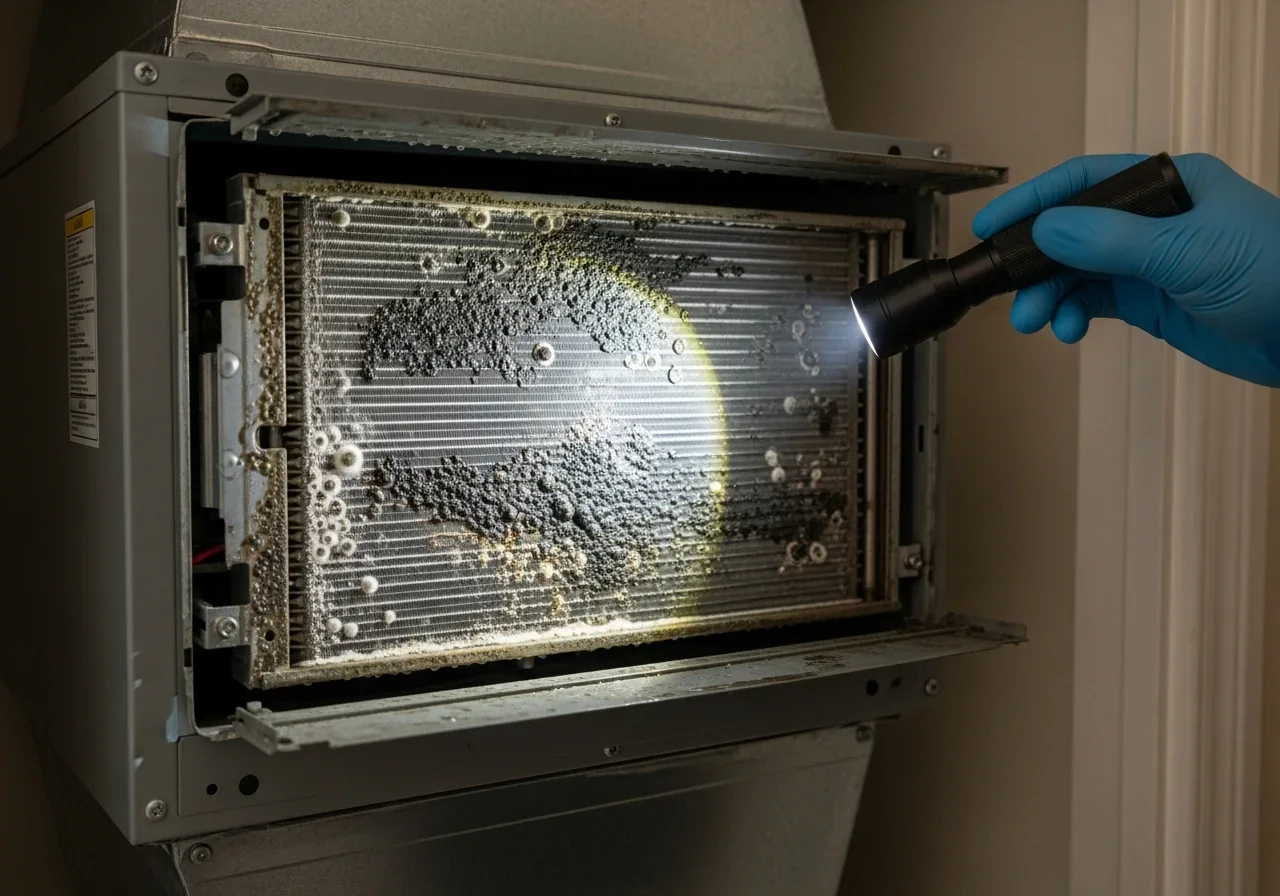
HVAC condensation mold — the most common hidden mold source in Port St. Lucie homes
The "Closed-Up House" Trap
Port St. Lucie's seasonal residents often close up homes for the summer, setting the
thermostat high or turning off the AC entirely. Within days, indoor humidity climbs
past 70-80%. Without dehumidification, every surface in the home — furniture,
clothing, drywall, carpet — absorbs moisture. Mold colonies establish throughout the
house. Many snowbirds return in the fall to find mold on walls, inside closets, and
throughout the HVAC system.
Why Running Fans Is Not Enough
A common misconception: homeowners leave ceiling fans or box fans running in a vacant home
to "keep air moving." In Port St. Lucie, ambient outdoor humidity runs 75-90%. Fans
circulate this moisture-laden air through the home without removing any moisture — you are
effectively pushing wet air across surfaces. Only mechanical dehumidification (AC or a
standalone dehumidifier) actually removes water from the air. The FL Department of Health
recommends maintaining indoor humidity below 60% — impossible with fans alone in the
Treasure Coast climate.
Common HVAC Mold Locations in Port St. Lucie Homes
Evaporator Coil
The coil cools air by pulling heat out — creating constant condensation. Dirt, dust, and organic debris accumulate on coil fins, providing food for mold in a perpetually damp environment. Once colonized, every cubic foot of air passing through the system picks up spores.
Condensate Drip Pan
The pan catches condensation dripping off the evaporator coil. In PSL humidity, pans fill quickly. Cracks, corrosion, or a slightly tilted unit allow water to overflow or pool — creating standing water that feeds mold growth within 24-48 hours.
Condensate Drain Line
The PVC drain line carries condensation outside. Algae, slime, and debris clog these lines regularly in Florida. A clogged line backs up water into the drip pan, the air handler cabinet, and eventually onto the floor or into the attic — the #1 hidden moisture source in PSL homes.
Supply Ductwork
Cool air flowing through ducts creates temperature differentials that produce condensation on duct surfaces, especially at joints and where insulation has deteriorated. Flex duct — common in Port St. Lucie homes — sags at connection points, trapping condensation and creating mold pockets.
Return Air Plenum
The return plenum collects air from the living space — including dust, skin cells, pet dander, and cooking particles. Combined with any moisture, this organic material provides a food source for mold colonies. Contamination in the return plenum distributes spores to the entire system.
Prevention Recommendations for Port St. Lucie Homeowners
Keep Thermostat at 78F or Lower
Maintaining a setpoint at or below 78F ensures the system runs long enough cycles to dehumidify — not just cool. Short cycling from oversized units or high setpoints cools the air without removing moisture, keeping indoor humidity dangerously high.
Standalone Dehumidifier for Vacant Homes
If you leave Port St. Lucie for the summer, a whole-home or portable dehumidifier set to 55% RH prevents humidity spikes that the AC alone may not catch — especially during power outages or if the AC fails while you are away.
Annual HVAC Maintenance
Professional maintenance should include evaporator coil cleaning, drip pan inspection, blower cleaning, and a full duct inspection. In PSL humidity, annual is the minimum — many HVAC professionals recommend biannual service.
Condensate Line Flush Every 3 Months
Flushing the condensate drain line with a vinegar or bleach solution every 90 days prevents the algae and slime buildup that causes clogs. This is the single most effective preventive measure against HVAC mold in Port St. Lucie.
Florida Mold Licensing: What Port St. Lucie Homeowners Must Know
Florida regulates mold work under Chapter 468, Part XVI of the Florida Statutes, administered by the Department of Business and Professional Regulation (DBPR). The
state requires separate licenses for mold assessment and mold remediation — and
explicitly prohibits the same company from performing both services on the same
project.
Mold Assessor (MRSA) — Licensed to inspect, test, and write mold assessment
reports. The assessor identifies the type, extent, and source of mold contamination. They
also perform post-remediation clearance testing to verify the work was done correctly.
Mold Remediator (MRSR) — Licensed to perform the physical work of mold
removal, containment, antimicrobial treatment, and dehumidification. The remediator executes
the remediation plan written by the assessor.
This conflict-of-interest protection ensures the company that identifies
the mold cannot profit from removing it. The assessor who writes the initial report must
be a different licensed entity than the remediator who does the work — and the post-remediation
clearance must come from a separate licensed assessor as well.
Verify DBPR mold remediator license (MRSR) before hiring any company
Assessor (MRSA) and remediator (MRSR) must be separate licensed entities
Same company cannot assess and remediate the same project
Post-remediation clearance must come from an independent licensed assessor
Check any company license status at myfloridalicense.com
Full liability insurance and workers' comp coverage
Works with independent FL-licensed assessors for all pre/post testing
Red Flags to Watch For
No DBPR mold license or refuses to provide license number
Same company offers to both assess AND remediate your mold
Offers to "spray and seal" mold without removing contaminated materials
Will not set up containment barriers or HEPA filtration
Claims "no license is needed" in Florida (false — it is required by law)
Why Independent Testing Matters
Independent pre- and post-remediation testing by a separately licensed assessor
protects you on two fronts: it ensures the scope of work is accurate before
remediation begins, and it provides unbiased verification that spore counts have
returned to acceptable levels after the work is complete. This documentation is also
critical for insurance claims.
Port St. Lucie Pricing
Mold Remediation Costs in Port St. Lucie
Costs vary based on contamination size, materials affected, HVAC involvement, and
whether reconstruction is needed. Most Florida insurance policies cap mold coverage at
$10,000 — moderate and large remediations frequently exceed that limit.
Small Remediation
Single area, accessible mold, <50 sq ft
$1,500 - $3,500
Bathroom mold, single closet wall, window frame, small section of drywall. Typically a contained area with no HVAC involvement and accessible surfaces.
Moderate Remediation
Multiple rooms, concealed mold, HVAC involvement
$3,500 - $10,000
Mold in multiple rooms, behind walls on CBS block, HVAC air handler and ductwork contamination, or mold resulting from a plumbing leak that affected adjacent areas. Requires full containment and possibly HVAC isolation.
Whole-home mold from extended vacancy, major water event, or storm damage. Extensive drywall removal on multiple CBS walls, complete HVAC system remediation, full reconstruction of affected areas. May require temporary relocation.
CBS Construction Can Work in Your Favor
Unlike wood-frame construction, Port St. Lucie's CBS (concrete block and stucco) walls
do not absorb mold the way lumber framing does. Once contaminated drywall is removed and
the block face is cleaned and treated, the structural wall remains intact. This often
means lower material replacement costs compared to wood-frame homes where studs,
sheathing, and sill plates may need replacement.
Insurance Mold Caps in Florida
Most Florida homeowner policies cap mold coverage at $10,000 — some as low as $5,000.
This cap applies even when mold results from a covered water event like a burst pipe.
Moderate and large remediations routinely exceed these limits, leaving homeowners
responsible for the difference. Review your policy's mold endorsement before you need
it.
Insurance Navigation
Mold Insurance Coverage in Port St. Lucie
Mold coverage in Florida has become increasingly restrictive. Understanding the
difference between covered and excluded mold — and meeting strict reporting deadlines —
can mean the difference between a paid claim and a full out-of-pocket expense.
Most Florida homeowner policies cap mold coverage at $10,000 — some policies exclude mold entirely or limit coverage to $5,000
Mold resulting from a covered sudden water event (burst pipe, appliance failure, storm damage) is typically covered up to the policy mold sublimit
Mold from gradual humidity, HVAC condensation, long-term stucco intrusion, or deferred maintenance is almost always excluded as a maintenance issue
Reporting the initial water damage immediately is critical — delayed reporting can give carriers grounds to deny the resulting mold claim
Florida Statute 627.70132 imposes strict claim filing deadlines — failure to report within the statutory window can void otherwise valid claims
Citizens Property Insurance (common in the Treasure Coast market) has particularly restrictive mold coverage and lower sublimits than private carriers
Covered Peril vs. Gradual Damage
The critical distinction: mold from a sudden pipe burst (covered peril) may be
claimable. Mold from years of HVAC condensation dripping (gradual/maintenance) will
not be. When water damage occurs, report it to your carrier immediately — even before
mold appears. This establishes the timeline connecting mold to the covered event.
Palm Build's Approach to Port St. Lucie Mold Claims
When mold results from a covered water event, our documentation connects the mold to the
original loss from day one — moisture maps, timeline photographs, air sampling results,
and remediation scope formatted for the adjuster. We understand Florida's strict claim
filing deadlines and mold coverage sublimits.
For non-covered mold (humidity, HVAC condensation, maintenance issues), we provide
transparent pricing and can discuss payment options. Either way, our documentation
protects your interests.
Real mold remediation work in Port St. Lucie homes — from HVAC contamination to hidden
mold behind walls in CBS construction.
HVAC condensation mold — the most common hidden mold source in Port St. Lucie homes, growing inside the air handler where condensate drainage failed
Hidden mold behind a bathroom vanity — concealed growth on the CBS wall face, discovered during a plumbing leak investigation
EPA-registered antimicrobial treatment applied to exposed CBS block wall and structural surfaces after contaminated drywall removal
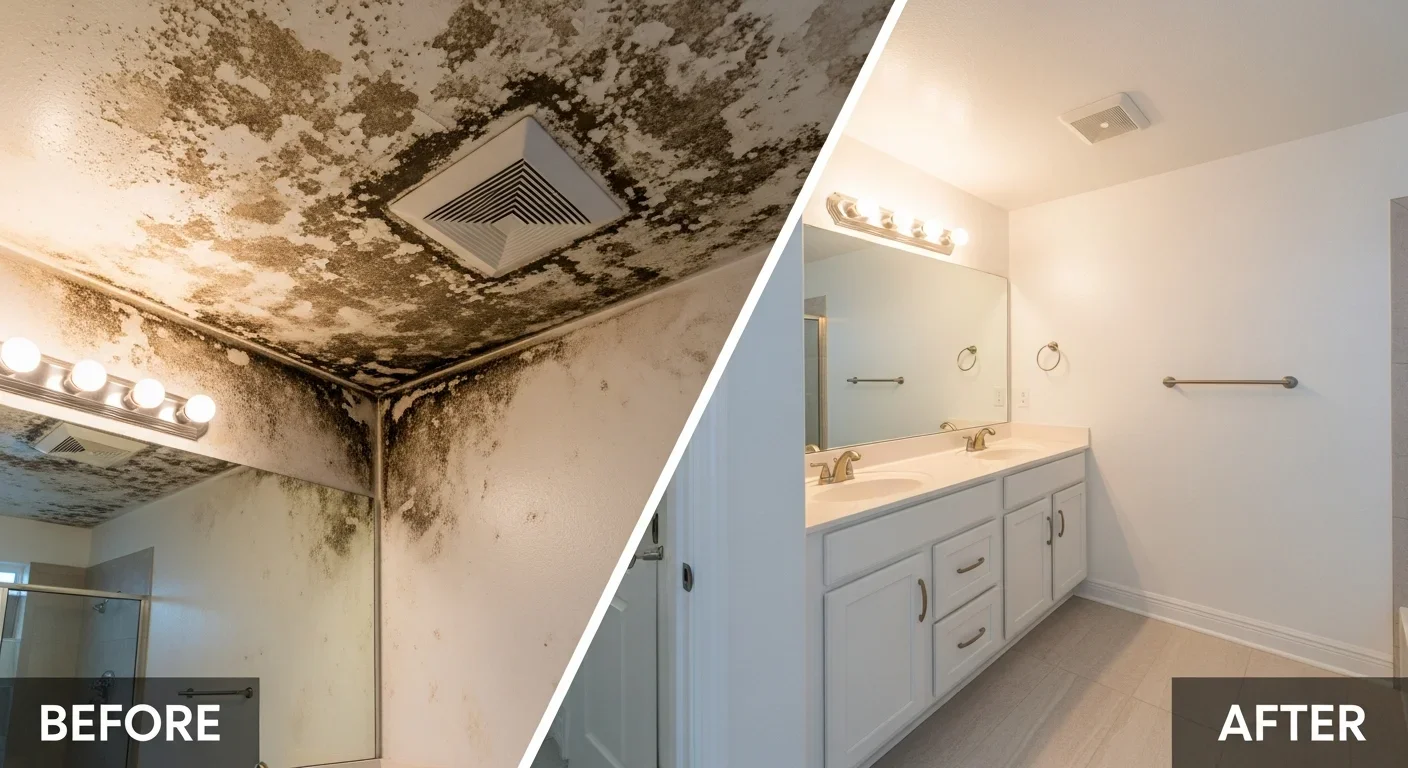
Before and after: professional mold remediation with full containment, HEPA filtration, and independent clearance testing
The Palm Build Difference
Why Port St. Lucie Homeowners Choose Palm Build for Mold
Florida DBPR Licensed Mold Remediator (MRSR)
Palm Build holds a current Florida DBPR mold remediation license (MRSR) and complies fully with Chapter 468, Part XVI requirements. Every project follows Florida's mandatory separation of assessment and remediation — we never assess and remediate the same project.
IICRC-Certified Technicians
Every crew lead carries current IICRC Mold Remediation Specialist (MRS) certification and follows IICRC S520 protocols. Our technicians receive ongoing training in containment procedures, HEPA filtration systems, and antimicrobial application methods specific to Florida construction.
Full Containment with HEPA Filtration & Negative Air
Every remediation project uses sealed polyethylene containment barriers, HEPA air scrubbers for negative air pressure, and HVAC isolation. We do not cut corners on containment — disturbing mold without proper barriers in a CBS home with central AC can spread spores to every room in minutes.
Independent Licensed Assessors for Conflict-Free Testing
We work with independently licensed FL mold assessors (MRSA) for all pre-remediation assessment and post-remediation clearance testing. This separation is required by Florida law and ensures unbiased results — protecting both you and your insurance claim.
Insurance Documentation from Day One
We understand Florida's mold coverage sublimits, claim filing deadlines, and post-reform requirements. Our documentation — moisture maps, timeline photos, air sampling results, and remediation scope — is formatted for adjusters and connects mold to the covered water event.
Treasure Coast Humidity & CBS Construction Expertise
We know Port St. Lucie's specific mold challenges: 2000s-era CBS construction, HVAC condensation in near-constant operation, seasonal vacancy humidity spikes, and the Treasure Coast's subtropical moisture pressure. This local knowledge drives more effective remediation and better prevention recommendations.
Licensed & Insured
Florida DBPR mold remediator (MRSR), IICRC certified, full liability insurance and
workers' compensation. Verify our credentials anytime.
Common Questions
Port St. Lucie Mold Remediation FAQ
How do I know if I need mold remediation in my Port St. Lucie home?
Common signs include musty odors (especially when the AC kicks on), visible discoloration on walls or ceilings, recurring allergy symptoms indoors, and condensation on windows or pipes. In Port St. Lucie's humidity, mold can grow in hidden locations for months before becoming visible. A professional mold assessment with air sampling provides definitive answers.
Is mold remediation covered by insurance in Port St. Lucie?
It depends on the cause. Mold resulting from a covered water damage event — a burst pipe, appliance failure, or storm damage — is typically covered as part of the original claim, subject to policy limits (often $10,000 for mold). Mold from gradual humidity, deferred maintenance, or unreported leaks is generally excluded. Report water damage immediately to preserve your mold coverage rights.
Does Palm Build hold Florida mold remediation licensing?
Yes. Palm Build holds current Florida MRSR (Mold Remediator) licensing through the Department of Business and Professional Regulation as required under Chapter 468, Part XVI. We work with independent licensed mold assessors for pre- and post-remediation testing to ensure conflict-free verification per Florida statute.
How long does mold remediation take in Port St. Lucie?
Most residential mold remediations in Port St. Lucie take 3 to 5 days for the containment, removal, and treatment phases. Post-remediation clearance testing adds 1 to 2 days. Full reconstruction of removed materials may add 1 to 3 weeks depending on scope. Port St. Lucie's humidity requires careful dehumidification throughout the process.
Can I stay in my Port St. Lucie home during mold remediation?
For small, contained remediations (one room, limited scope), you can often stay in the home while containment barriers are in place. For larger remediations affecting HVAC systems, multiple rooms, or common areas, temporary relocation is recommended — especially for household members with respiratory conditions or compromised immune systems.
What causes mold to grow so fast in Port St. Lucie?
Port St. Lucie's subtropical climate provides year-round warmth (mold thrives between 60-80°F) and ambient humidity that regularly exceeds 80% outdoors. When indoor humidity rises above 60% — from a leak, HVAC failure, or a closed-up house — mold spores that are always present in Florida's air can colonize wet materials within 24 to 48 hours.
How do I prevent mold from coming back after remediation?
Prevention starts with humidity control. Keep your HVAC running consistently (78°F or lower), ensure condensate lines are clear and draining properly, address any plumbing leaks immediately, and maintain indoor humidity below 60%. For homes that sit vacant seasonally, consider a standalone dehumidifier with a drain line and a smart humidity monitor.
Trusted Vendors
Trusted local pros in Port St. Lucie
Outside our restoration scope, these are the vetted, licensed contractors we trust
alongside our work. Personally evaluated, reference-checked, and recommended by Palm
Build.
In Port St. Lucie's humidity, mold spreads fast. Call Palm Build for licensed, IICRC-certified mold remediation with containment protocols and clearance testing.