Palm Build technician using moisture meter on interior wall of upscale Weston FL home during mold assessment with dehumidifier running
WESTON FL — FLORIDA-LICENSED MOLD REMEDIATION

Mold Remediation in Weston, Florida

South Florida's sustained humidity, Weston's aging 1990s housing stock, and a stormwater system that keeps 1,877 lakes at your property line create ideal conditions for mold amplification. Palm Build provides Florida-licensed assessment and remediation with full containment, HEPA filtration, and HOA-compliant protocols.

Serving Weston from Deerfield Beach, FL 30 min Response IICRC Certified

30 min

Emergency Response

24/7

Dispatch Available

IICRC

Certified Technicians

Why Mold Thrives Here

Weston's Perfect Storm for Mold Growth

Weston's combination of sustained wet-season dewpoints, aging 1990s housing stock entering its failure window, 1,877 retention lakes elevating ambient humidity, and HOA shared-wall construction creates some of the highest baseline mold risk of any city in western Broward County. Understanding why is the first step toward permanent remediation — not just cosmetic cleanup.

Wet-Season Dewpoints in the 70s°F

70s°F

Wet-season dewpoints

From May through October, Weston sustains dewpoints consistently in the 70s°F — meaning the air itself carries enough moisture to condense on any surface below that temperature. Every cold AC supply duct, every window frame, every slab edge becomes a condensation point. This isn't occasional humidity; it's a sustained, months-long moisture load that pushes water vapor into every building assembly that isn't actively conditioned. Even homes with functional HVAC struggle to keep indoor relative humidity below the 60% mold threshold during peak wet season.
1990s Housing Now in Its Failure Window

52.3%

Built 1990-1999

52.3% of Weston's housing stock was built between 1990 and 1999 — placing HVAC systems, roof underlayments, stucco envelopes, and plumbing connections squarely in the 25-35 year lifecycle window where component failures accelerate. Original barrel tile roofs with felt underlayment are past their rated lifespan. First-generation HVAC ductwork seals have degraded. Stucco has endured decades of thermal cycling, developing hairline cracks that allow wind-driven rain into CBS wall cavities. These aren't catastrophic failures — they're gradual, hidden moisture pathways that feed mold colonies for months before anyone notices.

1,877 Lakes Elevate Ambient Humidity

1,877

Lakes and canals

Weston's master-planned stormwater management system includes 1,877 lakes and canals — more surface water per capita than almost any city in Broward County. These water bodies continuously evaporate moisture into the surrounding air, elevating ambient humidity 5-10% above already extreme South Florida levels for homes within 500 feet of the water's edge. Communities like The Lakes, Bonaventure, and Weston Hills are built directly around these retention systems. Premium lakefront lots command higher prices but face the highest baseline mold risk in the city.

HOA Shared-Wall Moisture Migration

Shared

Wall moisture migration

Weston's HOA-governed townhomes and villas — Isles at Weston, sections of Savanna, and multi-family communities throughout — have shared CBS walls where moisture from one unit can migrate to another through block cavities. A neighbor's undetected leak or HVAC condensate overflow becomes your mold problem. HOA common-area maintenance delays compound the issue: slow roof repairs, deferred exterior painting, and aging shared HVAC infrastructure create moisture pathways that affect multiple units simultaneously.

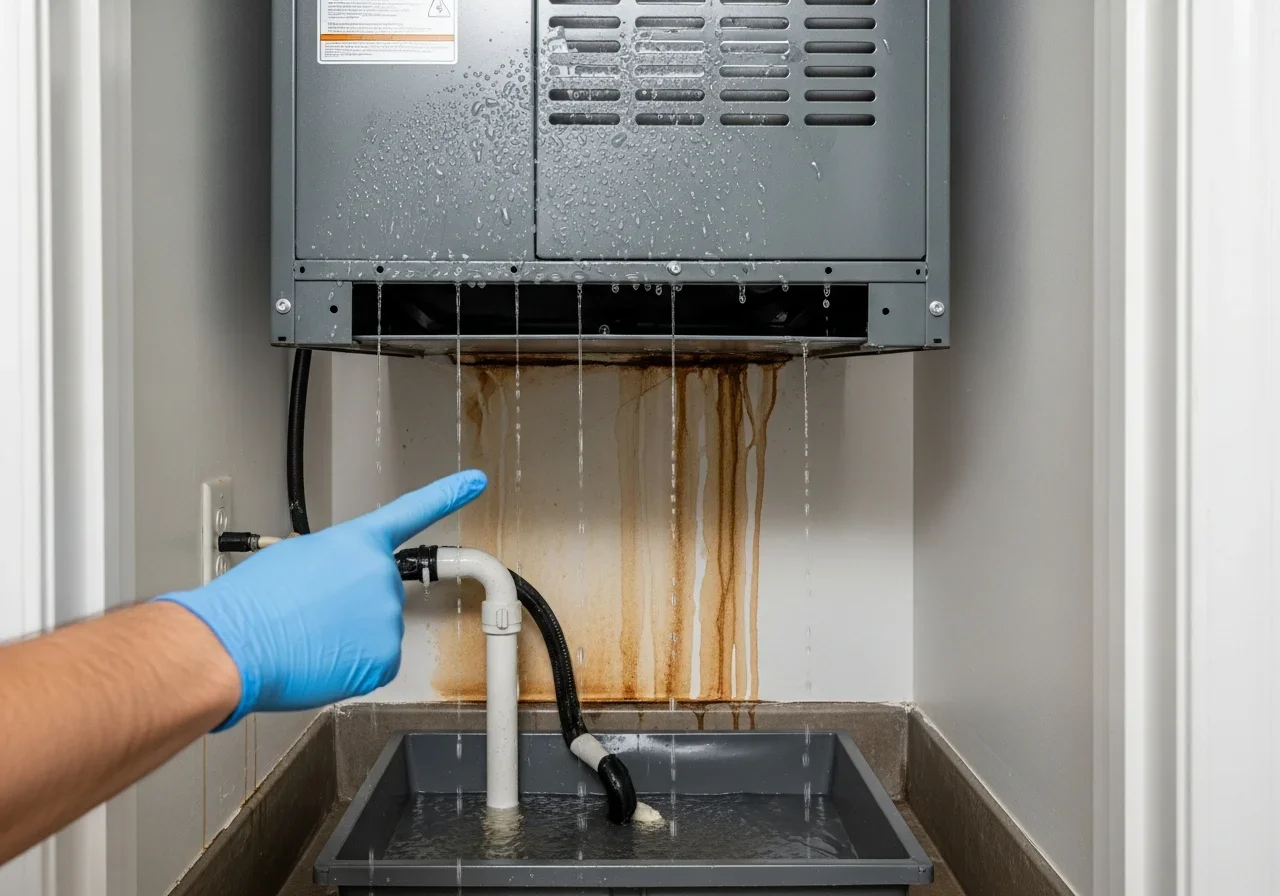
HVAC air handler closet in a Weston FL home showing condensation on supply plenum, clogged condensate drain, and moisture damage — a common source of mold
HVAC condensation is the #1 hidden mold source in Weston — condensate line backups, handler closet moisture, and supply vent condensation all feed mold growth in homes where AC runs 10+ months per year.

Weston's #1 Mold Source

HVAC System Mold: The Hidden Epidemic in Weston Homes

HVAC condensate failures are the single most common mold trigger we respond to across Weston's master-planned communities. AC systems running 10+ months per year generate constant condensation — and when drain lines clog, supply vents sweat, or drip pans overflow, the blower fan distributes mold spores to every room through the ductwork before visible signs ever appear.

Condensate Drain Line Clogs

5-20 gal/day

Condensate volume

The #1 mold trigger in Weston. Condensate drain lines carry water generated by AC evaporator coils to an exterior drain. In South Florida's humidity, these lines produce 5-20 gallons of condensate daily. Algae and biofilm accumulate inside the drain line year-round, eventually creating a complete blockage. When the line clogs, water backs up into the drip pan, overflows into the air handler cabinet, and saturates surrounding drywall, insulation, and flooring — often inside an interior utility closet where the damage goes unnoticed for days or weeks.

Supply Vent Condensation

55-60°F

Supply air temp

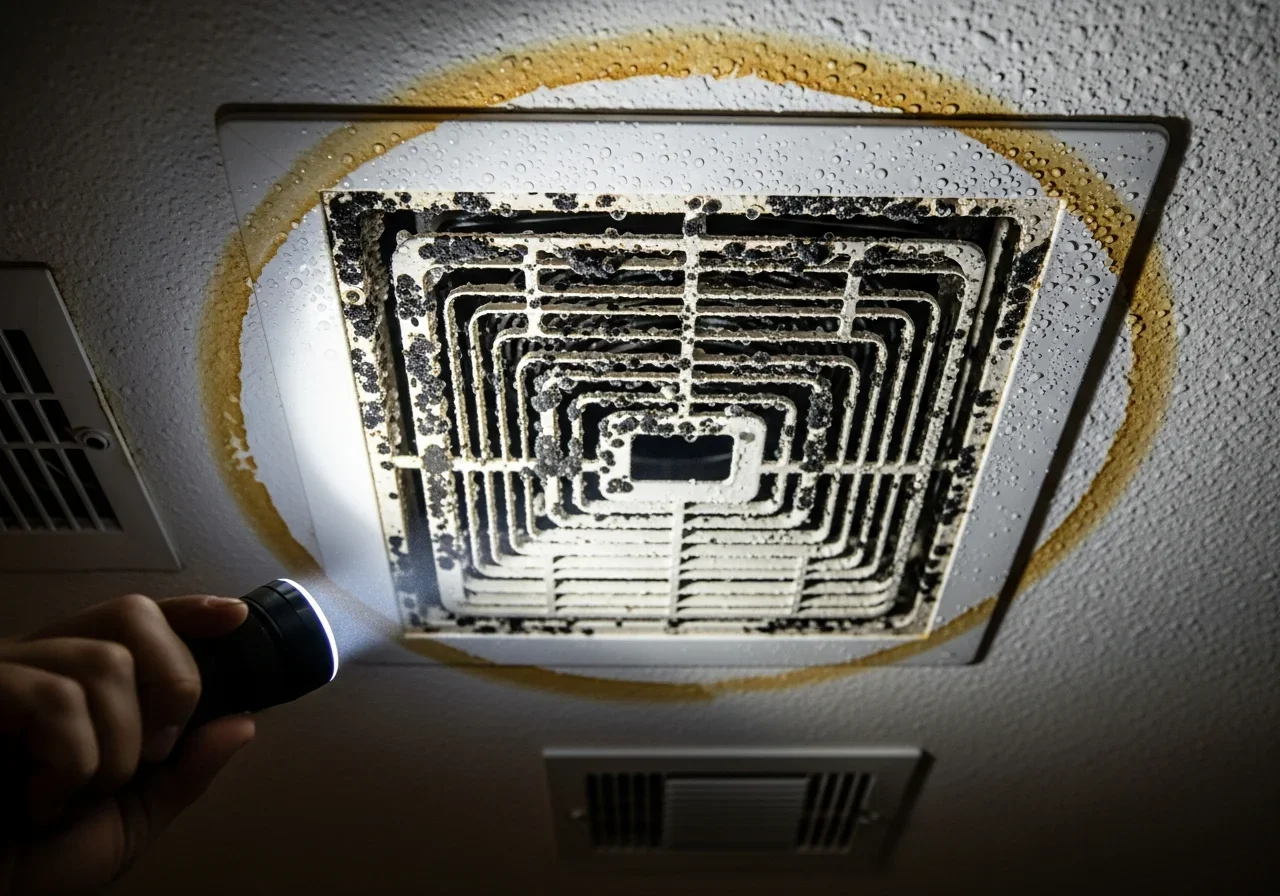
In Weston's homes, cold supply air at 55-60°F exits registers into rooms where attic-side temperatures reach 130°F+. The temperature differential creates condensation on the register boot, the surrounding drywall, and the vent grille itself. Over months, this persistent moisture feeds mold growth that appears as dark rings around ceiling vents — one of the most common visible mold presentations in Weston's 1990s housing stock. The problem is worst in upstairs rooms where ductwork runs through unconditioned attic space.

Air Handler Closet Contamination

Interior

Closet placement risk

Most Weston homes place the air handler in an interior utility closet — a confined, unventilated space where moisture has nowhere to escape. When the primary drip pan overflows or condensate backs up, water saturates the closet floor, adjacent walls, and migrates under baseboards into neighboring rooms. Secondary safety pans with float switches are code-required in newer construction but absent in many 1990s-era Weston homes. By the time water stains appear, mold contamination inside the closet and surrounding walls is typically extensive.

Ductwork Spore Distribution

800-1,200

CFM spore dispersal

Once mold colonizes the air handler — coils, drip pan, blower housing, or supply plenum — the blower fan distributes spores through the entire duct system at 800-1,200 CFM. Every supply register becomes a spore delivery point. Duct interiors develop secondary colonies where condensation collects at low points, boot connections, and takeoff fittings. In Weston's larger homes with multi-zone systems, contamination can be isolated to one air handler while affecting every room on that zone. Complete HVAC remediation requires air handler treatment, duct cleaning, and often component replacement.

Mold growth around AC supply vent register in ceiling of Weston FL home from HVAC condensation
Supply vent condensation mold in a Weston home — the temperature differential between cold supply air and humid attic space creates persistent condensation that feeds mold around ceiling registers.

Warning Signs of HVAC Mold

  • Musty or stale odor when AC cycles on — strongest at supply registers
  • Visible dark spots or rings around supply vents and return grilles
  • Recurring respiratory symptoms, allergies, or headaches that improve when away from home
  • Water stains on ceiling or walls near interior air handler closet
  • AC producing less cooling with same thermostat setting — contaminated coils reduce efficiency
  • Condensate drain line overflow or water pooling around air handler base
Schedule HVAC Mold Inspection

FL Regulatory Landscape

Florida Mold Licensing: What Weston Homeowners Must Know

Florida has one of the strictest mold regulatory frameworks in the country. Under DBPR Chapter 468, Part XVI, the state requires separate licenses for mold assessment and mold remediation — and explicitly prohibits the same company from performing both on the same project within 12 months.

Separate Assessor vs. Remediator Licenses

Florida issues distinct license types: Mold Assessor (inspection, testing, and reporting) and Mold Remediator (physical removal and treatment). Each requires separate application, insurance, and examination. This separation prevents the entity that finds mold from profiting by removing it — a consumer protection unique to Florida among restoration licensing.

The 12-Month Conflict-of-Interest Rule

The same company cannot perform both mold assessment and mold remediation on the same structure within 12 months. This means your initial mold assessor and your post-remediation clearance tester must be independent from the remediation company. In Weston, where some operators try to bundle both services, this rule is frequently violated — making license verification critical.

Education and Experience Requirements

DBPR mold licenses require documented training hours, passing a state examination, proof of $1 million general liability insurance, and continuing education credits for renewal. Mold remediators must additionally demonstrate financial responsibility and workers' compensation coverage. These requirements ensure licensed operators have the training and resources to handle contamination safely.

How to Verify a Florida Mold License

Before hiring any mold company in Weston, verify their DBPR license at myfloridalicense.com. The lookup is free and instant — search by company name or license number. Confirm the license type (assessor vs. remediator), status (active/inactive), and expiration date. Any company that refuses to provide a license number or claims "no license needed" should be avoided.

Verify License on DBPR Website
Verify the mold assessor holds a current Florida Mold Assessor license (DBPR)
Verify the mold remediator holds a current Florida Mold Remediator license (DBPR)
The assessor and remediator should be different entities — Florida law separates these roles to prevent conflicts
Ask for license numbers and verify them on the DBPR license search portal
Confirm the company carries liability insurance covering mold remediation work
Request a written remediation protocol (the assessor's report should define the scope the remediator follows)
Ensure post-remediation clearance testing is performed by the licensed assessor, not the remediator
Be cautious of companies offering to "test and remediate" — the roles should be separate

Palm Build Credentials

  • DBPR-licensed mold remediator — Florida compliant
  • IICRC AMRT (Applied Microbial Remediation Technician) certified
  • CBS construction and HVAC mold expertise
  • $1M+ general liability insurance and workers' comp coverage
  • Coordinates with independent FL-licensed assessors for clearance
  • Deerfield Beach hub — 30-minute response to all Weston communities

Red Flags to Watch For

  • No DBPR mold license or refuses to provide license number
  • Same company offers to assess AND remediate your mold
  • Offers to "spray and seal" without removing contamination
  • No containment barriers or HEPA filtration during work
  • Claims "no license needed" in Florida (false — it is state law)
  • Targets HOA communities door-to-door after storms without credentials

Insurance Impact of Unlicensed Work

Florida insurance carriers increasingly require proof of DBPR licensing for mold remediation claims. Work performed by an unlicensed operator may void your mold coverage, disqualify your remediation from the claim, or provide grounds for the carrier to deny the entire loss. Always verify licensing before work begins.

Neighborhood Risk Profiles

Mold Risk by Weston Community

Mold risk in Weston varies by community based on construction era, proximity to retention lakes, building type, and HVAC system age. Bonaventure's late-1980s housing stock, The Lakes' water adjacency, and Isles at Weston's shared-wall construction face the highest baseline exposure.

Weston Hills

High Risk 1990s
Primary Mold Driver:

Complex roof elevations trap moisture; aging underlayment allows attic humidity

Common Species / Location:

Aspergillus, Cladosporium on attic sheathing and ceiling surfaces

Bonaventure

Critical Risk Late 1980s-1990s
Primary Mold Driver:

Oldest housing stock with aging HVAC and plumbing — repeated small leak events

Common Species / Location:

Penicillium, Aspergillus behind vanities, under sinks, at handler closets

The Lakes

Critical Risk 1990s
Primary Mold Driver:

Lake adjacency keeps exterior humidity elevated at building envelope year-round

Common Species / Location:

Cladosporium on window frames, AC registers; Aspergillus in wall cavities

Savanna

High Risk 2000s
Primary Mold Driver:

AC condensate control issues under wet-season dewpoints

Common Species / Location:

Supply vent condensation mold, handler closet moisture, duct boot leaks

Isles at Weston

Critical Risk 1990s-2000s
Primary Mold Driver:

Shared walls allow moisture migration between units; HVAC in unconditioned spaces

Common Species / Location:

Multi-unit cross-contamination; mold in party walls and shared attic spaces

Emerald Estates

High Risk 1990s
Primary Mold Driver:

Window/door seal failure and stucco crack moisture pathways

Common Species / Location:

Hidden mold behind drywall at stucco penetrations; CBS wall moisture

IICRC S520 Protocol

Our Weston Mold Remediation Process

Professional mold remediation follows a strict sequence defined by the IICRC S520 standard and Florida DBPR regulations. Here is exactly what happens when Palm Build's licensed team arrives at your Weston home.

01

Licensed Assessment

Day 1

A Florida-licensed mold assessor inspects the property using moisture meters, thermal imaging, and visual examination. The assessment identifies the moisture source — HVAC condensate overflow, stucco crack intrusion, roof underlayment failure, or lake-adjacent humidity — and maps all affected areas. Air and surface sampling may be included. The assessor produces a written remediation protocol that defines the scope of work the remediator must follow.

02

HOA Notification & Containment

Day 1-2

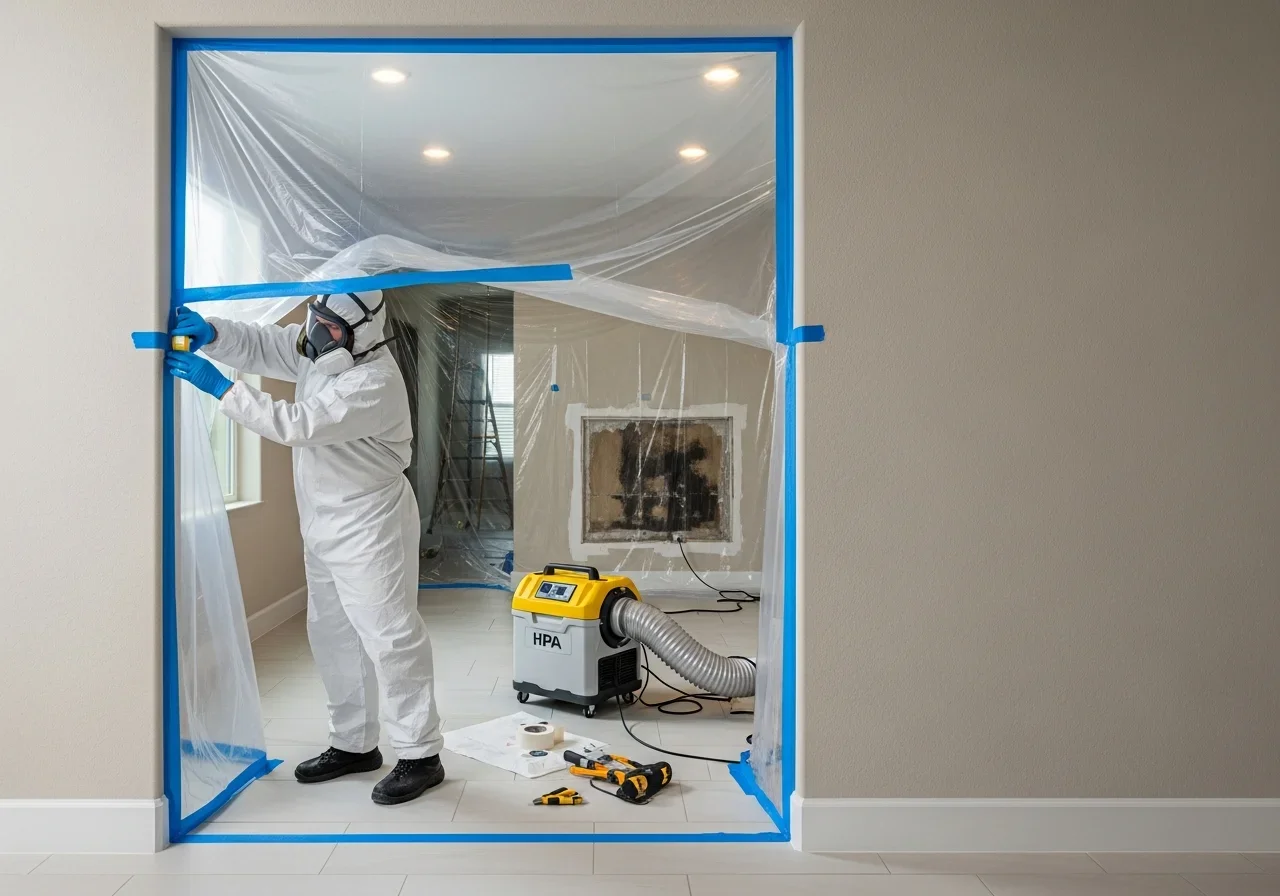
For Weston's HOA communities, we notify the association before work begins and coordinate staging, parking, and noise schedules. Full containment is established using polyethylene sheeting and negative air pressure with HEPA-filtered air scrubbers — preventing spore migration to unaffected areas, neighboring units, and common areas. In shared-wall townhomes at Isles at Weston and similar communities, containment extends to party wall interfaces.

03

HEPA Vacuuming

Day 2

All mold-affected surfaces are HEPA vacuumed to capture loose spores before material removal begins. Porous materials with embedded growth — drywall, insulation, carpet, and affected ceiling tiles — are removed and disposed of in sealed bags. Non-porous CBS (concrete block structure) walls are cleaned and prepared for antimicrobial treatment. HVAC components are isolated during this phase to prevent spore distribution.

04

Antimicrobial Treatment

Days 2-3

EPA-registered antimicrobial agents are applied to all treated and adjacent surfaces. For CBS construction common in Weston, antimicrobial-coated encapsulants may be applied to treated block surfaces to prevent recurrence. HVAC components — evaporator coils, drip pans, supply plenums, and duct interiors — receive specialized treatment if contamination has entered the air handling system.

05

Moisture Source Correction

Days 3-4

Remediation without fixing the moisture source guarantees recurrence. Depending on the root cause, we address AC condensate line repair or rerouting, stucco crack sealing, roof underlayment repair, plumbing corrections, or enhanced dehumidification strategies. For lake-adjacent properties in The Lakes and Bonaventure, this may include whole-home dehumidification systems to manage elevated ambient humidity.

06

Post-Remediation Clearance

Day 4-5

The licensed mold assessor — not the remediator — performs post-remediation clearance testing. This includes visual inspection and air sampling to verify that airborne spore counts have returned to acceptable levels. Florida law requires this separation of roles. Complete documentation is provided for your records, insurance carrier, and HOA if required by your Weston community's governing documents.

Palm Build technician in Tyvek suit installing mold containment with plastic sheeting and HEPA air scrubber in a Weston FL home

Why Containment Matters in Weston's Climate

Disturbing mold without proper containment sends billions of spores airborne. In Weston's sustained humidity with 1,877 retention lakes elevating ambient moisture, those spores find viable growth surfaces within hours — and the HVAC system can distribute them to every room within minutes. Our containment protocol ensures mold stays isolated during removal.

1

Sealed Barriers

Polyethylene sheeting floor-to-ceiling on CBS walls

2

Negative Pressure

HEPA air scrubbers pull air through containment zone

3

HVAC Isolation

AC system sealed to prevent spore distribution

4

Decontamination

Air lock entry/exit with HEPA decon chamber

Schedule Mold Assessment

Year-Round Risk

Weston Mold Risk Calendar

Unlike northern cities where winter freezing halts mold growth, Weston never drops below mold-favorable conditions. The risk ranges from elevated to critical — it is never low. Understanding the seasonal pattern helps you time inspections, maintenance, and insurance deadlines.

January - April

Elevated Risk Dry Season — Discovery Period

Lower humidity reveals musty odors that were masked by constant AC operation. Homeowners discover mold behind furniture, in closets, and at handler closets during deep cleaning. Weston's dry season still averages 60-70% relative humidity — above the mold threshold in most indoor environments. This is the best window for proactive mold assessments, preventive HVAC maintenance, and condensate line cleaning before wet-season load surges.

May - June

High Risk Wet Season Onset — HVAC Stress Begins

AC systems ramp to full operation as dewpoints climb into the 70s. Condensate lines under heavy load are most likely to clog or overflow. June's 9.55 inches of rain drives humidity against every building surface. Wind-driven rain through stucco cracks feeds hidden mold colonies in CBS wall cavities. This is when dormant mold colonies in Weston's 1990s housing stock explode into visible contamination.

July - September

Critical Risk Peak Season — Amplification

Maximum mold risk. Sustained high humidity creates ideal conditions for rapid mold amplification. Any water event — even a minor one — can trigger colonization within 24-48 hours. HVAC condensation is at its worst as systems run continuously against extreme heat and humidity. Tropical storm remnants add massive rainfall events. Power outages disable AC, causing indoor humidity to spike above 85% within hours.

October - December

High Risk Late Season — Insurance Clock Ticking

Still within wet-season window through mid-October. Homeowners who delayed addressing summer moisture events face expanding mold colonies. Florida's 1-year insurance claim filing deadline (Fla. Stat. 627.70132) means damage from early wet season events approaches its filing window. Post-hurricane discovery lag creates a secondary surge as Weston homeowners find hidden moisture damage weeks or months after storms pass.

Florida's 1-Year Insurance Deadline: Don't Wait

Under Fla. Stat. 627.70132, all property claims — including mold resulting from a covered water event — must be filed within 1 year of the date of loss. If you discover mold months after a water event, document the connection between the original event and the mold growth immediately. Palm Build provides insurance-ready documentation linking moisture source to mold amplification timeline.

Common Mold Sources

Mold in Weston Homes: What We See

These are the most common mold presentations we encounter in Weston's 1990s-era CBS construction — from HVAC condensation and stucco moisture intrusion to aging roof underlayment failure and slab vapor transmission.

Mold growth around AC supply vent register in ceiling of Weston FL home from HVAC condensation
AC vent condensation mold — the #1 hidden source in Weston homes where cold supply air meets humid attic space, creating persistent condensation around ceiling registers
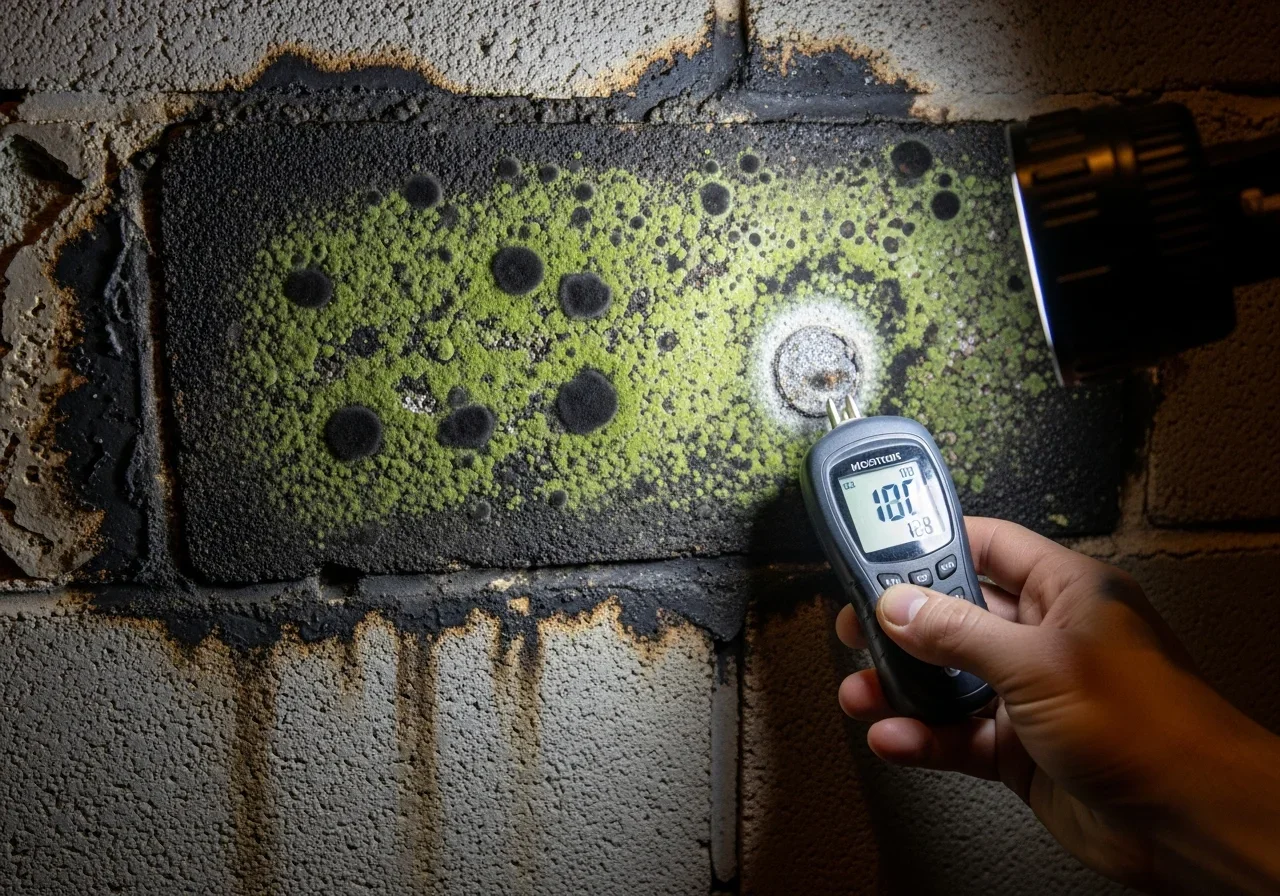
Black and green mold on CBS concrete block wall behind removed drywall in a Weston FL home from stucco moisture intrusion
Hidden mold behind drywall on CBS block — stucco cracks from decades of thermal cycling allow moisture into wall cavities where mold thrives unseen for months
Aging terra cotta tile roof on Weston FL home showing cracked tiles and deteriorated underlayment allowing moisture entry
Tile roof underlayment failure — after 25-30 years, the felt paper under Weston's barrel tile roofs deteriorates, allowing moisture into attic spaces where mold colonizes sheathing
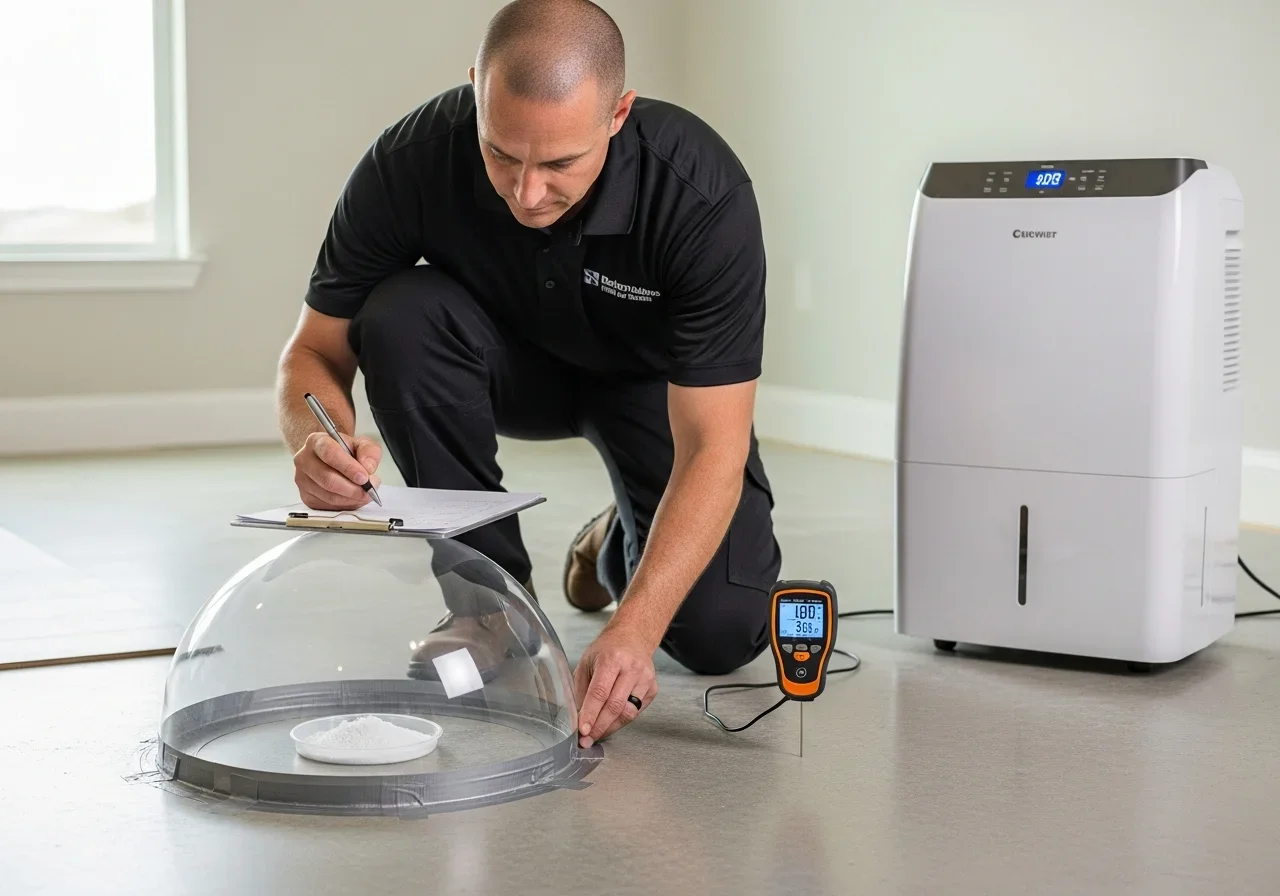
Slab moisture testing with calcium chloride test kit on concrete floor in a Weston FL home during mold assessment
Slab RH testing before new flooring — elevated slab moisture in Weston can drive mold growth under flooring; testing prevents installing materials over an active moisture source

Weston Pricing

Mold Remediation Costs: Weston vs. National Average

South Florida mold remediation costs typically exceed national averages due to Weston-specific factors: CBS construction requiring specialized techniques, mandatory DBPR-licensed separate assessors, HVAC system scope, Florida insurance complexity, and HOA coordination requirements.

FL Licensed Assessment

Air sampling, moisture meters, thermal imaging, DBPR-licensed assessor report

Weston

$300 - $1,000

National Avg.

$250 - $700

Standard Remediation

Single room: bathroom, closet, utility closet, or small contained area

Weston

$2,000 - $6,000

National Avg.

$1,500 - $4,000

HVAC System Mold

Air handler, evaporator coil, drip pan, ductwork cleaning or replacement

Weston

$3,000 - $8,000

National Avg.

$2,000 - $6,000

Multi-Room Remediation

Multiple rooms, CBS wall cavities, attic, extensive ductwork contamination

Weston

$6,000 - $18,000

National Avg.

$4,000 - $12,000

Whole House Remediation

Full-home contamination, structural, post-flood, complete CBS cavity scope

Weston

$12,000 - $35,000+

National Avg.

$8,000 - $22,000

Why Weston Mold Costs Run Higher Than National Averages

South Florida mold remediation costs typically exceed national averages due to several Weston-specific factors: CBS (concrete block and stucco) construction requires specialized demolition and restoration techniques that wood-frame specialists lack. HVAC system contamination — the most common mold source in Weston — adds air handler, evaporator coil, and ductwork scope to the project. Florida's mandatory separate-assessor requirement adds independent testing costs at both pre- and post-remediation phases. Weston's HOA communities require coordination, compliance documentation, and sometimes architectural review for exterior restoration. However, proper remediation prevents far more expensive structural damage, health consequences, and property value losses in a city where home values remain among western Broward County's highest.

Insurance Navigation

Mold Insurance Claims in Weston

Mold coverage in Florida is limited and has become more restrictive following recent insurance reforms. Understanding sublimits ($10K-$50K typical caps), the gradual damage exclusion, DBPR licensing requirements, and post-AOB reform changes can save Weston homeowners thousands.

Most Florida policies cap mold coverage with sublimits of $10,000 to $50,000 — HVAC mold and CBS wall remediation in Weston frequently exceed these limits, leaving homeowners responsible for the difference

Mold resulting from a covered sudden water event (burst pipe, appliance failure, storm damage) is typically covered up to your policy's mold sublimit

Mold from gradual moisture, humidity, HVAC condensation, slab vapor transmission, or long-term stucco intrusion is almost always excluded as a maintenance issue

Florida's DBPR licensing requirement means unlicensed mold work can void your insurance claim — carriers increasingly require proof that the remediator holds a current FL mold license

Florida's 1-year claim filing deadline (Fla. Stat. 627.70132) is strictly enforced — delayed discovery of mold from earlier water events can reduce coverage or void claims

Post-AOB reform (2023 SB 2-A) eliminated assignment of benefits for property insurance claims — homeowners must now manage the claim process directly or work with a public adjuster

Some Florida carriers offer mold endorsements for additional premium that raise the sublimit — ask your agent about expanded coverage before you need it

Document the Moisture Source Connection

For mold resulting from a covered water event, establishing the connection between the original water intrusion and the subsequent mold growth is critical for claim approval. Palm Build provides moisture source documentation including thermal imaging, moisture mapping, timeline analysis, and scope reports that connect the mold to the covered peril — the key factor insurance adjusters evaluate when processing mold claims.

Common Carriers in Broward County

Citizens Property InsuranceUniversal Property & CasualtyHeritage Property & CasualtySecurity First InsuranceFedNat InsuranceTower Hill Insurance

Each carrier has different mold sublimits, endorsement options, and claim handling procedures. We document remediation work to satisfy all major Broward County carriers.

Palm Build's Approach to Weston Mold Claims

When mold results from a covered water event, our documentation connects the mold to the original loss — moisture maps, infrared thermal images, air quality reports, and remediation scope all formatted for the adjuster. We understand post-AOB reform requirements, Florida's strict 1-year claim deadline, and Broward County-specific claim patterns. For mold not covered by insurance (HVAC condensation, humidity, gradual moisture), we provide transparent pricing and financing options. For Weston HOA properties, we coordinate documentation between unit owner policies and master HOA policies.

Insurance Claims Guide

The Palm Build Difference

Why Weston Homeowners Choose Palm Build for Mold

FL Licensed (DBPR)

Palm Build holds a current Florida DBPR mold remediation license and complies fully with Chapter 468, Part XVI requirements. We coordinate with independent DBPR-licensed assessors for the conflict-of-interest separation Florida law mandates — the same company cannot assess and remediate on the same property within 12 months. Every Weston project follows this legal framework, and we welcome license verification through the DBPR portal.

HOA-Compliant Containment

Weston's master-planned communities require HOA coordination for gate access, work hours, noise restrictions, staging, and compliance documentation. We understand community association processes, maintain current insurance certificates required by HOAs, and provide project documentation formatted for board review. From Weston Hills to Bonaventure, we work within your community's requirements — including neighbor notification for shared-wall townhomes.

Moisture Source Correction

Remediation without fixing the moisture source guarantees recurrence. We identify and address the root cause — HVAC condensate line repair, stucco crack sealing, roof underlayment repair, plumbing corrections, or enhanced dehumidification for lake-adjacent properties. Our technicians understand Weston's 1990s CBS construction, the specific failure modes of aging building components, and the elevated ambient humidity from 1,877 retention lakes.

Premium Finish Preservation

Weston's homes feature premium finishes — custom cabinetry, engineered hardwood, imported tile, and designer fixtures. Our remediation and reconstruction teams work together to preserve existing finishes wherever possible and match materials precisely when replacement is required. We understand that in Weston's upscale communities, the quality of the finished product matters as much as the remediation itself.

Palm Build restoration team performing mold remediation with full containment in a Weston FL upscale home
Palm Build's licensed mold remediation team at work in a Weston home — full containment, HEPA filtration, and HOA-compliant protocols from our Deerfield Beach hub, 30 minutes from every Weston community.

Common Questions

Weston Mold Remediation FAQ

Does Florida require mold remediation licensing?
Yes. Areas over 10 sq ft require a licensed mold assessor and a licensed mold remediator under Chapter 468, Part XVI. These must be separate roles. Verify through DBPR.
What is the most common source of mold in Weston homes?
HVAC condensation. AC runs 10+ months/year and condensate lines, handler closets, and supply vent connections all create moisture that feeds hidden mold.
How do I know if I have mold?
Persistent musty odors, visible discoloration, dark spots around AC registers, allergy symptoms, and water staining around windows are common signs.
How much does mold remediation cost in Weston?
Standard: $3,000-$9,000. HVAC: $3,000-$8,000. Multi-room/whole house: $12,000-$40,000+. FL licensing adds $700-$1,800 for assessment and clearance.
Will mold come back after remediation?
Only if the moisture source isn't fixed. In Weston, that means HVAC condensate management, stucco sealing, roof repair, or enhanced dehumidification.
How does HOA coordination work?
We handle HOA notification, staging coordination, noise schedules, and provide association-ready documentation. For townhomes, we assess party-wall migration.
How long does mold remediation take?
Small areas: 1-2 days. Single room: 2-3 days. HVAC: 3-5 days. Multi-room: 1-2 weeks. Add time for FL-required assessment and clearance testing.
Does Palm Build serve all of Weston?
Yes. All communities including Weston Hills, Bonaventure, The Lakes, Country Isles, The Ridges, Savanna, Emerald Estates, and the broader western Broward metro.
Trusted Vendors

Trusted local pros in Weston

Outside our restoration scope, these are the vetted, licensed contractors we trust alongside our work. Personally evaluated, reference-checked, and recommended by Palm Build.

View all trusted vendors in Weston
plumbing

F1 Plumbing Corp

Miami, FL

The only Latina-owned, SBA-WOSB-certified plumber on Palm Build's directory — Niurka Muñoz's Miami-Dade-and-Broward shop carries DOT DBE certification, federal SAM.gov registration, and bilingual English/Spanish dispatch as published baseline.

4.7 · 55 reviews View profile
plumbing

John the Plumber, Inc.

Pompano Beach, FL

John the Plumber is the oldest vendor on Palm Build's directory — John Krobatsch's 1979 third-generation Pompano Beach family shop carries three active Florida CFC licenses (CFC057705/057318/057704), 1,975 Google reviews at 4.9 stars (the largest absolute sample on our list), a BuildZoom score of 116 placing it in the top 2% of 191,428 FL contractors, and BBB A+ Accredited since 9/7/2022.

4.9 · 1,975 reviews View profile
plumbing

Mainline Plumbing Service, Inc.

Pompano Beach, FL

Mainline Plumbing, AC & Electrical is the only multi-trade vendor on Palm Build's directory — three active Florida state licenses under one entity (plumbing CFC1429264, air conditioning CAC1823791, electrical EC13003477), one truck dispatched for all three scopes, 4.8 stars across 854 Google reviews, and a 24/7 live-answering line behind the standard Monday–Saturday 8:00 AM – 7:00 PM dispatch window.

4.8 · 854 reviews View profile
plumbing

West End Plumbing

Sunrise, FL

West End Plumbing has been BBB A+ Accredited since January 14, 2011 — fifteen unbroken years — and operates from a Sunrise HQ that puts every truck within a 30-minute drive of central Broward and the Palm Beach county line. Founded in 1980 and run today by Adam Stricker as A & I West End Plumbing, Inc. under Florida CFC1427334, they cover all of Broward and most of Palm Beach — the widest single-trade footprint of any plumber on the Palm Build directory.

4.8 · 251 reviews View profile

Mold in Your Weston Home? Get Licensed Help.

Palm Build provides Florida-licensed mold remediation with full containment, HEPA filtration, and HOA-compliant protocols. Discreet. Professional. Documented. Call now for an assessment.

30 min Response IICRC Certified