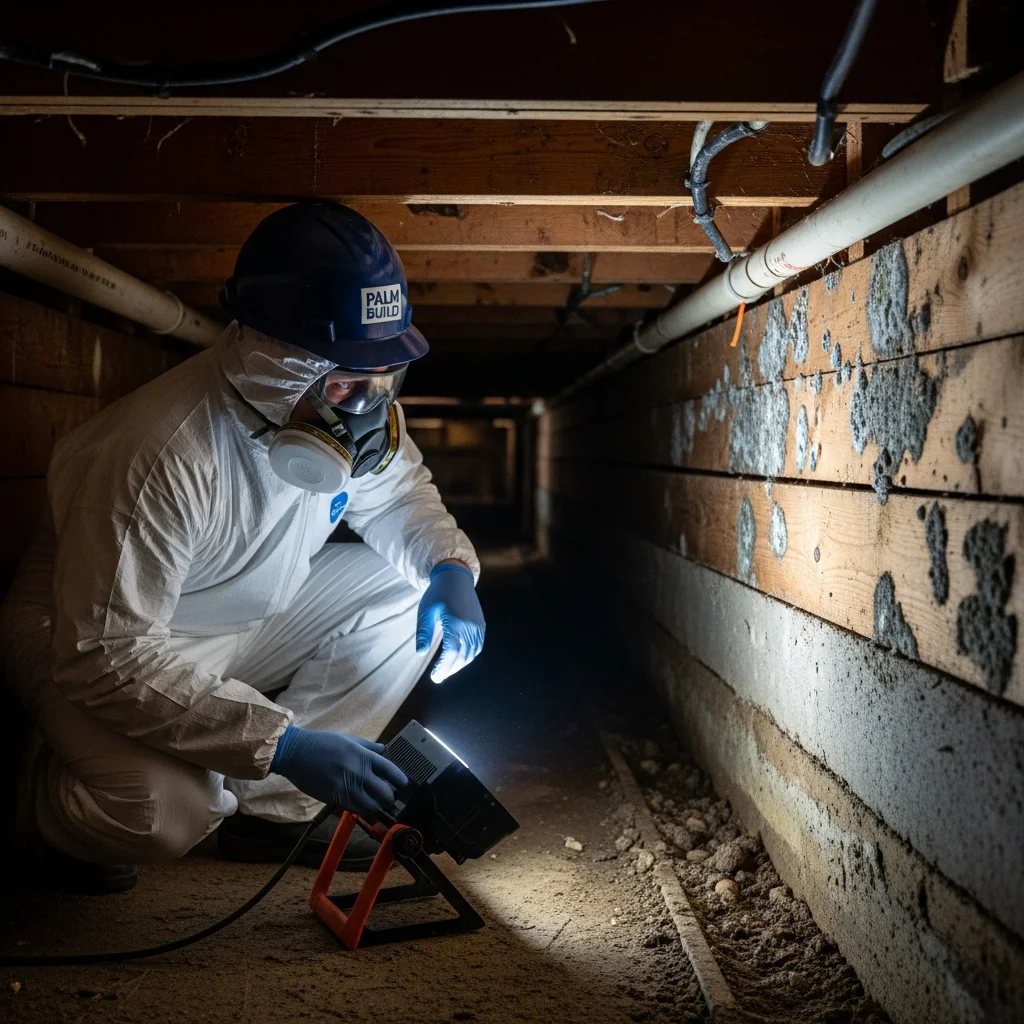
Weddington's Cecil-series clay soil drives continuous ground vapor upward through vented crawl spaces. Combined with 70-90% summer humidity and the estate HOA communities of Stratford on Providence, Weddington Chase, and Providence Woods South, mold builds silently in structural wood until it's a health hazard and a major repair scope. Palm Build's IICRC S520-certified team reaches Weddington in 35-45 minutes from Charlotte — with full containment, EPA-registered treatment, and the documentation your insurer needs.
~20 miles from Weddington 35-45 min Response IICRC Certified
Weddington's ZIP 28104 sits at the intersection of four compounding mold drivers: clay
soil that keeps foundations wet, summer humidity that sustains mold growth without any
leak, widespread vented crawl space construction, and large-lot moisture convergence.
Most homeowners don't find out until structural wood is already compromised.
Clay Soil Ground Vapor
<0.2 in/hr
Clay soil drainage rate
Union County's Cecil-series clay soil drains at less than 0.2 inches per hour — keeping the ground beneath Weddington crawl spaces wet for days after rain ends. Ground vapor continuously migrates upward through vented crawl space foundations into the structure's wood framing. This passive vapor drive is constant, invisible, and relentless — most Weddington homeowners never know it's happening until mold is visible on floor joists.
70–90% Summer Humidity
70–90%
Summer humidity range
Weddington's humid subtropical climate drives summer relative humidity to 70–90% from May through October. Vented crawl spaces — still common in most of Weddington's established HOA communities — track outdoor humidity closely, meaning the space under your home reaches and sustains mold-permissive conditions for months without any water intrusion event at all. At 70%+ sustained humidity, dormant mold spores reactivate and existing colonies expand.
Crawl Space Prevalence in Estate HOAs
1989–2008
HOA community build era
A large share of Weddington's established HOA communities — Weddington Heights, Weddington Heritage, Weddington Woods, Weddington Chase, Stratford on Providence — were built with vented crawl space foundations. Building science now recognizes this design as incompatible with humid southeastern climates. Many of these homes have never had a professional moisture assessment, and mold has developed silently in crawl spaces for years. Large HOA estate homes with multi-zone HVAC further mask the musty odors that would otherwise prompt investigation.
Septic & Large-Lot Moisture Convergence
1+ acres
Typical Weddington lot size
Most Weddington properties use on-site septic systems on large lots of one acre or more. The combination of septic drain field saturation, surface runoff concentration from extensive landscaping and hardscaping, and clay soil ground moisture creates multiple moisture convergence points near foundations. On larger estate lots in Providence Woods South and Stratford on Providence, multiple convergence zones can sustain elevated crawl space humidity year-round.
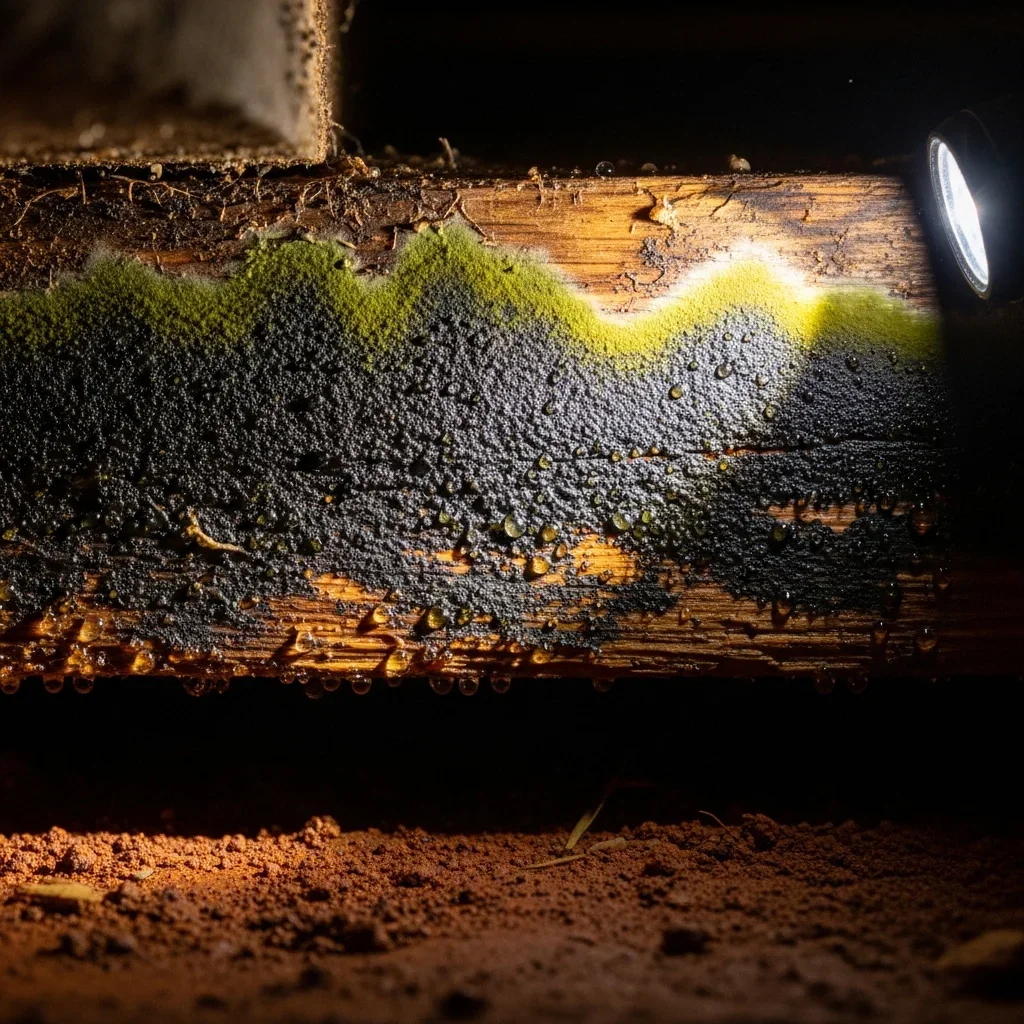
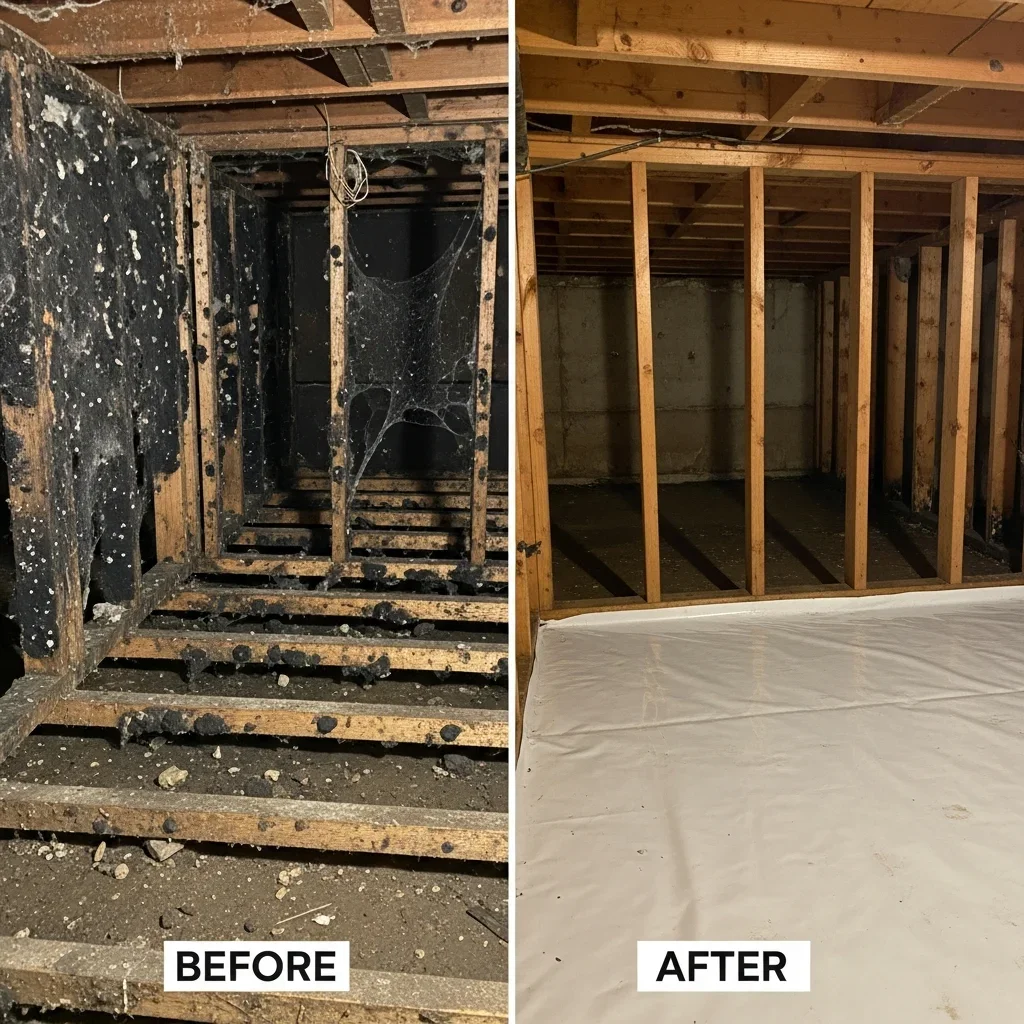
Mold colonies on floor joists beneath a Weddington NC estate home — the result of
sustained clay soil ground vapor and summer humidity in a vented crawl space. This
pattern is common and underdiagnosed in 28104's established HOA communities.
Warning Signs
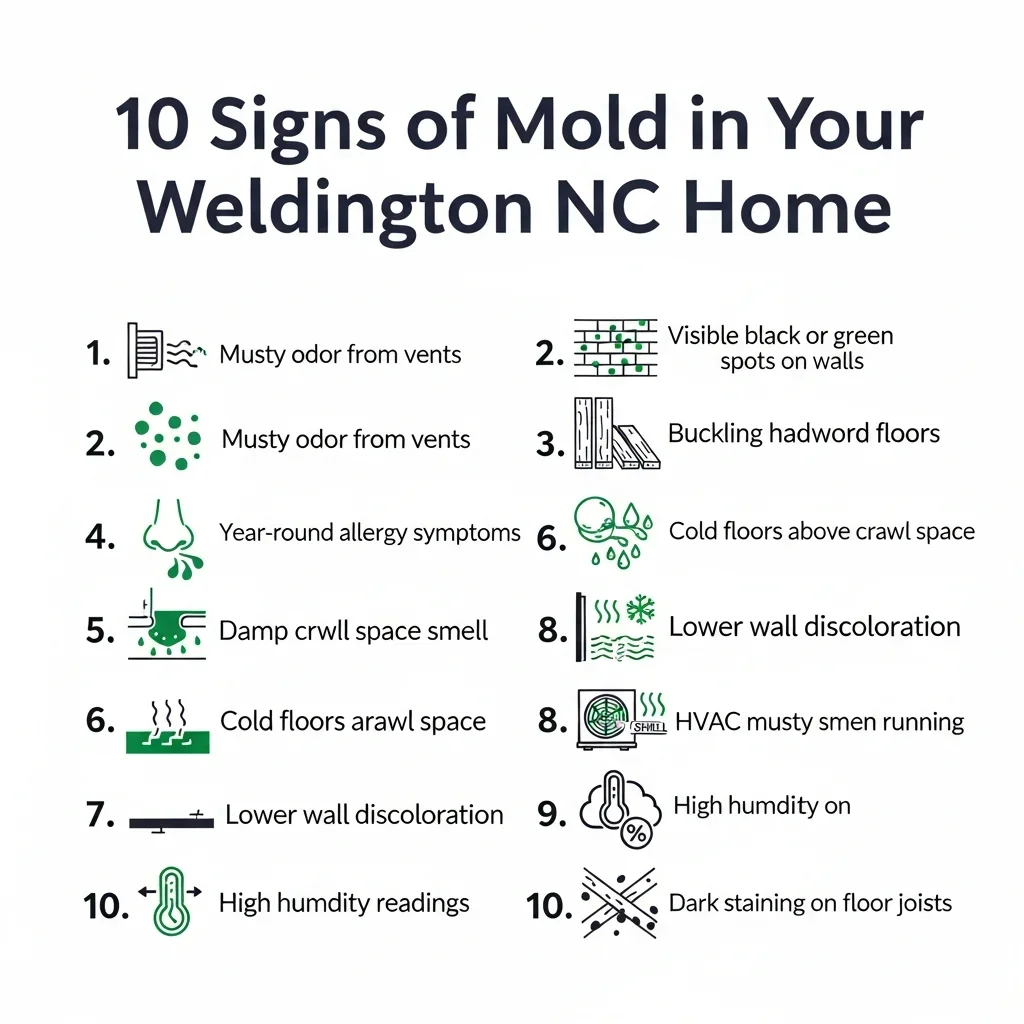
8 Signs of Mold in Your Weddington NC Home
Mold in Weddington estate homes often develops silently in crawl spaces and wall
cavities for months before it becomes visible. These are the early warning signs — and
what each one means for your home.
01
Persistent Musty Odor from HVAC Vents
A musty smell that intensifies when the HVAC runs is a strong indicator of mold in the ductwork or crawl space. In Weddington's multi-zone estate homes, HVAC systems can pull contaminated air from a moldy crawl space and distribute it throughout the entire home before anyone notices the odor at the source.
02
Visible Discoloration on Walls or Ceilings
Black, green, or gray spotting on drywall, especially in lower-level rooms, bathrooms, or laundry areas, often indicates active mold growth. In Weddington's older construction phases (Weddington Heritage, Weddington Woods), aging plumbing and original shower pans are common sources.
03
Unexplained Allergy or Respiratory Symptoms
If household members experience year-round allergy symptoms — sneezing, congestion, eye irritation — that improve when away from home, airborne mold spores may be the cause. Mold spores from a Weddington crawl space can migrate upward through gaps in the floor assembly into living areas.
04
Buckling or Soft Hardwood Floors
Wide-plank hardwood floors are common in Weddington estate homes. When subfloor moisture content rises from crawl space vapor, hardwood planks absorb moisture and buckle, cup, or develop soft spots. This is often the first visible sign that crawl space moisture has been building for months.
05
Cold or Damp Feeling Floors
An unusually cold or slightly damp floor surface above a crawl space — especially in first-floor rooms — indicates that ground vapor is rising through the floor assembly. In Weddington's winters, this temperature differential is most noticeable and is a reliable sign of crawl space moisture intrusion.
06
HVAC Musty Smell on First Run of Season
When an HVAC system sits idle through spring and then starts up for summer cooling, mold that developed in the ductwork or crawl space during the wet winter months releases a burst of musty odor. This is especially common in Weddington homes that are seasonal or have second-home usage patterns.
07
Lower-Wall Staining or Paint Bubbling
Paint bubbling, peeling, or brownish staining on lower sections of interior walls — especially in finished basement spaces or rooms over the crawl space — suggests moisture migrating through the foundation wall or floor assembly. This often indicates mold activity that has been ongoing for months.
08
High Humidity Readings in Crawl Space
A simple hygrometer placed in the crawl space reading above 60% relative humidity indicates conditions favorable for mold growth. In Weddington's climate, most unencapsulated crawl spaces exceed 70% humidity from May through October. At 70%+, mold can grow without any water intrusion event.
Mold warning signs are easy to miss in Weddington's large estate homes — especially when
mold is developing in the crawl space far below the living area. If you notice any of
these signs, schedule a professional inspection before the problem grows.
Crawl Space Mold
Crawl Space Mold in Weddington NC: Why It Happens & How to Stop It
Crawl space mold is the most common and most underdiagnosed problem in Weddington's HOA
estate communities. Understanding the mechanism — not just the symptoms — is what makes
remediation permanent rather than temporary.
Vented Crawl Space Design
Most of Weddington's HOA communities built between 1989 and 2010 used vented crawl space foundations — a design that was standard at the time but is now understood to be incompatible with humid southeastern climates. Exterior vents were intended to allow air circulation, but in practice they pull in warm, humid outside air during summer months, which then condenses on cooler crawl space surfaces. The result is chronic moisture accumulation that no amount of ventilation can prevent.
Cecil Clay Soil Vapor Drive
The Cecil clay series underlying Weddington drains extremely slowly and retains moisture for days after rain ends. Ground vapor continuously rises from the damp soil beneath the crawl space, migrating upward into the wood floor assembly. Without an effective vapor barrier — or with an aging one that has torn, shifted, or degraded — this moisture drives elevated crawl space humidity year-round, regardless of weather conditions above ground.
HVAC Duct Contamination Pathways
Many Weddington estate homes have HVAC ducts or air handler components in the crawl space. When mold develops on floor joists and crawl space surfaces, spores can be drawn into return air pathways and distributed throughout the home's living areas. This cross-contamination pathway means crawl space mold often causes indoor air quality issues throughout the entire home, not just in the space directly above the crawl space.
Why Encapsulation Solves the Root Cause
Removing existing mold is necessary, but without addressing the vapor drive and humidity conditions that caused it, mold will return. Full crawl space encapsulation — a sealed vapor barrier covering the entire floor and stem walls, combined with a dehumidifier — eliminates the moisture source permanently. For Weddington estate homes, encapsulation is the long-term solution that makes mold remediation permanent.
Is Your Weddington Crawl Space at Risk?
If your home was built between 1989 and 2010 and has a vented crawl space, the answer is
almost certainly yes — regardless of whether you've seen visible mold yet. A
professional inspection with moisture readings is the only way to know for certain. Palm
Build provides free crawl space assessments for Weddington homeowners.
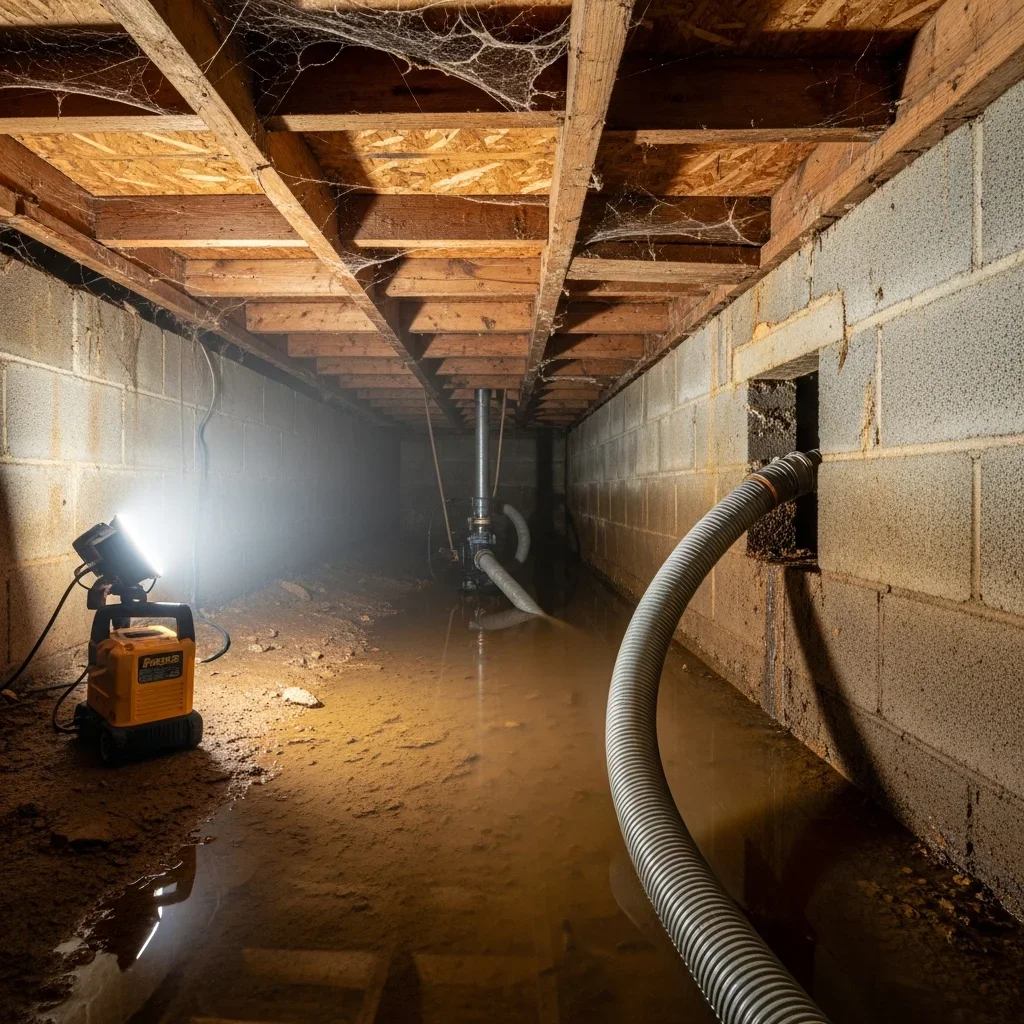
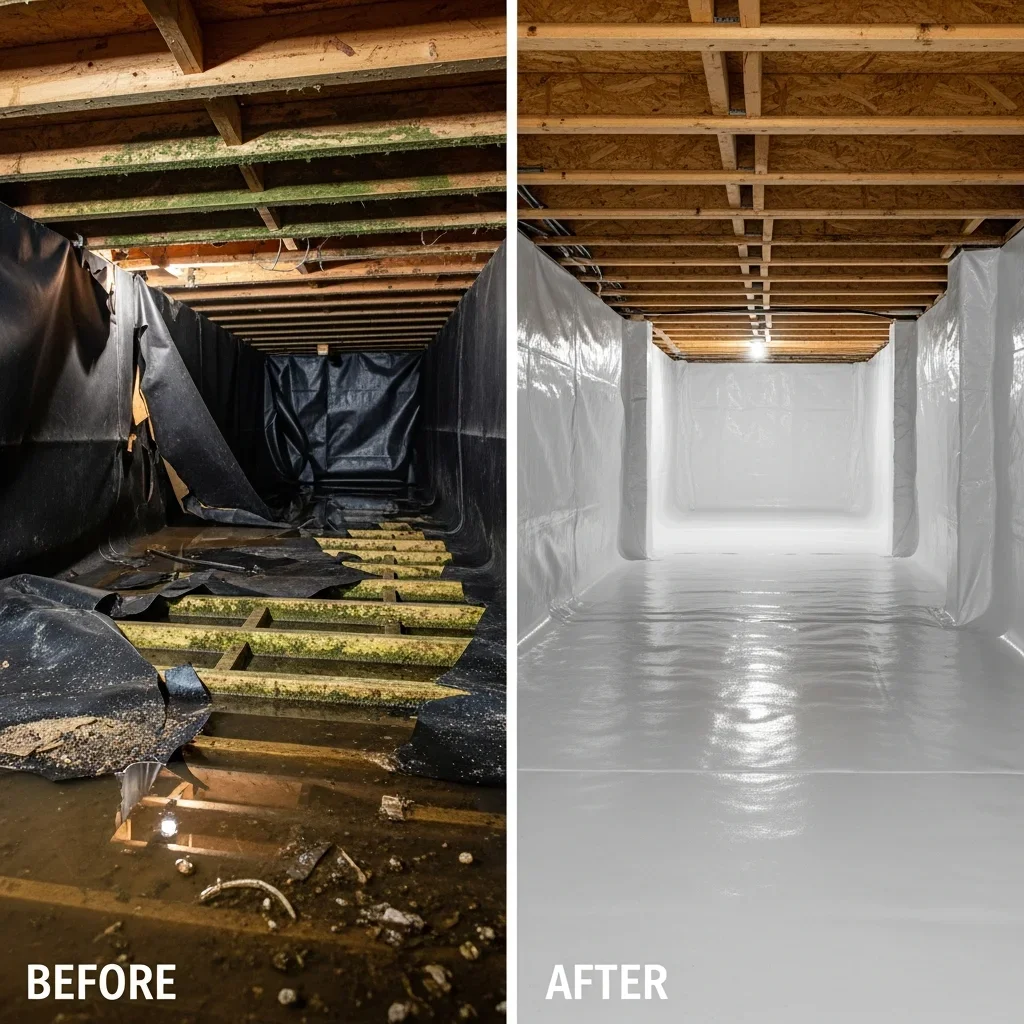
Standing water in a Weddington crawl space — visible here before extraction — is the
acute stage of a moisture problem that often begins months earlier as invisible ground
vapor. Once visible, mold has typically been present on structural wood for weeks.
Our Process
IICRC S520 Mold Remediation Process for Weddington NC Homes
Every step follows IICRC S520 standards — the accepted benchmark for professional mold
remediation in North Carolina, where no state license program exists. Documentation at
every stage for insurance, health records, and future sale disclosures.
01
Inspection & Moisture Mapping
We begin with a comprehensive inspection using calibrated moisture meters, thermal imaging, and visual documentation. For Weddington estate homes, this includes crawl space entry and assessment, HVAC duct inspection, and identification of all affected materials and moisture sources. Written assessment provided before remediation begins.
02
Containment Barriers
We establish negative air pressure containment around affected areas to prevent cross-contamination of clean spaces. For Weddington's large estate homes, this is especially important — a crawl space mold event should not contaminate the finished living areas above. Containment barriers are removed only after clearance testing confirms safe levels.
03
HEPA Air Filtration
Commercial HEPA air scrubbers run continuously throughout the remediation, capturing airborne mold spores before they can spread. Air filtration continues until clearance testing is performed — ensuring that spore counts in affected areas are within acceptable ranges per IICRC S520 standards.
04
Controlled Demolition of Affected Materials
Porous materials that cannot be effectively cleaned — drywall, insulation, severely contaminated wood — are removed and disposed of following EPA and state guidelines. For Weddington crawl spaces, this typically includes degraded vapor barriers, contaminated insulation batts, and in severe cases, sections of compromised floor joists.
05
EPA-Registered Antimicrobial Treatment
All affected structural surfaces are treated with EPA-registered antimicrobial agents following IICRC S520 procedures. We do not use bleach on porous wood surfaces — it kills surface mold but does not penetrate the wood's pores. Professional-grade encapsulants and antimicrobials address the full depth of contamination.
06
Post-Remediation Verification (PRV)
We offer independent, third-party air quality and surface sampling after remediation is complete. PRV confirms that mold spore counts are within acceptable ranges and provides documented proof that the work was effective. For Weddington estate properties, PRV is especially valuable for insurance records and future home sale disclosures.
07
Documentation & Rebuild Coordination
Complete written documentation of all work performed, materials removed, treatments applied, and final moisture readings. Insurance-formatted scope of work for adjuster review. Rebuild coordination available through our licensed reconstruction team — drywall, insulation, flooring, and finish work to match original estate specifications.
Cost Guide
Mold Remediation Costs in Weddington NC
Weddington's estate housing stock means larger crawl spaces and higher-value finishes —
both of which increase baseline remediation costs compared to smaller suburban homes.
These ranges reflect local market conditions for 28104.
Crawl Space — Joists Only
$2,500 – $6,000
Surface mold on floor joists without subfloor involvement. Common in Weddington's newer HOA communities (Weddington Preserve, Vintage Creek) where moisture has begun accumulating but hasn't yet penetrated structural wood deeply. Includes containment, treatment, and optional encapsulation.
Key cost factors
Crawl space square footageMold colony depthInsulation conditionVapor barrier status
Crawl Space + Subfloor Involvement
$5,000 – $14,000
Mold has spread from floor joists to the subfloor decking. Common in Weddington's 1990s-2000s communities (Weddington Heights, Weddington Heritage, Weddington Woods) where vented crawl spaces have been accumulating moisture for 20+ years. Subfloor section removal may be required.
Key cost factors
Subfloor area affectedJoist replacement needAccess difficultyRebuild scope
Wall Cavity Mold
$3,000 – $9,000
Mold in wall cavities from water intrusion events — common after roof leaks, supply line failures, or window flashing failures in Weddington estate homes. Requires selective drywall removal, treatment, and restoration. High-value wall finishes (plaster, custom tile, premium paint) increase replacement costs.
Key cost factors
Linear feet affectedFinish levelOrigin source resolvedContamination depth
Estate Multi-Zone Mold (Complex Scope)
$8,000 – $20,000+
Multi-area mold events in Weddington's large estate homes — crawl space plus wall cavities plus HVAC duct contamination. Common in older homes that have had multiple unresolved moisture events. Larger crawl space square footage in estate homes means higher baseline remediation scope compared to smaller suburban homes.
Key cost factors
Total area affectedHVAC involvementMultiple moisture sourcesRebuild complexity
The Cost of Delaying Mold Remediation
Mold colonies in Weddington crawl spaces double in size approximately every 1-2 weeks
under sustained humidity conditions. A $3,000 surface mold treatment today can become
a $12,000 subfloor removal scope if left untreated through one humid summer. Getting
an assessment now — before the peak May-October mold season — is always less expensive
than addressing advanced colonization later.
NC Mold Licensing
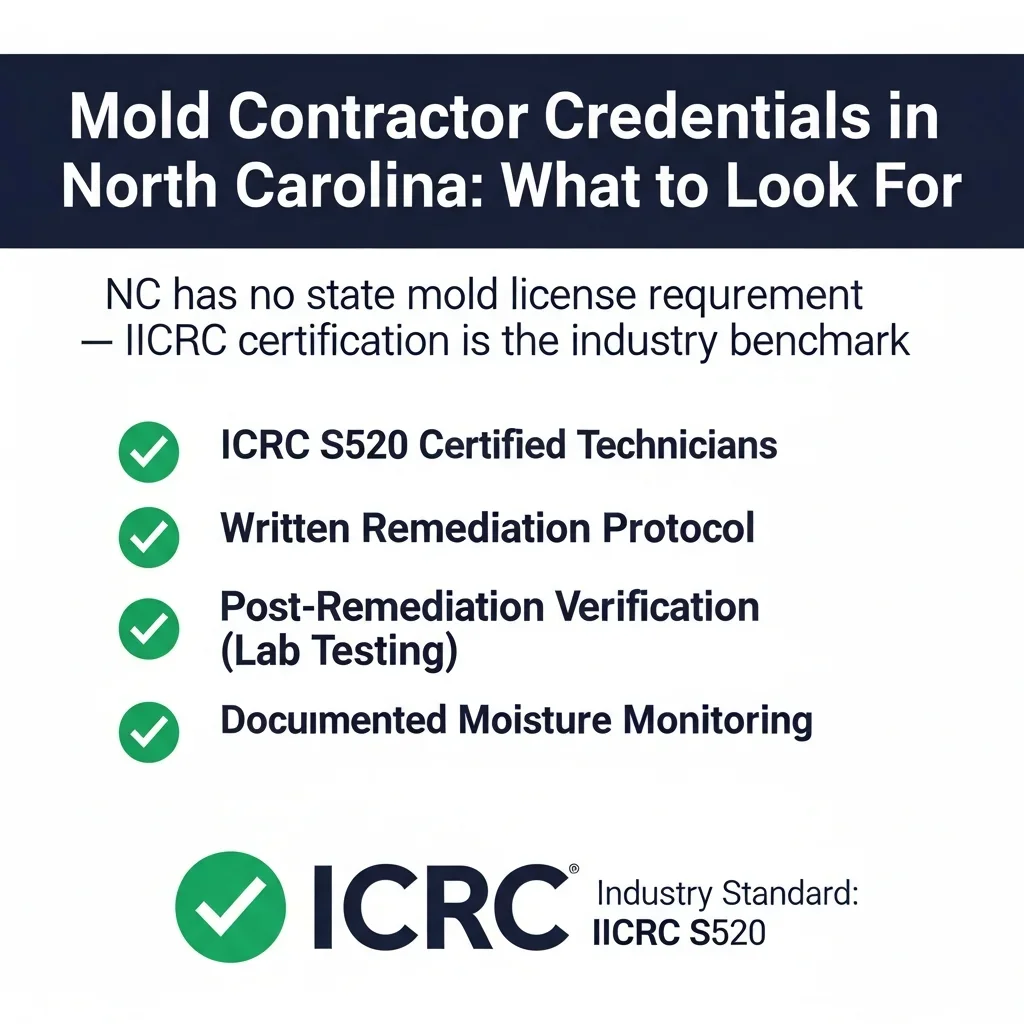
Mold Remediation Credentials in North Carolina: What You Need to Know
North Carolina has no state or federal mold remediation licensing program. NC State
University Extension confirms: "no federal or state certification programs exist for companies or individuals
providing mold remediation services." This means any company can legally claim to do mold remediation in NC without credentials.
Here's how to verify you're hiring a qualified contractor.
IICRC Certification (S520)
Ask for individual technician certification numbers and verify at iicrc.org. The IICRC S520 Standard for Professional Mold Remediation is the accepted industry benchmark in NC. Certified technicians complete documented training and testing — not just a weekend course.
Written Remediation Protocol
Any legitimate mold remediation company should provide a written protocol before beginning work — describing the scope, containment approach, treatment methods, and clearance criteria. If a contractor won't provide a written protocol, that's a red flag.
Post-Remediation Verification Option
Ask whether the contractor offers independent, third-party post-remediation verification (PRV) testing. PRV uses lab analysis to confirm mold spore counts are within acceptable ranges after remediation. A contractor who discourages PRV may not be confident in their own work.
Documented Moisture Monitoring
Professional remediation should include documented moisture readings before, during, and after treatment — not just a visual inspection. Calibrated meters confirm that structural materials have reached acceptable moisture content before containment is removed.
Avoid: "Mold Specialist" Without Credentials
Because NC has no licensing requirement, anyone can advertise mold removal services. Watch for: no written protocol, pressure to begin immediately without assessment, claims to fix everything with spray treatment only, no mention of containment or air filtration, and no option for third-party verification.
NC has no state mold license — IICRC S520 certification is the accepted benchmark. Palm
Build technicians hold current IICRC certifications verifiable at iicrc.org. Ask any
contractor for their certification number before work begins.
Does Insurance Cover Mold Remediation in Weddington NC?
Coverage depends entirely on what caused the mold. Most Weddington crawl space mold is
not covered — but mold following a covered water event often is. Understanding the
distinction before you call your insurer can mean the difference between a paid claim
and an out-of-pocket expense.
Covered: Mold Resulting from a Sudden Covered Event
Mold that results from a sudden, accidental covered water event — burst pipe, appliance overflow, storm-driven roof leak — is typically covered as part of the water damage claim. The mold remediation scope is included in the original loss adjustment. Documentation of the source event and the mold that followed is critical to keeping this coverage intact.
Not Covered: Pre-Existing or Gradual Mold
Mold that developed from long-term humidity, gradual leaks, or ongoing moisture conditions — the most common type in Weddington crawl spaces — is typically excluded from standard NC homeowners policies. Insurers classify this as a maintenance issue, not a covered sudden loss. This is why most Weddington crawl space mold is an out-of-pocket remediation cost.
Know Your Mold Sublimit
Most NC homeowners policies carry a mold sublimit — a cap on total mold-related coverage regardless of the underlying water damage amount. Common sublimits are $5,000-$10,000. For Weddington estate properties where a full crawl space + subfloor remediation can reach $14,000+, this sublimit may cover only a portion of the scope. Review your policy declarations page for the specific mold sublimit.
Endorsements That Can Help
Several optional endorsements increase mold coverage: mold sublimit buyup (increases the cap), water backup and sump overflow (covers mold from backup events), and service line coverage. For Weddington homeowners with older HOA homes and known moisture risk, reviewing endorsement options with your agent before a loss occurs is far more cost-effective than discovering the gap after a claim.
Before & After
Mold Remediation Results in Weddington NC Homes
From heavily colonized crawl space joists to clean encapsulated spaces — Palm Build
restores Weddington homes to safe, documentable condition with IICRC S520 protocols at
every step.
Before
After
Crawl space mold remediation — Weddington NC: treated and documented per IICRC S520
Before
After
Floor joist mold to encapsulated crawl space — the complete Weddington solution
Why Palm Build
Why Weddington NC Homeowners Choose Palm Build for Mold Remediation
IICRC S520 Certified
Our technicians hold current IICRC certifications in mold remediation (AMRT) and applied microbial remediation technology. We follow IICRC S520 protocols on every job — containment, HEPA filtration, EPA-registered treatment, and calibrated moisture verification. Certification numbers available on request and verifiable at iicrc.org.
NC Market Specialist
We work exclusively in North Carolina, South Carolina, and Florida. We know NC's licensing landscape (no state program — IICRC is the benchmark), the Union County moisture environment, and the specific construction eras of Weddington's HOA communities. We don't apply a generic franchise playbook to a market that has its own conditions.
Estate Home Expertise
Weddington's estate properties require a different level of care during mold remediation. We use containment barriers sized for larger rooms, protect high-value contents in place where possible, coordinate with specialty contractors for custom finish restoration, and treat every project with the discretion that large properties and HOA communities require.
Insurance Documentation
We write remediation scopes for insurance review, not just internal records. Our documentation clearly establishes the loss origin, mold cause classification (sudden event vs. long-term moisture), treatment protocols followed, and final verification results. For covered events, our documentation supports maximum claim recovery. For non-covered events, it supports future sale disclosures.
Mold in Your Weddington NC Home?
IICRC S520-certified remediation, 35-45 minutes from Charlotte, with documentation for
insurance and future disclosure. Call Palm Build today.
Mold Remediation Questions from Weddington NC Homeowners
Common questions about mold in Weddington's estate HOA communities, NC licensing
reality, crawl space conditions, and what to expect from a professional remediation.
Mold in Your Weddington NC Home? Don't Wait.
Weddington's clay soil and humid Piedmont climate mean mold spreads fast once it starts. Palm Build's IICRC S520-certified team arrives in 35-45 minutes from Charlotte with full containment, EPA-registered treatment, and optional third-party clearance testing.