Mold Remediation in Statesville, North Carolina
Statesville's humid subtropical climate — with summer humidity regularly reaching 70-90% — combined with Iredell County's clay soil and the prevalence of crawl space foundations creates ideal conditions for mold growth. When mold appears in your crawl space, walls, or HVAC system, Palm Build provides IICRC S520-compliant remediation with full containment, source elimination, and clearance testing.
45-60 min
Emergency Response
24/7
Dispatch Available
IICRC
Certified Technicians
Why Statesville Homes Are Vulnerable to Mold
Four converging factors make Iredell County properties more susceptible to mold than the national average — and most of them don't require a visible flood to trigger.
Year-Round High Humidity
Statesville's ambient relative humidity exceeds 60% for most of the year and reaches 70–90% from June through September. In these conditions, any moisture event — a slow drip, a condensation cycle, a clogged gutter — can initiate mold growth within 24 to 48 hours.
Clay Soil Crawl Space Vapor
Iredell County's clay soil continuously releases water vapor into crawl spaces through ground evaporation — even without a leak. When warm summer air enters through foundation vents and meets the cooler soil and joist surfaces, it deposits condensation directly onto wood — a daily cycle that builds mold conditions without any visible flooding.
Aging Wood-Framed Housing Stock
Statesville's city core is dominated by 1960s–1980s brick veneer construction with wood-framed crawl space foundations. Older wood that has experienced previous moisture cycles — without full drying or treatment — carries dormant mold spores that reactivate the moment humidity conditions return.
HVAC Condensation and Distribution
Air handling units in humid climates accumulate condensation on coil surfaces. When not properly maintained, mold colonizes HVAC components and the system then distributes spores through every room in the home during each cooling cycle — transforming a localized moisture problem into a whole-house mold event.
What to Do When You Find Mold in Statesville
Iredell County Building Standards officially routes mold inquiries to the NC Department of Health and Human Services Environmental Health division — recognizing that mold is both a structural and a health concern. Here's how to decide what to do first.
Official resource: Iredell County Building Standards publishes a "Dampness & Mold Growth" guidance document directing residents to NC DHHS for health concerns and professional contractors for structural remediation. Building Standards can be reached at (704) 878-3113.
You have health symptoms (coughing, respiratory issues, headaches) that may be related to mold exposure
See your physician or contact NC DHHS Environmental Health
Then call a professional remediator — symptoms indicate active exposure
NC DHHS Environmental Health: (919) 707-5900
You can see visible mold growth — any color, any surface, anywhere in the home
Call a professional mold remediator immediately
Do not attempt DIY removal of areas larger than 10 sq ft — disturbing mold spreads spores
IICRC S520 — the standard for all Palm Build work in Iredell County
You smell a persistent musty odor but cannot see mold — especially in crawl spaces or walls
Schedule a professional mold inspection with moisture assessment
Thermal imaging and moisture meters reveal hidden growth and active moisture sources
Crawl space mold is common in Statesville — often discovered only at inspection or real estate transaction
You have had a water damage event (burst pipe, flooding, appliance failure) within the last 72 hours
Call for emergency water damage restoration — prioritize drying before mold develops
The 24-48 hour window is real in Statesville's humid climate — drying speed is mold prevention
(704) 464-0121 — 24/7 emergency response from our Charlotte hub
Not sure which situation applies? Call us first.
We'll walk through your situation over the phone and tell you honestly whether you need emergency remediation, a scheduled inspection, or whether your concern can wait. 24/7, no pressure.
Why Statesville Crawl Spaces Develop Mold Without a Flood
Most crawl space mold in Iredell County doesn't start with a burst pipe or a storm. It starts with physics.
The Condensation Cycle
Outside air at 85°F with a dew point of 68°F carries significant moisture. When this air enters your crawl space through foundation vents, it meets surfaces that stay at 60-65°F year-round (soil and concrete thermal mass). That air immediately reaches its dew point and deposits liquid water on every surface it contacts — floor joists, vapor barriers, concrete blocks, and anything stored in the space.
This cycle repeats every day from May through September. By late summer, joists that were dry in April can have established mold colonies — without a single pipe having leaked.
The Only Permanent Solution
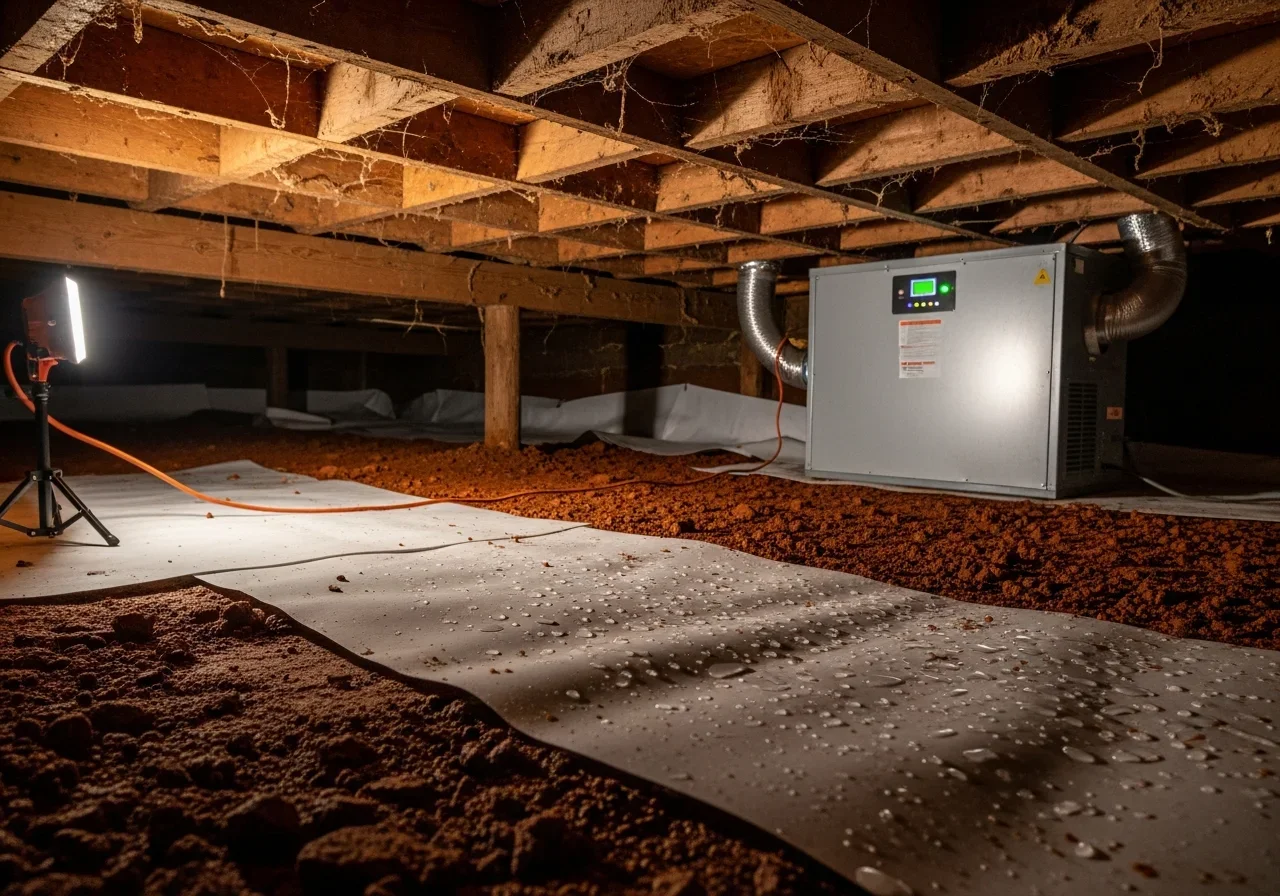
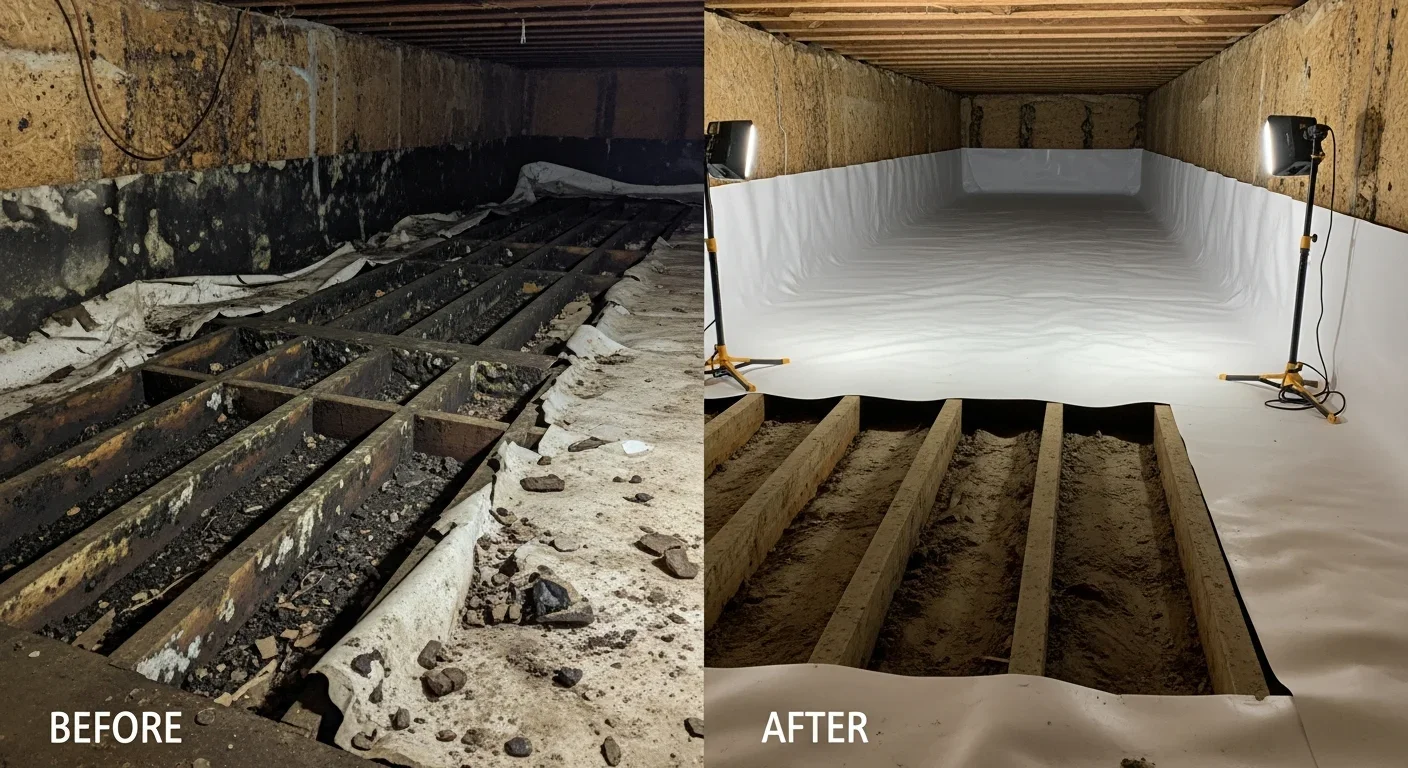
Crawl space encapsulation — sealing the earth floor with a heavy vapor barrier, sealing or eliminating foundation vents, and installing a dedicated dehumidifier — breaks the condensation cycle permanently. Remediation without encapsulation produces recurrence. In Statesville's clay soil and humid climate, this isn't a recommendation — it's the difference between a one-time fix and an annual mold problem.
Four Moisture Pathways in Statesville Crawl Spaces
Traditional vented crawl space design allows warm humid summer air (80-90°F, dew point >65°F) to enter and contact cooler soil and joist surfaces (55-65°F). The result is direct condensation on wood — up to 10-15 gallons per day during peak summer.
Iredell County clay soil continuously releases water vapor upward through capillary action — even without any rainfall. An unencapsulated earth floor emits moisture 24/7. This is the reason crawl space mold can develop in a dry summer without any water damage event.
Cold water supply lines running through warm crawl spaces develop condensation on their exterior surfaces during humid months. Over time, this drip pattern creates localized wet spots directly beneath the condensing pipes — a slow, invisible moisture source.
Improperly insulated or disconnected HVAC ducts in crawl spaces leak both conditioned air and moisture. Return air ducts that draw crawl space air into the living space can import both elevated humidity and existing mold spores throughout the entire home.
Mold Contractor Credentials in North Carolina
North Carolina does not have a state mold remediation contractor license. Any contractor can legally offer mold services without formal training — which makes independent credential verification essential when hiring in Iredell County.
What to know: NC DHHS and NC State University Extension both confirm there is no federal or state mold certification required in North Carolina. The IICRC S520 Standard and AMRT certification are the accepted industry benchmarks. Verify credentials independently before hiring.
How to Verify a Mold Remediator in Iredell County
Red Flags When Evaluating Contractors
- IICRC AMRT-certified field technicians
- Written scope referencing IICRC S520 on every job
- General liability + contractor's pollution liability insured
- Containment and negative pressure standard — not optional
- Moisture source correction included in every remediation scope
Our Mold Remediation Process in Statesville
Six steps following the IICRC S520 Standard — adapted for Iredell County's crawl space construction, clay soil moisture conditions, and NC regulatory environment.
Inspection & Moisture Assessment
We assess the full extent of visible and concealed mold with thermal imaging and calibrated moisture meters before any disturbance begins. In Statesville homes, this means checking crawl spaces, adjacent wall cavities, subfloor assemblies, and HVAC air handling components that may have distributed spores through the living space.
Containment with Negative Pressure
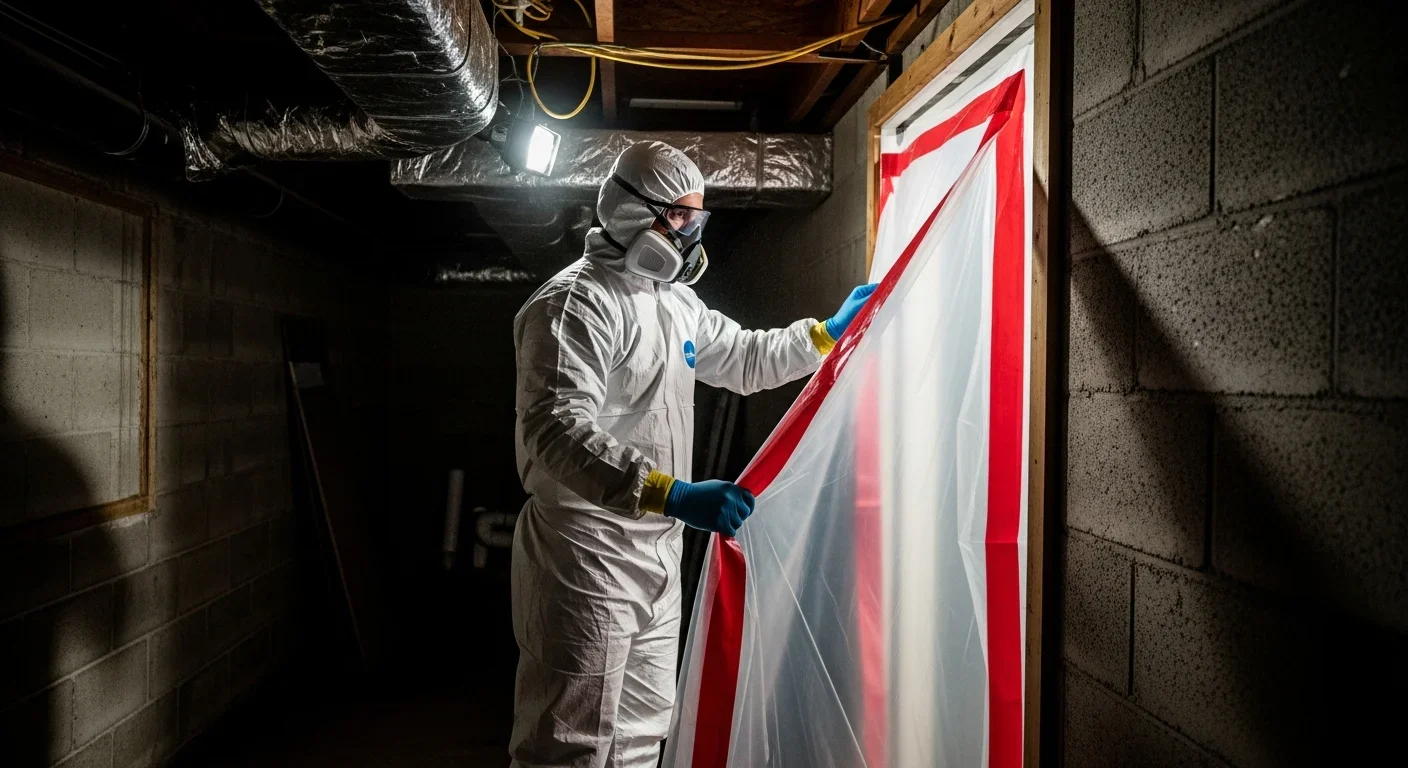
S520 requires establishing negative-pressure containment barriers using poly sheeting and commercial air scrubbers before any disturbance work begins. This prevents spores disturbed during remediation from spreading to unaffected areas. For crawl spaces, we seal access points and create negative pressure throughout the space.
Remediation & Material Removal
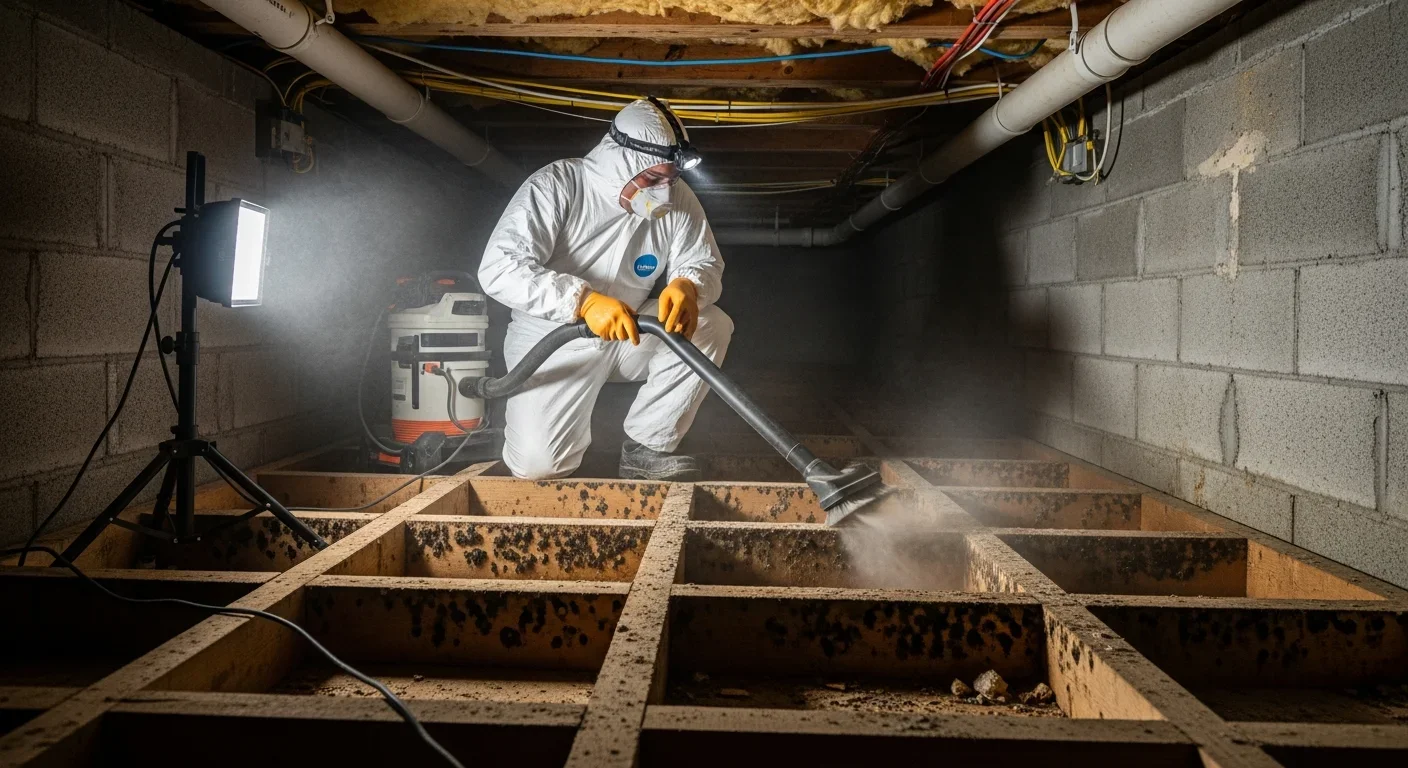
We remove mold-affected materials that cannot be remediated to clearance standard — typically drywall, insulation, and heavily contaminated wood. For structural lumber — joists, sheathing — we use HEPA vacuuming, physical agitation, and EPA-registered antimicrobial treatment per S520 protocols. Nothing is cut out that can be saved.
Moisture Source Correction
Remediation without source correction produces recurrence — guaranteed, in Statesville's climate. We identify and address the moisture source: vapor barrier replacement, crawl space encapsulation, foundation vent sealing, plumbing repair coordination, or HVAC condensate drainage correction. This step is non-negotiable on every Palm Build job.
Structural Drying
After remediation, we run commercial dehumidifiers to bring wood moisture content below 16% — the threshold below which most mold species cannot maintain active growth. This drying phase runs 3 to 7 days. In Statesville's humid summers, this step is not optional — ambient humidity will reintroduce moisture to incompletely dried materials.
Clearance Testing & Documentation
We provide a clearance report documenting that remediated areas have reached acceptable conditions. For insurance claims or real estate transactions, we coordinate third-party clearance testing. All documentation — pre-remediation photos, containment records, moisture readings, work log, and clearance results — is provided for your records.
When Mold Risk Peaks in Statesville
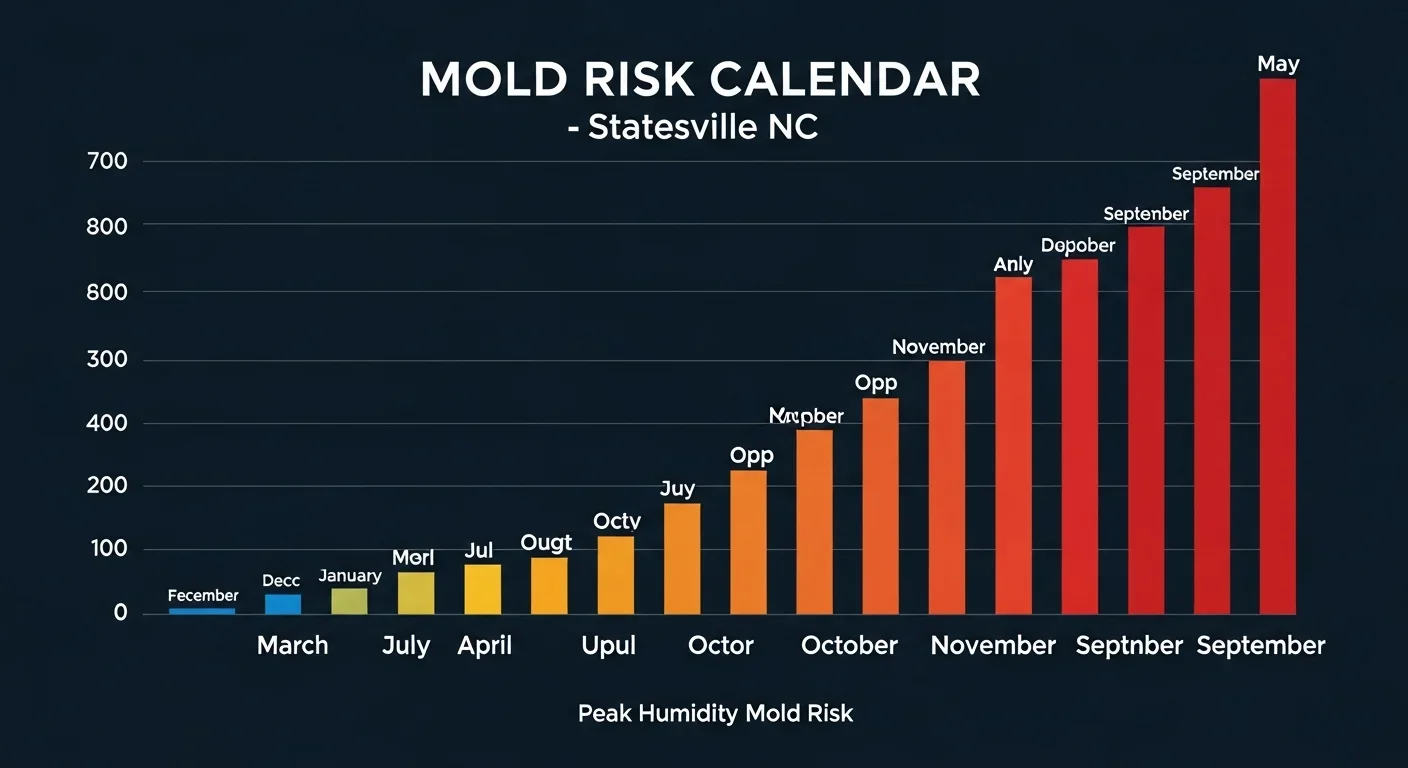
Statesville's mold risk tracks summer humidity — with a five-month peak and meaningful shoulder-season elevation in spring and fall.
Mold Remediation Costs in Statesville
Costs depend on extent, surface type, and whether source correction is included. The crawl space + encapsulation scenario costs more upfront but is the only option that prevents annual recurrence in Iredell County's climate.
- Isolated growth on a single accessible surface
- Containment, HEPA vacuum, treatment, and minor removal
- Moisture source must still be addressed
- Often not covered by insurance without prior water event
- Full joist treatment and vapor barrier replacement
- Negative pressure containment throughout
- Dehumidification and drying phase
- Often covered if linked to a documented water event
- Remediation plus full sealed encapsulation system
- Heavy vapor barrier, sealed vents, access door
- Dedicated crawl space dehumidifier installation
- Permanent moisture source correction — breaks the cycle
Insurance note: NC policies cover mold remediation when it results from a covered sudden water damage event. Mold from gradual humidity accumulation or lack of maintenance typically is not covered. We document cause and scope on every job. Call (704) 464-0121 for a free assessment.
Does Insurance Cover Mold Remediation in Statesville?
It depends on the cause. NC homeowners policies are clearer about mold coverage than some other states — here's what to know before you file.
Typically Covered
Typically Not Covered
Documentation That Supports a Mold Claim in NC
Palm Build provides all documentation items above automatically on every job — no need to request them separately.
Mold Remediation in Statesville Homes
Crawl space mold is the most common remediation scenario in Iredell County — here's what the process looks like.
Why Statesville Homeowners Choose Palm Build for Mold Remediation
NC has no state mold contractor license — which means credentials, process, and local knowledge are the only things that differentiate quality providers from everyone else claiming to "remove mold."
IICRC AMRT Certified
Our field technicians hold Applied Microbial Remediation Technician (AMRT) certification from the IICRC — the industry credential that verifies S520 training and proficiency. In NC without a state mold license, this is the credential that separates qualified providers from everyone else.
We Know Iredell County Conditions
We understand Statesville's clay soil condensation behavior, the crawl space construction patterns in homes from the 1960s through today, and how the Fourth Creek and Third Creek drainage corridors affect soil moisture around foundations. We've worked in homes like yours.
Source Correction Is Non-Negotiable
We will not complete a remediation job without identifying and addressing the moisture source. In Statesville's humid climate, every job where the source isn't corrected becomes a repeat call within a season. We're not interested in that — and neither should you be.
Insurance Documentation From Day One
We produce the complete documentation package that NC carriers need to process mold claims linked to water damage events: pre-remediation photos, moisture data, S520 compliance records, daily monitoring logs, and clearance reports. No gaps for adjusters to exploit.
Encapsulation Capability
We don't just remediate the mold — we can encapsulate the crawl space to prevent recurrence. For Iredell County clay soil homes, remediation without encapsulation in the same scope is often a short-term fix. We offer the complete solution.
24/7 Emergency Response
Active mold after a water event moves fast. Call (704) 464-0121 any hour — a real person answers, and we dispatch toward Statesville immediately. 45 to 60 minutes from our Charlotte hub to your door.
Mold Found in Your Statesville Home?
Don't wait on this one — mold grows fast in Iredell County's climate. Call now for a same-day inspection or emergency response. IICRC-certified. 24/7.
Questions About Mold Remediation in Statesville
Answers specific to North Carolina regulations, Iredell County crawl space conditions, and IICRC S520 standards.
Have a mold question specific to your Statesville home? Call us — a real person answers 24/7.
(704) 464-0121Mold in Your Statesville Home? Don't Wait.
In Iredell County's humid climate, mold grows year-round in crawl spaces and walls. Palm Build provides IICRC-certified mold remediation with S520 compliance, full containment, moisture source correction, and documentation for your insurance claim.
Related Services