Loxahatchee's subtropical humidity never drops below the mold growth threshold. CBS stucco walls trap moisture from summer rains and ITID canal overflow. HVAC systems run year-round, creating condensate-driven mold growth inside wall cavities and ductwork. Palm Build holds the DBPR licenses required under Florida Chapter 468 — and we respond to The Acreage, Arden, Deer Run, and all of western Palm Beach County 24/7.
~45 miles via Florida's Turnpike 55–65 minutes Response IICRC Certified
Outside our restoration scope, these are the vetted, licensed contractors we trust
alongside our work. Personally evaluated, reference-checked, and recommended by Palm
Build.
Mold in Your Loxahatchee Home? DBPR-Licensed Team Available 24/7.
Palm Build holds the DBPR licenses required under Florida Chapter 468. We serve The Acreage, Arden, Deer Run, Westlake, Cresswind, and all of western Palm Beach County. Every day you wait, mold spreads — call now.
Why Loxahatchee Homes Are Especially Vulnerable to Mold
Loxahatchee Groves and The Acreage sit in one of the most humidity-intensive
environments in Palm Beach County. The combination of year-round subtropical moisture,
12-month HVAC operation, CBS stucco construction, and proximity to ITID canal systems
creates conditions where mold doesn't just survive — it thrives in every season.
70–75%
Year-Round Humidity
Loxahatchee's outdoor relative humidity never drops below the 60% threshold at which mold can colonize surfaces. Unlike northern Florida cities that enjoy a genuine dry season, The Acreage sits in a subtropical moisture band that keeps exterior walls, attic spaces, and building cavities perpetually conditioned for mold growth.
12 Months
Annual HVAC Runtime
Air conditioning systems in Loxahatchee run every single month of the year — not 10 or 11 months like South Florida averages. This continuous operation generates constant condensation at the evaporator coil. When condensate drain lines clog with algae (a near-universal Florida maintenance issue), that water overflows the drip pan and soaks into surrounding wall cavity insulation for weeks before any visible damage appears.
24–48 Hours
Mold Establishment Time
In Loxahatchee's summer heat and humidity, active mold colonization can begin within 24 hours of a moisture event. A burst pipe at noon becomes an established mold problem before dinner the next day. Florida's standard 48-hour mold window — already aggressive compared to northern climates — is the outer edge in western Palm Beach County's subtropical conditions.
CBS Stucco: A Moisture Trap
Virtually every home in The Acreage and Loxahatchee Groves uses CBS (concrete block and
stucco) construction on slab-on-grade foundations. While this building method provides
hurricane resistance, it creates a persistent moisture management problem: stucco is
porous. Rain-driven water, particularly during Loxahatchee's 7–9 inch monthly wet season
deluges, penetrates hairline stucco cracks and is absorbed into the concrete masonry
unit behind it.
Concrete block holds moisture for days to weeks. Interior drywall applied directly over
that moisture-laden CMU creates a sandwiched cavity — perpetually humid, dark, and warm
— that is ideal mold habitat. Standard moisture meters often cannot detect moisture at
depth in CBS construction, which is why thermal imaging is critical for Loxahatchee mold
inspections.
ITID Canals and Slab-Edge Moisture
The Indian Trail Improvement District (ITID) manages hundreds of miles of drainage
canals that run through and alongside Loxahatchee properties. During heavy wet season
rainfall, these canals can overflow or surcharge, saturating the soil immediately
adjacent to home slabs. On slab-on-grade construction, elevated soil moisture wicks
upward through the concrete — a process called capillary action — and into the base of
interior wall assemblies.
Canal-adjacent lots in neighborhoods like Santa Rosa Groves, Las Flores Ranchos, and
lower-lying sections of The Acreage are particularly vulnerable. Homeowners often
attribute musty odors to "general humidity" without realizing the source is slab-edge
moisture infiltration causing mold behind baseboards and within the bottom 18 inches of
interior drywall.
No Crawl Spaces — Different Mold Locations
Unlike the Carolinas where crawl spaces are the primary mold habitat, Loxahatchee
homes sit on slab-on-grade foundations. There is no crawl space. Mold establishes in
walls, ceilings, HVAC components, bathrooms, and attic decking — often invisible until
spore counts are already elevated throughout the living space.
The most dangerous mold growth in Loxahatchee homes is typically hidden: inside HVAC
air handler units, inside CBS wall cavities adjacent to exterior stucco, and at
slab-edge wall bases on canal-adjacent properties. Early professional assessment is
the only reliable way to find it before it spreads.
Year-Round Exposure
Mold Risk by Season in Loxahatchee, FL
Unlike northern climates where mold risk is seasonal, Loxahatchee properties face
year-round exposure. The four "seasons" here are better understood as shifts in risk
type — not risk presence or absence.
Dry Season
December – February
Low
Outdoor humidity drops slightly — but still averages 65–70%, above the 60% mold threshold
HVAC still runs daily; condensate drain clogs continue to be a risk year-round
Seasonal residents returning from up north frequently discover undiscovered summer mold
Best window to conduct mold inspections before next wet season begins
Many Loxahatchee "snowbird" homes left closed in summer return to established mold colonies. December is prime discovery season.
Pre-Season
March – May
Elevated
Humidity climbs from 68% toward 75% as spring temperatures rise rapidly
Irrigation systems activate — especially on equestrian lots — adding surface moisture
HVAC transitions to heavier cooling load; condensate drain clogs peak in early spring
A/C startup after reduced winter use reveals clogged lines and pan overflows
Spring HVAC startup is Loxahatchee's second most common mold trigger event — many homeowners turn on full cooling in March to find drain lines blocked since fall.
Wet Season / Hurricane Season
June – October
High
PEAK RISK — 7–9 inches of rain per month; humidity 80–90% during events
Daily afternoon thunderstorms drive wind-rain into stucco cracks and window flashing gaps
ITID canal systems reach capacity; canal-adjacent lots face slab-edge moisture infiltration
Hurricane and tropical storm events compress the 24–48 hour mold window to hours
June through October is when most Loxahatchee mold damage occurs. Post-storm CBS moisture intrusion is the #1 driver of wall cavity mold in The Acreage.
Post-Season Recovery
November
Elevated
Humidity falls from summer peaks but mold colonies established in July–September remain active
Homeowners begin noticing musty odors as indoor air mixing resumes
Many properties discover summer mold damage after the wet season ends
Critical window for insurance documentation — FL §627.70132 requires claims within 1 year
November is the most common month Palm Build receives first mold calls — homeowners sense something changed during summer but waited until conditions improved to investigate.
In Loxahatchee, there is no safe season to ignore musty odors or visible moisture. Mold
can establish in any month — but the damage is far greater if it's left to grow through
summer.
Your Air Conditioner: Loxahatchee's #1 Hidden Mold Source
In a climate where the AC runs every day of the year, the HVAC system is both the home's
most important humidity control tool and its greatest mold vulnerability. Most
Loxahatchee mold discoveries that aren't storm-related trace back to one root cause:
HVAC condensate failure.
Condensate Line Clogging
In Loxahatchee's year-round heat, the algae that colonizes condensate drain lines grows faster than anywhere in the continental US. A blocked drain line causes the overflow tray beneath the air handler to fill — typically within 2–4 days — and then spill into the surrounding wall cavity or ceiling. Homeowners rarely notice until drywall begins to soften or a musty odor appears. By that point, mold has been actively growing for 1–3 weeks in a warm, enclosed space with unlimited moisture supply.
Ductwork Colonization
Loxahatchee's 70–75% ambient humidity means that ductwork surfaces never fully dry between cooling cycles. Flex duct liners, fiberglass duct board, and drain pan insulation absorb moisture and create surfaces where mold colonizes the duct interior. Once mold establishes in ductwork, the air handler blower becomes a mold distribution system — circulating spores to every room in the house with every cooling cycle. Occupants experience elevated allergy symptoms and musty odors without ever seeing visible mold growth.
Warning Signs You May Be Missing
Many Loxahatchee homeowners attribute HVAC mold symptoms to "general Florida humidity" and never investigate further. The warning signs are specific: a musty or earthy smell that appears or intensifies when the AC turns on (not when windows are open); dark discoloration ringing supply or return vents; persistent respiratory irritation in family members that improves when leaving the home; and visible moisture or rust staining on or around air handler units. Any one of these warrants immediate professional inspection.
Why Loxahatchee HVAC Fails Faster
Condensate drain lines in Loxahatchee need cleaning 2–3 times per year — more than the
once-per-year HVAC maintenance schedule most homeowners follow. The combination of
year-round AC operation and the warm, nutrient-rich condensate environment creates
ideal conditions for algae and biofilm that can block a line in as little as 6–8 weeks
during summer.
Equestrian properties in Deer Run, Fox Trail, and White Fences face an additional
challenge: barn and stable dust particles enter the home's return air system and
combine with condensate moisture to create an especially aggressive biofilm. Homes on
equestrian lots typically need condensate maintenance quarterly.
Homeowner HVAC Mold Check: 4 Things to Inspect Today
If you find any of these signs, call Palm Build at (754) 600-3369 for a same-day HVAC mold assessment.
Neighborhood Guide
Loxahatchee Neighborhood Mold Risk Guide
Mold risk in Loxahatchee varies significantly by neighborhood based on construction era,
proximity to ITID drainage canals, HVAC age, and equestrian land use patterns. Use this
guide to understand the primary risk factors for your area.
Primary driver: HVAC condensate in new construction
Newer homes have tighter building envelopes, which helps — but also means moisture from condensate failures stays trapped longer before discovery.
Westlake
2020s
Medium
Primary driver: Modern HVAC systems, appliance line failures
Newly built community; primary mold risks are dishwasher supply lines, refrigerator ice makers, and HVAC condensate during high-cooling-load summer months.
Cresswind Palm Beach
2021
Medium
Primary driver: Single-story HVAC overload in 55+ community
Single-story CBS construction means all HVAC components are at ceiling level. Condensate line issues drain directly into ceiling drywall before reaching floors.
Equestrian lots have elevated ambient humidity from water features and animal areas. HVAC systems are reaching the 15–20 year replacement window.
Fox Trail
2000s–2010s
High
Primary driver: Similar to Deer Run; barn and stable moisture infiltration
Barn and stable structures adjacent to homes contribute organic particulates to return air systems, accelerating biofilm growth in condensate lines.
White Fences Equestrian
Pre-2000
High
Primary driver: Aging HVAC, stucco cracks, possible polybutylene plumbing
Older construction predates modern stucco crack standards. Polybutylene plumbing (gray pipe) was common in Florida pre-2000 and can fail without warning, flooding wall cavities.
Santa Rosa Groves
Mid-20th century
High
Primary driver: Oldest CBS stock; highest moisture infiltration risk
Original block construction with decades of hairline stucco cracking. Many properties have not had stucco remediation and allow steady moisture infiltration during wet season.
Las Flores Ranchos
Mid-20th century
High
Primary driver: Canal-adjacent; low-lying lots; aging construction
Proximity to ITID canals and low elevation creates elevated slab-edge moisture risk. Wet season canal overflow events directly impact adjacent slab-on-grade homes.
Mix of agricultural and residential properties. Older homes near drainage ditches show similar patterns to Santa Rosa Groves; newer construction closer to Medium risk.
High:Older construction, canal proximity, or HVAC age
Elevated:Mixed age stock or documented drainage factors
Medium:Newer construction with lower structural risk factors
Disclaimer: Risk levels reflect general neighborhood factors and are not a
guarantee of mold presence or absence in any individual property. Every home should be professionally
assessed regardless of neighborhood classification. Factors such as HVAC maintenance history,
stucco condition, and plumbing age affect individual property risk significantly.
IICRC S520 Protocol
Palm Build's Mold Remediation Process
Florida's DBPR regulations and the IICRC S520 standard define a strict sequence for
professional mold remediation. Here is exactly what happens when Palm Build's licensed
team arrives at your Loxahatchee home — from licensed assessment through clearance
documentation.
01
Mold Assessment
Day 1
A DBPR-licensed mold assessor (MRSA) — a separate licensed entity from the remediator, as required by Florida Chapter 468 — performs a comprehensive inspection of your Loxahatchee home. This includes visual inspection, thermal imaging to detect moisture in CBS wall cavities, air quality sampling, and surface sampling of suspect areas. The assessor writes a Mold Assessment Report defining the exact scope of remediation required. No legal remediation work can begin without this document.
02
Containment Setup
Day 1–2
Sealed polyethylene barriers isolate affected zones from the rest of your home. HEPA air scrubbers establish negative air pressure within the containment area — this ensures airborne spores released during removal travel toward filters, not toward your living space. In Loxahatchee CBS construction, containment includes sealing HVAC supply and return registers within the affected area and isolating the air handler to prevent cross-contamination throughout the duct system.
03
HEPA Air Filtration
Continuous
Commercial HEPA air scrubbers run continuously throughout the remediation process — not just during removal. HEPA filtration captures particles as small as 0.3 microns, including mold spores which range from 2–100 microns. In Loxahatchee's humid environment, we run additional dehumidification equipment alongside air scrubbers to drop interior RH below 50% during work — a level that stops mold from re-establishing on cleaned surfaces before reconstruction begins.
04
Mold Removal
Days 2–5
Contaminated drywall, insulation, HVAC components, and non-salvageable building materials are physically removed using controlled demolition. In Loxahatchee CBS homes, this typically means removing drywall to the block wall face, removing contaminated insulation, and exposing the CMU surface for treatment. HVAC air handler components — including contaminated duct liner and insulation — are replaced rather than treated in place. All removed materials are double-bagged and disposed of per Florida DOH guidelines.
05
Antimicrobial Treatment
Days 4–6
EPA-registered biocidal antimicrobials are applied to all treated structural surfaces: block wall faces, window bucks, framing members, subfloor, and any areas where moisture intrusion was documented. HVAC components receive specialized antimicrobial treatment inside accessible ductwork sections and at all air handler surfaces. Treatment dwell times are followed per manufacturer specifications — this step cannot be rushed, particularly in Loxahatchee's humidity where residual moisture can interfere with product efficacy.
06
Clearance Testing & Restoration
Days 6–8
Post-remediation air sampling is conducted by an independent DBPR-licensed mold assessor — a different licensed entity than both the initial assessor and Palm Build, as required by Florida law. Clearance testing confirms spore counts have returned to acceptable levels and no visible contamination remains. You receive a written clearance report suitable for submission to your insurance carrier. Reconstruction of removed drywall and finishes then begins under a separate scope of work.
Why CBS Construction Requires Specialized Protocol
Loxahatchee's CBS stucco homes present unique remediation challenges. Concrete masonry
units absorb and retain moisture differently from wood frame construction. Standard
drying approaches that work in frame walls often leave residual moisture in CMU blocks
— moisture that continues to feed mold after remediation is "complete."
Palm Build's CBS protocol includes extended drying monitoring via pin and pinless
meters calibrated for concrete density, antimicrobial application directly to the CMU
face (not just the cavity air), and moisture documentation for insurance carriers that
understand the extended drying timelines required for block construction in Florida.
CBS Remediation: Key Differences
1
Deeper Moisture Detection
Thermal imaging + depth-calibrated meters required — standard surface meters miss moisture inside CMU
2
Extended Drying Phase
Block walls may need 5–10 days of dehumidification vs. 2–3 days for frame walls before reconstruction
3
Direct Block Treatment
EPA biocide applied to CMU face, not just surrounding air — block surface must be cleaned and treated
4
Stucco Void Documentation
If stucco cracking allowed moisture entry, the crack must be documented and repaired before reconstruction
Florida DBPR Mold Licensing: What Loxahatchee Homeowners Must Know
Before you hire any mold contractor in Palm Beach County, Florida law requires specific
licenses that most homeowners don't know to ask for. Not knowing can cost you your
insurance claim.
What Florida Law Requires
Chapter 468, Part XVI of the Florida Statutes, administered by the
Department of Business and Professional Regulation (DBPR), mandates separate licensing
for every mold-related service in Florida. This law applies to every property in
Loxahatchee, The Acreage, and all of Palm Beach County.
Mold Assessor License (MRSA)
Licensed to inspect, test, and write Mold Assessment Reports. The assessor
identifies the type, extent, and source of mold contamination. They also conduct
post-remediation clearance testing to verify the work was done correctly. An
assessor cannot perform remediation on any property they assessed.
Mold Remediator License (MRSR)
Licensed to perform the physical work of mold containment, removal, antimicrobial
treatment, and disposal. The remediator executes the remediation plan written by the
assessor. A remediator cannot perform assessments on properties they
remediate — this conflict-of-interest prohibition is explicit in Florida law.
Conflict-of-Interest Prohibition
Florida law explicitly prohibits the same company or individual from both assessing
and remediating mold on the same property. This protection ensures the scope of work
is determined by an independent assessor who has no financial interest in the size
of the remediation job. Post-remediation clearance must come from a separately
licensed assessor as well.
A Mold Assessment Report is legally required before any remediation work begins
Assessor (MRSA) and remediator (MRSR) must be separately licensed entities
The same company cannot perform both services on one property
Post-remediation clearance requires another independent licensed assessor
How to Verify Before Hiring
Step-by-Step License Verification
1Visit myfloridalicense.com — DBPR's official license verification portal
2Select "Verify a License" and choose license type: "Mold Assessor" or "Mold Remediator"
3Search by the contractor's full legal name or license number
4Confirm the license status shows "Current, Active" — not expired, suspended, or under investigation
5Ask for the license number in writing before any work begins
What is your DBPR mold remediator (MRSR) license number?
Who is the independent licensed assessor performing the Mold Assessment Report?
Will the same assessor also perform post-remediation clearance testing?
Can you provide documentation of your liability and workers' comp insurance?
Critical Warning for Loxahatchee Homeowners
Hiring an unlicensed mold contractor can void your homeowners insurance claim in
Florida. Insurance carriers are increasingly requiring proof of DBPR licensure as a condition of
mold claim payment. If you pay an unlicensed contractor first, your insurer may deny the
entire claim — including the cost of work you already paid for. Verify before you sign anything.
Cost Reference Guide
Mold Remediation Costs in Loxahatchee, FL
Mold remediation costs in Loxahatchee vary widely based on the extent of contamination,
whether HVAC systems are involved, and whether CBS wall cavities require opening. Use
this guide to understand likely cost ranges before your assessment.
Damage Type
Typical Scope
Estimated Cost
Insurance Coverage
Standard Single-Room Mold
One bathroom or bedroom, non-HVAC source, limited drywall removal (< 100 sq ft)
$3,000 – $8,000
Often covered if caused by sudden plumbing event
HVAC System Mold
Air handler unit, ductwork colonization, adjacent wall cavity — requires HVAC component replacement
$5,000 – $20,000
Limited coverage; condensate failures often excluded as "maintenance"
Moderate Multi-Room
Two or more rooms, shared wall cavity contamination, moderate drywall removal (100–400 sq ft)
$8,000 – $20,000
Covered up to policy mold sublimit (typically $10,000–$25,000)
Severe / CBS Wall Cavity
Whole-home or multi-room with CBS block wall cavity involvement, full drywall tear-out, HVAC replacement, structural antimicrobial treatment
$15,000 – $50,000+
Coverage likely maxes out at sublimit; gap coverage may apply
Standard Single-Room Mold
One bathroom or bedroom, non-HVAC source, limited drywall removal (< 100 sq ft)
Estimated Cost:$3,000 – $8,000
Coverage: Often covered if caused by sudden plumbing event
HVAC System Mold
Air handler unit, ductwork colonization, adjacent wall cavity — requires HVAC component replacement
Estimated Cost:$5,000 – $20,000
Coverage: Limited coverage; condensate failures often excluded as "maintenance"
Moderate Multi-Room
Two or more rooms, shared wall cavity contamination, moderate drywall removal (100–400 sq ft)
Estimated Cost:$8,000 – $20,000
Coverage: Covered up to policy mold sublimit (typically $10,000–$25,000)
Severe / CBS Wall Cavity
Whole-home or multi-room with CBS block wall cavity involvement, full drywall tear-out, HVAC replacement, structural antimicrobial treatment
Estimated Cost:$15,000 – $50,000+
Coverage: Coverage likely maxes out at sublimit; gap coverage may apply
Florida Homeowners Insurance & Mold Coverage
Most Florida homeowners insurance policies cap mold coverage at $10,000–$25,000. Coverage typically requires that the mold is a
direct result of a sudden, covered water event — such as a burst pipe or storm
water intrusion — rather than gradual moisture buildup or maintenance-related HVAC failure.
Under Florida §627.70132, mold claims related to water damage must be
filed within 1 year of the date of loss. Many Loxahatchee homeowners discover
summer mold damage in the fall — the clock is already running. Contact Palm Build and your
insurance carrier at the same time, not sequentially.
Document everything immediately — photos, moisture readings, date of discovery
File your insurance claim before spending money on remediation
A DBPR-licensed assessor's Mold Assessment Report supports your claim
Our documentation format is designed for Palm Beach County insurance adjusters
Costs above are general ranges. Your actual cost depends on factors only visible during a
licensed mold assessment. The assessment cost is typically credited toward remediation if
you proceed with Palm Build.
Licensed DBPR mold remediator · Serving Loxahatchee and The Acreage · (754) 600-3369
Results Gallery
Loxahatchee Mold Remediation — Results
Every Palm Build mold remediation follows the same IICRC S520 standard and Florida DBPR
compliance protocol. Here is what professional mold remediation looks like in
Loxahatchee's CBS construction environment.
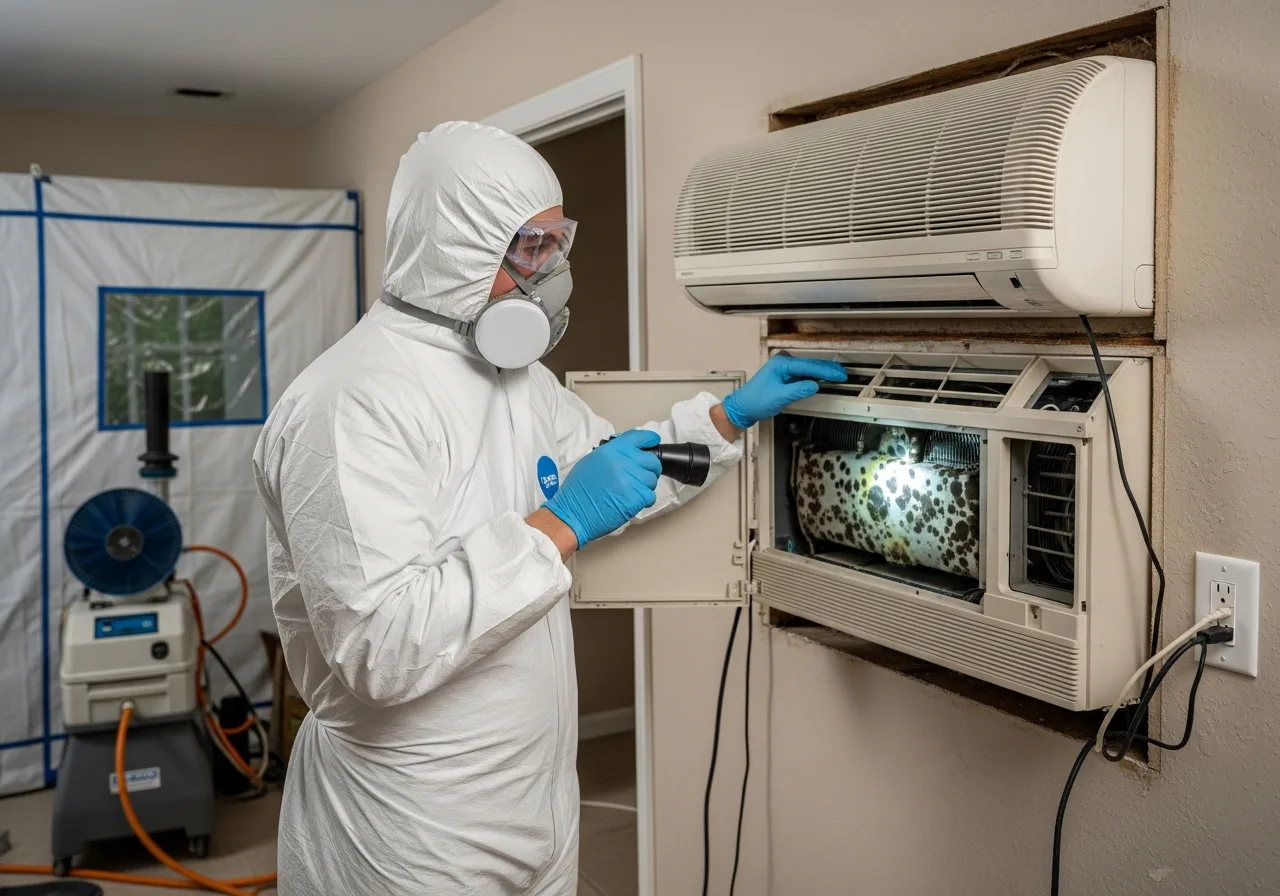
Professional Remediation
DBPR-licensed mold technician at work in a Loxahatchee home
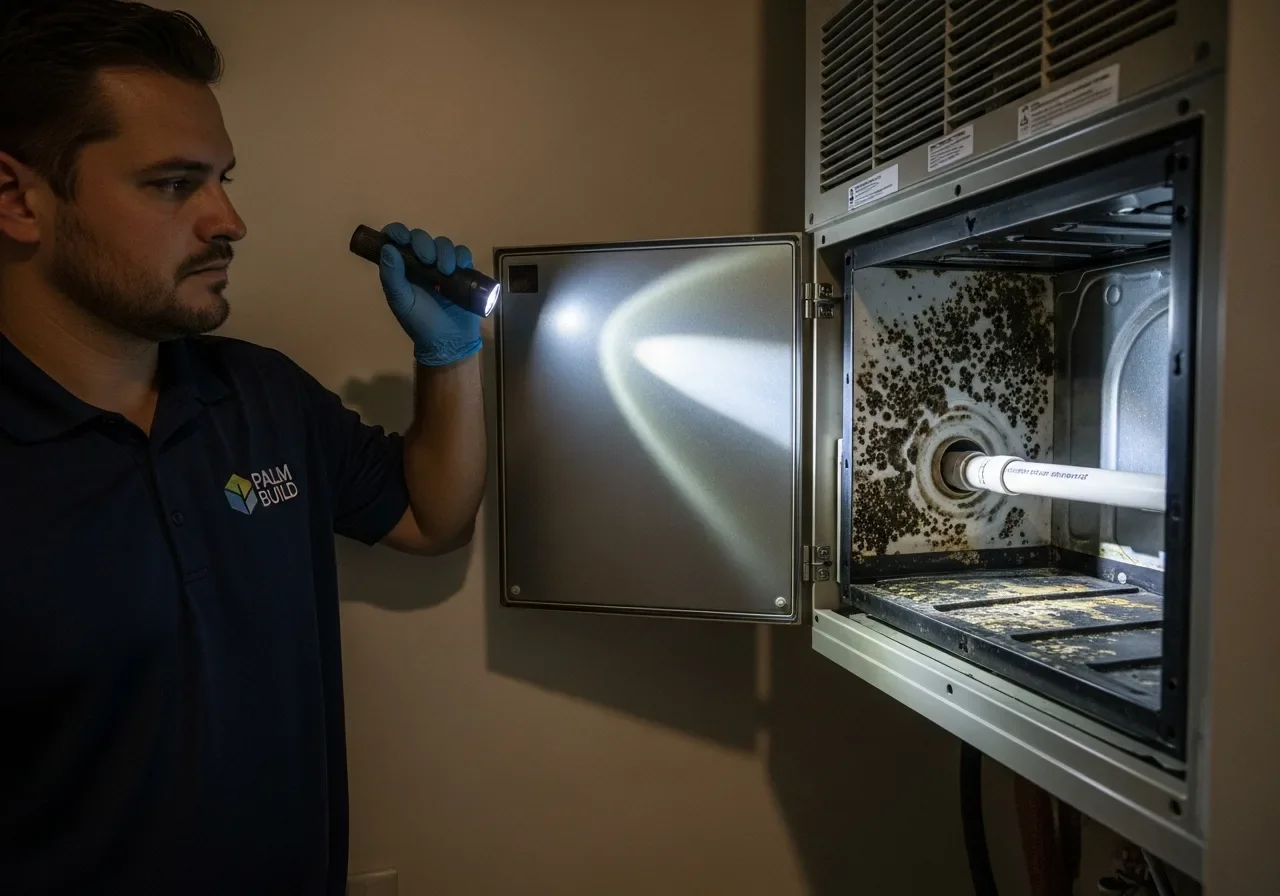
HVAC Inspection
HVAC air handler inspection — Loxahatchee's most common hidden mold source
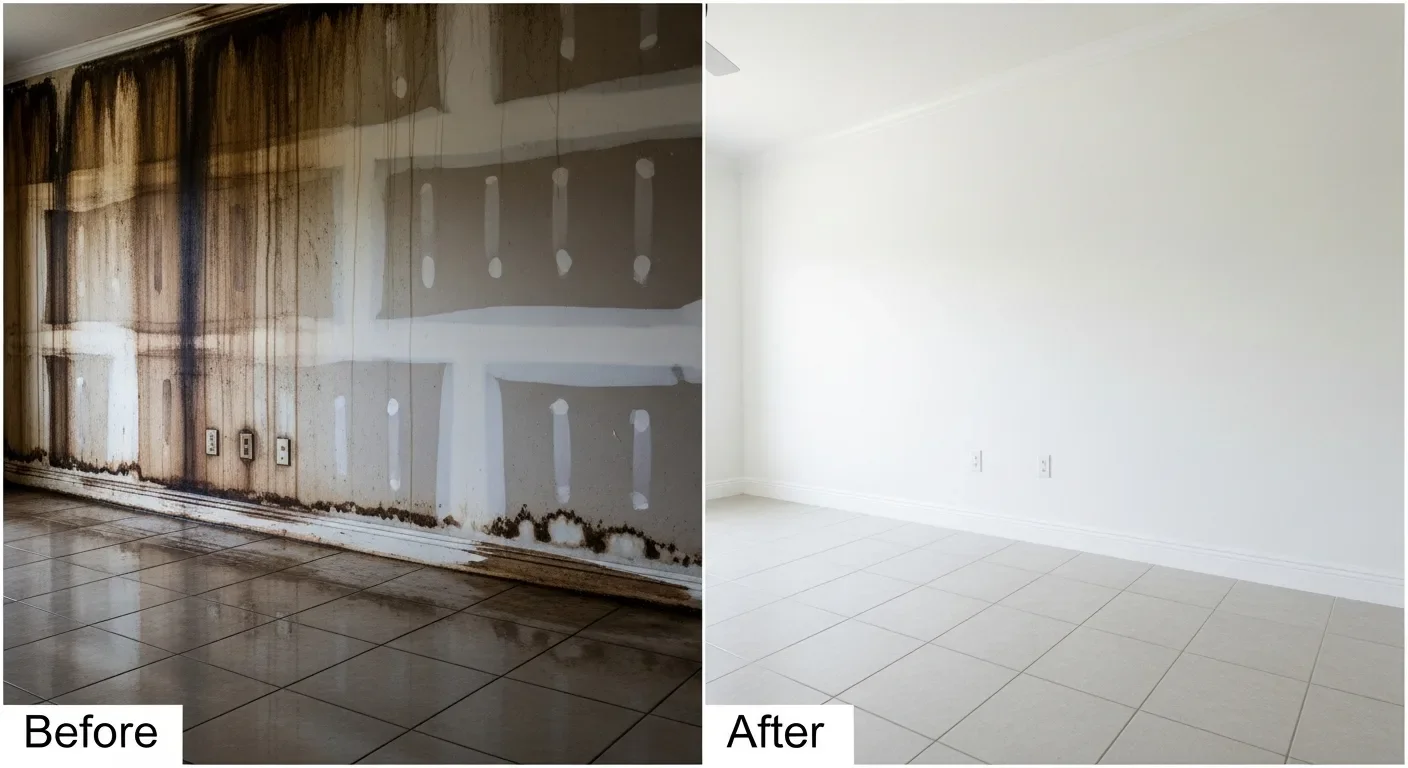
Before & After
Before and after: water-driven mold remediation in a Loxahatchee CBS home
Every project ends with post-remediation clearance testing by an independent DBPR-licensed
assessor.
You receive written clearance documentation — required by most insurance carriers and
suitable for real estate disclosures.
The Palm Build Difference
Why Loxahatchee Homeowners Trust Palm Build
Licensed, certified, and experienced in the specific mold challenges of western Palm
Beach County's rural and equestrian communities. We know CBS stucco, ITID drainage, and
Florida DBPR compliance.
DBPR Licensed — Separate Assessor & Remediator
Palm Build holds a current Florida DBPR mold remediator (MRSR) license and operates in full compliance with Chapter 468, Part XVI. We never perform assessment and remediation on the same property — we coordinate with independently licensed DBPR mold assessors (MRSA) for all pre-remediation scoping and post-remediation clearance testing. This protects your insurance claim and ensures unbiased documentation.
IICRC Certified — Insurance Adjuster Standards
Our technicians carry current IICRC Mold Remediation Specialist (MRS) certification and follow IICRC S520 protocols. This certification matters because insurance adjusters use S520 compliance as the benchmark for claim evaluation. Non-certified contractors produce documentation that adjusters routinely reject — costing homeowners the full cost of remediation.
24/7 Response — 55–65 Minutes to Loxahatchee
Our nearest team is based in Deerfield Beach, approximately 45 miles from The Acreage via I-95 and Southern Blvd. We reach most Loxahatchee neighborhoods in 55–65 minutes under normal conditions. In a climate where mold establishes in 24–48 hours, rapid response is not a luxury — it is the difference between a contained remediation and a whole-home project.
CBS Stucco Experts — Thermal Imaging Standard
Loxahatchee's CBS stucco construction requires thermal imaging to detect moisture at depth in masonry walls — standard pin moisture meters cannot reliably find moisture inside CMU blocks. Palm Build uses thermal imaging cameras on every Loxahatchee assessment, revealing hidden moisture pockets in wall cavities that would otherwise be missed until visible mold appears on interior surfaces.
Serving The Acreage & All of Western Palm Beach County
Ready to Schedule Your Mold Assessment?
Serving The Acreage, Arden, Deer Run, Westlake, Fox Trail, White Fences, Santa Rosa
Groves, Cresswind, and all of Loxahatchee Groves. Our Deerfield Beach team responds
55–65 minutes to your door, 24 hours a day, 7 days a week.
Response AreaLoxahatchee, The Acreage, and all of western Palm Beach County
Response Time55–65 minutes from Deerfield Beach office
Available24 hours / 7 days / 365 days
Common Questions
Mold Remediation FAQs — Loxahatchee, FL
Answers to the questions Loxahatchee homeowners ask most often about mold remediation,
Florida licensing, HVAC mold, and insurance claims in western Palm Beach County.
Have a question not covered here? Call our Loxahatchee mold specialists directly.