Mold Remediation in Hialeah, Florida
Hialeah's wet season runs May 15 through October 15 — five months of sustained humidity above 80%, near-constant AC operation, and 67+ inches of annual rainfall pressing on 1960s and 1970s housing stock. From HVAC condensate failures in Westland Gardens apartments to stucco-crack water intrusion in Palm Springs homes and post-storm mold in multi-family buildings across West Hialeah Heights, Palm Build's DBPR-licensed team delivers same-day assessments, professional containment, complete remediation, and post-clearance air quality testing.
Same day
Emergency Response
24/7
Dispatch Available
IICRC
Certified Technicians
Trusted local pros in Hialeah
Outside our restoration scope, these are the vetted, licensed contractors we trust alongside our work. Personally evaluated, reference-checked, and recommended by Palm Build.
Borkat Plumbing Services, LLC
Miami, FL
Miami's licensed plumber for the four-county reach Palm Build can't always cover ourselves — Miami-Dade, Broward, Palm Beach, and the Florida Keys, owner-led by Boris Inclan with an OSHA-disciplined crew.
F1 Plumbing Corp
Miami, FL
The only Latina-owned, SBA-WOSB-certified plumber on Palm Build's directory — Niurka Muñoz's Miami-Dade-and-Broward shop carries DOT DBE certification, federal SAM.gov registration, and bilingual English/Spanish dispatch as published baseline.
Mold Problem in Hialeah? Get a DBPR-Licensed Assessment Today.
Palm Build's DBPR-licensed mold remediation team provides same-day inspections, professional containment, complete remediation, and post-clearance air quality testing — with documentation your insurance carrier accepts from day one.
How Mold Starts in Hialeah
Composite based on real Hialeah losses
"Carlos noticed a musty smell in his Westland Gardens apartment in early July. He assumed it was the heat. Two weeks later, he saw black spots spreading across the AC closet wall. The condensate drain line had been backing up for a month — water had soaked the drywall around the air handler and the mold had already distributed through the ductwork to every room. What could have been a $3,000 job was now a full-unit remediation."
In Hialeah's wet season, mold grows faster than most homeowners expect. The CDC puts the window at 24 to 48 hours after moisture exposure — and HVAC systems distribute spores to every room before the problem is even visible.
Know What You Are Facing
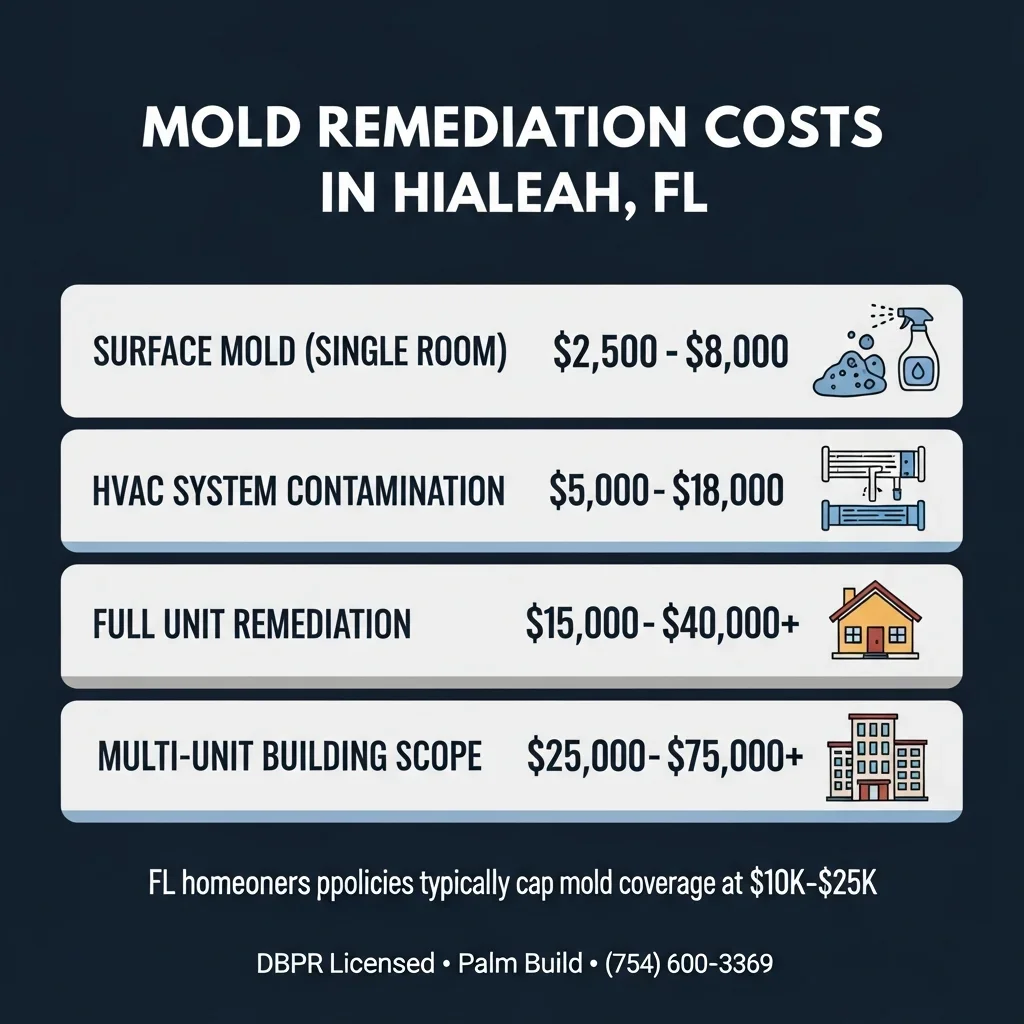
Mold Remediation Costs in Hialeah, FL
Ranges reflect typical Hialeah losses. FL homeowners policies typically cap mold coverage at $10K–$25K — documentation maximizes your recovery.
| Damage Type | Scope | Cost Range | Notes |
|---|---|---|---|
| Surface mold — single room | Bathroom, closet, wall section | $2,500 – $8,000 | Localized containment + surface remediation |
| HVAC system contamination | Air handler + ductwork | $5,000 – $18,000 | Most common in Hialeah — AC runs 10–11 months/year |
| Full unit remediation | Multiple rooms or whole-unit | $15,000 – $40,000+ | Long-standing or severe mold colonization |
| Multi-unit building scope | Adjacent units affected | $25,000 – $75,000+ | Shared plumbing stacks in Hialeah apartment buildings |
FL mold coverage cap: Most Florida homeowners policies include a mold sublimit of $10,000–$25,000 regardless of actual cost. DBPR-licensed documentation is essential for maximizing recovery against these sublimits.
#1 Mold Source in Hialeah
HVAC Systems — Why They Are the Leading Cause of Mold in Hialeah Homes
Hialeah's air conditioning runs 10 to 11 months per year — far longer than anywhere in the continental US. That continuous operation creates constant condensation, and any failure in the drain system delivers that moisture directly into walls and floors.
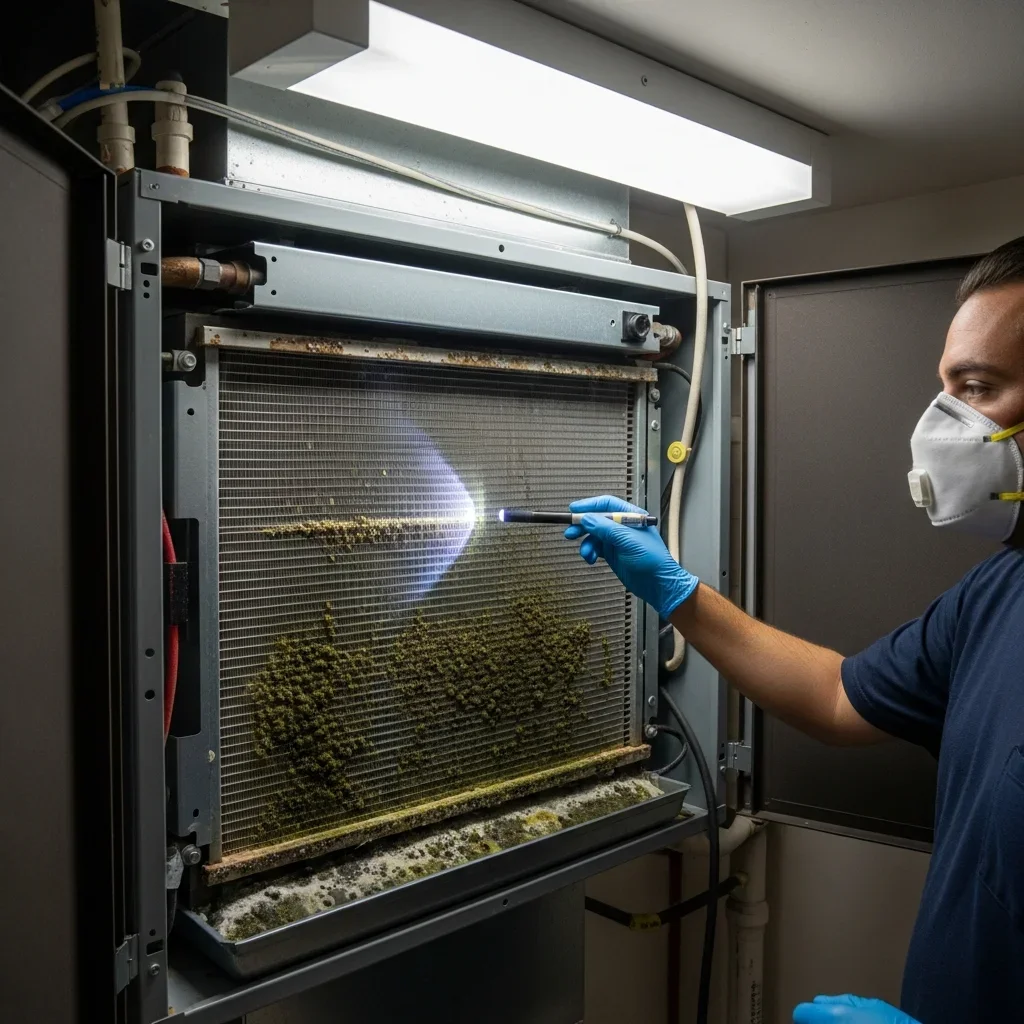
Mold inside an air handler cabinet — when AC runs year-round, drain line failures and cracked drip pans deliver moisture directly into the unit's interior.
Clogged Condensate Drain Lines
The most common cause. When the drain line that removes condensation from the air handler becomes blocked by algae, debris, or sediment, water backs up into the drip pan — and overflows into the wall, floor, and surrounding materials. In Hialeah, where AC runs nearly year-round, drain lines can clog within a single wet season.
Cracked or Corroded Drip Pans
Drip pans in 1970s–80s air handlers are typically galvanized steel — they rust, crack, and fail silently over years. A cracked pan delivers a slow continuous drip directly into the utility closet or ceiling cavity below. In Hialeah's multi-family buildings, this means water migrating to the unit below before either occupant knows there is a problem.
Oversized Units That Short-Cycle
An oversized AC unit cools the space quickly, then shuts off — without running long enough to dehumidify. The result: lower temperature but high relative humidity, creating condensation on interior surfaces that feeds mold growth even when no visible water event has occurred. A very common issue in Hialeah's older housing where original equipment has been swapped for larger tonnage.
Mold in the Ductwork
Once mold establishes in the air handler cabinet, the blower distributes spores through every supply duct in the house — often before the homeowner sees any visible growth. Every time the AC cycles, it is effectively spreading mold to every room. This is why remediation of HVAC-related mold always requires ductwork inspection and often full duct cleaning.
7 Warning Signs of HVAC Mold in Your Hialeah Home
If you see two or more of these signs, call Palm Build at (754) 600-3369. Same-day DBPR-licensed assessment available across all Hialeah ZIP codes.
Know Your Area
Mold Risk by Hialeah Neighborhood
Hialeah's mold risk is not evenly distributed. Housing era, construction type, and proximity to canals create different mold patterns by neighborhood.
| Neighborhood | Housing Era | Primary Mold Risk | Risk Level |
|---|---|---|---|
Westland Gardens 273-home multi-unit community | 1972 | Shared HVAC systems, aging plumbing stacks, unit-to-unit moisture migration through concrete assemblies. One drain line failure can affect 3–4 units. | Elevated |
Westland Gardens Club Condo / multi-family | 1970s | Stacked units with shared return-air pathways. HVAC mold in one unit circulates to adjacent units through ductwork connections. | Elevated |
Palm Springs Single-family / duplex | 1970s–80s | Deferred maintenance, slow supply-line leaks, original bathroom sealants that fail silently. Mold often found behind tile in 1970s bathrooms. | Moderate |
Hialeah Acres Single-family / duplex | 1960s–70s | Oldest housing stock. Original vapor barriers compromised. Stucco crack water intrusion over decades creates hidden wall cavity mold. | Elevated |
West Hialeah Heights Single-family residential | 1960s–70s | Canal-adjacent moisture pressure. High water table increases slab moisture. Post-flood mold establishes within 48 hours if not dried immediately. | Elevated |
Gratigny Red Single-family residential | 1970s–80s | Storm-driven flooding in wet season creates recurring post-flood mold events. Homes with low thresholds admit water rapidly during downpours. | Elevated |
Country Club Gardens Single-family residential | 1970s–80s | HVAC condensate + irrigation over-saturation of CBS block walls. Moisture in block cavities feeds mold growth invisible from interior. | Moderate |
Palm Springs Estates Single-family residential | 1980s | Appliance failures and original drain systems. Mold under kitchen cabinets from dishwasher connection leaks is most common finding. | Moderate |
Sun-Tan Village Single-family / multi-unit | 1960s–70s | Canal-adjacent high water table. Slab moisture migration in older homes. Wet season humidity amplification pushes indoor moisture above mold threshold. | Elevated |
Trojan Park Single-family / duplex | 1970s | Multi-unit shared systems. Prolonged humid conditions from frequent small water events compound into chronic mold pressure. | Moderate |
Serving all Hialeah ZIP codes: 33010, 33012, 33013, 33014, 33015, 33016, 33018. Same-day DBPR-licensed mold assessments available across the entire city. Call (754) 600-3369.
Unique to Hialeah
Hialeah Wet Season Mold Risk Calendar
South Florida's wet season runs May 15 through October 15. For Hialeah homeowners, this is the five-month window when mold growth can establish in 24 to 48 hours after any moisture event. Here is the month-by-month mold pressure map.
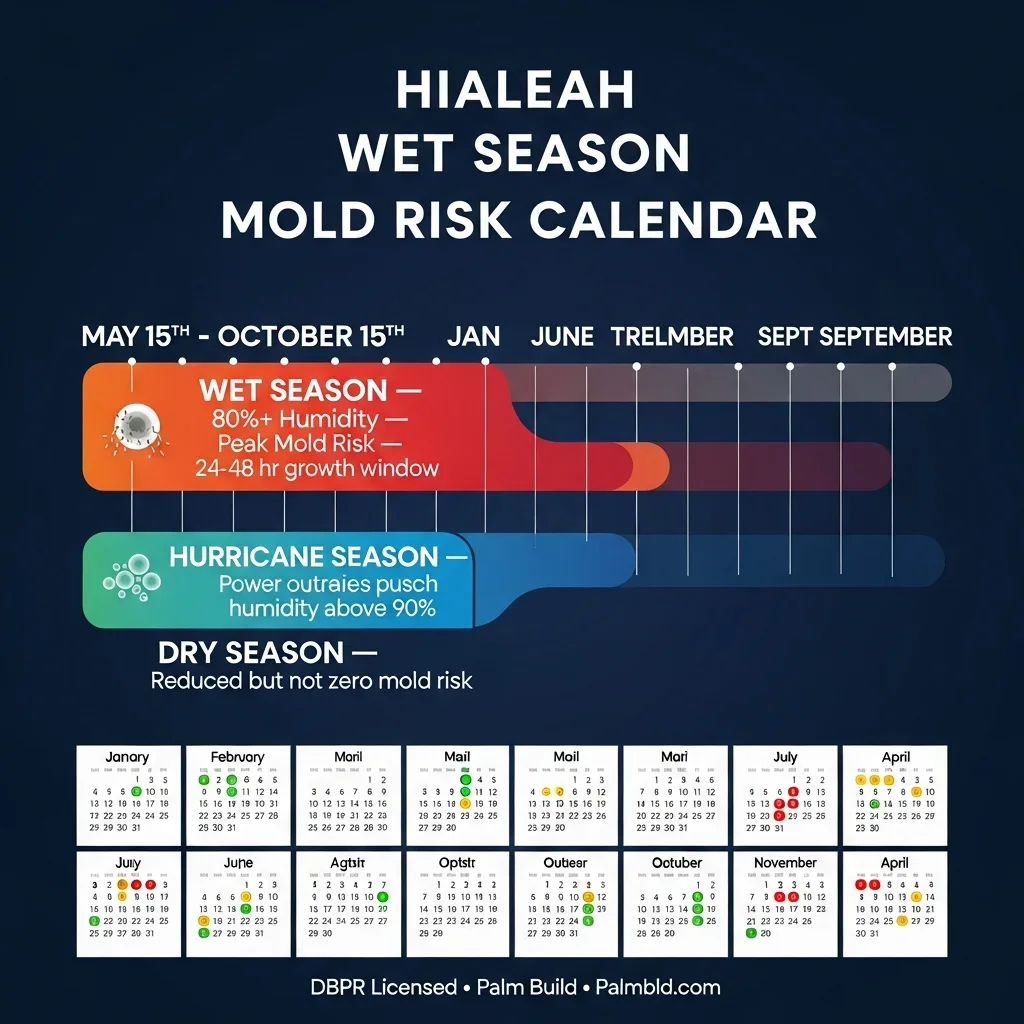
~65–70% RH
Dry season. Indoor humidity manageable with AC. HVAC condensate issues still occur but mold growth is slower.
~65–70% RH
Driest month. Best time to remediate any deferred mold issues before wet season.
~65–72% RH
Pre-wet-season window. Inspect HVAC drain lines and bathroom seals now.
~68–75% RH
Transitioning. Humidity begins rising. Check stucco cracks before first rains arrive.
~74–80% RH
Wet season begins May 15. First storms. HVAC starts running continuously — condensate risk rises sharply.
~80–85% RH
Hurricane season opens. Heavy rain. HVAC drain line failures peak. Mold can establish within 24–48 hours of any moisture event.
~82–88% RH
Peak mold risk month. Sustained outdoor humidity above 80% prevents drying. Power outages push indoor humidity to 90%+ within hours.
~83–90% RH
Highest sustained humidity. Any untreated moisture event becomes visible mold within 48–72 hours. Storm-related losses multiply.
~82–88% RH
Highest rainfall month. Post-storm mold calls peak. Every flooded property in Hialeah is a 48-hour mold clock.
~78–84% RH
Wet season winding down but still active. Late-season storms. HVAC still under full load.
~70–76% RH
Dry season transition. Mold growth slows but HVAC condensate issues persist year-round in Hialeah.
~65–72% RH
Dry season. Lowest mold growth risk but not zero — HVAC still running and producing condensation.
The CDC/EPA Warning: Mold can begin growing within 24 to 48 hours of moisture exposure. In Hialeah during July–September, when outdoor humidity stays above 80% and power outages push indoor humidity above 90%, visible mold colonies can appear within 48–72 hours after a storm or water event. Call Palm Build at (754) 600-3369 — same-day assessment available.
Unique to Hialeah
The Hialeah Multi-Family Mold Playbook
Nearly 30% of Hialeah's housing is in 20+ unit buildings — communities like Westland Gardens, Westland Gardens Club, and Palm Springs Estates that were built in the early 1970s and share plumbing, HVAC, and building assemblies. Mold in these buildings requires a different approach than single-family remediation.
29%
of Hialeah housing in 20+ unit buildings
273
homes in Westland Gardens (built 1972)
36%
of all units built 1960–1979 — aging systems
1
HVAC failure can affect 3–4 adjacent units
Identify the Source Unit First
In Hialeah multi-family buildings, the mold you see in one unit is often caused by a water source in another unit or a shared building system. We trace the moisture source before any remediation begins — preventing re-contamination after cleanup and establishing accurate liability documentation for HOAs and insurers.
Coordinate Access with Building Management
Westland Gardens, Palm Springs Estates, and Hialeah's other multi-family communities have building managers, maintenance staff, and sometimes security protocols. We contact building management before arrival, coordinate access to mechanical rooms, shared spaces, and adjacent units as needed — so remediation starts on schedule.
Containment That Protects Neighbors
Mold remediation creates airborne spores during the removal process. In shared buildings, this is a liability risk if not properly contained. We establish full negative pressure containment with HEPA air scrubbers before breaking any contaminated material — protecting adjacent units, common areas, and HVAC systems from cross-contamination.
HOA and Association Communication
Multi-family mold losses in Hialeah often involve the homeowner's HO-6 policy, the HOA or building master policy, and potentially a neighbor's liability coverage. We provide written assessment reports, photo documentation, and scope-of-work summaries formatted for HOA board review and master policy adjusters.
Multi-Party Documentation from Day One
When multiple policies are involved, documentation clarity prevents disputes. We photograph and document for all parties simultaneously — source of moisture, extent of mold, containment setup, remediation work, and clearance — so no adjuster can challenge what was present or what was done.
Post-Clearance Air Quality Testing
Remediation is not complete without clearance. We coordinate post-remediation air quality testing by a DBPR-licensed independent assessor (the same contractor cannot remediate and clear under Florida law). The clearance report confirms ambient mold spore counts are at or below baseline — the document your HOA, insurer, and future buyers will require.
Why this matters in Hialeah: HOA documents in Hialeah's multi-family communities often include provisions that make unit owners financially liable for damage caused to common areas or neighboring units during remediation. Palm Build's containment protocols and multi-party documentation are designed to ensure our work never creates a secondary liability claim against you.
IICRC S520 & DBPR Certified Process
Our 6-Step Mold Remediation Process in Hialeah
Every Hialeah mold job follows the same DBPR-compliant, IICRC S520-based protocol — from same-day assessment to independent clearance testing.
Same-Day DBPR-Licensed Assessment
Our DBPR-licensed mold assessor visits your Hialeah property the same day you call. We identify all mold colonies, measure airborne spore counts, trace the moisture source, and determine whether adjacent assemblies or HVAC systems are involved. Written assessment with photos and moisture readings delivered before remediation begins.
Containment — Negative Pressure Barriers
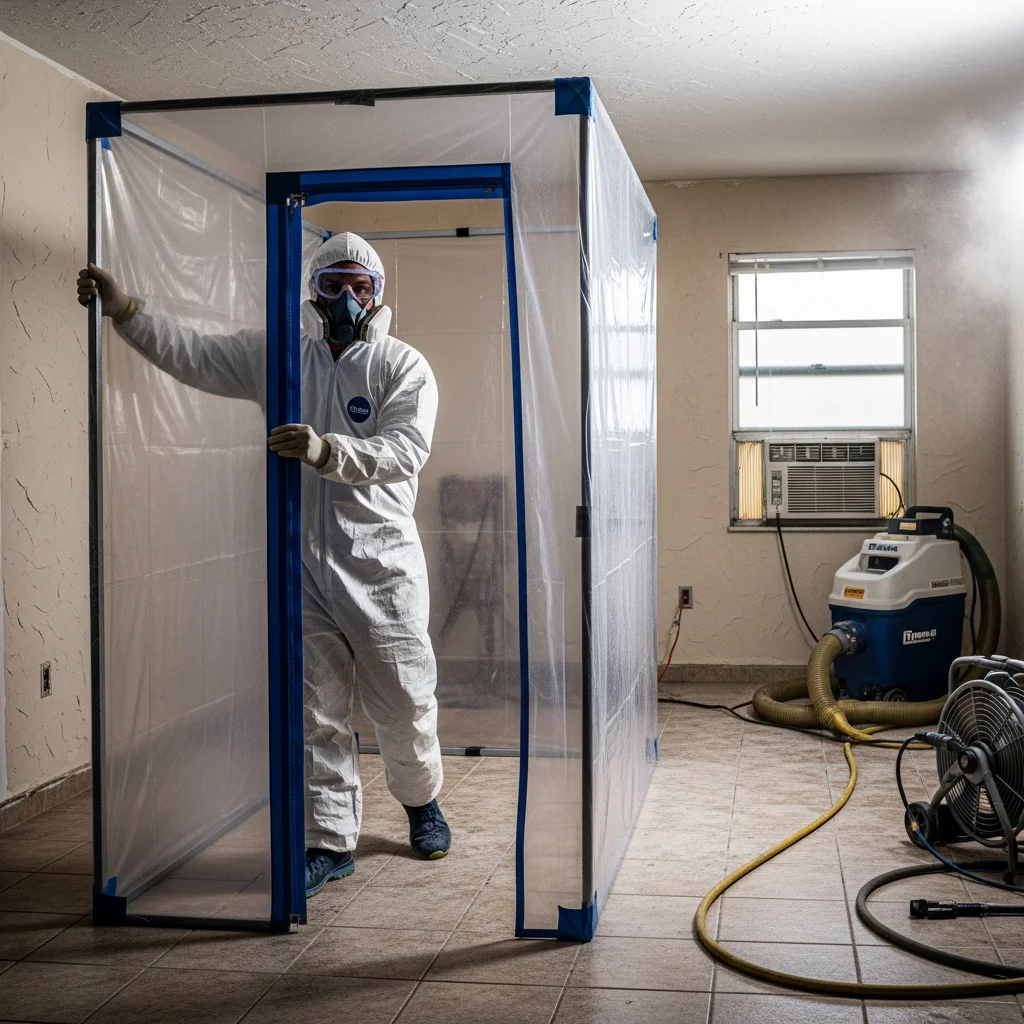
Before any mold is disturbed, we establish full negative-pressure containment using 6-mil poly sheeting with professional zipper-door entries. HEPA air scrubbers create negative pressure that prevents spores from escaping the work zone. In Hialeah's multi-family buildings, this containment setup protects adjacent units and common areas.
HEPA Air Filtration — Continuous During Remediation
Commercial HEPA air scrubbers (capturing particles down to 0.3 microns) run continuously throughout all removal work. Air changes per hour are calculated for each room based on cubic footage per IICRC S520 standards. In Hialeah's humid climate, additional dehumidification runs in parallel to prevent recontamination during work.
Physical Removal — IICRC S520 Protocol
All contaminated porous materials (drywall, insulation, wood framing with deep penetration) are removed per IICRC S520 guidelines and disposed of in sealed bags within the containment area. Non-porous surfaces are HEPA-vacuumed and treated. We remove what cannot be cleaned and preserve what can — reducing costs and rebuild scope.
Antimicrobial Treatment and Encapsulation
After removal, all remediated surfaces receive EPA-registered antimicrobial treatment. In Hialeah's humidity, structural encapsulants are applied to remaining wood framing to provide long-term mold resistance. HVAC systems involved in the loss receive full internal cleaning and antimicrobial fogging before being returned to service.
Independent Clearance Testing + Full Documentation
Florida law requires the same contractor who remediates to not perform the clearance assessment. We coordinate with an independent DBPR-licensed assessor who conducts post-remediation air sampling and surface testing. The clearance report confirming spore counts at or below baseline is the document your insurer, HOA, and future buyers require.
Florida Consumer Protection
Florida Mold Licensing — What Hialeah Homeowners Must Know
Florida is one of the most strictly regulated states for mold services under DBPR Chapter 468, Part XVI. Before hiring any mold contractor in Hialeah, verify their license status — and understand the rules designed to protect you.
Mold Assessor (MRSA)
Mold Remediator (MRSR)
6 Things Every Hialeah Mold Homeowner Should Know
Verify license status at MyFloridaLicense.com before signing any contract
The 12-month separation rule prevents the same contractor from assessing and remediating — protecting you from conflicts of interest
Florida Dept. of Health recommends mold sampling only when done by experienced professionals — not routine
Miami-Dade County routes mold complaints to FL Dept. of Health as a health issue, not cosmetic
Beware any company that offers to both inspect and remediate in the same visit — this violates DBPR rules
A company that pressures you to sign quickly after finding mold is a red flag — get the assessment report first
Verify Palm Build's DBPR License
Check our current DBPR mold remediator license status at MyFloridaLicense.com before any work begins. We encourage every Hialeah homeowner to verify.
Cost Transparency
Mold Remediation Costs in Hialeah, FL — What to Expect
Mold remediation cost in Hialeah depends on scope, affected systems, and extent. Understanding what your insurance covers — and its limits — before work begins protects your recovery.
$6,023
avg Miami-Dade homeowners premium with wind
$2,848
avg Miami-Dade condo unit owner premium with wind
$10K–$25K
typical FL mold coverage sublimit
18 months
supplemental claim window (F.S. 627.70132)
Surface Mold
Single room, closet, or bathroom
Typical scope:
Localized containment, surface removal, antimicrobial treatment, independent clearance test
Insurance note:
Often covered under standard FL homeowners mold sublimit
HVAC System Mold
Air handler + ductwork cleaning
Typical scope:
Most common in Hialeah — AC runs 10–11 months/year. Includes handler cleaning, duct cleaning or replacement, and fogging.
Insurance note:
Covered when caused by sudden appliance failure; may be excluded for maintenance neglect
Full Unit Remediation
Multiple rooms or whole-unit remediation
Typical scope:
Long-standing or severe colonization requiring drywall removal, structural drying, full containment across multiple rooms
Insurance note:
May exceed typical FL mold sublimit of $10K–$25K — documentation critical for supplemental claims
Multi-Unit Building
Adjacent units and shared systems
Typical scope:
Multi-party coordination, building-wide HVAC cleaning, HOA documentation package, multi-unit clearance testing
Insurance note:
Involves HOA master policy + individual HO-6 policies — multi-policy documentation essential
Florida's 18-month supplemental claim window: Under F.S. 627.70132, you can file supplemental mold claims for 18 months from the date of loss. If initial remediation reveals additional mold scope not identified at first assessment — common in Hialeah's multi-family buildings — Palm Build's documentation supports supplemental claims with complete updated scope records.
Mold Remediation in Hialeah
What DBPR-Licensed Mold Remediation Looks Like in Hialeah
From containment setup in Hialeah apartments to HVAC air handler mold — documented, contained, and cleared by DBPR-licensed professionals.
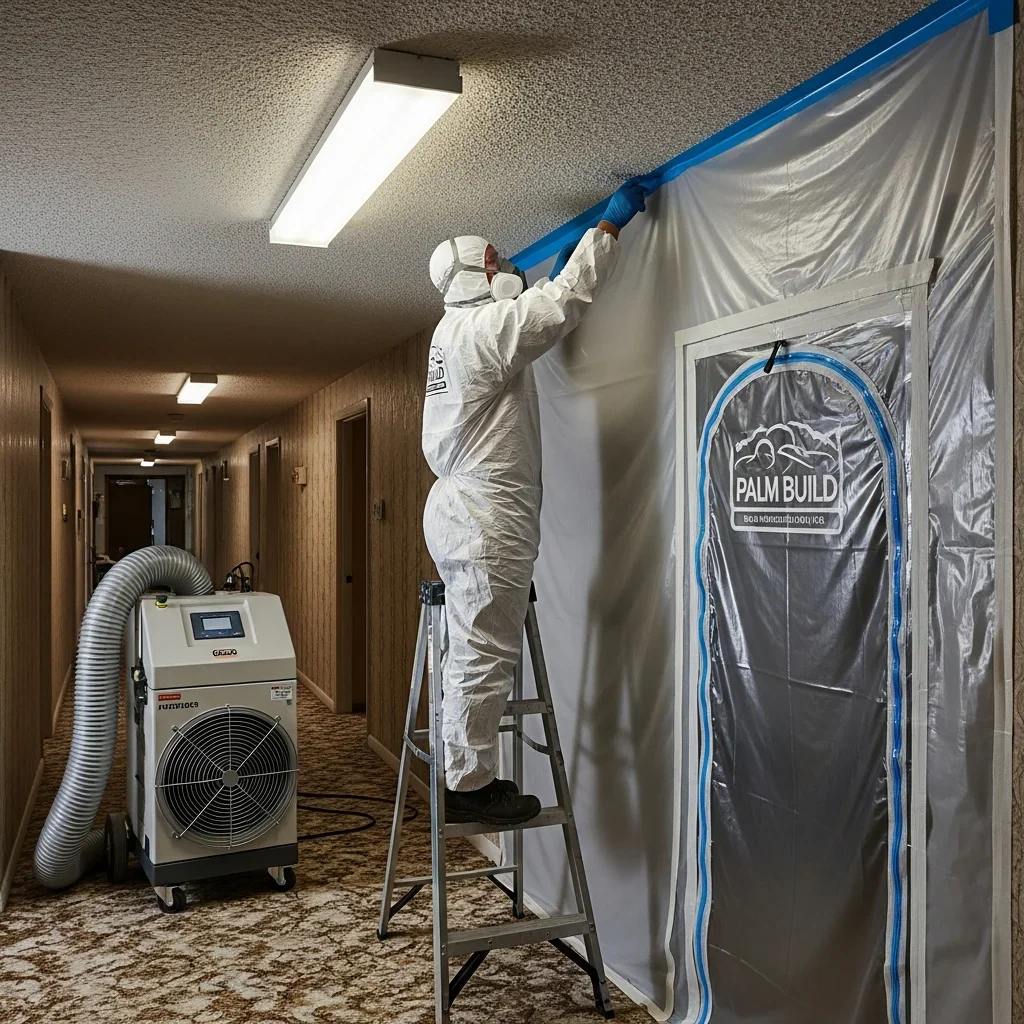
Full negative-pressure containment setup — HEPA scrubbers running before any mold is disturbed.
HVAC air handler mold — the leading cause of mold in Hialeah. Drain line backup feeds moisture to coil and pan.
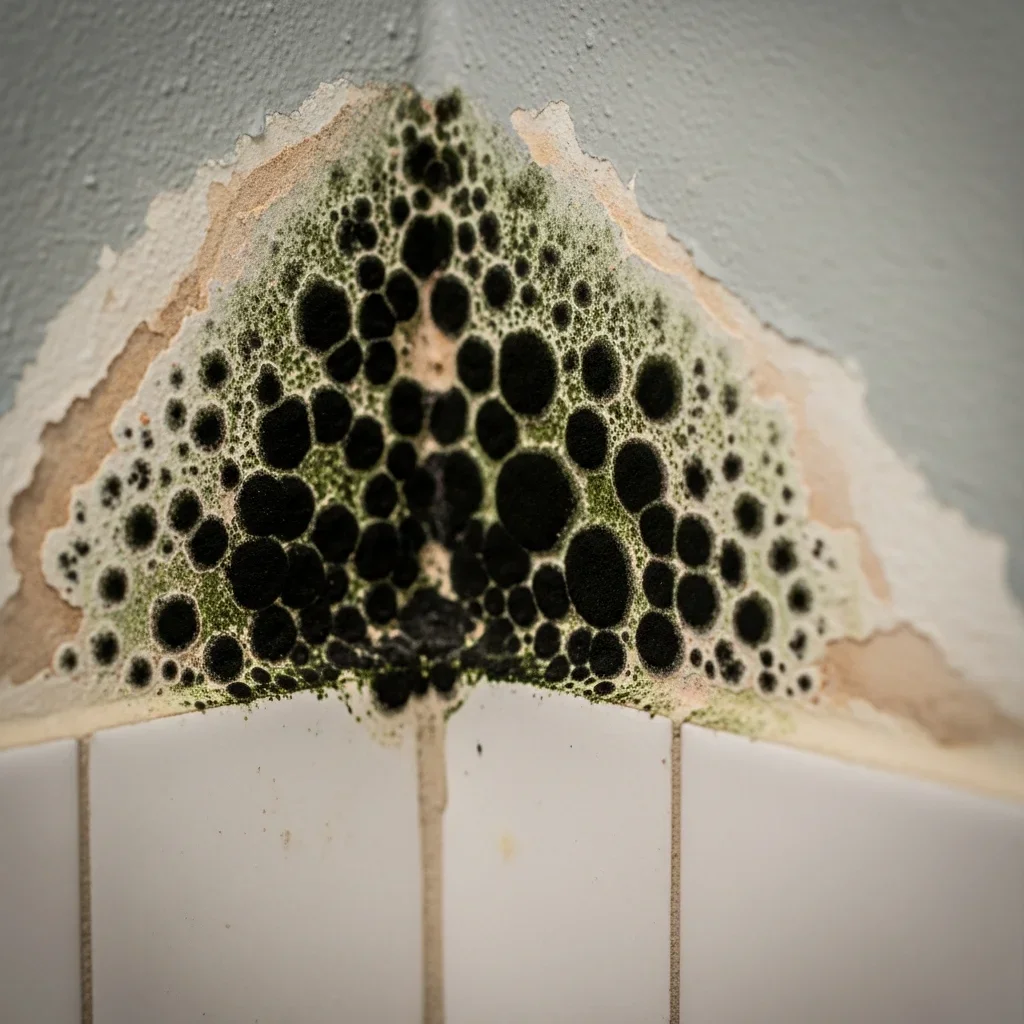
Mold in a Hialeah bathroom — stucco wall with failed sealant allowing moisture intrusion over time.
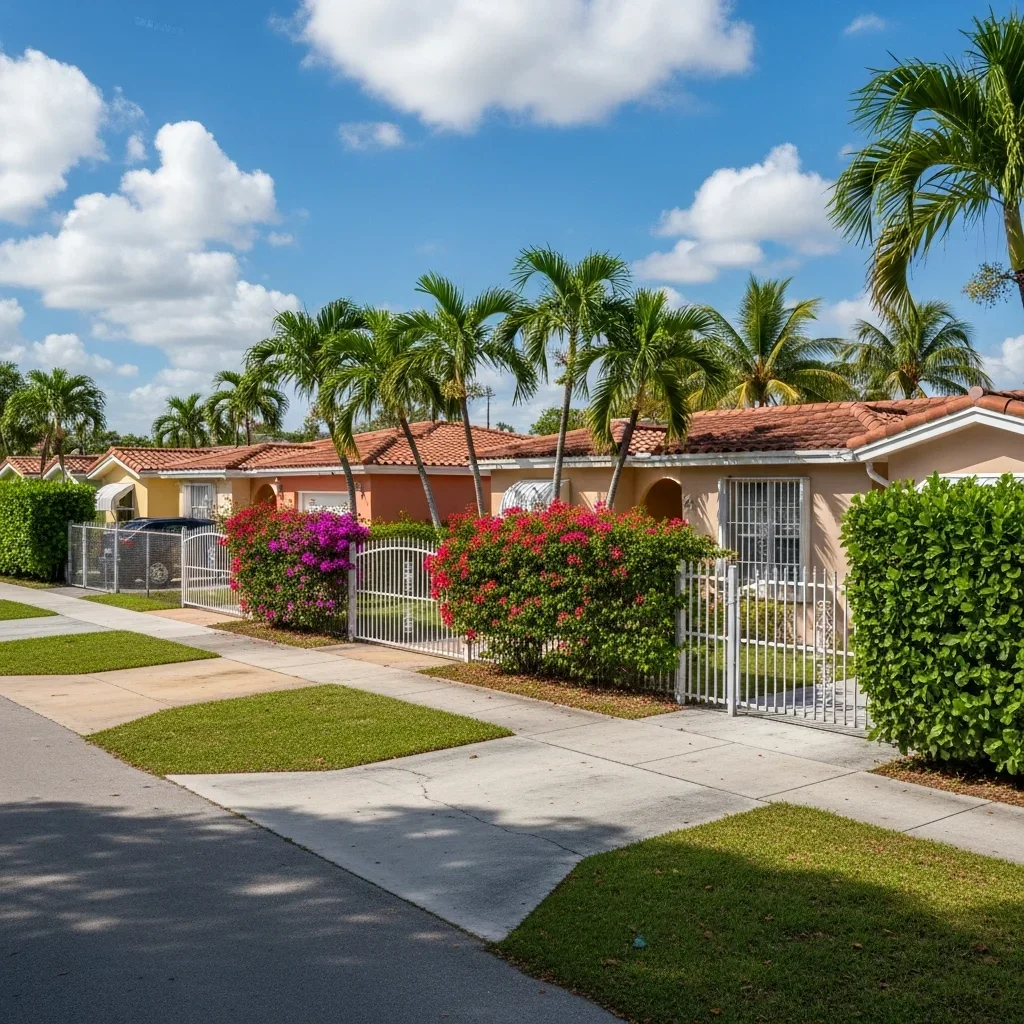
Hialeah's 1960s–70s CBS stucco housing stock — aging construction creates specific mold vulnerability patterns by neighborhood.
Florida homeowners policies typically cap mold coverage at $10,000–$25,000. Palm Build's DBPR-licensed documentation maximizes recovery against these sublimits.
Why Hialeah Homeowners Choose Us
Why Palm Build for Mold Remediation in Hialeah
DBPR licensed, HVAC mold specialists, multi-family coordination, and insurance documentation built for Miami-Dade's complex claims environment.
DBPR Chapter 468 Licensed
Florida requires separate DBPR licenses for mold assessment (MRSA) and remediation (MRSR). Palm Build holds current DBPR mold remediator credentials and coordinates with independent licensed assessors — maintaining the 12-month separation rule that protects Hialeah homeowners from conflicts of interest. Verify our license at MyFloridaLicense.com any time.
HVAC Mold Specialists
HVAC systems are the #1 mold source in Hialeah — and treating them requires more than surface remediation. We handle full air handler cleaning, ductwork remediation, drain system repair coordination, and antimicrobial fogging to prevent spore redistribution when the system is returned to service. We understand how Hialeah's 10–11 month AC season creates this risk.
Multi-Unit Building Expertise
Hialeah's Westland Gardens, Palm Springs Estates, and similar 1970s multi-family communities require a different approach. We trace moisture sources through shared assemblies, coordinate with building management, contain mold to prevent spread to adjacent units, and provide multi-party documentation for HOA master policies and individual HO-6 claims simultaneously.
Insurance Documentation for Miami-Dade
Florida's 2023 AOB reform changed how mold claims are processed. Palm Build provides the complete documentation package — DBPR assessment findings, containment records, remediation scope, photos, and independent clearance report — formatted to what Miami-Dade adjusters need under the post-reform direct claims process.
Mold Problem in Hialeah?
Same-day DBPR-licensed assessment. Professional containment, remediation, and independent clearance testing — with documentation your insurance carrier accepts.
Frequently Asked Questions
Mold Remediation in Hialeah — Common Questions
Answers specific to Hialeah's HVAC mold risk, multi-family mold spread, DBPR licensing requirements, and Florida's insurance coverage limits.
Questions about mold at your Hialeah property?
Call (754) 600-3369 — DBPR LicensedMore in Hialeah