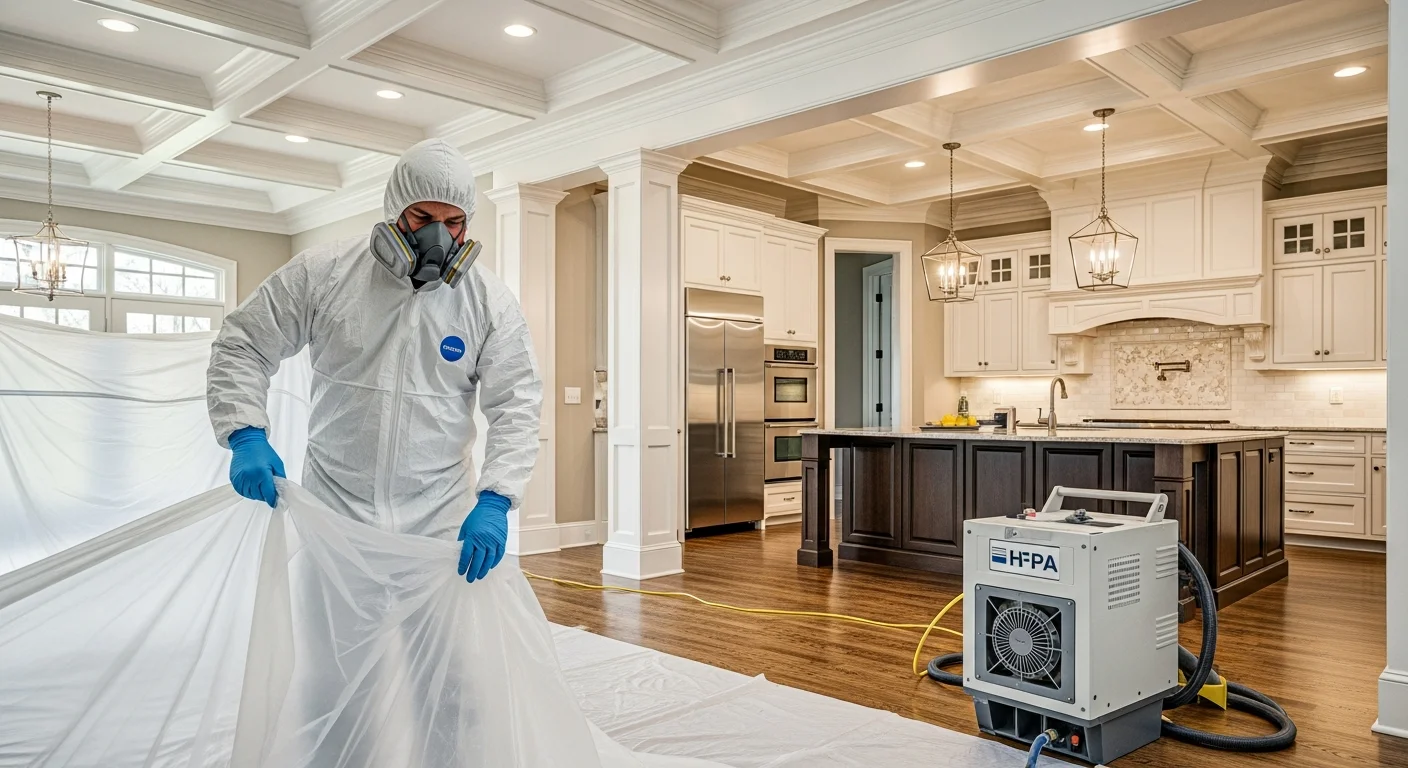
Palm Build mold remediation technician in full PPE setting up containment inside an upscale Davidson North Carolina home with premium finishes near Lake Norman
DAVIDSON NC — IICRC-CERTIFIED MOLD REMEDIATION

Mold Remediation in Davidson, North Carolina

Lake Norman's humidity, Piedmont clay soil, and Davidson's mix of vintage crawl spaces and modern tight-envelope homes create ideal mold conditions year-round. North Carolina has no statewide mold license — which means choosing an IICRC-certified team with proper containment protocols is the only way to protect your investment. Palm Build delivers verified remediation for Davidson's premium homes.

Local Office — Charlotte, NC (30-60 min to Davidson) 30-60 min Response IICRC Certified

30-60 min

Emergency Response

24/7

Dispatch Available

IICRC

Certified Technicians

Local Mold Risk Factors

Why Davidson, NC Homes Are Vulnerable to Mold

Davidson is one of the most mold-susceptible towns in the greater Charlotte metro. Its position between Lake Norman and Lake Davidson, combined with Piedmont clay soils, a mix of housing eras, and increasing density of attached-unit construction, creates five overlapping risk factors that make professional mold remediation — not DIY treatment — the only reliable solution.

Lake-Adjacent Humidity

32K+ acres

Lake Norman surface area

Davidson sits between two significant water bodies: Lake Norman at 32,510 acres and the smaller Lake Davidson. These lakes generate persistent ambient humidity that saturates the surrounding air, particularly in summer when surface evaporation peaks. Homes within a mile of either shoreline — which includes most of the town — experience indoor relative humidity 8-15% higher than inland Mecklenburg County locations. This sustained humidity creates condensation on cool surfaces (ductwork, cold water pipes, foundation walls) that feeds mold colonies year-round, not just during rain events.
Piedmont Clay & Crawl Spaces

70%+

Crawl space RH typical

Davidson sits on Piedmont red clay — a soil type with extremely poor drainage that holds moisture against foundations for weeks after rain events. This clay creates a persistent vapor drive that pushes ground moisture upward through crawl space floors and into floor assemblies. Most Davidson homes built before 2015 have vented crawl spaces, which in the humid Piedmont climate actually introduce more moisture than they remove. The result is a crawl space environment where relative humidity regularly exceeds 70% — well above the 60% threshold where mold begins colonizing wood framing, subfloor sheathing, and insulation.

Split-Era Housing Stock

4 eras

Distinct construction periods

Davidson has a uniquely compressed housing timeline: 1960s-1980s lakeside originals, 1990s-2000s master-planned communities, 2007-2019 infill development, and 2019-present new construction. Each era carries distinct mold risk drivers. Older homes have aging plumbing and vented crawl spaces. Mid-era homes have complex rooflines prone to flashing failures. Newer homes have tight building envelopes that trap moisture when the drying assembly fails. Understanding which era built your home is the first step in diagnosing where mold is hiding and why.

Tight Modern Envelopes

2012+

Tight envelope era

Davidson homes built after 2012 under the updated NC energy code have significantly tighter building envelopes than their predecessors — better insulation, house wrap, sealed penetrations, and high-performance windows. This is excellent for energy efficiency but creates a critical vulnerability: when moisture enters from any source (roof leak, plumbing failure, construction moisture, flashing defect), it has nowhere to dry. The assembly traps moisture between vapor-resistant layers, creating an ideal incubation environment where mold can colonize behind drywall for months before any visible sign appears.

Townhouse & Condo Complexity

Multi-unit

Shared wall moisture risk

Davidson Bay, Linden Court, and other attached-unit communities add a layer of mold risk that detached homes do not face: shared wall cavities. When moisture migrates through a party wall — from a neighbor's plumbing leak, condensation in a shared HVAC chase, or vapor drive through a common foundation — mold can colonize in the shared cavity and affect both units simultaneously. Remediation in these environments requires coordinated access, and the mold source may be in a unit you do not own or control.

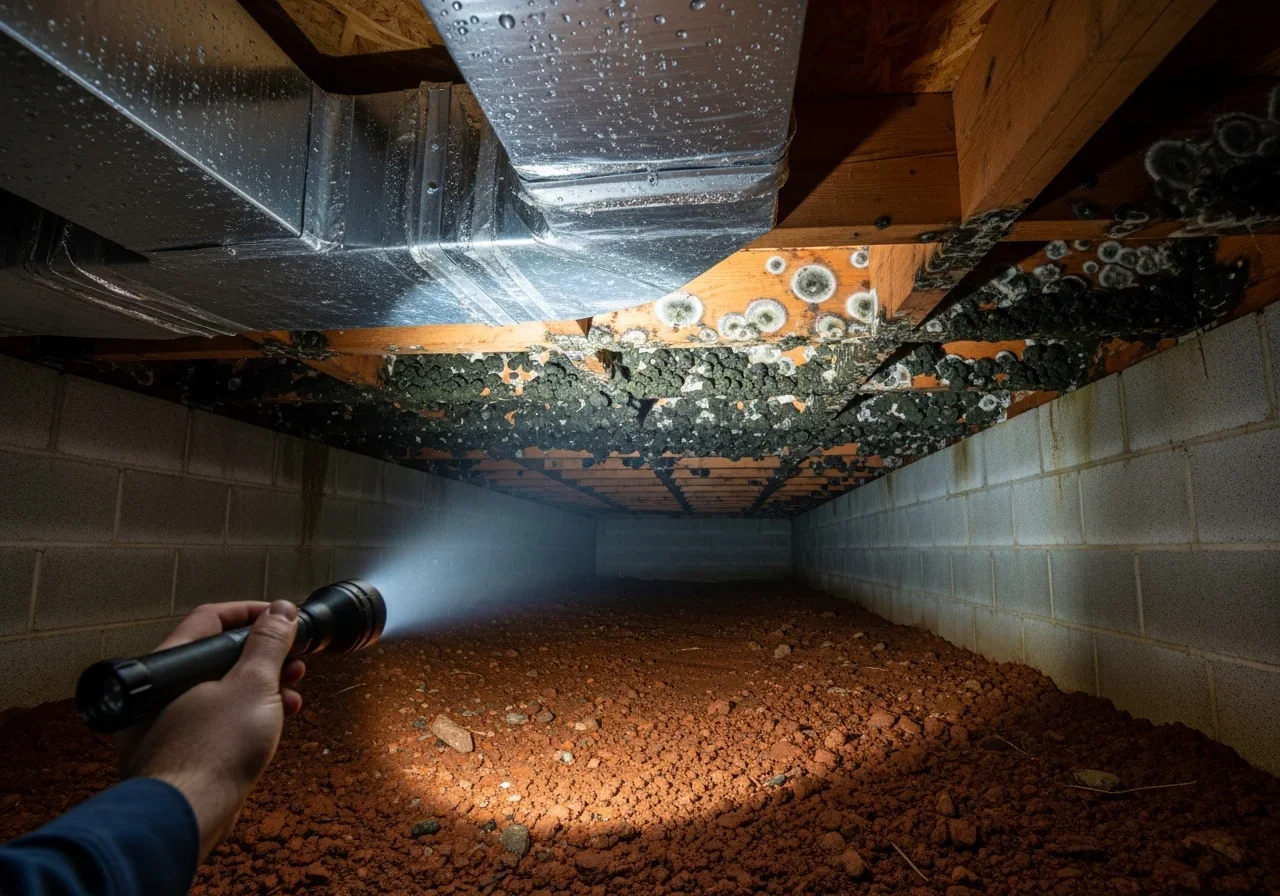
Mold growth on crawl space floor joists and subfloor sheathing in a Davidson NC home caused by persistent humidity from Lake Norman proximity and Piedmont clay vapor drive
Crawl space mold in a Davidson home — Piedmont clay vapor drive and lake-adjacent humidity create conditions where crawl space relative humidity regularly exceeds 70%, feeding mold colonies on wood framing and subfloor sheathing.

Know the Warning Signs

7 Signs Your Davidson Home May Have a Mold Problem

Mold in Davidson homes rarely announces itself with a visible patch on the wall. More often, the first indicators are subtle — a smell, a symptom, a floor that feels different underfoot. Recognizing these early signs can prevent a small colony from becoming a full remediation project.

Musty Odor from Crawl Space or HVAC

The most common first indicator of mold in Davidson homes is a persistent musty smell — often strongest when the HVAC system kicks on or when you open a crawl space access door. This odor comes from microbial volatile organic compounds (MVOCs) produced by active mold colonies. In Davidson, where crawl space humidity feeds mold growth below the living space, the HVAC return pulls contaminated air directly into the duct system and distributes it through every room. If you smell mustiness when the air handler starts, the source is almost always in the crawl space, the air handler closet, or the ductwork itself.

Visible Discoloration on Walls or Ceilings

Dark spots, grey-green patches, or fuzzy growth on drywall surfaces signals mold that has already colonized through the wall cavity and reached the surface. By the time mold is visible on painted drywall, the colony behind the wall is typically 10-50 times larger than what you see. In Davidson homes, visible mold most commonly appears on exterior walls (condensation zones), around bathroom fixtures (plumbing leaks), at ceiling-wall junctions (roof/flashing leaks), and along baseboards in rooms adjacent to crawl spaces.

Persistent Allergy Symptoms Indoors

If household members experience sneezing, congestion, itchy eyes, or respiratory irritation that improves when they leave the house and returns when they come home, indoor mold is a likely cause. Mold spores are potent allergens, and even non-toxic species produce enough airborne spores to trigger persistent symptoms. In Davidson homes with crawl space mold, residents often report that symptoms are worst in rooms directly above the crawl space — bedrooms and living areas on the first floor.

Condensation on Pipes, Windows, or Ductwork

Visible condensation — water droplets on cold water pipes, window glass, or HVAC supply ducts — indicates indoor relative humidity high enough to support mold growth. In Davidson, condensation is most common in crawl spaces (cold pipes sweating in humid air), on single-pane or older windows in lakeside homes, and on poorly insulated ductwork running through unconditioned spaces. Condensation itself does not mean mold is present, but it confirms the moisture conditions that make mold growth inevitable without intervention.

Cupping or Buckling Hardwood Floors

Hardwood floors that are cupping (edges higher than center) or buckling indicate moisture intrusion from below — almost always from a crawl space in Davidson homes. The subfloor absorbs moisture from the humid crawl space, swells, and pushes upward against the hardwood. This is a late-stage indicator: by the time hardwood visibly cups, the subfloor and floor joists below have been at elevated moisture levels long enough for mold colonization. If your Davidson hardwood floors are cupping, the crawl space needs inspection immediately.

Dark Spots in HVAC Supply or Return Vents

Dark discoloration around HVAC registers — especially supply vents — indicates mold is growing inside the duct system or at the air handler and depositing spores on the vent grilles as air passes through. In Davidson homes, this is typically caused by condensation inside ductwork running through unconditioned crawl spaces or attics. The temperature differential between conditioned air inside the duct and humid unconditioned air outside the duct creates a condensation layer that feeds mold growth on interior duct surfaces.

"Mystery" Musty Smell That Intensifies in Summer

A musty odor that comes and goes — strongest in June through September and barely noticeable in winter — is a hallmark of mold driven by seasonal humidity rather than a plumbing leak. In Davidson, summer humidity from Lake Norman and Lake Davidson pushes indoor relative humidity above the 60% mold threshold even in air-conditioned homes, especially in rooms with poor air circulation (closets, guest bedrooms with closed doors, finished basements). The mold colony goes semi-dormant in winter's lower humidity and reactivates each summer.

Seeing one or more of these signs in your Davidson home?

A professional mold assessment with air sampling identifies the species, concentration, and source — giving you clear data before any remediation decisions.

Schedule a Mold Assessment — (704) 464-0121

IICRC S520 Compliant Process

6-Step Mold Remediation Process for Davidson Homes

Every Palm Build mold remediation follows IICRC S520 standards — the industry protocol that defines proper containment, removal, treatment, and verification. In Davidson, where lake humidity and crawl space moisture create persistent recontamination risk, we add aggressive dehumidification and premium finish protection to the standard protocol.

01

Assessment & Air Sampling

Day 1

Our IICRC-certified team conducts a comprehensive inspection of your Davidson home, including thermal imaging to identify moisture concentrations behind walls and in crawl spaces, moisture meter readings at all suspected intrusion points, and professional air sampling. Air samples are sent to an independent lab that identifies mold species and spore concentrations — giving us (and you) objective data on what species are present, where concentrations are highest, and how they compare to outdoor baseline levels. This assessment drives the remediation scope: no guessing, no over-scoping, no unnecessary work.

02

Containment & Premium Finish Protection

Day 1-2

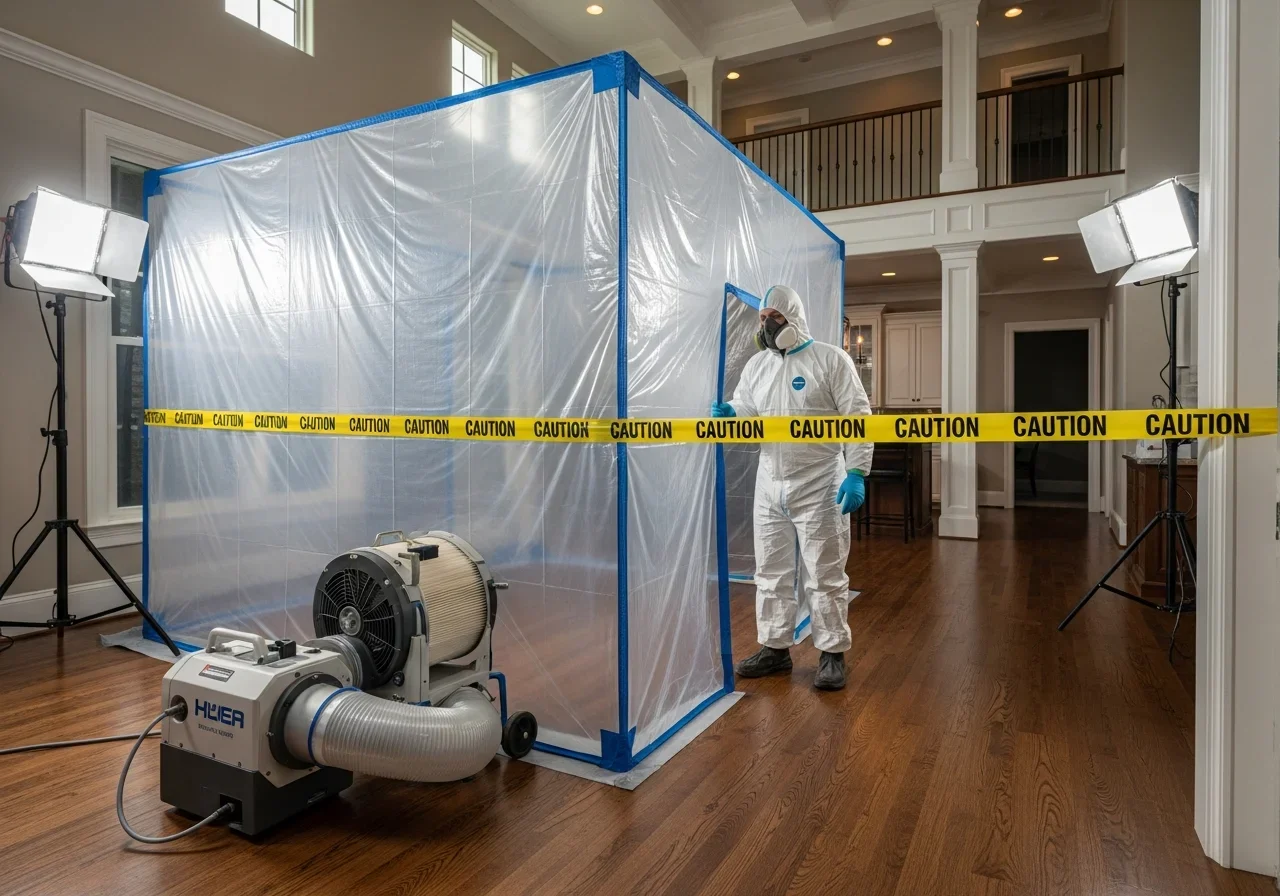
Before any remediation begins, we establish engineering controls to prevent cross-contamination. Poly sheeting barriers isolate the work area from the rest of your home. Negative air machines with HEPA filtration create negative pressure inside containment, ensuring all airflow moves inward — not outward into your living spaces. For Davidson premium homes, we take additional steps: floor protection over hardwood, trim protection on painted millwork, furniture wrapping and relocation from adjacent rooms, and HVAC isolation to prevent spores from entering the duct system during removal.

03

HEPA Vacuuming & Source Removal

Days 2-4

All mold-contaminated materials are removed following IICRC S520 protocols. Porous materials that cannot be cleaned to pre-loss condition — drywall, insulation, carpet padding — are cut out and disposed of in sealed bags. Semi-porous materials (wood framing, subfloor sheathing) are HEPA-vacuumed to remove surface spores, then sanded or media-blasted to reach embedded growth. Non-porous materials are HEPA-vacuumed and cleaned with antimicrobial solutions. Every removed material is documented with photographs for insurance records.

04

Antimicrobial Treatment

Days 3-5

After source removal, all exposed surfaces within the containment zone receive professional antimicrobial treatment. We apply EPA-registered antimicrobial solutions to wood framing, subfloor sheathing, concrete surfaces, and any remaining semi-porous materials. In Davidson crawl spaces, this includes treatment of all accessible floor joists, sill plates, rim joists, and foundation walls. The antimicrobial creates a residual barrier that inhibits regrowth during the reconstruction period — critical in Davidson where ambient humidity would otherwise allow recolonization within weeks.

05

Aggressive Dehumidification

Days 3-7

Davidson's lake-adjacent humidity makes aggressive post-remediation drying essential. We deploy commercial dehumidifiers and air movers to bring the entire affected area — including crawl spaces — below 45% relative humidity and maintain it there until clearance testing. This is more aggressive than standard protocols because Davidson's ambient humidity will push moisture back into the structure as soon as equipment is removed. We monitor conditions continuously with data-logging hygrometers and do not remove equipment until readings confirm sustained drying below the 60% mold threshold.

06

Independent Clearance Testing

Day 7-10

After remediation is complete, an independent third-party hygienist — not employed by Palm Build — conducts post-remediation verification (PRV). This includes visual inspection of all remediated areas and new air sampling at the same locations sampled during the initial assessment. The independent lab compares post-remediation spore counts against pre-remediation levels and outdoor baselines. Clearance is achieved when indoor mold concentrations are at or below outdoor ambient levels. This independent verification protects you: it confirms the work was effective and provides documentation your insurance carrier requires.

Professional mold remediation containment setup in a Davidson NC home with poly sheeting barriers negative air machines and HEPA filtration to prevent cross-contamination
Full containment with negative air pressure in a Davidson home — poly barriers, HEPA air scrubbers, and premium finish protection prevent cross-contamination during mold removal.

Davidson Housing Era Analysis

Mold Risk by Housing Era in Davidson, NC

When your home was built determines where mold hides and why. Davidson's compressed development timeline — from 1960s lakeside originals to 2026 new construction — means every era has a distinct mold risk profile. Knowing your home's era is the first step in understanding its specific vulnerabilities.

1960s - 1980s

HIGH RISK

Neighborhoods: Lakeside Park, Kimberly, older lakefront homes

Aging copper and galvanized plumbing with hidden slow leaks
Vented crawl spaces that introduce humid air year-round
Original single-pane windows with condensation at frames
Aging rooflines with deteriorated flashing and valley details

Common Mold Pattern:

The dominant mold pattern in these homes is the "long-duration slow leak" — a plumbing joint, roof flashing, or window seal that has been weeping moisture for months or years. Mold colonies in these homes are typically extensive, deeply embedded in framing, and hidden behind original finishes. Crawl space joists are the most common location, followed by behind bathroom walls and behind exterior cladding at flashing defects. Remediation often reveals damage far beyond the visible complaint area.

1990s - 2000s

MODERATE-HIGH RISK

Neighborhoods: River Run Country Club, Magnolia Mews, Little Gate

Mid-life roof and flashing nearing replacement age
Aging HVAC systems with condensation and drain issues
Hardwood flooring sensitive to subfloor moisture
Complex architectural details with multiple moisture entry points

Common Mold Pattern:

These master-planned community homes are now 20-30 years old — the age when roof flashing, HVAC systems, and plumbing connections begin failing. The most common mold locations are behind kitchen and bathroom walls (where supply lines penetrate framing), in attics at condensation points near bathroom exhaust vents, and around HVAC closets where condensate lines clog or drain pans crack. The hardwood floors in these homes are an early warning system: cupping or crowning indicates moisture from below that has likely already supported mold growth.

2007 - 2019

MODERATE-HIGH RISK

Neighborhoods: Woodlands at Davidson, Bailey Springs, Davidson Wood

Complex rooflines with multiple valleys and dormers
Tighter building assemblies under updated energy codes
Crawl space humidity in homes without encapsulation
Construction moisture trapped during build

Common Mold Pattern:

The signature mold pattern in this era is "mystery mold" — growth behind drywall that has no obvious water source. These homes were built tight enough to trap moisture but not tight enough to fully control it. Wind-driven rain entering through complex roofline intersections, construction moisture that was never dried before drywall installation, and crawl space vapor drive through the floor assembly all create hidden moisture pockets. Homeowners typically discover the mold during a renovation or when selling — a home inspector flags elevated moisture, and opening the wall reveals extensive colonization.

2019 - 2026

MODERATE RISK

Neighborhoods: Kenmare, Maple Grove, Davidson Cottages

Very tight envelope with high moisture retention potential
Construction moisture from green lumber and wet-applied finishes
Mixed foundation types (slab, crawl) with different moisture profiles
High-efficiency HVAC that may not run enough to dehumidify in shoulder seasons

Common Mold Pattern:

New Davidson homes carry a counterintuitive risk: their tight envelopes are excellent at keeping water out but equally effective at trapping moisture in. Construction moisture from green lumber, wet-applied drywall compound, and concrete curing can take 12-18 months to fully dry — and if the building assembly does not provide a drying path, that moisture feeds microbial amplification behind finished surfaces. The drying window is narrow: if HVAC commissioning is delayed, if the home sits unoccupied with humidity controls off, or if a minor plumbing leak goes unnoticed during the first year, mold can establish faster in these tight assemblies than in any previous era.

Townhouse & Condo

ELEVATED RISK

Neighborhoods: Davidson Bay, Linden Court, attached-unit communities

Shared wall cavities that allow moisture migration between units
Multi-unit HVAC systems with cross-contamination potential through shared duct chases
Stacked plumbing risers where one leak affects multiple floors
HOA/management complexity for coordinated remediation access

Common Mold Pattern:

Attached-unit communities add a unique dimension to mold risk: the source may not be in your unit. A plumbing leak in a neighbor's wall sends moisture through the shared party wall into your wall cavity. Condensation in a shared HVAC chase deposits moisture on your side of the firewall. A vapor drive through the common foundation moisturizes your crawl space section. Remediation in these environments requires coordinated access to multiple units, clear communication with HOA management, and often moisture testing in adjacent units to confirm the source has been addressed — not just the symptom.

Not sure which era your Davidson home falls into?

Our assessment team identifies your home's construction era and its specific mold risk profile as part of every inspection. This determines where we look, what we test, and how we scope the remediation.

Call (704) 464-0121 for a Free Assessment

Crawl Space + Lake Humidity

Lake-Adjacent Crawl Space Mold: Davidson's #1 Problem

The single most common mold remediation job in Davidson is crawl space mold driven by Lake Norman humidity. The combination of a 32,000-acre lake, Piedmont clay soil, and vented crawl space construction creates an environment where mold is not a possibility — it is an inevitability unless the crawl space is properly encapsulated and conditioned.

<60%

EPA indoor humidity target

70-80%

Typical Davidson crawl space RH

48-72 hrs

Mold colonization at >60% RH

20-mil

Minimum vapor barrier thickness

Lake Norman Proximity Amplifies Crawl Space Moisture

Lake Norman's 32,510-acre surface generates constant evaporation that raises ambient humidity across Davidson by 8-15% compared to inland Charlotte neighborhoods. This elevated ambient humidity enters crawl spaces through foundation vents, gap around penetrations, and through the soil itself. The result: even a "well-ventilated" crawl space in Davidson maintains 70-80% relative humidity in summer — well above the 60% threshold where mold colonizes wood surfaces within 48-72 hours.

The Condensation Cycle

Davidson crawl spaces experience a destructive condensation cycle: warm, humid outside air enters through foundation vents and contacts the cooler surfaces below the air-conditioned living space (cold water pipes, HVAC ductwork, floor joists cooled by the conditioned air above). The temperature differential causes water vapor to condense as liquid water on these surfaces — the same process that forms dew on grass. This condensation saturates wood framing and insulation, creating a perpetually wet environment even without any plumbing leak or groundwater intrusion.

Signs of Crawl Space Mold in Davidson Homes

Musty odor when HVAC runs (drawing crawl space air into the system). Cupping or crowning of hardwood floors above the crawl space. Visible mold on floor joists, subfloor sheathing, or HVAC ductwork visible from below. Standing water or damp soil in the crawl space after rain. Fiberglass insulation sagging or falling from between joists (moisture has saturated the insulation and broken the facing adhesive). Condensation on cold water pipes or HVAC supply ducts in the crawl space.

Encapsulation: The Long-Term Solution

NC State University Building Science research and EPA guidance both recommend crawl space encapsulation — not ventilation — for homes in humid climates like Davidson. Encapsulation involves sealing foundation vents, installing a heavy-gauge vapor barrier (20-mil minimum) over the soil floor and up the foundation walls, and conditioning the crawl space with a dehumidifier or supply air from the HVAC system. This converts the crawl space from an uncontrolled humid environment to a conditioned dry environment, eliminating the moisture source that feeds mold. For Davidson homes near Lake Norman, encapsulation is not optional — it is the only reliable long-term prevention.

Crawl space mold growth on floor joists in a Davidson NC home near Lake Norman showing extensive colonization from persistent humidity and inadequate ventilation
Crawl space in a Davidson home near Lake Norman — mold colonization on floor joists and subfloor sheathing caused by persistent humidity from lake evaporation and Piedmont clay vapor drive through the unencapsulated soil floor.

Cost Guide

Mold Remediation Costs in Davidson, NC

Mold remediation costs vary significantly based on the size of the affected area, the materials involved, accessibility, and the complexity of your home's construction. Davidson's premium housing stock means remediation often costs more than average because of larger homes, more complex construction, and higher-end finishes that require careful protection during the process.

Small Remediation

Under 50 sq ft

$2,000 - $4,000
Single bathroom wall cavity behind shower
Localized crawl space section (under one room)
HVAC closet mold from condensate overflow
Small window leak with mold on surrounding drywall

Most common in Davidson 1990s-2000s homes where a single plumbing connection or flashing detail has failed. Typically discovered during a renovation or during a home sale inspection.

Moderate Remediation

50-300 sq ft

$4,000 - $12,000
Full crawl space remediation (most Davidson homes)
Multiple rooms affected by a single water source
Attic mold from chronic roof leak or condensation
Basement or lower-level mold from foundation moisture

The most common scope in Davidson. Full crawl space remediation including containment, HEPA vacuuming, antimicrobial treatment, and encapsulation recommendation typically falls in this range. Premium homes with larger crawl spaces or higher-end finishes requiring extra protection run toward the higher end.

Large Remediation

300+ sq ft

$12,000 - $35,000+
Whole-house mold from long-term undetected leak
Multi-system contamination (crawl space + walls + HVAC)
Post-flood mold in homes that missed the drying window
Large premium homes with extensive custom finishes

Premium Davidson homes in River Run, Bailey Springs, and Kenmare — with larger square footage, more complex construction, and custom finishes that require careful protection during remediation — typically fall at the higher end of this range. Homes over 4,000 sq ft with full crawl space and wall contamination can exceed $35,000.

Insurance Mold Coverage Caps

Most North Carolina homeowner policies cap mold coverage at $10,000 — regardless of the actual remediation cost. For Davidson's premium homes where remediation can easily exceed this cap, understanding your policy limits before remediation begins is critical. Palm Build provides detailed scope-of-work estimates that help you plan for any gap between insurance coverage and actual remediation cost. We also document everything to maximize what your carrier will approve within their cap.

Insurance & Coverage

Mold Insurance Coverage for Davidson Homeowners

Whether your insurance covers mold remediation depends entirely on how the mold developed. Mold from a sudden, covered water event is generally covered. Mold from gradual humidity — the most common source in Davidson — is generally excluded. Understanding this distinction before you file a claim is critical.

Covered: Mold from a Covered Peril

When mold results from a sudden, accidental event covered by your homeowner's policy — a burst pipe, appliance failure, storm damage — mold remediation is covered under the same claim. The key phrase in your policy is "ensuing loss": if water from a covered peril causes mold, the mold remediation is an ensuing loss from the covered event. For Davidson homeowners, the most common covered scenarios are burst water supply lines, water heater failures, washing machine hose ruptures, and roof damage from wind or fallen trees that allows rain intrusion. Document the original water event immediately — this establishes the covered peril that triggers mold coverage.

Not Covered: Gradual Humidity & Maintenance

Mold caused by gradual conditions — persistent crawl space humidity, deferred maintenance, slow roof deterioration, chronic condensation — is excluded from standard NC homeowner's policies. This is the most common coverage gap in Davidson: crawl space mold from Lake Norman humidity is a gradual condition, not a sudden event. Similarly, mold from a slow plumbing leak that has been weeping for months is typically classified as a maintenance issue, not a sudden loss. This distinction matters enormously in Davidson where the most common mold problem — crawl space colonization from ambient humidity — falls squarely in the excluded category.

NC Carriers & the $10,000 Cap

Most North Carolina homeowner policies include a mold sublimit — a maximum the carrier will pay for mold remediation regardless of the total claim size. The most common cap is $10,000, though some policies offer $15,000 or $25,000 with additional premium. For Davidson premium homes where full crawl space remediation alone can cost $6,000-$12,000 and wall cavity remediation adds $3,000-$10,000, the $10,000 cap often falls short. Major NC carriers including State Farm, Nationwide, USAA, Erie, and North Carolina Farm Bureau all impose mold sublimits. Review your declarations page before remediation begins.

Fast Reporting Is Critical

North Carolina carriers expect prompt reporting of water damage — and any resulting mold — within the timeframe specified in your policy (typically 30-60 days for the original water event). Delayed reporting is the single most common reason mold claims are denied or reduced. When mold develops from a sudden water event, report the original water damage immediately — even before mold appears. This establishes the claim timeline and prevents the carrier from arguing that delayed reporting allowed mold to develop from what would have been a minor, easily dried event. Palm Build provides same-day documentation that supports your claim timeline.

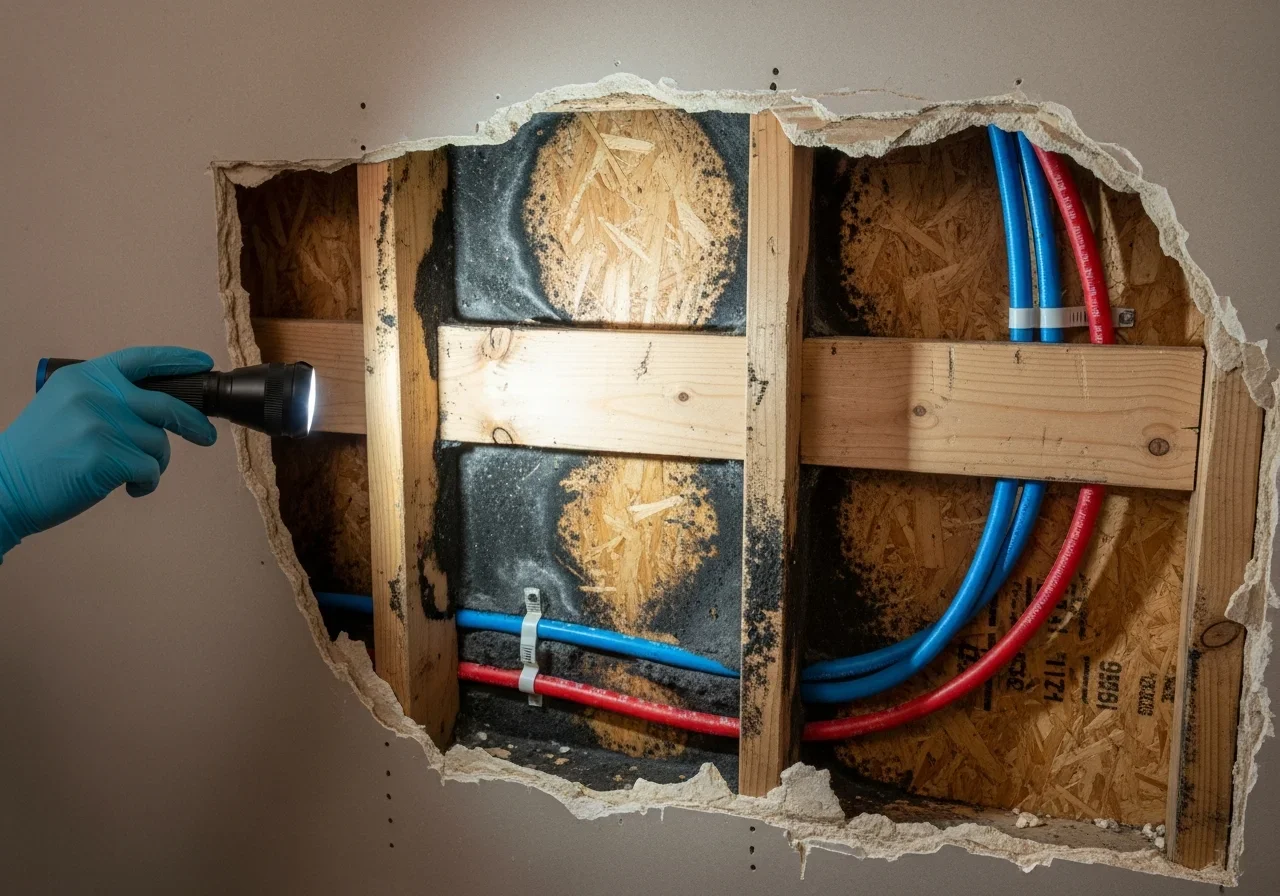
Hidden mold discovered inside a wall cavity during renovation in a Davidson NC home showing extensive colonization behind drywall that was not visible from the living space
Hidden mold discovered inside a wall cavity in a Davidson home — this growth was invisible from the living space and only found during renovation. Whether insurance covers this depends on the moisture source: sudden pipe failure (covered) vs. gradual condensation (excluded).

Need help understanding your mold coverage?

Palm Build works with all major NC carriers. We document the water source, establish the claim timeline, and provide the scope-of-work detail your adjuster needs to process the claim within your policy limits.

Call (704) 464-0121

Davidson Mold Remediation

Mold Remediation in Davidson, NC Homes

From crawl space colonization in lakeside homes to hidden wall cavity growth in newer construction, mold in Davidson takes many forms. Here is what professional assessment, containment, remediation, and verification look like in Mecklenburg County.

Extensive mold growth on crawl space floor joists and subfloor sheathing in a Davidson NC home near Lake Norman caused by persistent humidity and Piedmont clay vapor drive
Crawl space mold in a Davidson lakeside home — persistent humidity from Lake Norman and Piedmont clay vapor drive created conditions where mold colonized floor joists and subfloor sheathing throughout the crawl space. Full HEPA vacuuming, antimicrobial treatment, and encapsulation were required.
Hidden mold discovered inside a wall cavity behind drywall in a Davidson NC home showing growth that was invisible from the living space until renovation exposed it
Hidden wall cavity mold in a Davidson home — discovered during a bathroom renovation when drywall was removed. The colony had been growing behind the wall for an estimated 12-18 months, fed by a slow leak at a supply line connection invisible from the living side.
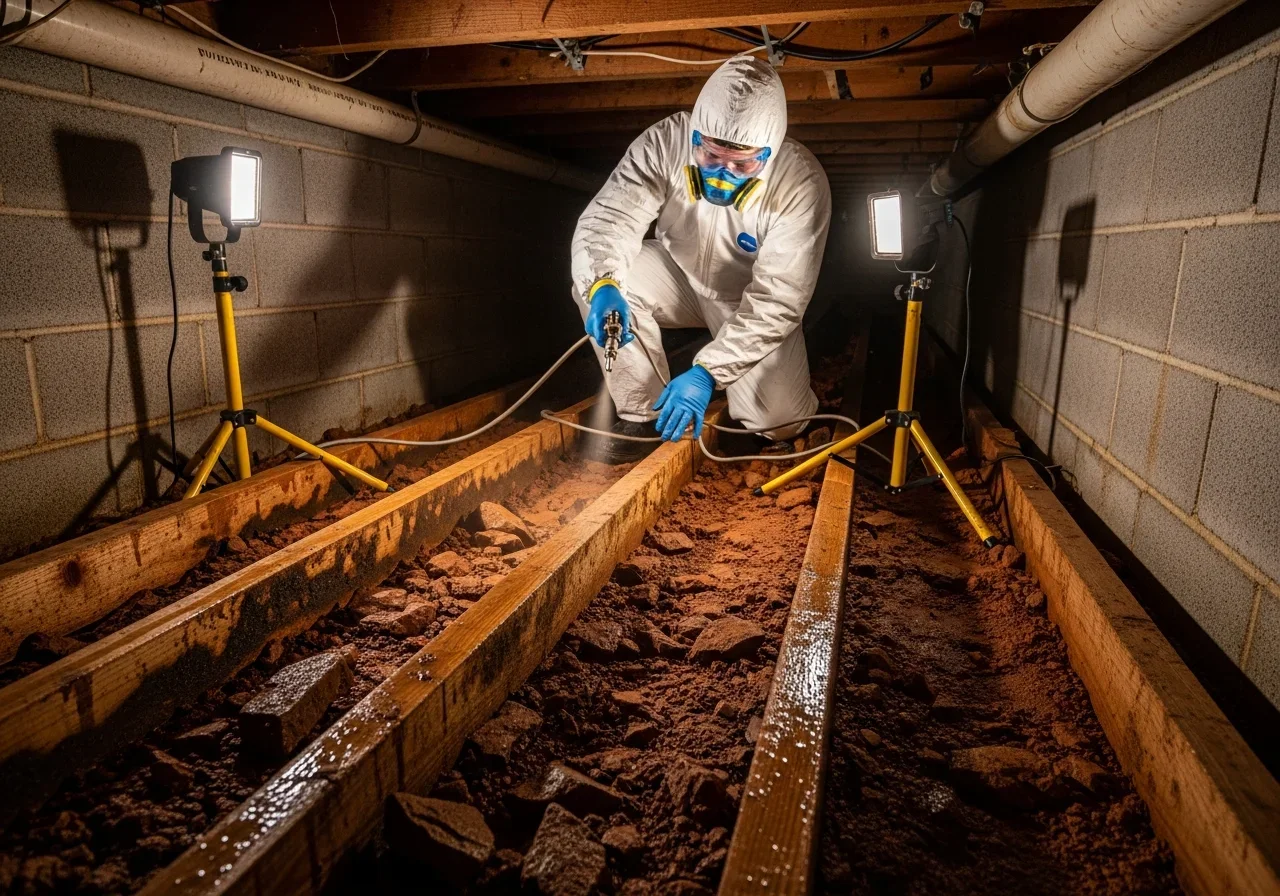
Professional antimicrobial treatment being applied to crawl space framing in a Davidson NC home after mold removal to prevent regrowth in the humid lake-adjacent environment
Antimicrobial treatment in a Davidson crawl space after mold removal — EPA-registered solution applied to all exposed framing to create a residual barrier against regrowth. Critical in Davidson where lake humidity would otherwise allow recolonization within weeks.
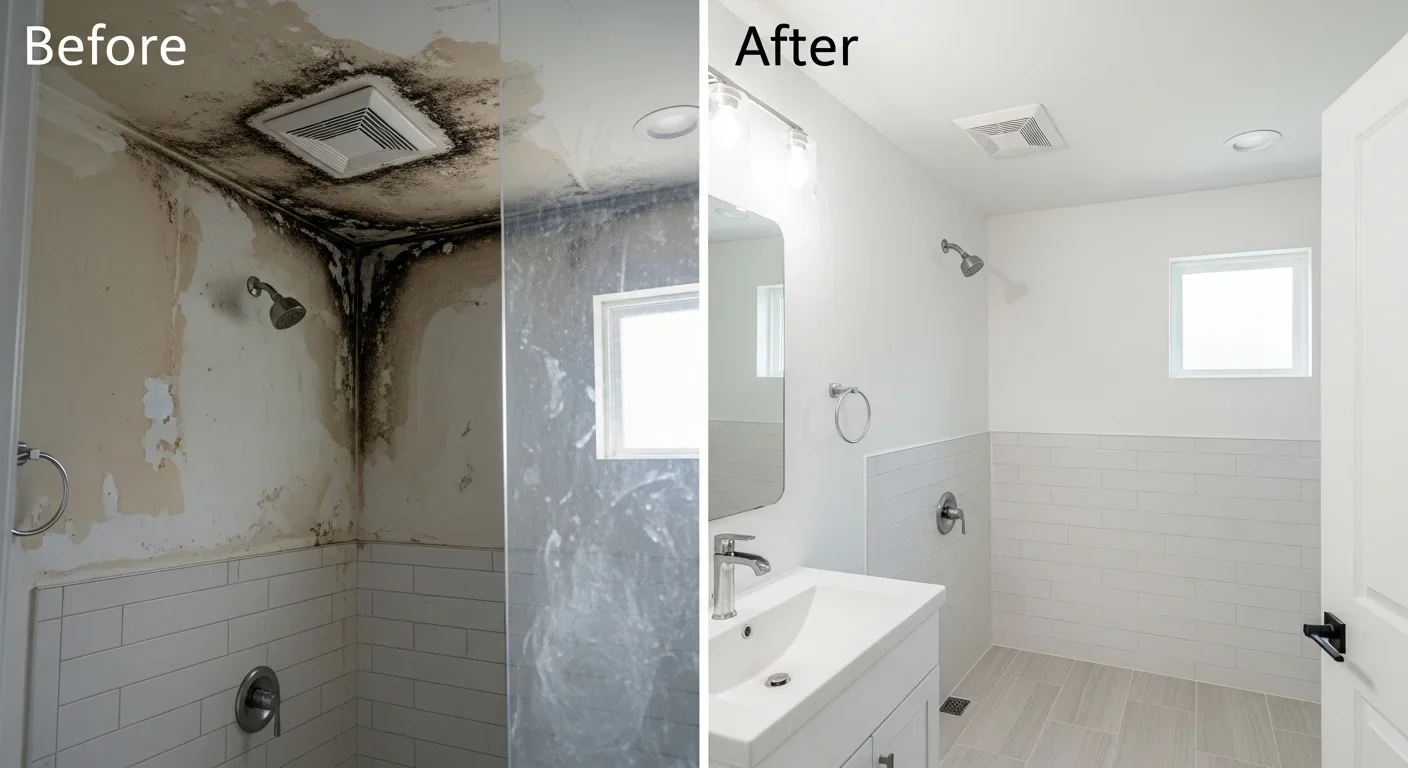
Before and after mold remediation in a Davidson NC home showing contaminated surfaces cleaned and treated to pre-loss condition with independent clearance testing verification
Before and after mold remediation in a Davidson home — contaminated drywall removed, framing HEPA-vacuumed and treated, independent clearance testing verified spore counts at or below outdoor baseline levels.

The Palm Build Difference

Why Davidson Homeowners Choose Palm Build for Mold Remediation

Davidson has general contractors who will "treat" mold with bleach and handymen who will paint over it. Neither solves the problem — and both can make it worse. Professional mold remediation requires IICRC-certified protocols, proper containment, independent verification, and an understanding of Davidson's specific moisture dynamics. That is what Palm Build delivers.

IICRC S520 Certified Remediation

Every Palm Build mold remediation follows IICRC S520 standards — the industry reference standard for professional mold remediation. Our technicians hold current IICRC certifications in Applied Microbial Remediation (AMRT) and Water Damage Restoration (WRT). This is not a marketing badge — it means our containment protocols, removal procedures, antimicrobial application, and verification methods meet the standard that insurance carriers, real estate attorneys, and independent hygienists recognize as the benchmark for professional remediation.

Full Containment & HEPA Filtration

Every remediation project — regardless of size — includes proper containment with poly sheeting barriers and negative air pressure maintained by HEPA-filtered air scrubbers. This prevents cross-contamination from the work area to the rest of your Davidson home during removal. We do not cut corners on containment even for small projects: a 20-square-foot mold patch can release millions of spores during removal, and without containment those spores settle throughout the house, creating new colonization sites.

Independent Clearance Testing

Palm Build never self-certifies its own work. After every remediation, an independent third-party industrial hygienist conducts post-remediation verification with new air sampling. The independent lab compares post-remediation results against the initial assessment and outdoor baselines. This independent verification provides you with objective proof that the remediation was effective — documentation that protects you during home sales, insurance claims, and any future dispute about the work quality.

Premium Material & Finish Preservation

Davidson homes have hardwood floors, custom millwork, built-in cabinetry, and premium fixtures that cannot be easily replaced. Our remediation protocols include dedicated finish protection: floor coverings over hardwood, trim wrapping on painted millwork, furniture relocation from adjacent rooms, and careful work practices that minimize dust and debris outside the containment zone. We remediate the mold without destroying the finishes that make your Davidson home premium.

Lake Norman Humidity Expertise

Davidson is not Charlotte, and lake-adjacent humidity changes every calculation in mold remediation. We adjust dehumidification timelines, antimicrobial application rates, and encapsulation specifications specifically for Davidson's moisture profile. Our team understands the condensation cycle in lake-adjacent crawl spaces, the vapor drive through Piedmont clay, and the seasonal humidity patterns that make Davidson homes uniquely susceptible to mold regrowth after remediation. This local expertise is the difference between a remediation that holds and one that fails within months.

Insurance-Ready Documentation

Every step of the remediation process is photographed, documented, and compiled into a comprehensive report that meets NC carrier requirements. Pre-remediation air sampling results, moisture readings, containment setup documentation, material removal records, antimicrobial application logs, and post-remediation clearance test results — all organized in a format that adjusters can process quickly. For Davidson homeowners working within the typical $10,000 mold sublimit, thorough documentation maximizes what your carrier approves.

Palm Build technician applying antimicrobial treatment to crawl space framing in a Davidson NC home after professional mold removal following IICRC S520 standards
Palm Build applying antimicrobial treatment to crawl space framing in a Davidson home — EPA-registered solution creates a residual barrier against regrowth in Davidson's persistent lake-adjacent humidity.

Common Questions

Davidson Mold Remediation FAQ

Does Lake Norman proximity increase mold risk in Davidson homes?
Yes. Lake Norman (32,000+ acres) and Lake Davidson (341 acres) create elevated ambient humidity that increases crawl space vapor drive, accelerates mold growth on wet materials, and makes humidity control harder than in inland communities. Davidson homes face higher baseline moisture pressure year-round.
Does North Carolina require a mold remediation license?
No. NC DHHS and NC State Extension both confirm that no federal or state mold certification exists in North Carolina. The IICRC is the most widely accepted industry benchmark, and ANSI/IICRC S520 defines professional procedures. Always verify your company holds current IICRC certification before hiring.
Why do newer Davidson homes still get mold?
Homes built since 2007 often have tight building envelopes that are energy-efficient but can trap moisture if the initial drying window after construction is missed, or if a leak occurs and isn't caught quickly. The sealed envelope that keeps conditioned air in also keeps moisture in — and in Davidson's lake-adjacent humidity, trapped moisture becomes mold faster than in drier environments.
Is mold remediation covered by insurance in Davidson?
Mold is typically covered only when it results from a covered water damage event — a burst pipe, appliance failure, or storm damage. Mold from gradual humidity, crawl space moisture, or deferred maintenance is generally excluded. Report water damage immediately to preserve the causal chain that supports your mold claim.
How do you protect premium finishes during mold remediation?
We use a contents-first approach with protective coverings on stone, cabinetry, and built-ins before staging equipment. Selective demolition removes only what's contaminated. Reconstruction matches original profiles and materials. Every item is documented for insurance purposes.
How common is crawl space mold in Davidson?
Very common. Davidson's Piedmont clay soil, lake-adjacent humidity, and the prevalence of vented crawl spaces in older neighborhoods create persistent moisture conditions. NC State guidance explicitly identifies crawl space inspection, sealing, and vapor barriers as frontline mold defenses — and most Davidson crawl spaces we inspect for the first time show some moisture issue.
What about mold in Davidson townhomes and condos?
Attached housing like Davidson Bay townhomes and Linden Court condos requires special attention because moisture and mold can migrate through shared walls, floor assemblies, and duct chases. What starts as a single-unit leak can become a multi-unit mold issue. Containment, negative air, and documentation suitable for both homeowners and HOA associations are critical.

Mold in Your Davidson Home? Lake Norman Humidity Won't Wait.

NC has no mold license — so choosing an IICRC-certified company matters more than ever. Call Palm Build for premium mold remediation with containment, HEPA filtration, and independent clearance testing.

30-60 min Response IICRC Certified

More in Davidson

Other Palm Build Services in Davidson, NC