Crawl Space Cleanup & Encapsulation in Gastonia, North Carolina
Gastonia sits at the intersection of three forces that create some of the worst crawl space conditions in the Charlotte metro: nearly impermeable red Piedmont clay soil that holds water against foundations for days, vented crawl space construction on 48% of the city's pre-1970 housing stock, and humid subtropical summers that push 70-75% relative humidity into those vented spaces. The result is a crawl space mold and moisture crisis hiding beneath thousands of Gaston County homes. Palm Build provides complete crawl space remediation — mold removal, moisture control, encapsulation, radon testing, and structural repair — engineered for the specific geology under your home.
Approximately 25 miles — Gastonia, NC 45-60 min Response IICRC Certified
Why Gastonia Has the Worst Crawl Space Problems in the Charlotte Metro
Gastonia is ground zero for crawl space failure in the Charlotte metropolitan area. The
city sits on poorly draining Piedmont red clay, nearly half its housing stock predates
modern building science, every older home has vented crawl space foundations that invite
humidity in, and Gaston County's subtropical summers deliver relentless moisture from
May through October. No other city in the metro combines all four factors at this
severity. The result: chronic mold growth, structural wood decay, falling insulation,
and indoor air quality problems affecting a majority of crawl space homes across Gaston
County.
Red Piedmont Clay — The Root Cause
<0.2 in/hr
Clay infiltration rate
Gastonia sits atop Cecil and Pacolet series Ultisols — red Piedmont clay with an infiltration rate below 0.2 inches per hour. When rain falls on Gaston County's clay, it doesn't percolate downward like it would in sandy or loamy soil. It pools. It saturates. And it presses against every foundation wall, pier, and footer in its path. This clay holds moisture against crawl space foundations for 3 to 5 days after a 2-inch rain event. The hydrostatic pressure it generates pushes liquid water through block wall joints, footer-to-wall connections, and any hairline crack in poured concrete. Between rain events, the clay doesn't dry — it releases water vapor upward through uncovered crawl space floors at a rate that keeps relative humidity above 70% even in winter months. Gastonia's clay isn't just a contributing factor to crawl space moisture. It is the primary driver. No crawl space solution that ignores the soil beneath it will succeed long-term in Gaston County.
Vented Crawl Space Design — A Building Code Failure
Pre-2009
Vented design era
Before North Carolina amended its building code in 2009 to permit sealed crawl spaces, every crawl space foundation in Gaston County was required to include foundation vents — openings in the block wall designed to circulate outdoor air through the space beneath the house. The theory was that air movement would prevent moisture buildup. In a humid subtropical climate like Gastonia's, this theory is catastrophically wrong. When outdoor air at 90 degrees and 75% relative humidity enters a crawl space where surfaces are 65-70 degrees, the temperature drop causes massive condensation. The vents that were supposed to dry the crawl space actually introduce the moisture that destroys it. Every pre-2009 Gastonia home with a crawl space foundation has this design flaw built into its structure. The vents are still open. The moisture is still entering. And the damage is still accumulating — every single summer, every single year.
Summer Humidity — 70-75% and Relentless
70-75%
Summer humidity avg
Gastonia's summer dew points regularly exceed 68-72 degrees Fahrenheit, with outdoor relative humidity hitting 70-75% as the daily average from June through September. On the worst days — and there are dozens of them every summer — afternoon humidity drops to 50-60% only to spike back above 80% overnight. This humid air enters vented crawl spaces continuously. When it contacts floor joists at 65-68 degrees, ductwork at 55-60 degrees, and cold water pipes at 50-55 degrees, condensation forms on every surface. A single Gastonia summer produces enough condensation in a vented crawl space to saturate fiberglass insulation, coat floor joists with moisture films that support mold germination within 48-72 hours, and create standing water on inadequate vapor barriers. This is not a periodic problem. From May through October, humidity-driven condensation in Gastonia crawl spaces is a daily event that never stops on its own.
48% Pre-1970 Housing — The Oldest Stock in Charlotte Metro
48%
Homes pre-1970
Gastonia has the oldest housing stock in the Charlotte metropolitan area. 48% of homes were built before 1970 — full-brick ranch homes and Craftsman-era cottages sitting on vented crawl space foundations with original plumbing, original HVAC systems, and original floor insulation that has been absorbing moisture for over five decades. These homes were built when crawl space science didn't exist. There are no vapor barriers on the ground. The foundation vents are wide open. The floor joists are often unprotected heart pine or yellow pine that has been wet for so long the wood has turned dark and soft. The original galvanized plumbing has corroded from the outside in, creating slow leaks that add liquid water to an already moisture-saturated environment. Gastonia's pre-1970 housing stock doesn't just have crawl space problems. The crawl spaces are the single biggest deferred maintenance liability these homes carry — and the damage compounds every year that passes without intervention.
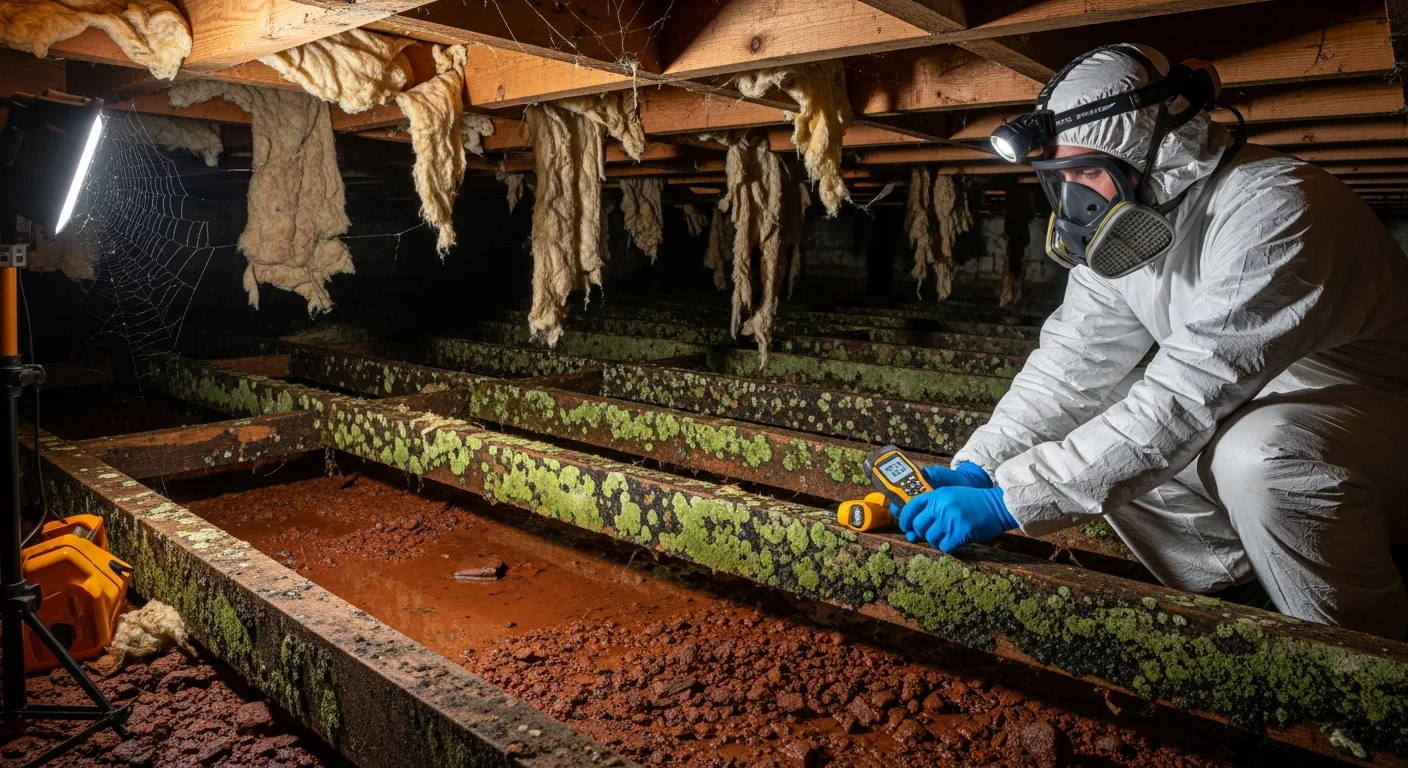
A Gastonia crawl space inspection reveals mold growth on floor joists — the direct
result of 70%+ humidity entering through open foundation vents over decades of unchecked
moisture exposure.
Soil Science Deep-Dive
Red Piedmont Clay: The Geology Behind Gastonia's Crawl Space Crisis
Understanding why Gastonia crawl spaces fail requires understanding the soil they sit
on. Gaston County's red Piedmont clay is not ordinary dirt — it is a specific soil type
with measurable properties that make crawl space moisture problems inevitable without
proper encapsulation. Here is the science behind the problem.
<0.002 mm
Clay particle size
Cecil & Pacolet Series Ultisols
Gaston County's red clay belongs to the Cecil and Pacolet soil series — deeply weathered Ultisols formed from the decomposition of igneous and metamorphic bedrock over millions of years. These soils are classified as fine, kaolinitic, thermic Typic Kanhapludults. The red color comes from iron oxide (hematite and goethite) released during weathering. What matters for your crawl space: the clay mineral kaolinite that dominates these soils has extremely small particle size (less than 0.002 mm) and a crystalline structure that resists water penetration. When water encounters Cecil clay, it cannot move through the soil matrix at any meaningful rate. Instead, it moves laterally along the surface or builds up pressure against any vertical barrier — including your foundation walls.
0.06-0.20
Inches per hour
Infiltration Rate Below 0.2 in/hr
The USDA Natural Resources Conservation Service classifies Cecil and Pacolet soils with a saturated hydraulic conductivity of 0.06 to 0.20 inches per hour — placing them in Hydrologic Soil Group B/C depending on subsoil compaction. For comparison, sandy loam drains at 1.0 to 6.0 inches per hour. Gastonia's clay drains 10 to 100 times slower than the soil types found in coastal North Carolina or the Sandhills region. During a 2-inch rain event — which Gastonia receives 8 to 12 times per year — the soil reaches saturation within the first 30 to 45 minutes. Every additional inch of rain after saturation becomes surface runoff that flows directly toward foundations, pools in low spots against crawl space walls, and enters through any opening or joint in the foundation system.
3-5 days
Post-rain pressure
Hydrostatic Pressure on Piers & Walls
When saturated Cecil clay surrounds a crawl space foundation, the water it holds exerts hydrostatic pressure against every surface it contacts. This pressure pushes water through block wall mortar joints at rates that can produce visible seepage within hours of a heavy rain. It forces water upward through footer-to-wall connections where the block sits on the poured footer — a joint that is never waterproofed in standard residential construction. In homes built on concrete block piers — common in Gastonia's pre-1970 housing stock — hydrostatic pressure pushes water up through the pier bases and along the pier surfaces, wetting everything the piers support. This pressure doesn't stop when the rain stops. Because Cecil clay holds moisture for 3 to 5 days after saturation, hydrostatic pressure continues pushing water into crawl spaces long after the storm has passed.
12-18 gal
Daily vapor emission
Continuous Vapor Emission from Clay
Even when no liquid water is entering the crawl space, Gaston County's clay soil continuously releases water vapor upward through uncovered crawl space floors. This process — soil vapor emission — occurs because the soil beneath the home is warmer and wetter than the air above it, creating a constant vapor drive from the ground into the crawl space. The rate of vapor emission from Cecil clay is substantially higher than from sandy or gravelly soils because the clay's fine particle structure holds water at higher tensions, releasing it slowly but persistently over weeks and months. A typical 1,200 square foot Gastonia crawl space with an exposed clay floor can emit 12 to 18 gallons of water vapor per day during summer months. This moisture alone — without any liquid water intrusion — is sufficient to maintain crawl space humidity above 70% and support active mold growth year-round.
Moderate
Shrink-swell rating
Shrink-Swell Foundation Movement
Cecil and Pacolet clays exhibit moderate shrink-swell behavior — expanding when wet and contracting when dry. While not as extreme as the expansive Vertisols found in Texas, this cyclical volume change is enough to cause measurable foundation movement in Gastonia homes. During wet seasons, the clay swells and pushes against foundation walls, causing inward deflection that opens new cracks and separates mortar joints. During dry periods, the clay shrinks away from the foundation, leaving gaps that channel water directly to the footer during the next rain. Over decades, this wet-dry cycling progressively loosens the foundation system, opens new water entry points, and accelerates the deterioration of footer-to-wall seals. Homes in Gastonia that show stair-step cracking in exterior brick veneer are often experiencing this shrink-swell cycle at the foundation level.
Interior
Only permanent fix
Why Exterior Drainage Alone Fails
Many Gastonia homeowners attempt to solve crawl space moisture with exterior solutions — grading corrections, gutter extensions, French drains around the foundation perimeter. These measures help manage surface water but do not address the fundamental problem: the clay soil beneath and around the foundation is permanently moisture-bearing. Even with perfect exterior drainage, Gaston County's clay will continue to exert hydrostatic pressure against foundation walls during wet seasons and release water vapor through the crawl space floor year-round. The only permanent solution is interior: a sealed vapor barrier covering the crawl space floor and walls, combined with mechanical dehumidification to remove the moisture that continues to enter through the concrete itself. Exterior drainage is a complement to encapsulation — never a substitute for it.
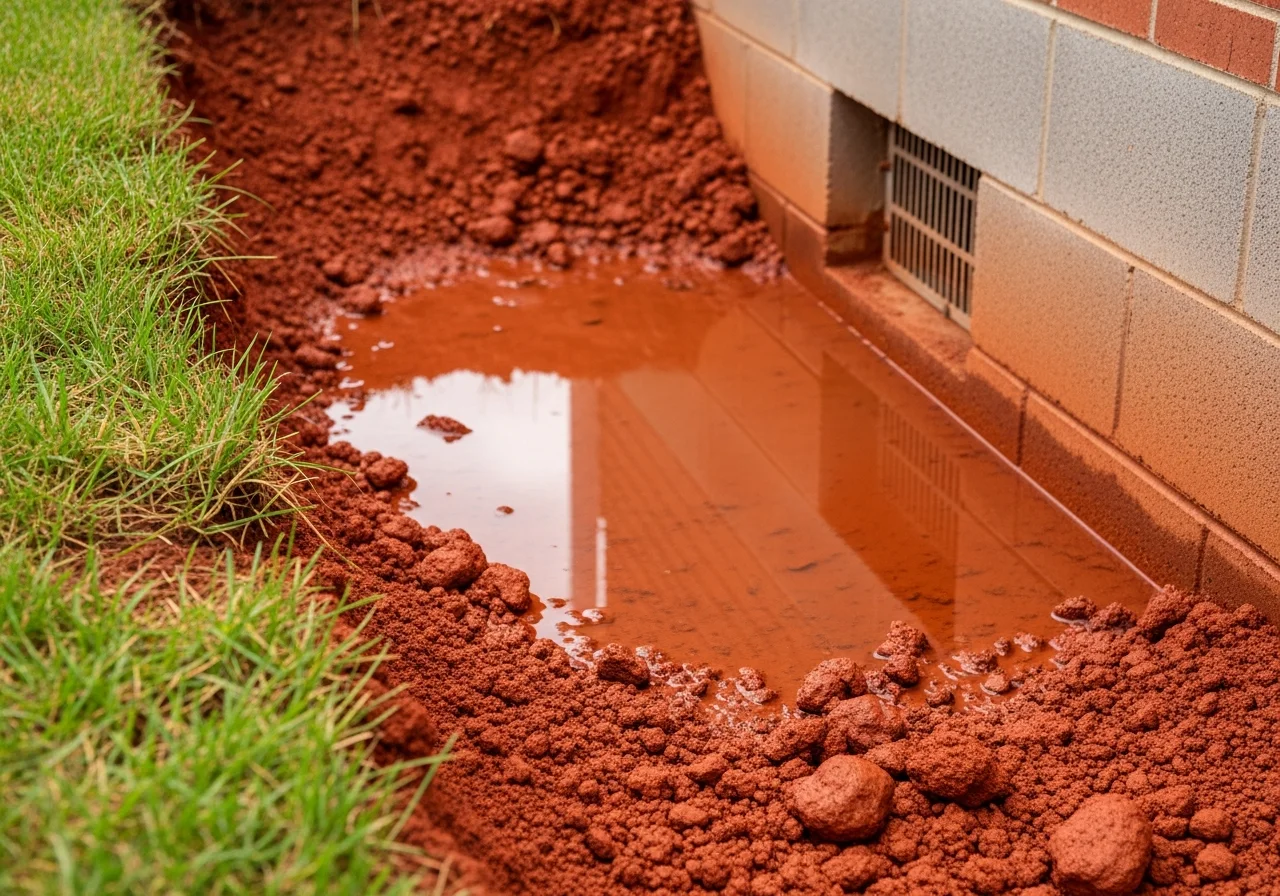
Cecil series red clay saturated after rainfall in Gaston County — this soil holds water
against crawl space foundations for days, generating continuous hydrostatic pressure and
vapor emission that no ventilation system can overcome.
Neighborhood-Level Risk
Crawl Space Risk by Gastonia Neighborhood
Every pre-1970 neighborhood in Gastonia with crawl space foundations is High risk —
without exception. The combination of red clay soil, vented crawl space design, and
aging plumbing means that moisture problems are not a question of if, but how severe.
Only newer neighborhoods built on slab foundations escape the crawl space equation
entirely.
Gardner Park
1950s-1970sCrawl space
Full-brick ranches on vented crawl space foundations with original galvanized plumbing. Floor joists show chronic mold growth from 50+ years of uncontrolled humidity. Clay soil pools water against east-facing foundations during spring rains. Supply line failures from corroded galvanized connections add liquid water to already moisture-saturated crawl spaces.
High
Quail Ridge
1960s-1980sCrawl space
Tract-built homes with vented block foundations and fiberglass batt insulation that has long since fallen from joists. Crawl spaces in this neighborhood consistently show humidity above 75% in summer months. The neighborhood sits on a gentle slope that channels surface water toward lower-elevation properties, creating hydrostatic pressure differentials that push water through foundation walls during heavy rain events.
High
Loray Village
1901-1920sCrawl space / piers
The oldest residential neighborhood in Gastonia. Original mill worker housing with rubble-stone and brick-pier foundations predating any moisture management standards. Many crawl spaces have exposed earth floors with zero vapor protection. Century-old heart-pine joists show decades of moisture staining and active fungal decay. These homes represent the most severe crawl space conditions in all of Gaston County — and the most rewarding transformations when properly encapsulated.
High
York-Chester
1930s-1960sCrawl space
Historic corridor connecting downtown to residential areas. Mix of Craftsman bungalows and mid-century ranches with block foundations and open vents. Low-lying terrain along the South Fork River corridor exposes western sections to elevated groundwater tables. Crawl spaces in the lower-elevation portions of York-Chester frequently show standing water during wet seasons — a condition that no amount of ventilation can resolve.
High
Brookwood
1960s-1970sCrawl space
Mid-century neighborhood with uniform brick ranch construction on vented crawl space foundations. Original 6-mil poly vapor barriers — where they exist — have deteriorated into fragments that provide no meaningful moisture protection. Brookwood crawl spaces are textbook examples of the vented-design failure: every home has the same problem because every home has the same fundamentally flawed foundation design.
High
Catawba Hills
1970s-1990sMixed crawl/slab
Older sections built on crawl space foundations with clay soil that channels storm drainage toward lower-elevation lots. Newer sections on slab foundations have lower risk. The crawl space homes in Catawba Hills face the same vented-design problems as older Gastonia neighborhoods, compounded by the neighborhood topography that concentrates surface water against specific properties during heavy rain events.
High
Robinson Oaks
2000s-2010sSlab
Slab-on-grade construction eliminates crawl space risk entirely. Modern drainage and stormwater management. Crawl space concerns do not apply to this neighborhood.
Low
Martha's Ridge
2010s-presentSlab
New construction on engineered slabs with modern moisture management. No crawl space exposure. Storm damage and roof leaks are the primary water concerns — not ground-level moisture.
Low
If your Gastonia home was built before 1990 and has a crawl space foundation, the crawl
space needs professional evaluation — regardless of whether you've noticed symptoms inside
the home yet.
Crawl space restoration in Gastonia is not a single-step service — it is a systematic
process that addresses every moisture pathway, every contamination source, and every
structural concern before sealing the space permanently. Here is exactly what our
Gastonia crawl space team does, from first inspection through long-term monitoring.
01
Inspection & Testing
Day 1
02
Standing Water Removal
Days 1-2
03
Mold Remediation
Days 2-5
04
Debris & Insulation Removal
Days 3-5
05
Vapor Barrier Installation
Days 5-7
06
Dehumidifier Setup & Monitoring
Days 6-8
01
Inspection & Testing
Day 1
Every Gastonia crawl space project begins with a documented assessment — not a sales visit disguised as an inspection. Our team enters the crawl space with pin-type and pinless moisture meters, calibrated hygrometers, a thermal imaging camera, and mold sampling equipment. We measure moisture content at multiple points on floor joists, sill plates, rim joists, and subfloor panels. We record ambient humidity and temperature. We probe structural wood for soft spots indicating fungal decay. Where visible mold growth is present, we collect surface and air samples for laboratory analysis to identify species and concentration levels. We photograph every condition found. This assessment determines the full scope: does the crawl space need cleanup only, mold remediation plus encapsulation, drainage installation, structural repair, or the full combination? In Gastonia's pre-1970 housing stock, the answer is rarely 'cleanup only' — most crawl spaces we inspect have multiple active conditions that require a comprehensive approach.
02
Standing Water Removal
Days 1-2
If the inspection reveals standing water — which is common in Gastonia crawl spaces during wet seasons, particularly in Gardner Park, Loray Village, and York-Chester — water extraction must happen before any other work begins. Our team deploys submersible pumps to remove bulk water, followed by wet vacuums for remaining puddles and saturated soil surfaces. We identify the water source: is it groundwater intrusion through foundation walls? Surface water entering through open vents? A plumbing leak beneath the house? The source determines whether drainage installation will be part of the project scope. In crawl spaces with chronic standing water from clay soil hydrostatic pressure, we mark the waterline on foundation walls and note the entry points — this documentation drives the drainage system design that will prevent recurrence after encapsulation.
03
Mold Remediation
Days 2-5
In Gastonia crawl spaces, mold remediation is the rule, not the exception. The majority of crawl spaces we inspect in Gaston County have visible mold on floor joists, sill plates, rim joists, or subfloor panels — typically Cladosporium, Penicillium, and Aspergillus species that thrive in the 70-90% humidity conditions created by vented crawl space design. Our remediation protocol includes containment barriers to prevent spore migration into the living space, HEPA air filtration operating continuously during work, mechanical removal of heavy surface growth using wire brushing and sanding on structural wood, EPA-registered fungicide application to all affected surfaces, and post-remediation air quality testing to verify spore counts have returned to ambient exterior levels. We do not encapsulate over existing mold. Ever. Sealing mold behind a vapor barrier does not kill it — it creates a concealed environment where growth continues unchecked.
04
Debris & Insulation Removal
Days 3-5
Gastonia crawl spaces built before 1990 almost universally contain deteriorated fiberglass batt insulation — either sagging from floor joists or already fallen to the ground in wet, compressed piles. This material has been absorbing crawl space moisture for decades. It is contaminated with mold spores, pest droppings, and decomposing organic matter. It must be removed completely before encapsulation. Our crew removes all fallen insulation, construction debris, old vapor barrier fragments, and any organic material from the crawl space floor. This includes rotted wood scraps, cardboard form boards left from original construction, and deteriorated foam board that previous contractors may have placed against foundation walls. The crawl space floor must be clean, graded to drain toward the sump location (if drainage is being installed), and free of any material that could puncture or degrade the new vapor barrier system.
05
Vapor Barrier Installation
Days 5-7
The vapor barrier is the core of the encapsulation system — a continuous, sealed sheet of reinforced polyethylene that eliminates ground-source moisture from entering the crawl space. We install 20-mil reinforced vapor barrier material covering the entire crawl space floor and extending up foundation walls to the top of the block or sill plate level. Every seam is overlapped 12 inches minimum and sealed with polyethylene tape rated for below-grade adhesion. The barrier is sealed around every pier, pipe penetration, support column, and utility entry with compatible sealant. Foundation vents are permanently closed with rigid foam board and spray-foam sealant — eliminating the design flaw that has been introducing humid air into your Gastonia crawl space since the house was built. The finished installation creates a complete moisture envelope between the earth and the living space above — no gaps, no unsealed penetrations, no pathways for soil vapor to enter.
06
Dehumidifier Setup & Monitoring
Days 6-8
Encapsulation without mechanical dehumidification is incomplete — especially in Gastonia's climate where moisture enters through vapor-permeable concrete walls year-round. We install commercial-grade crawl space dehumidifiers (Santa Fe, Aprilaire, or equivalent) sized for the specific square footage and moisture load of your crawl space. These are not residential units from the hardware store — they are purpose-built systems rated for below-grade temperatures, continuous operation, and direct condensate drainage. The dehumidifier maintains crawl space humidity below 55% year-round, regardless of exterior conditions. We install remote humidity monitoring that tracks conditions continuously and alerts both you and our team if humidity exceeds target thresholds. This monitoring catches maintenance issues — filter changes, drain line blockages, dehumidifier malfunctions — before they allow moisture to return. Your Gastonia crawl space becomes a monitored, controlled environment instead of an unmanaged void.
Crawl Space Encapsulation: The Permanent Solution for Gastonia Homes
Encapsulation is not a repair — it is a fundamental redesign of your crawl space from a
vented, moisture-permeable void into a sealed, conditioned space. For Gastonia homes
built on red clay with vented foundations, encapsulation is the only permanent solution
to chronic moisture, mold, and structural deterioration. Here is what a complete
encapsulation system includes, what it costs, and why each component is necessary.
12-20 Mil Reinforced Vapor Barrier
The barrier is the foundation of the entire system. We install 12-mil minimum, 20-mil for crawl spaces with heavy foot traffic or sharp debris. This is not the 6-mil poly sheeting from the hardware store — it is engineered, reinforced polyethylene with puncture resistance rated for below-grade installation. The barrier covers the entire crawl space floor with 12-inch minimum seam overlaps sealed with polyethylene tape, extends up foundation walls to the sill plate or top of block, and is sealed around every pier, pipe, column, and utility penetration with compatible sealant. The finished barrier creates a continuous moisture envelope — no gaps, no unsealed joints, no pathways for Gaston County clay to push vapor into the space above.
Foundation Vent Closure
Every open foundation vent in your Gastonia crawl space is an open door for humid air. We permanently seal all foundation vents with rigid foam board cut to fit inside the vent opening, sealed with closed-cell spray foam at every edge. This is not reversible — and it should not be. The vented crawl space design that Gastonia homes were built with is a recognized building science failure. North Carolina code changed in 2009 to allow sealed crawl spaces because the research was conclusive: in humid climates, vents cause the moisture problems they were supposed to prevent. Closing the vents eliminates the single largest source of summer humidity entering your crawl space.
Commercial Dehumidifier System
Even with a sealed vapor barrier and closed vents, moisture continues to enter through vapor-permeable concrete walls and the small amount of air exchange that occurs at door openings and utility penetrations. A commercial-grade dehumidifier removes this residual moisture continuously. We install Santa Fe, Aprilaire, or equivalent units sized for your specific crawl space square footage and moisture load — typically 70 to 110 pint capacity for Gastonia crawl spaces. These units operate at temperatures down to 40 degrees F (well below the winter crawl space temperatures in Gaston County), drain condensate directly to exterior or sump, and are rated for 20,000+ hours of continuous operation.
Interior Drainage (When Required)
Crawl spaces with active groundwater intrusion — standing water after rain, visible seepage through foundation walls, hydrostatic pressure through the floor — require interior drainage before encapsulation. We install a perimeter French drain system along the interior foundation walls, sloped to a sump pit with a commercial pump and battery backup. Gastonia homes near the South Fork River corridor, in low-lying sections of York-Chester, and in areas with particularly poor surface drainage frequently need this component. Not every crawl space requires drainage — but when liquid water is entering the space, no amount of vapor barrier will solve the problem. The drainage must be installed before the barrier, and the barrier must be installed over the drainage trench to maintain the sealed envelope.
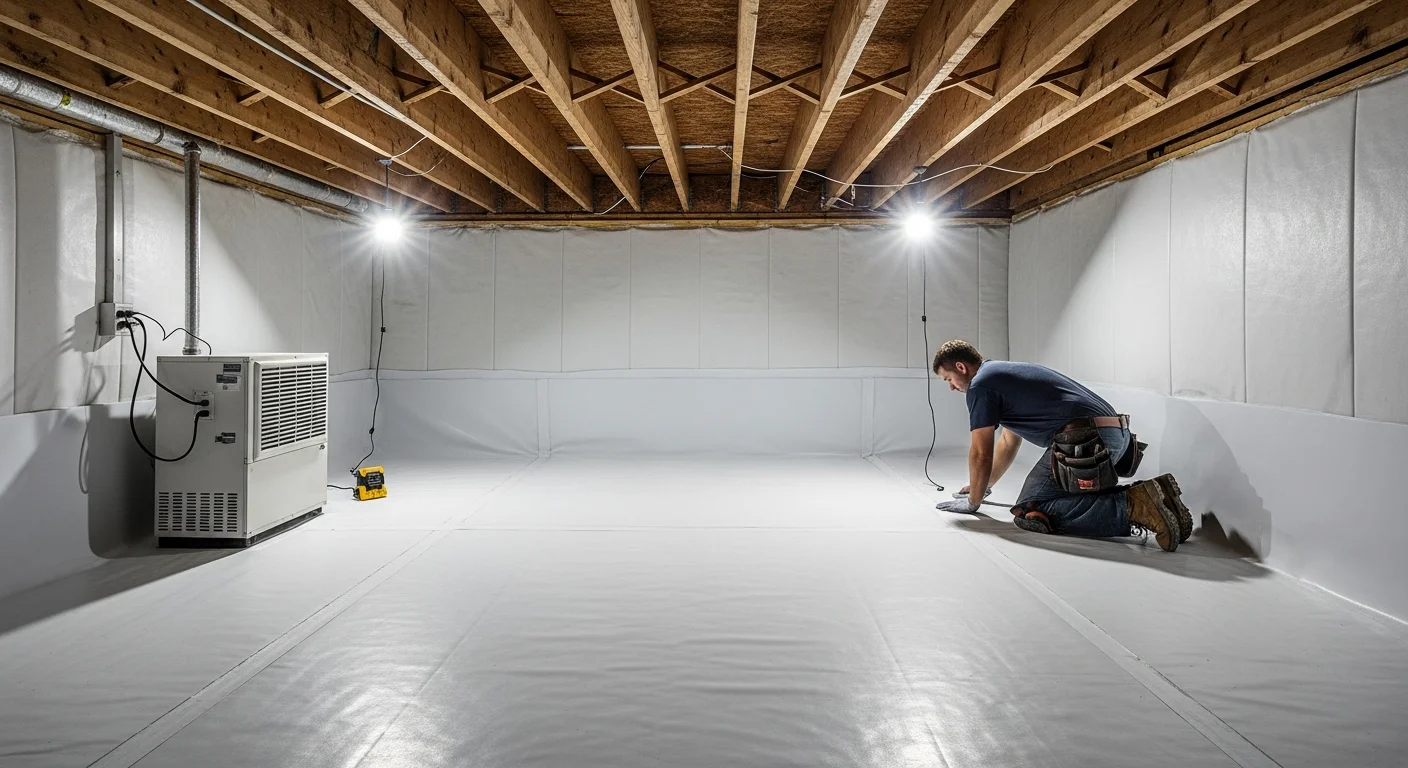
A fully encapsulated Gastonia crawl space: 20-mil vapor barrier sealed to walls and
piers, foundation vents permanently closed, commercial dehumidifier maintaining humidity
below 55% year-round.
Interior drainage system (if needed)$3,000 - $6,000
Monitoring system setup$200 - $400
Total encapsulation (without drainage)$4,000 - $9,000
Total encapsulation (with drainage)$8,000 - $20,000
Costs vary based on crawl space size, accessibility, condition, and whether drainage is
required. Every Gastonia estimate is based on a documented inspection — not a formula.
Radon and Crawl Space Encapsulation in Gaston County
Gaston County has documented radon levels well above the EPA action threshold —
including 123 school rooms exceeding 4.0 pCi/L, with a maximum reading of 17.7 pCi/L.
Sealing a crawl space without testing for radon first can concentrate this radioactive
gas in your home. This section explains why radon testing is a non-negotiable step
before any encapsulation work in Gastonia.
17.7 pCi/L
Highest school reading
123 School Rooms Above EPA Action Level
Gaston County Schools radon testing found 123 classrooms with radon levels exceeding the EPA action level of 4.0 pCi/L (picocuries per liter). The highest reading was 17.7 pCi/L — more than four times the threshold at which the EPA recommends mitigation. These readings are from the same Piedmont geology that underlies every home in Gastonia. If school buildings on concrete slabs are measuring these levels, homes with vented crawl spaces sitting directly on exposed red clay have equal or greater radon exposure potential.
MUST TEST
Before encapsulating
Encapsulation Can Concentrate Radon
This is the critical safety issue that many crawl space companies in Gastonia either don't know about or choose not to disclose: sealing a crawl space without testing for radon first can make a radon problem dramatically worse. Vented crawl spaces, despite all their moisture problems, do allow radon to dissipate through air exchange with the exterior. When you seal the vents, install a vapor barrier over the soil, and close the space — you eliminate the natural dilution pathway. If radon is present in the soil beneath your Gastonia home, encapsulation can concentrate it in the sealed crawl space and increase radon levels in the living space above. You must test before you seal.
4.0 pCi/L
EPA action level
Pre-Encapsulation Radon Testing Protocol
Before any encapsulation work begins on a Gastonia crawl space, we recommend a 48-hour short-term radon test placed in the crawl space and on the lowest occupied floor of the home. If results exceed 4.0 pCi/L — the EPA action level — a radon mitigation system must be integrated into the encapsulation design before the crawl space is sealed. Testing costs $150-$300 and takes 2-3 days for results. This is not optional due diligence — it is a health safety requirement that the North Carolina Department of Health and Human Services (NCDHHS) explicitly recommends for any home undergoing crawl space modification in counties with known radon presence.
SMD System
Standard approach
Radon Mitigation System Integration
When radon testing indicates mitigation is needed, the system is installed as part of the encapsulation project — not as a separate retrofit. A sub-membrane depressurization (SMD) system is the standard approach for encapsulated crawl spaces: a perforated pipe is laid beneath the vapor barrier in a gravel bed, connected to a radon fan that exhausts soil gases to the exterior above the roofline. The vapor barrier serves double duty — as both a moisture barrier and a radon barrier — but only if the barrier is properly sealed at every seam, penetration, and wall connection. Incomplete barrier installation that leaks moisture will also leak radon. This is why radon-aware encapsulation requires a higher standard of workmanship than moisture-only encapsulation.
$800-$2,500
Mitigation cost
Mitigation Cost: $800 - $2,500
Adding radon mitigation to a crawl space encapsulation project costs $800 to $2,500 depending on crawl space size, soil conditions, and fan placement requirements. When installed concurrently with encapsulation, the cost is significantly lower than retrofitting a mitigation system into an already-sealed crawl space — which requires cutting the vapor barrier, disturbing sealed connections, and re-sealing after pipe installation. Testing before encapsulation and mitigating during encapsulation is both safer and more cost-effective than discovering a radon problem after the work is complete.
Zone 2
NCDHHS classification
NCDHHS Guidance for Gaston County
The North Carolina Department of Health and Human Services classifies Gaston County in Zone 2 for radon potential — predicted average indoor screening levels between 2.0 and 4.0 pCi/L. However, individual home readings in Gaston County have exceeded this average significantly, as the school testing data demonstrates. The NCDHHS recommends radon testing for all homes in Zone 2 counties, and specifically advises testing before and after any crawl space modification that could alter soil gas pathways. Any crawl space company operating in Gaston County that does not discuss radon testing as part of encapsulation planning is either unaware of the NCDHHS guidance or choosing to ignore it.
Do Not Seal Your Crawl Space Without Testing for Radon First
Palm Build includes radon risk assessment in every Gastonia crawl space evaluation. If
your crawl space company hasn't mentioned radon, ask them why — or call us at (704) 464-0121 for a second opinion.
What We Find
6 Most Common Crawl Space Problems in Gastonia Homes
After inspecting hundreds of crawl spaces across Gaston County, these are the six
conditions we encounter most frequently — and every one of them traces back to the
combination of red clay soil, vented crawl space design, and decades of uncontrolled
moisture exposure that defines Gastonia's housing stock.
Mold on Floor Joists
Common species: Cladosporium, Penicillium, Aspergillus
The most common crawl space problem in Gastonia — and the one with the most direct impact on indoor air quality. Mold colonizes floor joists, rim joists, sill plates, and subfloor panels when surface moisture exceeds 16% and relative humidity stays above 60%. In Gastonia's vented crawl spaces, both conditions are met from May through October. Cladosporium appears as dark green-to-black patches and is the most common outdoor mold that colonizes crawl space wood. Penicillium appears as blue-green colonies and produces distinctive musty odors that migrate into the living space. Aspergillus species produce airborne spores that are particularly concerning for residents with respiratory conditions. In advanced cases, Stachybotrys chartarum (black mold) establishes in areas with chronic liquid water contact. All mold species found on structural wood require professional remediation — not bleach, not paint, not encapsulation over top.
Deteriorating Fiberglass Insulation
Fiberglass batt insulation installed between floor joists in Gastonia crawl spaces follows a predictable failure pattern. First, the batts absorb moisture from the humid crawl space air. Then they sag, pulling away from the subfloor panels they were meant to insulate. Then they fall to the ground, landing on the damp crawl space floor where they become a compressed, moisture-laden mat that harbors mold, pests, and decomposing organic matter. In nearly every Gastonia crawl space we inspect that was built before 1990, the insulation is either sagging or already on the ground. This material must be completely removed during cleanup — it cannot be reinstalled, and it serves no insulation purpose in an encapsulated crawl space where the thermal boundary moves from the floor to the foundation walls.
Wood Rot on Sill Plates & Rim Joists
Sill plates — the horizontal wood members that sit directly on top of the foundation wall — are the first structural components to develop fungal decay in Gastonia crawl spaces. They are in direct contact with concrete block that wicks moisture from the clay soil below, exposed to humid air entering through foundation vents, and often untreated with any preservative in pre-1980 construction. When sill plates develop wood rot, the decay spreads to rim joists (the vertical boards at the outer edge of the floor system) and eventually to the ends of floor joists that bear on the sill plate. Advanced sill plate rot compromises the entire floor system — the house is literally sitting on decomposing wood. Sill plate replacement requires structural shoring and is one of the most expensive crawl space repairs.
Standing Water & Chronic Puddles
Standing water in Gastonia crawl spaces comes from three sources: groundwater intrusion through foundation walls during wet seasons (hydrostatic pressure from saturated clay), surface water entering through open foundation vents during heavy rain, and plumbing leaks from aging supply lines, drain lines, or water heaters located in the crawl space. Chronic standing water — water that returns repeatedly after rain events — indicates either a drainage problem that requires interior French drain installation or a grading problem that requires exterior correction (or both). Standing water accelerates every other crawl space problem: it feeds mold growth, accelerates wood decay, creates pest habitats, and can produce Category 3 (sewage-contaminated) conditions if drain lines are involved.
Inadequate or Deteriorated Vapor Barriers
Many Gastonia crawl spaces have some form of existing vapor barrier — typically 6-mil polyethylene sheeting laid loosely on the ground during original construction or a previous service call. These barriers have failed for multiple reasons: the material is too thin (6-mil tears during installation and degrades within 5-10 years), the seams were never sealed (allowing vapor to pass through every overlap), the barrier was never attached to the foundation walls (leaving the entire wall surface as an open moisture pathway), and the barrier does not extend up the walls (leaving the most active moisture source — the concrete block itself — completely exposed). A deteriorated vapor barrier is worse than no barrier at all because it creates the illusion that the moisture problem has been addressed. Proper encapsulation requires removing the old barrier completely and installing a sealed system that covers both the floor and walls.
Pest Intrusion & Habitat
Gastonia's moist, warm crawl spaces are ideal habitats for pests. Termites are attracted to the moisture-softened wood and direct wood-to-soil contact found in many older crawl spaces. Carpenter ants establish colonies in wet joists. Rodents nest in fallen insulation on the ground. Snakes enter through open foundation vents to hunt the rodents. Camel crickets and other moisture-loving insects thrive in the perpetually humid environment. Encapsulation does not replace pest control — but it eliminates the moisture conditions that make crawl spaces attractive to pests in the first place. Closed vents remove the primary entry point for larger pests, and the reduced humidity makes the environment inhospitable for moisture-dependent insects. We coordinate with licensed pest control professionals when active infestations are present during cleanup.
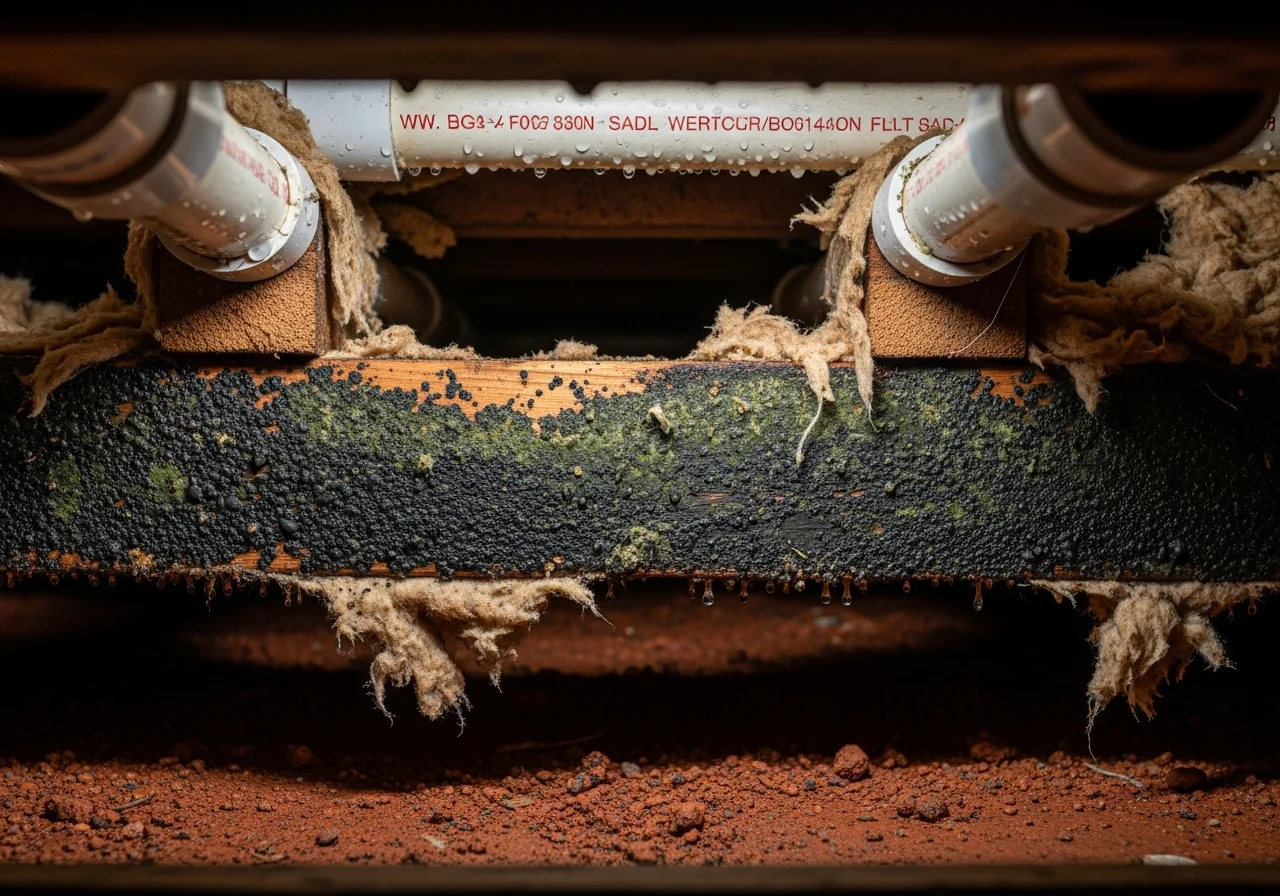
Active mold growth on floor joists in a Gastonia crawl space — the direct result of
decades of uncontrolled humidity in a vented crawl space over red clay soil.
Gastonia Pricing
Crawl Space Cleanup & Encapsulation Costs in Gastonia
Crawl space costs in Gastonia range from $2,000 for basic cleanup to $25,000+ for full
encapsulation with drainage and structural repair. The scope depends entirely on what
the inspection reveals — not on a standard package. Here are real-world cost ranges
based on Gaston County projects.
Basic Cleanup
Debris removal, minor moisture control, no mold
Crawl space debris & insulation removal$500 - $1,200
Basic vapor barrier (floor only)$800 - $1,500
Minor grading corrections$300 - $600
Vent screening and pest exclusion$200 - $400
Total basic cleanup$2,000 - $5,000
Basic cleanup applies to crawl spaces with minor moisture and no active mold — a condition we find in fewer than 15% of Gastonia homes we inspect. Most crawl spaces in Gaston County have progressed well beyond this stage by the time homeowners call.
This is the most common scope for Gastonia crawl space projects. The majority of homes in Gardner Park, Quail Ridge, Loray Village, and Brookwood require mold remediation before encapsulation can proceed. Attempting to encapsulate over existing mold is a guaranteed failure.
Full Encapsulation
Drainage, structural repair, remediation, full seal
Full-scope projects are common in Gastonia homes near the South Fork River corridor, in York-Chester, and in any pre-1960 home where decades of moisture have caused structural deterioration. These projects address the root cause permanently — the investment prevents ongoing damage that compounds every year without intervention.
Every Gastonia crawl space is different. Call (704) 464-0121 for a free inspection and detailed scope-of-work estimate.
We document exactly what your crawl space needs — and what it doesn't — so you know where
every dollar goes before any work begins.
The Palm Build Difference
Why Gastonia Homeowners Choose Palm Build for Crawl Space Work
Gaston County has multiple companies offering crawl space encapsulation. The difference
is in how the work is evaluated, how environmental risks like radon are handled, and
what happens when the crawl space reveals problems that go beyond a vapor barrier and
dehumidifier. Here is what sets Palm Build apart from every other option in the Gastonia
market.
IICRC Certified Technicians
Our crawl space team holds current IICRC (Institute of Inspection, Cleaning and Restoration Certification) credentials in Water Damage Restoration (WRT), Applied Microbial Remediation (AMRT), and Applied Structural Drying (ASD). These aren't display certificates — they represent tested competency in moisture science, mold remediation protocols, and structural drying that directly applies to crawl space work. When your Gastonia crawl space requires mold remediation, structural assessment, and moisture management, you want technicians who understand the science behind the work — not just the installation sequence.
Crawl Space Specialists — Not Generalists
Palm Build's Gastonia crawl space team does not dabble in encapsulation as a sideline to pest control, insulation, or general contracting. Crawl space remediation and encapsulation is a core service built on restoration science. We understand the moisture dynamics specific to Gaston County's red clay soil, the structural implications of wood decay in different-era construction, and the environmental considerations (including radon) that generic encapsulation companies overlook. Our scoping process evaluates every condition in the crawl space — not just the ones that fit a standard package.
Radon-Aware Encapsulation
Palm Build is one of the few crawl space companies in the Gastonia market that incorporates radon risk assessment into every encapsulation project. Gaston County's documented radon levels — including 123 school rooms above the EPA action level of 4.0 pCi/L — make pre-encapsulation radon testing a health safety requirement, not an optional add-on. We recommend testing before every sealed crawl space project in Gaston County and integrate radon mitigation systems into the encapsulation design when testing indicates it's needed. Companies that seal crawl spaces in Gaston County without discussing radon are either uninformed or negligent.
NC Licensed & Insured
Palm Build holds all required North Carolina licensing for the work we perform in Gaston County crawl spaces, including general contractor licensing and mold remediation credentials. We carry comprehensive general liability insurance and workers' compensation coverage for every crew member who enters your crawl space. This matters because crawl space work involves confined space entry, potential exposure to biological contaminants, structural modification, and electrical proximity — any of which can produce liability if the contractor is uninsured or unlicensed. Verify licensing and insurance before allowing any contractor into your crawl space.
Encapsulation Warranty & Monitoring
Every crawl space encapsulation we install in Gastonia includes a warranty on materials and workmanship, backed by remote humidity monitoring that verifies ongoing performance. The monitoring system tracks crawl space humidity continuously and alerts our team if conditions deviate from target ranges. This accountability matters: we don't seal your crawl space and disappear. We monitor it, we maintain it, and we stand behind it. The monitoring data also provides documentation for real estate transactions — verifiable proof that the crawl space has been professionally encapsulated and maintained.
45-Minute Emergency Response
When a pipe bursts in your Gastonia crawl space at 2 AM, the crawl space is suddenly a water damage emergency — not a scheduled encapsulation project. Palm Build maintains 24/7 emergency response capability with a 45-minute response time to Gaston County. Our emergency crew can extract standing water from crawl spaces, establish drying equipment, and assess damage the same night the event occurs. This emergency capability is unique to restoration companies — crawl space encapsulation specialists don't offer emergency services because they don't have the equipment, the training, or the after-hours availability.
Common Questions
Gastonia Crawl Space FAQ
Answers to the most common questions Gastonia homeowners ask about crawl space cleanup,
mold remediation, and encapsulation in Gaston County.
Why are Gastonia crawl spaces worse than other Charlotte-area cities?
Three factors compound in Gastonia to a degree not seen in other Charlotte suburbs. First, 48% of Gastonia homes were built before 1970 — the highest rate of aged housing in the metro — and virtually all of them have vented crawl space foundations. Second, Gaston County's Cecil and Pacolet series clay soils are nearly impermeable at less than 0.2 inches per hour, holding water against foundations for 3-5 days after rain. Third, Gastonia's summer humidity runs 70-75%, well above the 60% mold threshold. Newer suburbs like Ballantyne or Huntersville have slab foundations and better drainage — they simply don't face this trifecta.
Does Gaston County have a radon problem that affects crawl space work?
Yes. Testing in Gaston County schools found 123 classrooms above the EPA action level of 4.0 pCi/L, with a maximum reading of 17.7 pCi/L — over four times the action threshold. Residential homes sit on the same Piedmont bedrock. Palm Build tests for radon before every Gastonia encapsulation project because sealing a crawl space without radon provisions can actually concentrate radon beneath the vapor barrier. If levels exceed 4.0 pCi/L, we integrate sub-membrane depressurization piping into the encapsulation design.
How much does crawl space encapsulation cost in Gastonia, NC?
Basic encapsulation (vapor barrier, vent sealing, commercial dehumidifier) runs $4,000-$8,000 depending on crawl space size. If active mold requires remediation before encapsulation, expect $8,000-$15,000. Full remediation with structural repair (joist sistering, sill plate replacement), drainage correction, mold remediation, radon mitigation, and encapsulation ranges from $15,000-$20,000+. Gastonia homes in the oldest neighborhoods — Loray Village, Gardner Park, York-Chester — typically fall in the higher ranges due to decades of uncontrolled moisture damage.
Does North Carolina require a license for crawl space mold remediation?
No. North Carolina has no state-level mold remediation license, which means any contractor can claim to offer mold remediation without verified training or certification. The IICRC S520 Standard for Professional Mold Remediation is the only independently verifiable credential for crawl space mold work in NC. Palm Build's technicians hold current IICRC S520 and WRT certifications. NC does require building permits for vented-to-closed crawl space conversions, and the encapsulated space must meet code requirements including a Class I vapor barrier, mechanical dehumidification, and a 3-4 inch termite inspection gap.
Which Gastonia neighborhoods have the worst crawl space problems?
Gardner Park (1950s-1970s), Loray Village (1901-1920s), Quail Ridge (1960s-1980s), and York-Chester (1940s-1960s) consistently show the most severe crawl space damage. These neighborhoods have the oldest homes on vented crawl space foundations over clay soil, many with original or no vapor barriers. Catawba Hills and Brookwood also experience significant issues. Loray Village is particularly challenging because the homes are over 100 years old with structural timbers that have been exposed to uncontrolled moisture since construction.
Is crawl space encapsulation covered by insurance in Gastonia?
Encapsulation itself is generally classified as home improvement and is not covered by standard homeowners insurance. However, if your crawl space damage resulted from a sudden covered event — a burst pipe that flooded the space, storm-driven water intrusion through a foundation breach — the remediation of that specific damage may be covered. Mold remediation costs from a covered water event may also be claimable, though mold coverage is often sublimited. Palm Build documents every project with cause-of-loss analysis to identify which portions may be covered by your specific policy.
How long does crawl space remediation take in Gastonia?
Encapsulation only (no mold, no structural damage): 2-4 days. Mold remediation plus encapsulation: 1-2 weeks, including containment, treatment, post-remediation air testing, and then encapsulation. Full-scope projects with drainage correction, structural joist or sill plate repair, mold remediation, radon mitigation, and encapsulation: 2-4 weeks. Gaston County's clay soil can extend exterior drainage work if heavy rain occurs during installation — a realistic factor given Gastonia's 43-inch annual rainfall.
Gastonia Crawl Space Problems? We Fix What's Under Your Home.
Palm Build's crawl space team addresses the root cause of Gastonia's crawl space crisis — clay soil, vented construction, and uncontrolled humidity — with complete mold remediation, encapsulation, radon testing, and structural repair managed as one coordinated project. Every Gastonia project starts with a full assessment and radon test.