Plantation sustains 66-70% relative humidity year-round — well above the 60% threshold where mold colonizes building materials. The city's 1960s-1980s CBS slab-on-grade homes trap moisture in block wall cavities with no designed exit path, and AC condensate overflow is the single most common mold trigger we respond to. When the April 2023 flood dropped 15 inches of rain in 12 hours, mold spikes followed within 48 hours across hundreds of Plantation homes. Florida's DBPR licensing law requires separate licensed assessors and remediators — Palm Build holds full DBPR mold remediation credentials and responds from our Deerfield Beach hub in under 30 minutes.
Deerfield Beach — Minutes from Plantation Under 30 min Response IICRC Certified
Plantation's specific combination of year-round subtropical humidity, aging CBS concrete
block construction without vapor retarders, near-constant AC operation, and
slab-on-grade foundations creates some of the highest baseline mold risk in Broward
County. Understanding these four risk factors is the first step toward permanent
remediation — not just cosmetic cleanup.
66-70% Year-Round Humidity
66-70%
Year-round RH
Plantation sustains 66-70% relative humidity year-round — well above the 60% threshold where mold colonizes building materials. During the May-October rainy season, afternoon thunderstorms push outdoor humidity above 85%. Unlike northern cities where winter provides a dry respite, Plantation's subtropical climate never drops below mold-viable humidity levels. This constant moisture pressure means CBS walls, ceilings, and HVAC systems remain perpetually mold-ready — every day, all year.
CBS Construction Traps Moisture
1960s-80s
Peak construction era
Plantation's housing stock was built predominantly in the 1960s-1980s using CBS (concrete block and stucco) slab-on-grade construction — without the modern vapor retarders that current building codes require. These porous block walls absorb moisture from driving rain through hairline stucco cracks caused by decades of thermal cycling. Once moisture enters the wall cavity, it has no designed exit path, creating a dark, humid environment where mold thrives unseen behind drywall for months before any visible signs appear.
AC Condensate Overflow — #1 Mold Trigger
#1
Mold trigger in Plantation
AC systems in Plantation run 10-11 months per year, generating constant condensation on evaporator coils, drip pans, and ductwork interiors. Clogged condensate drain lines that back up water into the drip pan are the single most common mold trigger we respond to in Plantation. Once mold colonizes the air handler, the blower fan distributes spores through ductwork to every room — often before homeowners notice any visible signs. Regular condensate line maintenance is the most impactful prevention step.
April 2023 Flood — Massive Mold Surge
15"
Rain in 12 hours
When April 2023 dropped 15 inches of rain in 12 hours — a third of Plantation's annual total — the Old Plantation Water Control District's 36-mile canal network was overwhelmed. Canal water backed up into Plantation Isles driveways, lake-edge lots in Jacaranda Lakes flooded, and water seeped through slab joints in thousands of CBS homes. In Plantation's climate, mold began colonizing within 24-48 hours on every damp surface. Hundreds of homes required professional mold remediation in the weeks that followed.
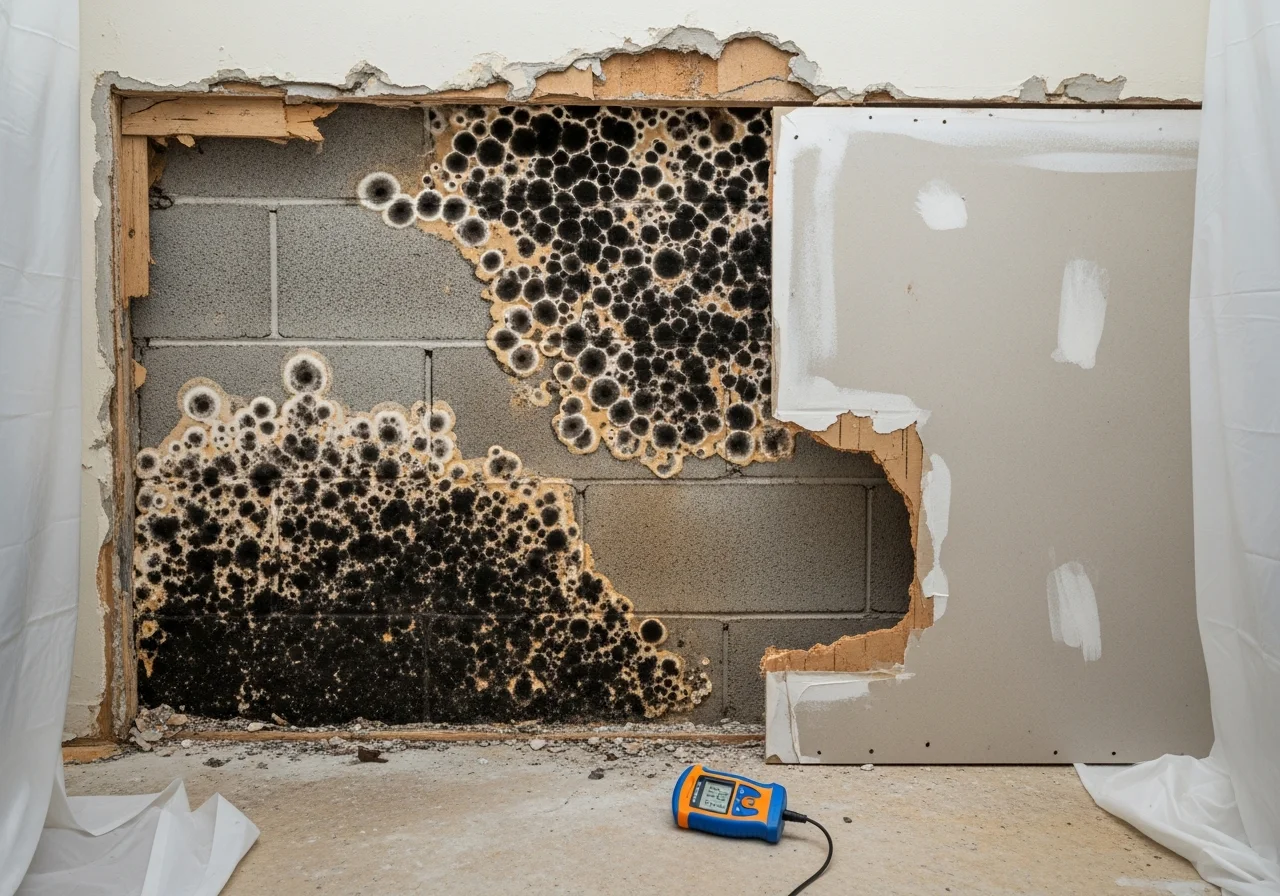
Mold hidden behind drywall in a Plantation CBS home — moisture trapped in block wall
cavities without vapor retarders creates ideal conditions for unseen mold colonization
in Plantation's 66-70% humidity environment.
Plantation Condo Mold
Mold in Plantation Condos & HOA Properties
Plantation's large condo and HOA community — from Plantation Forest to Jacaranda Lakes
to Plantation Isles — faces unique mold challenges that single-family homes do not.
Shared walls, stacked units, flat roofs, and divided responsibility between unit owners
and associations create disputes that delay remediation and allow mold to spread.
Flat-Roof Leak Mold in Plantation Forest
Plantation Forest and other 1970s-1980s condo developments feature flat or low-slope roofs that pond water after heavy rain. When the roofing membrane deteriorates — accelerated by Plantation's UV exposure and thermal cycling — water infiltrates the roof deck and enters unit ceilings. Because flat roofs cannot shed water as quickly as sloped roofs, even minor membrane failures create sustained leaks that feed mold growth in ceiling cavities, often affecting multiple stacked units simultaneously.
Party-Wall Moisture Migration
In stacked condo units, moisture from one unit's leak can migrate through shared CBS walls and floor/ceiling assemblies to adjacent units. A third-floor AC condensate overflow can cause mold in the second-floor unit below. A bathroom leak in one unit can saturate the party wall and produce mold in the neighboring unit. Identifying the originating source is critical for determining responsibility — and it often requires infrared thermal imaging to trace moisture paths through CBS construction.
HOA vs. Unit-Owner Responsibility
Florida condominium law (Chapter 718) generally assigns responsibility based on where the mold originates. The association is responsible for common elements — roof, exterior walls, shared plumbing risers, hallway HVAC. The unit owner is responsible for interior sources — their AC system, appliance leaks, bathroom moisture. When mold results from a common-element failure (roof leak, shared pipe burst), the HOA's master policy should cover remediation. Disputes arise when the originating source is ambiguous — particularly with party-wall migration between units.
How Palm Build Works with Plantation Condo Boards
We regularly coordinate with Plantation condo associations and property management
companies on mold projects. Our process includes source identification using thermal
imaging (critical for determining HOA vs. unit-owner responsibility), scope documentation
that satisfies both the unit owner's carrier and the HOA's master policy adjuster, and
remediation execution that minimizes disruption to adjacent units. We understand Florida
Chapter 718 condo law and how it applies to mold responsibility — and we help boards and
owners navigate disputes before they escalate.
Plantation's climate and CBS construction create six distinct mold sources — each
requiring different investigation and remediation approaches. AC condensate overflow and
CBS wall cavity intrusion account for the majority of professional remediation projects
in the city.
Critical
AC Condensate Drain Clogs
The #1 mold trigger in Plantation. AC systems running 10-11 months per year generate constant condensation. When the condensate drain line clogs — a near-certainty without semi-annual cleaning — water backs up into the drip pan and overflows into the air handler cabinet, wall cavities, and ceiling spaces. The blower fan then distributes spores to every room through ductwork.
High
Roof Leaks Through Tile Underlayment
Plantation's concrete tile roofs rely on a waterproof underlayment beneath the tiles. After 15-20 years, UV degradation and thermal cycling deteriorate this membrane, allowing water to seep through to the roof deck and into the attic or ceiling cavity. Slow, hidden leaks feed mold growth for months before staining becomes visible on interior ceilings.
High
Stucco Crack Water Intrusion
CBS stucco walls develop hairline cracks from decades of thermal expansion and contraction. Plantation's driving rain penetrates these cracks and saturates the concrete block beneath. Without vapor retarders in 1960s-1980s construction, this moisture migrates inward and feeds mold in the wall cavity — invisible from both sides until contamination is extensive.
High
Slab Seepage in Canal-Adjacent Homes
Homes near Plantation's 36-mile canal network and retention lakes face elevated water tables that push moisture upward through the concrete slab via capillary action. This moisture exits upward, trapping under flooring and feeding mold along baseboards, beneath vinyl plank and tile, and inside the bottom plates of CBS walls — a chronic driver that intensifies after heavy rain events.
Common
Bathroom Exhaust Failures
Many 1960s-1980s Plantation homes have bathroom exhaust fans that vent into the attic space rather than to the building exterior — or have no exhaust fans at all. Shower and bath moisture accumulates in attic cavities, saturating insulation and roof decking. In Plantation's humidity, this chronically damp environment produces mold that eventually penetrates through ceiling drywall.
Common
Plumbing Leaks in Older Homes
Plantation homes from the 1978-1995 era may still have original polybutylene supply lines — a material prone to sudden failure. Even small, slow leaks at fittings or within slab can saturate surrounding materials for weeks before detection. Under-sink supply connections, toilet fill valves, and water heater fittings are common failure points that create localized but severe mold outbreaks.
IICRC S520 Protocol
Our Plantation Mold Remediation Process
Professional mold remediation follows a strict sequence defined by the IICRC S520
standard and Florida DBPR regulations. Here is exactly what happens when Palm Build's
licensed team arrives at your Plantation home.
01
Initial Assessment & Testing
Day 1
02
Containment Setup
Day 1-2
03
HEPA Air Filtration
Continuous
04
Mold Removal & Cleaning
Days 2-4
05
Antimicrobial Treatment
Days 4-5
06
Clearance Testing & Restoration
Day 5-6
01
Initial Assessment & Testing
Day 1
Comprehensive visual inspection, infrared thermal imaging of CBS walls, and air quality sampling. We identify the moisture source — AC condensate overflow, stucco crack intrusion, slab vapor transmission, or plumbing failure — and classify contamination level per IICRC S520. Florida law requires a separate DBPR-licensed mold assessor for the initial report.
02
Containment Setup
Day 1-2
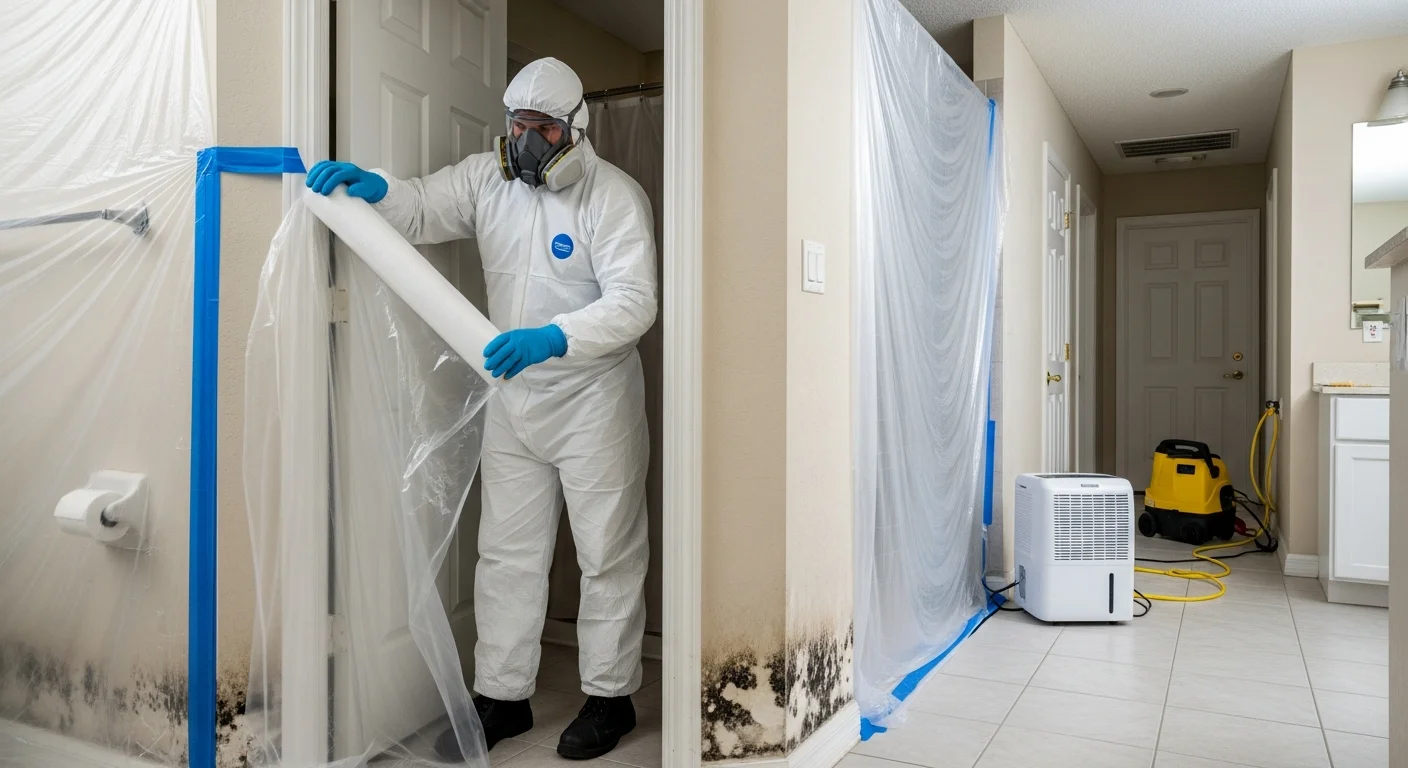
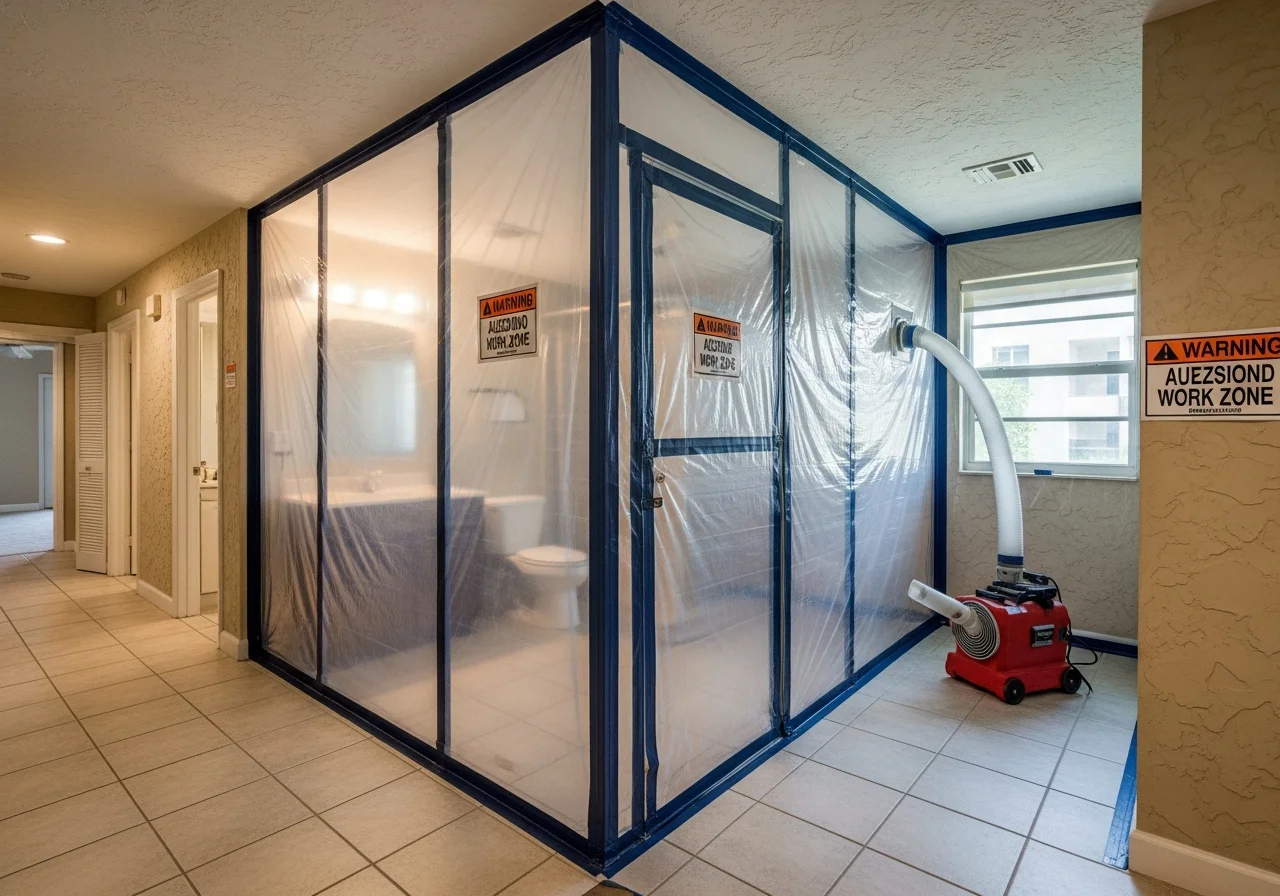
Sealed polyethylene containment barriers isolate affected areas, including CBS wall cavities and HVAC system components. In Plantation's 66-70% ambient humidity, containment must account for elevated moisture pressure that accelerates spore dispersal outside the work zone. HEPA air scrubbers create negative air pressure to prevent migration to unaffected areas.
03
HEPA Air Filtration
Continuous
HEPA filtration runs throughout the project, capturing airborne spores down to 0.3 microns. In Plantation homes with HVAC contamination — the city's #1 mold source — the entire duct system is isolated and filtered separately to prevent recontamination of cleaned areas during remediation. Multiple air scrubber stages maintain clean air outside containment zones.
04
Mold Removal & Cleaning
Days 2-4
Contaminated materials are removed using controlled demolition. Affected drywall on CBS walls, contaminated HVAC components (evaporator coils, drip pans, ductwork sections), impacted insulation, and mold-damaged flooring from slab moisture are removed. Salvageable CBS block surfaces are HEPA-vacuumed and media blasted to remove embedded mold from block pores.
05
Antimicrobial Treatment
Days 4-5
EPA-registered antimicrobial agents are applied to all treated surfaces. For CBS construction, this includes interior block wall faces, window bucks, slab edges, and any areas where moisture intrusion was identified. HVAC components receive specialized coil and duct treatment to eliminate residual spores and prevent recolonization.
06
Clearance Testing & Restoration
Day 5-6
Post-remediation air quality testing by an independent DBPR-licensed mold assessor confirms spore counts have returned to acceptable levels. Florida's conflict-of-interest rule requires clearance from a different licensed assessor than the remediator. Upon clearance, reconstruction of removed drywall, flooring, and finishes begins. Complete documentation is provided for your records and insurance carrier.
Why Containment Matters in Plantation's Climate
Disturbing mold without proper containment sends billions of spores airborne. In
Plantation's 66-70% humidity environment, those spores find viable growth surfaces
within hours — and the HVAC system can distribute them to every room within minutes.
Our containment protocol ensures mold stays isolated during removal.
1
Sealed Barriers
Polyethylene sheeting floor-to-ceiling on CBS walls
Florida DBPR Mold Licensing: What Plantation Homeowners Must Know
Florida has one of the strictest mold regulatory frameworks in the country. Under DBPR Chapter 468, Part XVI, the state requires separate licenses for mold
assessment and mold remediation — and explicitly prohibits the same company from
performing both on the same project within 12 months.
This conflict-of-interest separation — often called the "Chinese wall" rule — prevents
the company that finds the mold from profiting by removing it. The intent is consumer
protection: if the same company can assess and remediate, there is a financial
incentive to find mold whether it exists or not, and to expand the scope beyond what
is necessary.
Florida mold assessors must carry $1 million in general liability insurance, and mold
remediators must demonstrate proof of financial responsibility. Both licenses require
continuing education and are enforced by the Department of Business and Professional
Regulation (DBPR). In Broward County, where Plantation's extreme humidity makes mold
ubiquitous, unlicensed operators are unfortunately common — verify credentials before
hiring anyone.
Verify DBPR mold remediator license before hiring any company
Assessor and remediator MUST be separate licensed entities
Same company cannot assess and remediate within 12 months (Chinese wall rule)
Post-remediation clearance must come from a different licensed assessor
Check any license status at myfloridalicense.com — free and instant
Full liability insurance and workers' comp coverage
Coordinates with independent FL-licensed assessors for clearance
Deerfield Beach hub — minutes from all Plantation neighborhoods
Red Flags to Watch For
No DBPR mold license or refuses to provide license number
Same company offers to assess AND remediate your mold
Offers to "spray and seal" without removing contamination
No containment barriers or HEPA filtration during work
Claims "no license needed" in Florida (false — it is required by state law)
Plantation Pricing
Mold Remediation Costs in Plantation
Costs vary by contamination extent, materials affected, and whether HVAC system or
structural work is needed. Florida insurance policies often cap mold coverage at
$10,000-$50,000 — larger CBS wall and HVAC remediation projects in Plantation can
approach or exceed these limits.
Small / Contained Area
Bathroom, closet, single wall section, window frame (<10 sq ft)
Most Florida homeowner's policies include mold sub-limits that cap coverage between
$10,000 and $50,000 — regardless of actual remediation costs. This means larger projects
involving CBS wall cavity remediation, HVAC system mold, or post-flood whole-home
treatment may exceed your policy's sub-limit. Some carriers offer mold endorsements for
additional premium that raise the cap. Check your declarations page for your specific mold
sub-limit before a loss occurs — and ask your agent about expanded coverage options.
Insurance Navigation
Mold Insurance Claims in Plantation
Mold coverage in Florida is limited and has become more restrictive following recent
insurance reforms. Understanding your coverage — including typical sub-limits, covered
vs. excluded mold sources, and strict filing deadlines — can save Plantation homeowners
thousands.
Mold resulting from a covered sudden water event (burst pipe, appliance failure) is typically covered up to your policy's mold sub-limit
Most Florida policies cap mold coverage at $10,000-$50,000 — CBS wall cavity and HVAC system mold remediation in Plantation frequently approaches these limits
Mold from gradual moisture, humidity, AC condensation, slab vapor transmission, or long-term stucco intrusion is almost always excluded
Florida's 1-year claim filing deadline (Fla. Stat. 627.70132) is strictly enforced — delayed reporting can void otherwise valid mold claims
Some Florida carriers offer mold endorsements for additional premium — ask your agent about expanded coverage before you need it
Professional documentation connecting mold to a covered water event is critical for successful claims — moisture maps, thermal images, and air quality reports all support your case
Palm Build's Approach to Plantation Mold Claims
When mold results from a covered water event, our documentation connects the mold to the
original loss — moisture maps, infrared thermal images, air quality reports, and
remediation scope all formatted for the adjuster. We work with all major carriers active
in Broward County — Citizens, State Farm Florida, Universal Property & Casualty, Slide,
Tower Hill, and others. For mold not covered by insurance (AC condensation, humidity,
gradual moisture), we provide transparent pricing and work within your budget.
These are common mold presentations we encounter in Plantation's CBS concrete block
homes — from hidden wall cavity contamination and AC system mold to post-flood
remediation and full restoration.
CBS wall cavity mold — moisture trapped behind drywall in a 1970s Plantation home built without vapor retarders, discovered during remediation
Full containment setup in a Plantation condo — sealed polyethylene barriers and HEPA negative air prevent spore migration to adjacent units
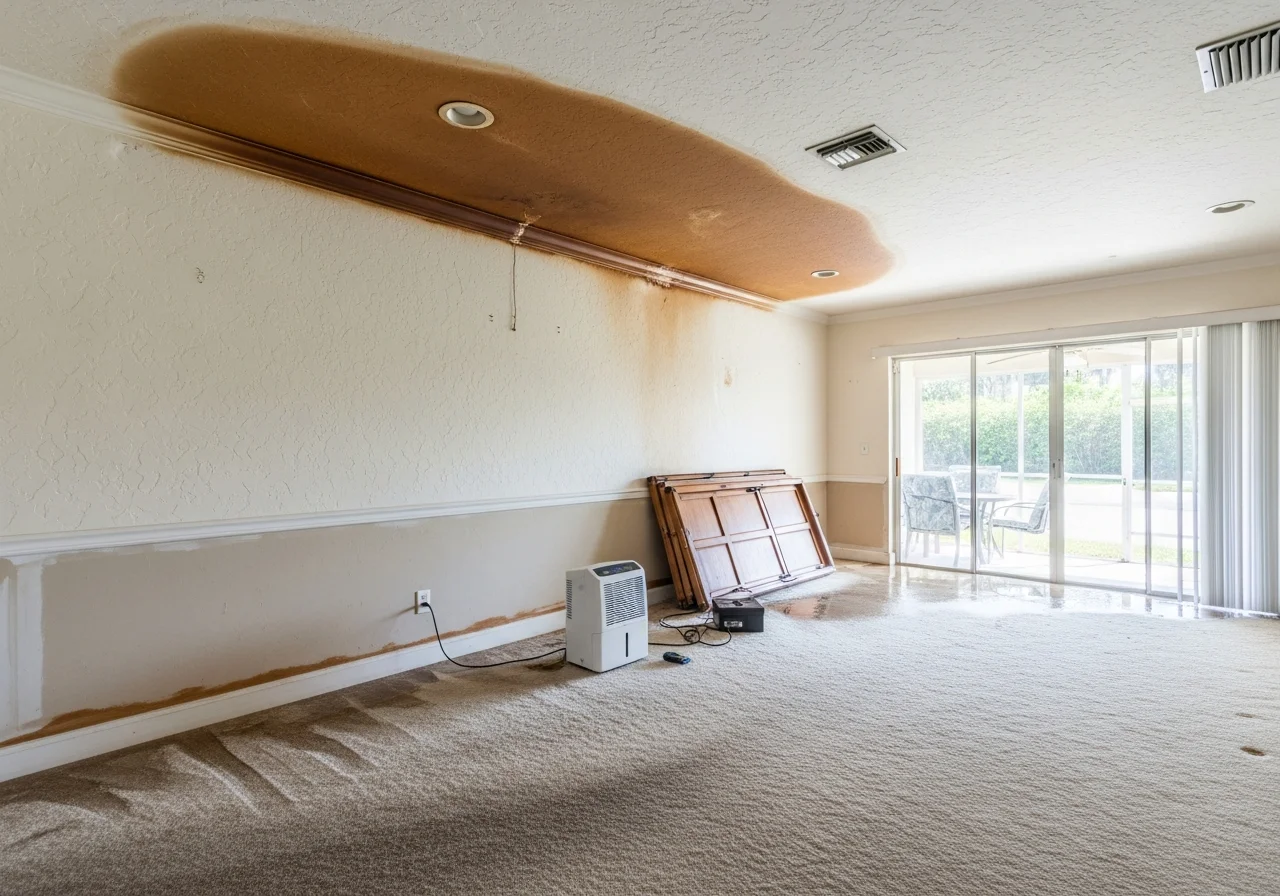
Before — water intrusion through CBS walls and slab seepage created extensive mold colonization in this Plantation living room
After — complete mold remediation, clearance testing, and reconstruction restored this Plantation home to pre-loss condition
Common Questions
Plantation Mold Remediation FAQ
Does Palm Build hold a Florida DBPR mold remediation license?
Yes. Palm Build holds a full DBPR mold remediation license under Florida Statute Chapter 468, Part XVI. Florida is one of the strictest states for mold regulation — the law requires separate licenses for mold assessment and mold remediation, and the same company cannot perform both on the same project within 12 months. You can verify our license instantly at myfloridalicense.com.
How dangerous is mold in Plantation homes to my family's health?
Mold exposure in Plantation's high-humidity environment poses real health risks. Common symptoms include persistent coughing, sneezing, eye irritation, skin rashes, and aggravated asthma. Certain mold species produce mycotoxins that can cause more serious respiratory and neurological effects with prolonged exposure. Children, elderly residents, and anyone with compromised immune systems are at elevated risk. If you smell musty odors or see visible growth, professional assessment is warranted.
How much does mold remediation cost in Plantation, FL?
Costs vary by scope. Small contained areas (bathroom, closet, single wall section) typically run $500-$1,500. Moderate contamination affecting multiple rooms or CBS wall cavities ranges from $1,500-$5,000. Large-scale or structural mold remediation — especially following flooding events like April 2023 — can cost $5,000-$15,000+. We provide detailed Xactimate estimates that align with insurance carrier expectations.
Will my Florida homeowner's insurance cover mold remediation in Plantation?
Florida insurance policies typically include mold sub-limits capping coverage between $10,000 and $50,000. Mold resulting from a covered sudden water event (burst pipe, appliance failure) is usually covered up to your sub-limit. Mold from gradual moisture, humidity, AC condensation, or long-term neglect is almost always excluded. Florida law requires filing your initial claim within one year of the date of loss — delayed reporting can void otherwise valid claims.
How do I control humidity to prevent mold in my Plantation home?
Keep indoor relative humidity below 55% using your AC system and supplemental dehumidifiers. Have your AC condensate drain line cleaned every 6 months — clogged lines are the #1 mold trigger in Plantation. Ensure bathroom exhaust fans vent to the exterior, not into the attic. Run AC continuously in fan-auto mode (not fan-on, which recirculates moisture from the evaporator coil). Address any stucco cracks promptly to prevent water intrusion into CBS wall cavities.
Can mold grow inside my AC system in Plantation?
Absolutely — and it is the single most common mold source we see in Plantation homes. Your AC runs 10-11 months per year, generating constant condensation on the evaporator coil, drip pan, and inside ductwork. When the condensate drain clogs, standing water in the drip pan becomes a mold incubator. The blower fan then distributes spores through your ductwork to every room, often before you see any visible signs. Regular condensate line maintenance is essential prevention.
Who is responsible for mold in a Plantation condo — the unit owner or the HOA?
It depends on the source. Generally, the condo association is responsible for mold originating from common elements — roof leaks, exterior walls, shared plumbing risers, and common-area HVAC. The unit owner is responsible for mold from interior sources — their AC system, bathroom moisture, or appliance leaks. Party-wall mold (where moisture migrates between stacked units) creates disputes that require investigation to identify the originating unit. Palm Build coordinates with condo boards and property managers to establish the source and route the claim appropriately.
How long does professional mold remediation take in Plantation?
Small projects (single room, contained area) take 1-3 days. Moderate remediation involving multiple rooms or CBS wall cavities requires 3-5 days. Large-scale projects following flooding events can take 5-10 days. These timelines include containment setup, HEPA filtration, removal, antimicrobial treatment, and clearance testing by an independent DBPR-licensed assessor. Plantation's high ambient humidity can extend drying times compared to drier climates.
Trusted Vendors
Trusted local pros in Plantation
Outside our restoration scope, these are the vetted, licensed contractors we trust
alongside our work. Personally evaluated, reference-checked, and recommended by Palm
Build.