Insurance Restoration Process in Plantation, Florida
Florida's property insurance market is the most volatile in the nation — and Broward County sits at its epicenter. Plantation homeowners pay $6,000+ per year in premiums, face a strict 1-year filing deadline under Fla. Stat. 627.70132, and navigate a carrier market where insolvencies, policy non-renewals, and AOB reform have rewritten the rules. Palm Build's Deerfield Beach team combines IICRC-certified restoration with carrier-specific documentation that turns Plantation insurance claims into funded restorations.
Deerfield Beach — Minutes from Plantation Under 30 min Response IICRC Certified
Plantation sits in Broward County — the most expensive property insurance market in
Florida. Between record premiums, carrier exits, tightened filing deadlines, and AOB
reform, Plantation homeowners face an insurance environment that demands professional
documentation and carrier-specific claim strategy.
Broward Premiums: Highest in Florida
$6,000+
Avg annual premium
Broward County homeowners pay an average of $6,000+ per year for property insurance — more than triple the national average and the highest in Florida. Plantation homeowners in flood-adjacent communities along the 36-mile canal network often pay significantly more, especially after FEMA flood zone remapping added thousands of Broward properties to high-risk designations.
Strict 1-Year Filing Deadline
1 Year
Filing deadline
Florida Statute 627.70132, amended by Senate Bill 2-A in January 2023, requires homeowners to notify their insurance company of property damage within 1 year of the date of loss. Supplemental claims must be filed within 18 months. These deadlines are absolute — miss them and your claim is permanently barred, regardless of damage severity or your premium payment history.
Volatile Carrier Market
12+
Carrier insolvencies since 2020
Since 2020, more than a dozen Florida property insurance carriers have gone insolvent — leaving hundreds of thousands of homeowners scrambling for coverage. In Plantation, this means fewer carrier options, higher premiums, and longer claim processing times as remaining carriers absorb displaced policyholders. Citizens Property Insurance, the insurer of last resort, has seen its Broward County policy count surge.
AOB Reform Changed Everything
SB 2-A
Effective Jan 2023
Senate Bill 2-A, effective January 2023, eliminated Assignment of Benefits (AOB) and one-way attorney fees. Plantation homeowners can no longer assign claim rights to contractors. You must file your own claim, attend adjuster inspections, and authorize every payment. In this environment, having a restoration company that produces carrier-grade documentation from day one is not optional — it is essential.
Plantation's housing stock — predominantly 1960s-1980s CBS construction — demands
specialized documentation knowledge for insurance claims in Broward County's complex
carrier market.
Broward County Carrier Guide
Insurance Carriers Active in Plantation & Broward County
Each carrier handles claims differently. Understanding your insurer's tendencies — their
typical mold sublimits, common denial strategies, adjuster patterns, and documentation
expectations — gives you a strategic advantage before you file. No competitor in
Plantation publishes this information.
6-Step Insurance Process
How Palm Build Aligns Restoration with Your Insurance Claim
Every step of our restoration process is designed to produce the documentation your
Broward County carrier requires — from emergency mitigation through final settlement and
depreciation holdback release.
Florida Statutory Deadlines
Critical Filing Deadlines for Plantation Insurance Claims
Florida Statute 627.70132 — amended by Senate Bill 2-A in January 2023 — imposes strict
filing deadlines on property insurance claims. These deadlines are absolute: miss them
and your claim is barred, period. Palm Build tracks every deadline on every Plantation
claim we manage.
1 Year
Fla. Stat. 627.70132
Notice of Loss Deadline
You must notify your insurance company of property damage within 1 year of the date of loss. This is the date the damage actually occurred — not the date you discovered it. For Plantation homeowners dealing with slow slab leaks, hidden AC condensate damage, or concealed mold behind CBS walls, this distinction is critical. Miss this deadline and your claim is permanently barred regardless of damage severity.
18 Months
Fla. Stat. 627.70132
Supplemental Claim Deadline
Supplemental claims — additional damage discovered during restoration — must be filed within 18 months of the original date of loss. In Plantation, where restoration frequently uncovers hidden mold behind CBS block walls, corroded plumbing beneath concrete slabs, and compromised electrical systems in 1970s-era homes, supplements are extremely common. Palm Build documents and files every supplement within the statutory window.
14 Days
Florida Statute
Carrier Investigation Deadline
Your insurance company must begin investigating your claim within 14 days of receiving your notice of loss. If your carrier fails to meet this deadline, it strengthens your position on disputed claims. Palm Build tracks carrier compliance timelines on every Plantation claim — ensuring your carrier meets their obligations under Florida law.
60 Days
Florida Statute
Coverage Determination
Your insurer must provide a coverage determination — accept, deny, or partially deny — within 60 days of your claim filing. For NFIP flood claims, a sworn proof of loss must be submitted within 60 days of the loss. In Plantation, where many canal-adjacent properties carry both homeowners and flood policies, managing parallel timelines for both carriers is critical.
These deadlines are strictly enforced — no exceptions.
Missing a filing deadline results in claim denial regardless of damage severity. Palm
Build tracks every statutory deadline and files all documentation within the required
windows.
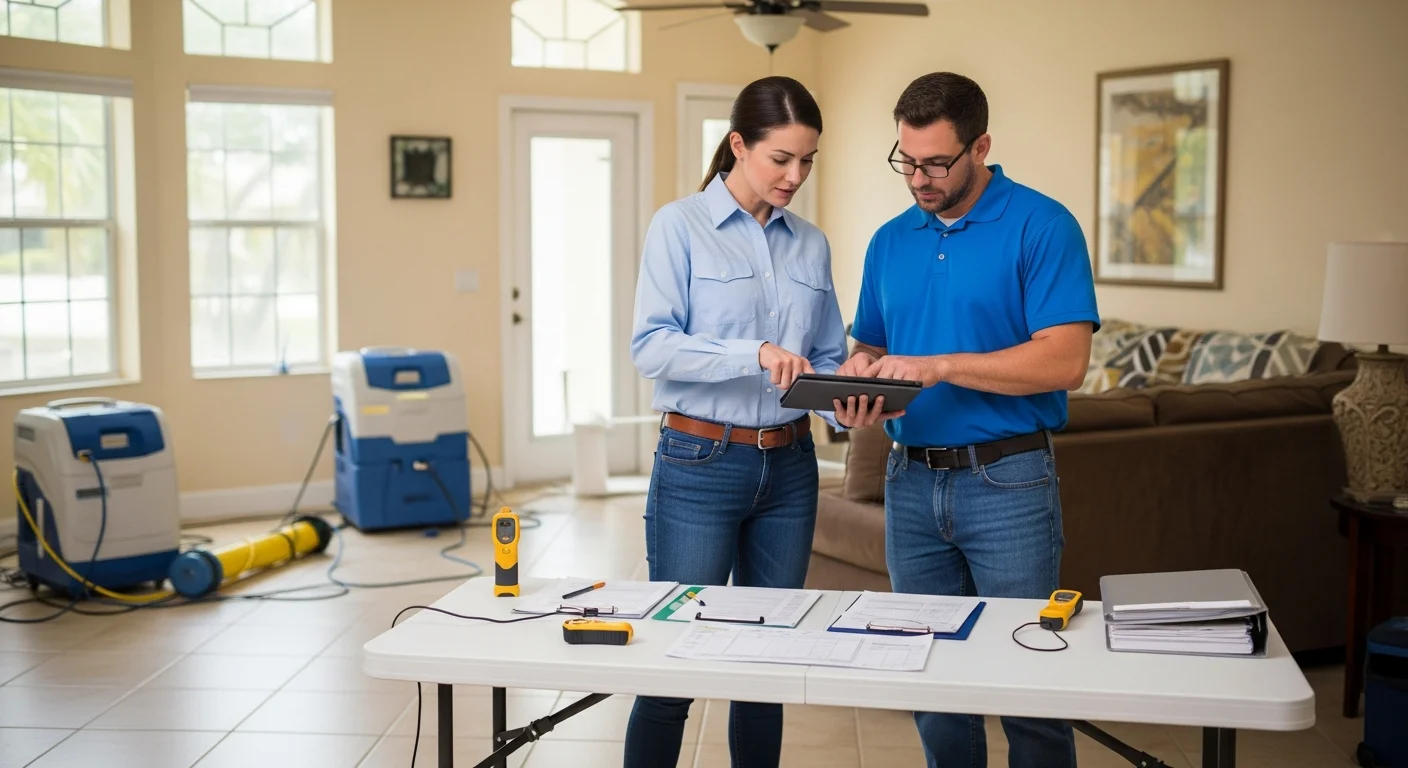
How Palm Build Documents Damage for Plantation Insurance Claims
The quality of documentation determines whether your claim is paid in full or disputed
for months. Palm Build's documentation process is engineered for the Broward County
insurance market — using the tools, formats, and standards that Florida adjusters expect
and approve.
Moisture Mapping
Protimeter and Delmhorst moisture meters measure material moisture content at dozens of points throughout the affected area, mapped to a floor plan. In Plantation CBS homes, we test block wall cavities at multiple heights — moisture wicks upward through concrete block differently than wood-frame construction. These moisture maps define the true scope of demolition and drying required.
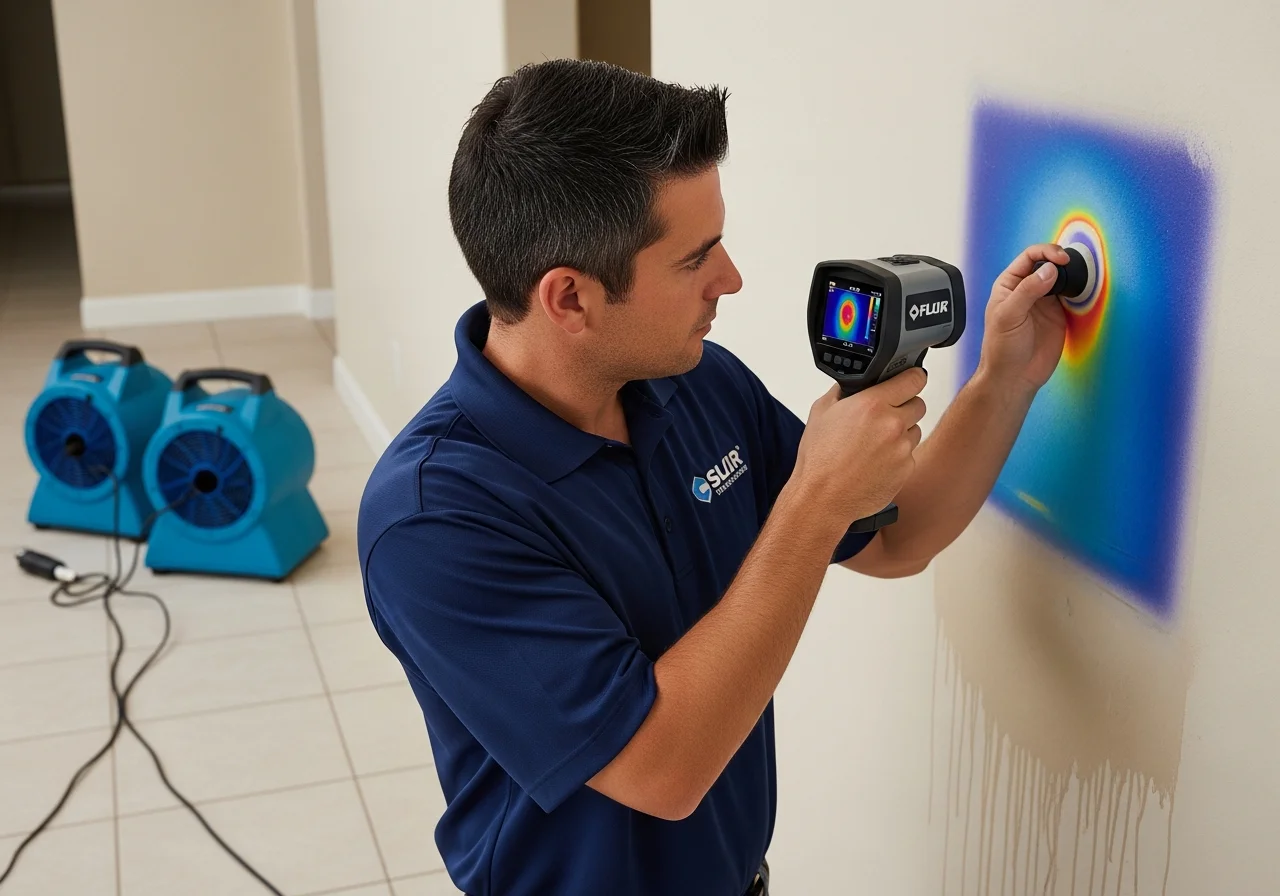
Thermal Imaging (FLIR)
Infrared thermal cameras detect moisture behind walls, above ceilings, and under flooring that is invisible to the naked eye. In Plantation's CBS construction, thermal imaging reveals moisture trapped inside block wall cavities — the evidence your adjuster needs to approve demolition beyond the visually damaged area. Without thermal documentation, adjusters routinely under-scope concealed damage.
Photo & Video Evidence
Every room, every surface, every item of damage — photographed with timestamps and GPS coordinates. Wide-angle shots establish context; macro close-ups document specific damage. Video walkthroughs narrate the damage sequence. For Plantation properties with multi-room damage, hundreds of photographs are standard. This visual record establishes the baseline your adjuster needs before any mitigation work begins.
Xactimate Estimates
Every estimate is prepared in Xactimate — the same software your insurance adjuster uses. Line-item pricing with material specifications, labor calculations, and Broward County regional pricing ensures our estimate speaks the same language as your carrier's. No format disputes, no translation required, no rejected estimates due to software incompatibility.
Daily Drying Logs
Every piece of equipment is logged: placement location, runtime hours, daily moisture readings at each monitoring point. In Plantation's high-humidity environment (average 66-70% RH), structural drying takes longer than in drier climates — and these logs justify the extended equipment rental that carriers question. Without daily logs, carriers routinely reduce equipment days.
Contents Inventory
For claims involving personal property damage, we create detailed contents inventories: item description, quantity, condition, estimated replacement cost, and photographic documentation. Organized contents inventories processed through carrier-accepted formats accelerate the personal property portion of your claim — the piece most homeowners struggle with on their own.
Thermal imaging reveals moisture trapped inside Plantation's CBS wall construction —
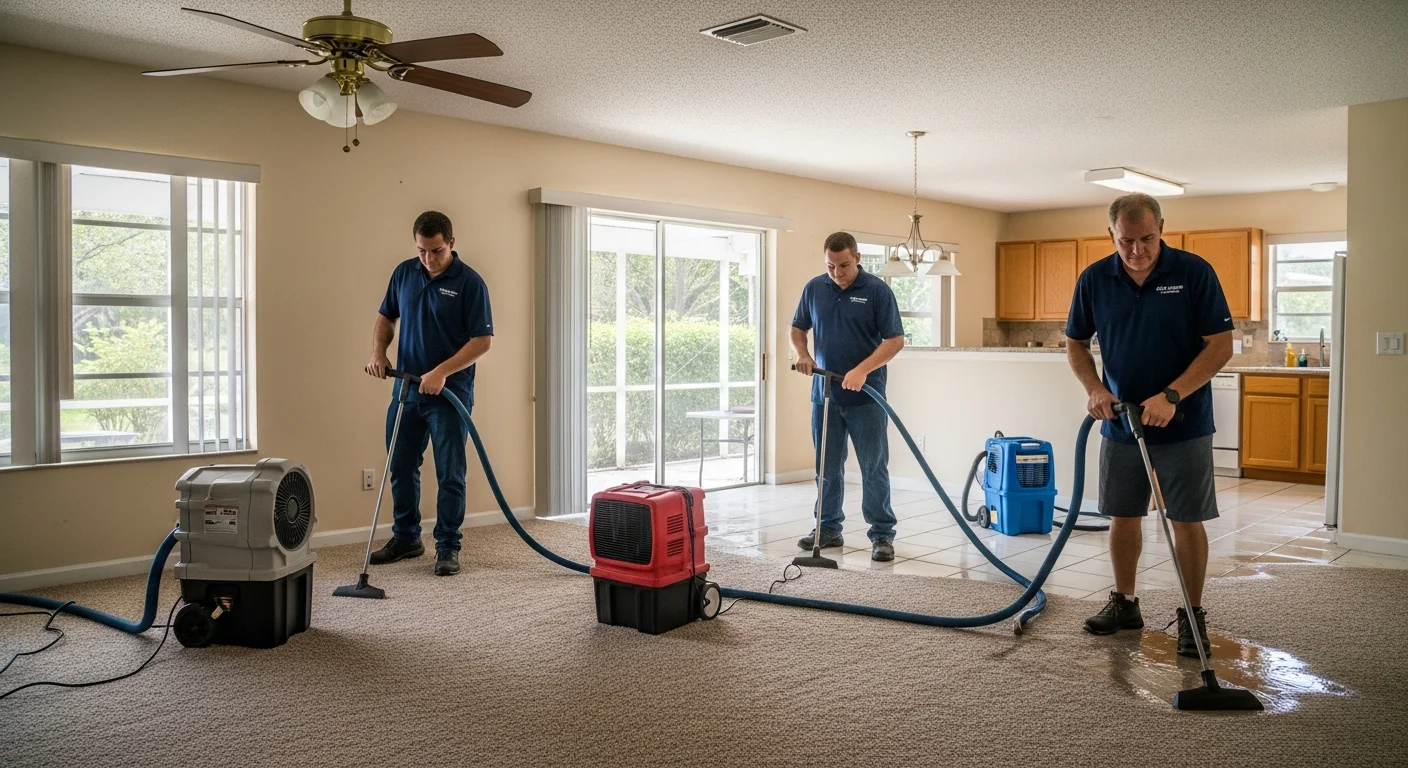
invisible to the naked eye but critical for accurate insurance claim scope.Every step of mitigation is documented — equipment placement, extraction volumes, and
material removal — creating the evidence trail your Broward County carrier requires.
Coverage Gaps
Critical Insurance Gaps Every Plantation Homeowner Should Know
Your insurance policy does not cover everything. These are the most common coverage gaps
that blindside Plantation homeowners after property damage — and how to plan for them
before you need to file.
Critical
Flood vs. Water Damage
Standard HO-3 policies explicitly exclude flood damage — water entering from outside the structure. In Plantation, with 36 miles of canals and documented flooding from events like April 2023, this is the most dangerous coverage gap. Canal overflow, storm surge, rising groundwater, and surface runoff are all excluded. Only a separate NFIP or private flood policy provides coverage for these events.
Impact: Zero coverage for external water events without flood policy
High
Mold Sublimits ($5K-$25K)
Most Broward County policies cap mold remediation at $5,000-$25,000 — often far below the actual cost of professional remediation in a CBS home. A typical mold project in a Plantation home with block wall cavities, HVAC contamination, and saturated drywall runs $8,000-$30,000+. If your sublimit is $10,000, you are personally responsible for every dollar above that threshold. Plantation's year-round humidity makes mold growth after water damage virtually guaranteed within 24-48 hours.
Impact: Out-of-pocket costs of $5,000-$20,000+ on mold projects
High
Roof ACV vs. RCV
Many Broward County carriers have shifted roof coverage from Replacement Cost Value (RCV) to Actual Cash Value (ACV) for roofs over 10-15 years old. On ACV, depreciation is deducted from the claim payment — a 20-year-old concrete tile roof worth $35,000 to replace might only yield $10,000-$15,000 after depreciation. For Plantation homes with original 1970s-1980s roofing, this gap can cost tens of thousands.
Impact: $15,000-$25,000 gap between ACV payment and replacement cost
Medium
Screen Enclosure Caps
Screen enclosures — ubiquitous on Plantation pool homes — are typically subject to coverage caps of $5,000-$15,000 or excluded entirely from windstorm coverage. A single hurricane can destroy a screen enclosure costing $15,000-$40,000 to replace. Many Plantation homeowners discover this gap only after a storm.
When restoration triggers Florida Building Code compliance — especially HVHZ (High-Velocity Hurricane Zone) standards in Broward County — required upgrades like impact-resistant windows, enhanced roof tie-downs, and upgraded electrical panels may not be covered under a standard policy. An ordinance-and-law endorsement is required. Without it, you pay for mandatory code upgrades out of pocket.
Impact: $5,000-$20,000+ in mandated but uncovered upgrades
Medium
AOB Limitations Post-Reform
Under SB 2-A, you can no longer assign your claim benefits to a contractor. Combined with the elimination of one-way attorney fees, this means you bear full responsibility for managing your claim and challenging underpayments. Without professional documentation supporting your position, carriers face less pressure to pay claims fairly.
Impact: Reduced homeowner leverage in claim disputes
Understanding Costs
How Insurance Restoration Costs Work in Plantation
Insurance restoration pricing follows industry standards that your carrier already
accepts. Understanding Xactimate pricing, O&P, depreciation holdback, and the supplement
process helps you know exactly what to expect financially throughout your Plantation
claim.
Xactimate Pricing
Broward County regional rates applied automatically
All insurance restoration work is priced using Xactimate — the industry-standard estimating software used by insurance adjusters nationwide. Xactimate calculates line-item costs using regional pricing data specific to Broward County, including material costs, labor rates, and equipment charges. When Palm Build and your adjuster both use Xactimate with the same regional pricing database, scope disputes center on what work is needed — not what it costs.
Overhead & Profit (O&P)
10% + 10% on qualifying multi-trade projects
On claims involving three or more trades — common in Plantation restoration projects where water damage leads to demolition, mold remediation, drywall, painting, flooring, and potentially electrical or plumbing — your restoration company is entitled to Overhead (10%) and Profit (10%) on top of the net repair estimate. Some carriers resist paying O&P on smaller claims. Palm Build documents trade involvement meticulously to establish O&P eligibility.
Depreciation Holdback
Holdback released upon Certificate of Completion
On ACV (Actual Cash Value) policies or ACV roof settlements, your carrier deducts depreciation from the initial payment. You receive the depreciated value upfront. The remaining holdback — often 20-40% of the total — is released only after you complete repairs and submit proof of completion. On a $30,000 Plantation restoration, this can mean $6,000-$12,000 held back until Palm Build delivers the final documentation package your carrier requires.
The Supplement Process
Must be filed within 18 months of date of loss
Hidden damage discovered during restoration — mold behind CBS walls, corroded plumbing beneath slabs, damaged electrical behind stucco — was not in the adjuster's original scope because it was not visible during the initial inspection. Each discovery is documented with photographs, measurements, and an updated Xactimate estimate, then filed as a supplement within Florida's 18-month statutory window. Supplements are how the claim grows to match the actual damage.
Why Palm Build
Why Plantation Homeowners Trust Palm Build for Insurance Restoration
Insurance claims succeed or fail based on documentation. Palm Build combines restoration
expertise with carrier-specific knowledge to give Plantation homeowners the strongest
possible claim position.
Insurance Documentation Experts
We produce moisture surveys, thermal imaging reports, photo evidence packages, and Xactimate-formatted scope reports — the exact documentation format Florida carriers require. In the post-AOB era, your documentation quality is the single biggest factor in claim outcomes. Palm Build documents every Plantation project to carrier-ready standards from day one.
Broward County Carrier Knowledge
We know how Citizens, State Farm Florida, Universal P&C, Tower Hill, American Integrity, and every major Broward County carrier processes claims. Their typical mold sublimits, common denial patterns, adjuster tendencies, and scope negotiation strategies — this knowledge shapes how we document every Plantation project.
IICRC Certified Technicians
Every Palm Build technician holds active IICRC certifications in Water Damage Restoration (WRT) and Applied Structural Drying (ASD). Carriers recognize IICRC standards — work performed by certified technicians is harder to dispute during scope review and more likely to survive carrier audits.
City of Plantation Permits
Every reconstruction project includes proper City of Plantation building permits. Permitted work to Florida Building Code standards — including HVHZ (High-Velocity Hurricane Zone) requirements — is the only work that holds up to carrier audits, HOA inspections, and future property transactions.
CBS Construction Specialists
Plantation's housing stock is predominantly 1960s-1980s CBS (concrete block and stucco) construction on slab-on-grade foundations. We understand how CBS homes trap and channel moisture differently than wood-frame homes — critical knowledge that affects documentation accuracy, drying protocols, and scope accuracy for every insurance claim.
Fast Emergency Response
Our Deerfield Beach hub reaches every Plantation neighborhood in under 30 minutes. For insurance claims, response speed matters — the faster we begin documentation and mitigation, the stronger your claim evidence and the lower the total loss. Every hour of delayed mitigation is additional damage your carrier may not cover.
Palm Build responds to insurance restoration projects across every Plantation
neighborhood — with the documentation, permits, and carrier knowledge that define
professional claim support in Broward County.
Common Questions
Plantation Insurance Restoration FAQ
Answers to the questions Plantation homeowners ask most about navigating insurance
claims for property damage in Broward County.
How long do I have to file an insurance claim after property damage in Plantation?
Under Florida Statute 627.70132, amended by Senate Bill 2-A in January 2023, you must notify your insurance company of property damage within 1 year of the date of loss. Supplemental claims — for hidden damage discovered during restoration — must be filed within 18 months of the original date of loss. These deadlines are absolute: miss them and your claim is barred regardless of damage severity or how much you've paid in premiums. Palm Build tracks every statutory deadline on every Plantation claim we manage.
Which insurance carriers are most active in Plantation and Broward County?
The most common carriers we work with on Plantation claims include Citizens Property Insurance (Florida's insurer of last resort), Universal Property & Casualty, Tower Hill Insurance, American Integrity Insurance, Heritage Insurance Holdings, Slide Insurance, and Florida Peninsula Insurance. Each carrier has different claim handling patterns, mold sublimits, and documentation requirements. Palm Build tailors our documentation package to your specific carrier's expectations.
Does Palm Build file my insurance claim for me?
No. Under Florida's post-AOB reform (SB 2-A, effective January 2023), homeowners must file their own claims and cannot assign benefits to contractors. What Palm Build does is prepare the documentation package your carrier requires — moisture surveys, thermal imaging reports, photo evidence, and Xactimate estimates — so your claim filing has the strongest possible evidence. We also attend adjuster inspections alongside you to ensure hidden damage is included in the scope.
What is the difference between flood damage and water damage for insurance purposes?
This is the most critical distinction in Florida insurance. Your standard HO-3 homeowners policy covers 'sudden and accidental' water damage from internal sources — burst pipes, appliance failures, AC condensate overflows. It explicitly excludes flood damage — water entering the home from outside, including storm surge, canal overflow, rising groundwater, and surface water runoff. Flood coverage requires a separate NFIP or private flood policy. In Plantation, with 36 miles of canals and documented flooding history, this distinction can mean the difference between a funded claim and zero coverage.
How do mold sublimits affect my Plantation insurance claim?
Most Broward County homeowners policies cap mold remediation coverage at $10,000-$25,000. In Plantation's high-humidity environment, where mold begins growing 24-48 hours after water damage in CBS (concrete block stucco) construction, professional remediation often costs $8,000-$30,000+. If your mold sublimit is $10,000, you are responsible for every dollar above that threshold. Palm Build documents mold as secondary damage caused by the original covered peril, which sometimes allows remediation to be included under the primary water damage claim rather than the sublimit.
What does Palm Build charge for insurance restoration work?
Palm Build prices all work using Xactimate — the same software your insurance adjuster uses. Our line-item estimates include material specifications, labor calculations, and Broward County regional pricing. For insured losses, we bill the carrier directly based on the approved scope of work. Your out-of-pocket is typically limited to your deductible. We also handle supplement filings for hidden damage discovered during restoration, ensuring the carrier pays for the full scope of documented work.
What is depreciation holdback and how do I get it released?
On an ACV (Actual Cash Value) settlement, your carrier deducts depreciation from the initial payment — you receive the depreciated value upfront. The withheld depreciation (holdback) is released after you complete the repairs and submit proof of completion. On an RCV (Replacement Cost Value) policy, you are entitled to the full replacement cost but only after the work is done. Palm Build provides the Certificate of Completion and final documentation package your carrier requires to release the holdback.
Can Palm Build help if my Plantation insurance claim is underpaid?
Yes. If your carrier's initial scope undervalues the documented damage, Palm Build prepares a detailed supplement with supporting evidence — additional moisture readings, thermal imaging, material specifications, and Xactimate line-item comparisons. Common supplement items on Plantation claims include mold remediation behind CBS walls, HVAC system cleaning, code upgrade requirements under HVHZ standards, and materials pricing disputes. We file supplements within the 18-month statutory window.
Trusted Vendors
Trusted local pros in Plantation
Outside our restoration scope, these are the vetted, licensed contractors we trust
alongside our work. Personally evaluated, reference-checked, and recommended by Palm
Build.