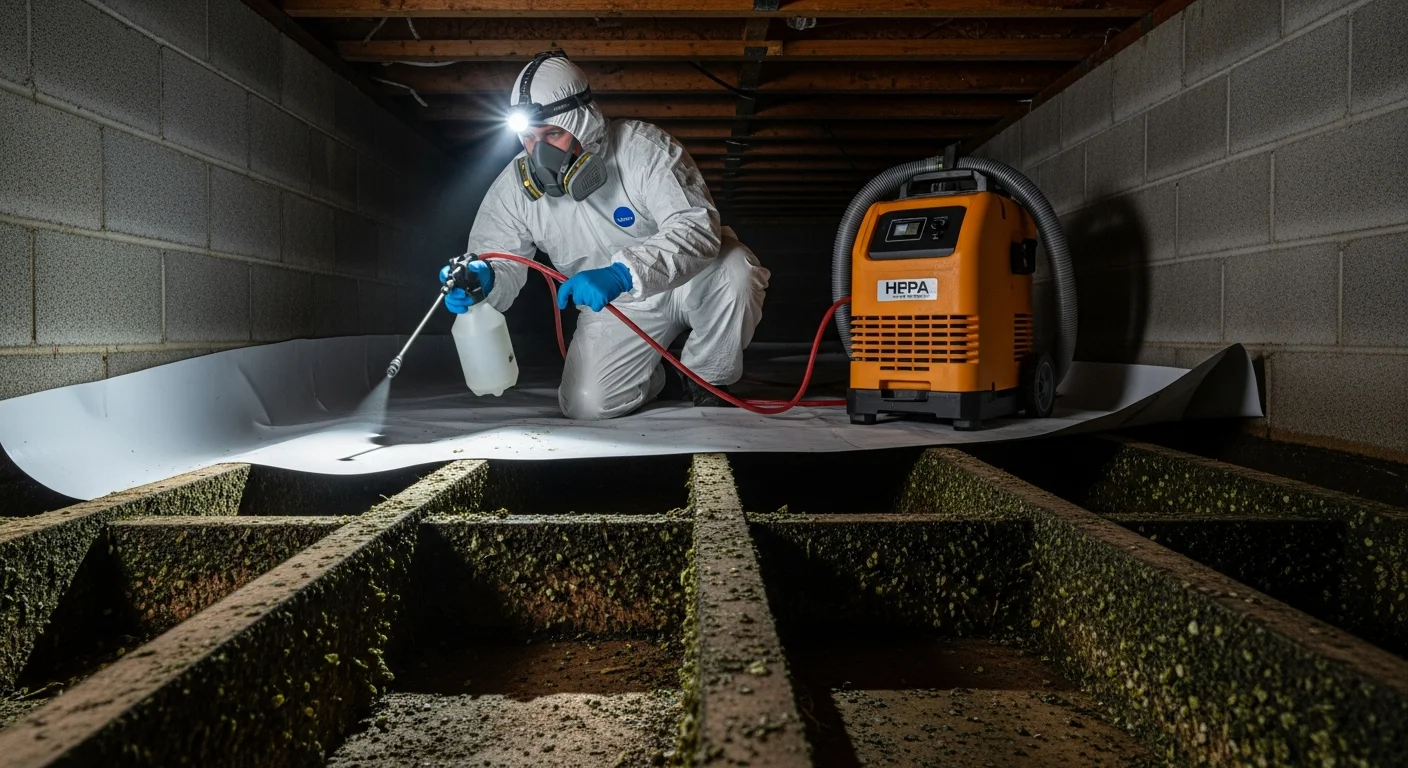
Crawl Space Cleanup & Encapsulation in Rock Hill, SC
You are breathing your crawl space. Up to 50% of the air inside a Rock Hill home with a vented crawl space originates from below the floor — carrying moisture, mold spores, and whatever else lives in that dark, humid void over Piedmont clay soil. If your Rock Hill home was built before 2000, your crawl space is almost certainly working against you. Palm Build provides complete crawl space remediation — mold removal, moisture control, encapsulation, structural repair, and dehumidifier installation — addressing the root cause that every other contractor ignores.
Charlotte Office — 25 min to Rock Hill via I-77 45-60 min Response IICRC Certified
Why Rock Hill Is Ground Zero for Crawl Space Problems
Rock Hill's Piedmont climate, clay soil, and massive inventory of vented crawl space
homes create what restoration professionals call the perfect storm for sub-floor
deterioration. If you own a pre-2000 home in Rock Hill — particularly in Southside,
College Downs, Old Town, or Millwood — your crawl space is almost certainly affecting
your home's air quality, structural integrity, and energy costs right now.
Piedmont Clay Soil Foundation
<0.2 in/hr
Clay drainage rate
Rock Hill sits atop expansive Piedmont clay with infiltration rates below 0.2 inches per hour. This clay retains moisture, drains poorly, and creates persistently humid conditions directly beneath your crawl space. After every rain event, moisture lingers against your foundation for days — feeding humidity into the space above.
Year-Round Humidity Exposure
44 in
Annual rainfall
Rock Hill receives 44 inches of rain annually with no dry season. Summer humidity regularly exceeds 60% — the threshold for active mold growth. The combination of near-constant moisture, warm temperatures, and poor sub-foundation drainage means your crawl space never fully dries out between rain events.
Vented Crawl Space Construction
60%+
Pre-2000 homes with vented crawl
A very high proportion of Rock Hill's pre-2000 housing stock sits on traditional vented crawl spaces — a construction method now recognized as fundamentally flawed for humid Piedmont climates. Exterior vents designed to 'air out' the crawl space actually pump hot, humid air directly beneath your home during summer months.
The Charlotte Transplant Knowledge Gap
2,800/yr
Charlotte-to-York migration
An average of 2,800 people per year relocated from Charlotte to York County. Many purchased older Rock Hill homes — particularly in Southside, College Downs, and Old Town — without understanding that their crawl space is the single biggest factor affecting their home's air quality, structural integrity, and energy efficiency.
Rock Hill's Piedmont clay soil and humid climate make crawl space issues endemic in
pre-2000 homes — affecting air quality, structural integrity, and energy efficiency.
The Stack Effect
How Your Crawl Space Affects the Air You Breathe
The stack effect is the single most important concept for Rock Hill homeowners to
understand. Warm air rises through your home and exits through upper-level gaps —
pulling replacement air upward from the lowest point: your crawl space. Up to 50% of the air in your home originates from your crawl space.
How Air Moves Through Your Rock Hill Home
Living Space
You breathe this air. Up to 50% originates from your crawl space.
Air rises
Floor System
Subfloor, floor joists, insulation — the first structural components affected by crawl space humidity.
Air rises
Crawl Space
Vented crawl space pulls in humid exterior air. Moisture condenses on cooler surfaces — pipes, ducts, joists.
Air rises
Clay Soil
Piedmont clay retains moisture, releasing it as vapor upward through the ground. Drainage rate: <0.2 in/hr.
In a vented crawl space, humid exterior air enters through foundation vents, picks up
additional moisture from the clay soil below, and is drawn upward into your living space
by the stack effect.
Mold Colonization
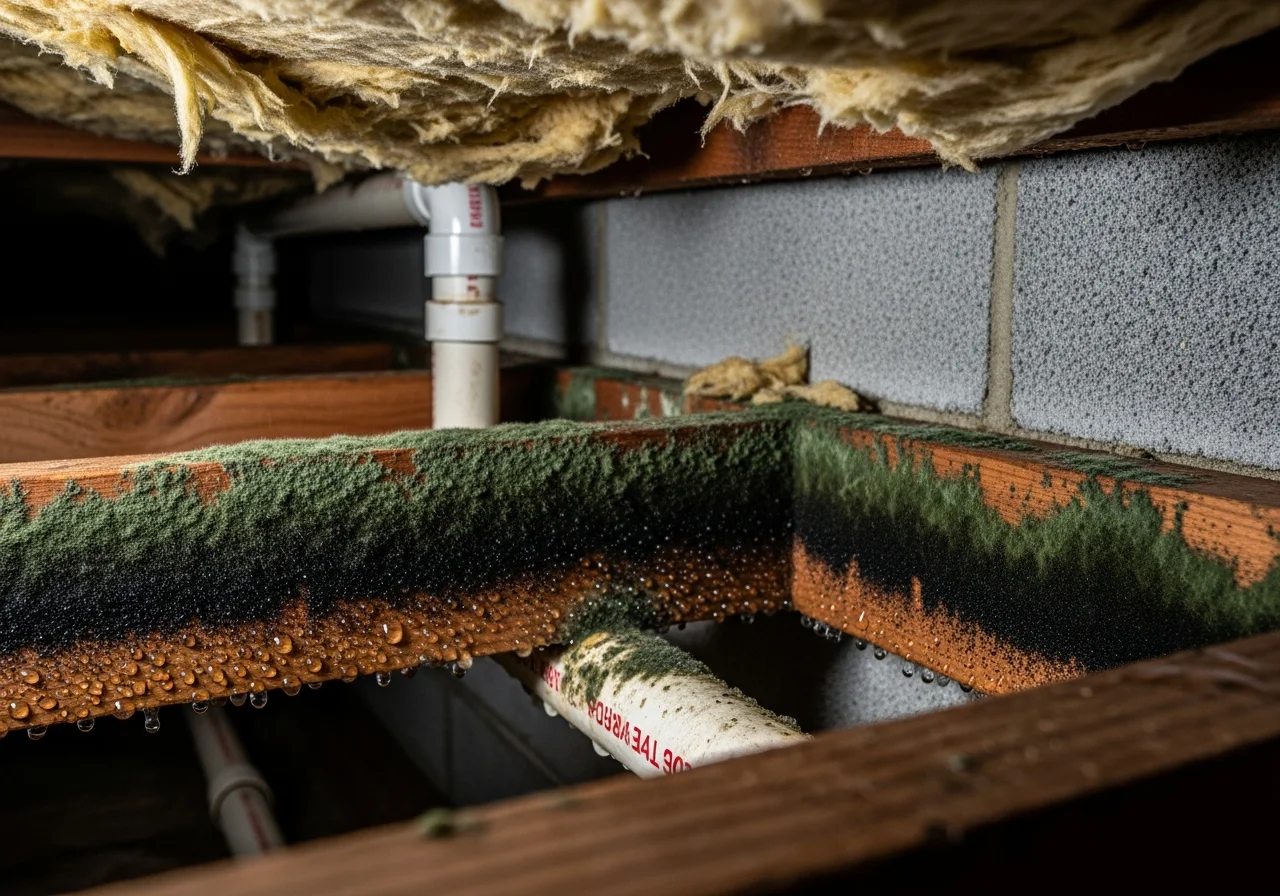
Crawl space humidity above 60% triggers active mold growth on floor joists, subfloor, and ductwork. Mold spores are drawn upward into living space by the stack effect — affecting indoor air quality throughout the home.
Structural Deterioration
Persistent moisture causes wood rot in floor joists and subfloor. Over years, this leads to sagging floors, bouncy subfloor, and structural compromise that requires joist repair or replacement — a common finding in Rock Hill homes built before 1980.
Energy Waste
Humid crawl space air drawn into the home forces your HVAC to work harder to dehumidify. Homes with unconditioned crawl spaces typically use 15-20% more energy for cooling — a significant cost in Rock Hill summers where AC runs 5-6 months per year.
Odor & Air Quality
The musty smell in many older Rock Hill homes isn't from the house itself — it's from the crawl space. Volatile organic compounds (VOCs) from mold, decaying organic matter, and soil gases are continuously pulled into living space through the stack effect.
Persistent humidity in Rock Hill's vented crawl spaces leads to mold colonization on
floor joists — the structural components that support your living space above.
Our Process
Our Rock Hill Crawl Space Restoration Process
Crawl space restoration is not a one-step job. It's a systematic process that addresses
the root cause — moisture intrusion — and creates a permanently conditioned environment
beneath your home.
01
Comprehensive Crawl Space Inspection
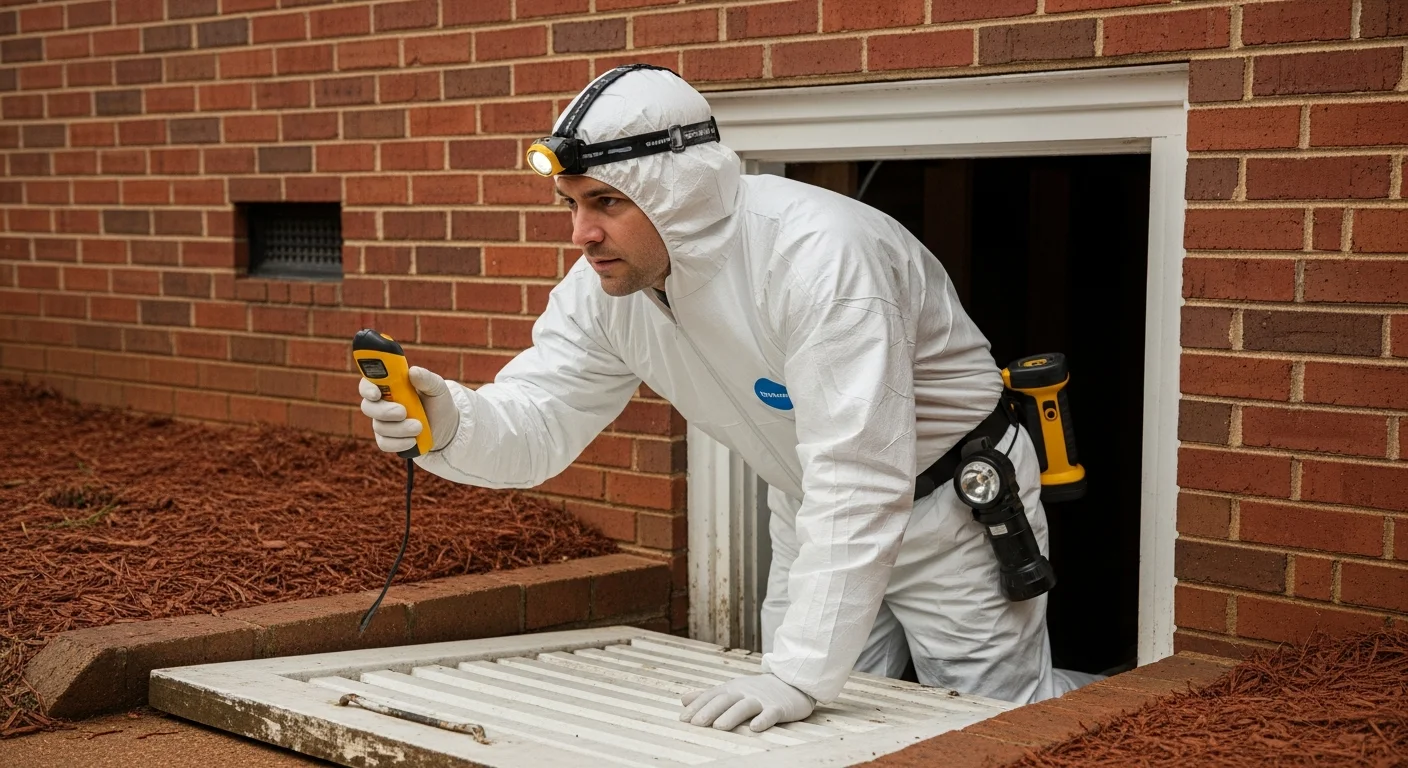
Our IICRC-certified technicians enter the crawl space with moisture meters, thermal cameras, and air quality monitors. We document everything: standing water, vapor barrier condition, insulation integrity, joist condition, ductwork, plumbing, and visible mold. For Rock Hill's clay-soil homes, we specifically check for soil moisture migration and foundation crack infiltration.
02
Debris Removal & Cleanup
Old insulation, deteriorated vapor barriers, organic debris, and any contaminated materials are removed. In many Rock Hill crawl spaces — particularly in Southside and College Downs brick ranches — we find decades of accumulated debris that creates habitat for pests and retains moisture against structural components.
03
Mold Remediation
If active mold is present — and it almost always is in untreated Rock Hill crawl spaces — we perform full IICRC S520-compliant remediation. This includes HEPA vacuuming of surfaces, antimicrobial treatment of structural wood, and containment protocols to prevent cross-contamination to living spaces above.
04
Encapsulation
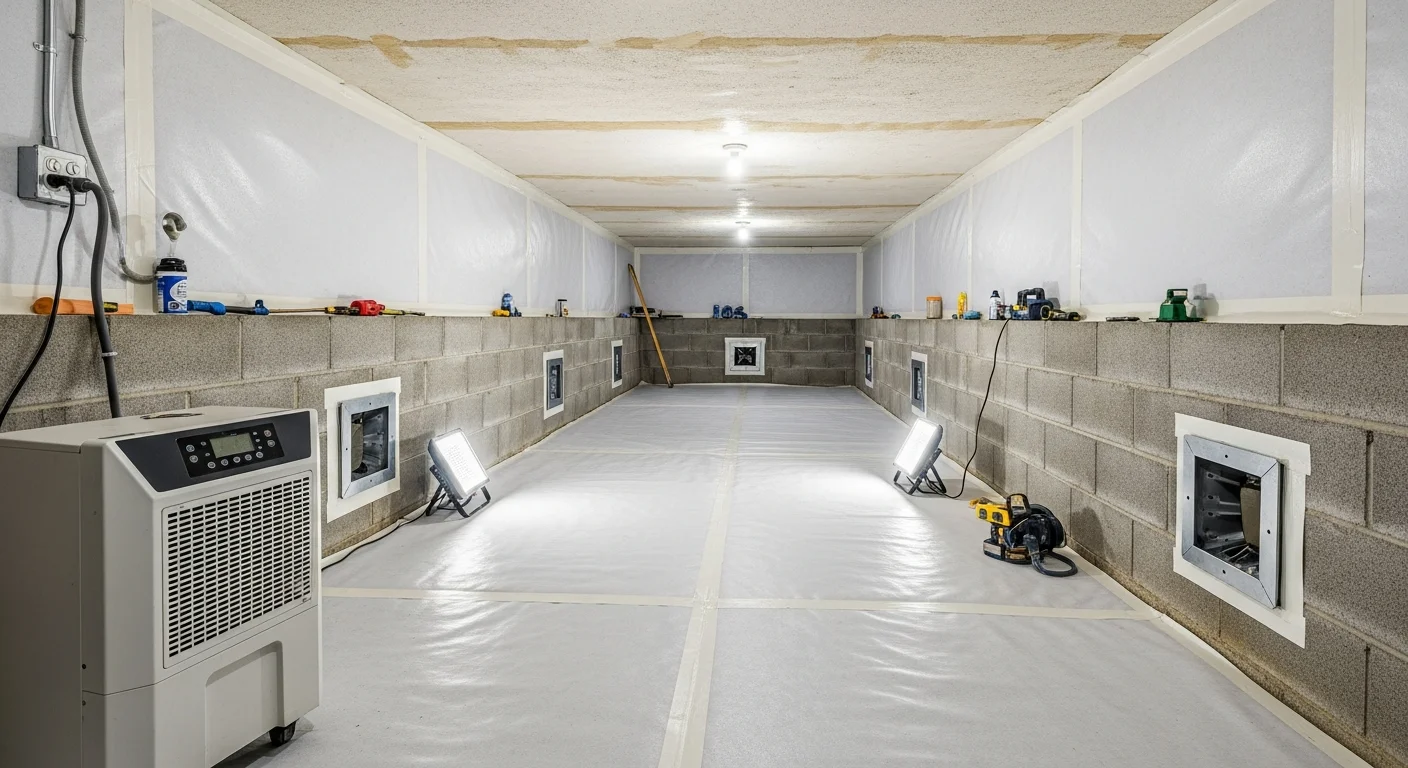
We install a heavy-gauge (20-mil) reinforced vapor barrier across the entire crawl space floor and up the foundation walls — sealing foundation vents, sealing rim joists, and creating a conditioned space that stops soil moisture migration and eliminates the stack effect pathway for humid air.
05
Dehumidification System
A commercial-grade crawl space dehumidifier is installed and calibrated to maintain humidity below 55% — well below the 60% mold growth threshold. For Rock Hill's climate, a dehumidifier is essential even after encapsulation: it handles the residual moisture load from concrete and masonry as the crawl space transitions from vented to conditioned.
06
Verification & Monitoring
Post-installation moisture readings are taken at multiple points to verify the system is performing. We provide homeowners with a humidity monitoring guide and recommend annual inspections to ensure long-term performance — especially important after major rain events or tropical systems that challenge even well-encapsulated crawl spaces.
A properly encapsulated crawl space with heavy-gauge vapor barrier, sealed vents, and
commercial dehumidification — the permanent solution for Rock Hill's Piedmont climate.
Neighborhood Risk Assessment
Which Rock Hill Neighborhoods Have the Worst Crawl Space Issues
Crawl space risk in Rock Hill correlates directly with housing age, foundation type, and
proximity to known drainage problems. Here's what we find in the neighborhoods where we
respond most frequently.
Crawl space risk: Oldest homes in Rock Hill with original foundations, aging plumbing prone to slow leaks
Winthrop Area
High Risk
Built: 1920s-1980s | Foundation: Mixed crawl space
Crawl space risk: Craftsman bungalows and faculty housing with unencapsulated crawl spaces and rental neglect
Millwood Plantation
Moderate
Built: 1990s-2000s | Foundation: Mixed crawl/slab
Crawl space risk: Vented-crawl design standard of the 1990s — now recognized as problematic for Piedmont humidity
Laurel Creek / India Hook
Moderate
Built: 1990s-2010s | Foundation: Mixed crawl/slab
Crawl space risk: Lake Wylie humidity amplifies crawl space moisture in homes with vented construction
Sweetwater Plantation
Lower Risk
Built: 2008-2019 | Foundation: Primarily slab
Crawl space risk: Lower crawl space risk — slab construction reduces but does not eliminate moisture issues
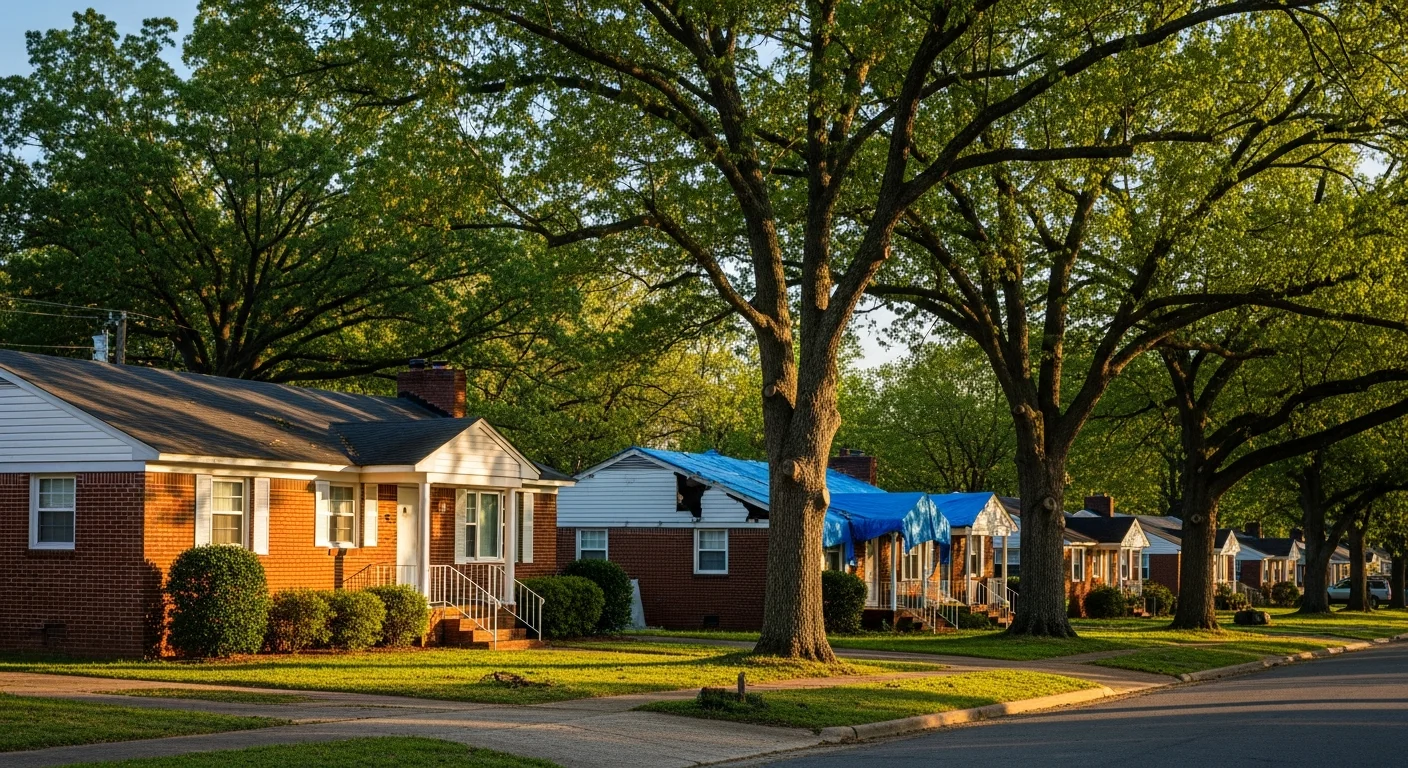
Rock Hill's Southside neighborhood — classic 1950s-1970s brick ranches on vented crawl
space foundations — represents the highest concentration of crawl space issues in the
city.
Approach Comparison
Encapsulation vs. Ventilation: Why Vented Crawl Spaces Fail in Rock Hill
The building science is clear: vented crawl spaces in humid Piedmont climates like Rock
Hill's are a fundamentally flawed design. The vents that were supposed to "air out"
moisture actually introduce it. Encapsulation is the permanent solution — and the
difference in performance is dramatic.
Vented (Traditional)
Encapsulated
Humidity control
Relies on outside air — fails in humid Rock Hill summers (60%+ RH)
15-20% higher cooling costs from humid crawl space air entering home
Significant HVAC savings — conditioned air stays in the system
Structural protection
Floor joists and subfloor exposed to persistent moisture and wood rot
Structural wood protected from moisture damage long-term
Pest control
Open vents allow insect and rodent entry into crawl space
Sealed environment significantly reduces pest access
Indoor air quality
Stack effect pulls crawl space air (mold, soil gases, VOCs) into living space
Clean, dry crawl space air contributes to healthier indoor environment
Radon management
Soil gases enter freely through exposed ground surface
Vapor barrier reduces radon infiltration; compatible with mitigation systems
Building science consensus: The Department of Energy,
Advanced Energy (the organization that pioneered crawl space encapsulation research in North
Carolina), and the IICRC all recommend sealed, conditioned crawl spaces over vented construction
in humid climates. For Rock Hill's Piedmont environment, encapsulation is not an upgrade — it's
a correction of a fundamentally flawed original design.
Cost Transparency
Crawl Space Restoration Costs in Rock Hill
Crawl space costs vary dramatically based on size, existing damage, and scope of work.
These ranges reflect real-world York County project costs. Most Rock Hill crawl spaces
with existing mold and moisture issues fall into the premium/complete range.
Basic Encapsulation
Clean crawl space with no mold, no structural damage, standard access
Crawl space inspection$250 - $500
Debris removal & cleanup$500 - $2,000
Vapor barrier (6-mil basic)$1,500 - $3,500
Vent sealing$300 - $800
Basic encapsulation package$3,500 - $7,500
Complete Restoration
Mold present, structural damage, drainage issues, or joist repair needed
Drainage system (sump + French drain)$2,000 - $6,000
Complete restoration package$10,000 - $35,000+
Why Palm Build
Why Rock Hill Homeowners Choose Palm Build for Crawl Space Work
Crawl space restoration in Rock Hill requires understanding of Piedmont soil dynamics,
humidity patterns, and the specific construction methods used in homes across the city's
neighborhoods. Generic franchise protocols designed for other climates don't work here.
Piedmont Crawl Space Specialists
We understand the specific dynamics of Rock Hill's Piedmont climate — clay soil moisture migration, vented-to-conditioned conversion, and the building science behind encapsulation. This isn't coastal crawl space work or generic franchise protocols — it's Piedmont-specific expertise.
IICRC Certified in South Carolina
South Carolina doesn't license mold remediators. Our IICRC certifications — including Water Restoration, Applied Structural Drying, and Mold Remediation — provide the quality assurance that protects your investment and satisfies insurance carriers.
25 Minutes from Rock Hill
Our Charlotte hub on Crompton Street puts us in Rock Hill within 45-60 minutes. For crawl space emergencies — standing water, active flooding, pipe failures — proximity means we can prevent the secondary damage that turns a mitigation job into a full remediation project.
Full Restoration, Not Just Encapsulation
Many companies install a vapor barrier and call it done. We address the complete system: mold remediation, structural repair, drainage solutions, encapsulation, and dehumidification. Every component matters — skip one, and the crawl space fails again within months.
Insurance Documentation Expertise
When crawl space damage is caused by a covered event — pipe burst, storm damage, appliance failure — we produce the documentation that supports your insurance claim. Our moisture mapping and photo evidence is formatted for the adjuster workflow.
Our IICRC-certified technicians specialize in Rock Hill's Piedmont crawl space
conditions — addressing mold, structural damage, and moisture control as a complete
system.
Common Questions
Rock Hill Crawl Space FAQ
Why are Rock Hill crawl spaces so problematic?
Three factors combine: Piedmont red clay soil holds moisture and drains at less than 0.2 inches per hour, keeping water against foundations for days. Rock Hill's humid subtropical climate produces summer humidity that routinely exceeds 60% — the threshold for mold growth. And most pre-2000 homes have vented crawl spaces that pull this humid air directly under the home, where it condenses on cooler surfaces and feeds mold colonization.
How much does crawl space encapsulation cost in Rock Hill?
Basic encapsulation with dehumidifier averages $6,000-$12,000. Mold remediation plus encapsulation ranges from $8,000-$18,000. Full remediation with structural repair and drainage correction ranges from $15,000-$35,000. The cost depends on crawl space size, existing damage severity, and whether drainage correction is needed.
Does adding more vents fix a humid crawl space?
No — building science has definitively proven this makes the problem worse. More vents introduce more humid air, creating more condensation and more mold. The solution is the opposite: seal all vents, install a vapor barrier, and add mechanical dehumidification. If a contractor recommends more ventilation for your Rock Hill crawl space, find a different contractor.
Is crawl space encapsulation covered by insurance?
Encapsulation itself is a preventive improvement and is not covered by homeowners insurance. However, crawl space damage from a covered sudden event (burst pipe, appliance failure) is typically covered, including mold remediation up to your policy's sublimit. Palm Build documents the cause-of-loss to determine which costs may be claimable.
How do I know if my Rock Hill crawl space needs attention?
Warning signs include musty odors in lower-level rooms, soft or squeaky floors, doors that stick or won't close properly, visible mold in closets or on baseboards, elevated humidity readings inside the home, allergy symptoms that worsen at home, and higher-than-expected energy bills. If your home was built before 2000 on a crawl space foundation, a professional inspection is recommended regardless of symptoms.
Which Rock Hill neighborhoods have the worst crawl space problems?
College Downs (1950s-1970s brick ranches with chronic flooding), Southside (1940s-1970s with decades of unchecked humidity), South Central/Flint Hill (90+ homes with repetitive flooding), and Old Town (1890s-1950s with century-old foundations) have the most severe crawl space issues. Millwood Plantation and older sections of Laurel Creek also have significant crawl space risk.
How long does crawl space encapsulation take?
Encapsulation only: 2-4 days. Mold remediation plus encapsulation: 1-2 weeks. Full remediation with drainage and structural repair: 2-4 weeks. Rock Hill's clay soil can complicate drainage work if heavy rains occur during installation.
I just moved to Rock Hill from Charlotte. Should I inspect my crawl space?
Yes — especially if you purchased a pre-2000 home. Charlotte transplants are often unfamiliar with South Carolina's vented crawl-space construction. A professional crawl space inspection ($200-$400) can identify problems early, when remediation costs $6,000-$12,000 instead of $25,000-$50,000 after years of unchecked damage.
Rock Hill Crawl Space Problems? We Fix What's Underneath.
Palm Build's IICRC-certified crawl space team addresses moisture, mold, and structural damage at the source. Complete remediation — mold removal, encapsulation, drainage, structural repair, and dehumidifier installation — managed as one coordinated project.