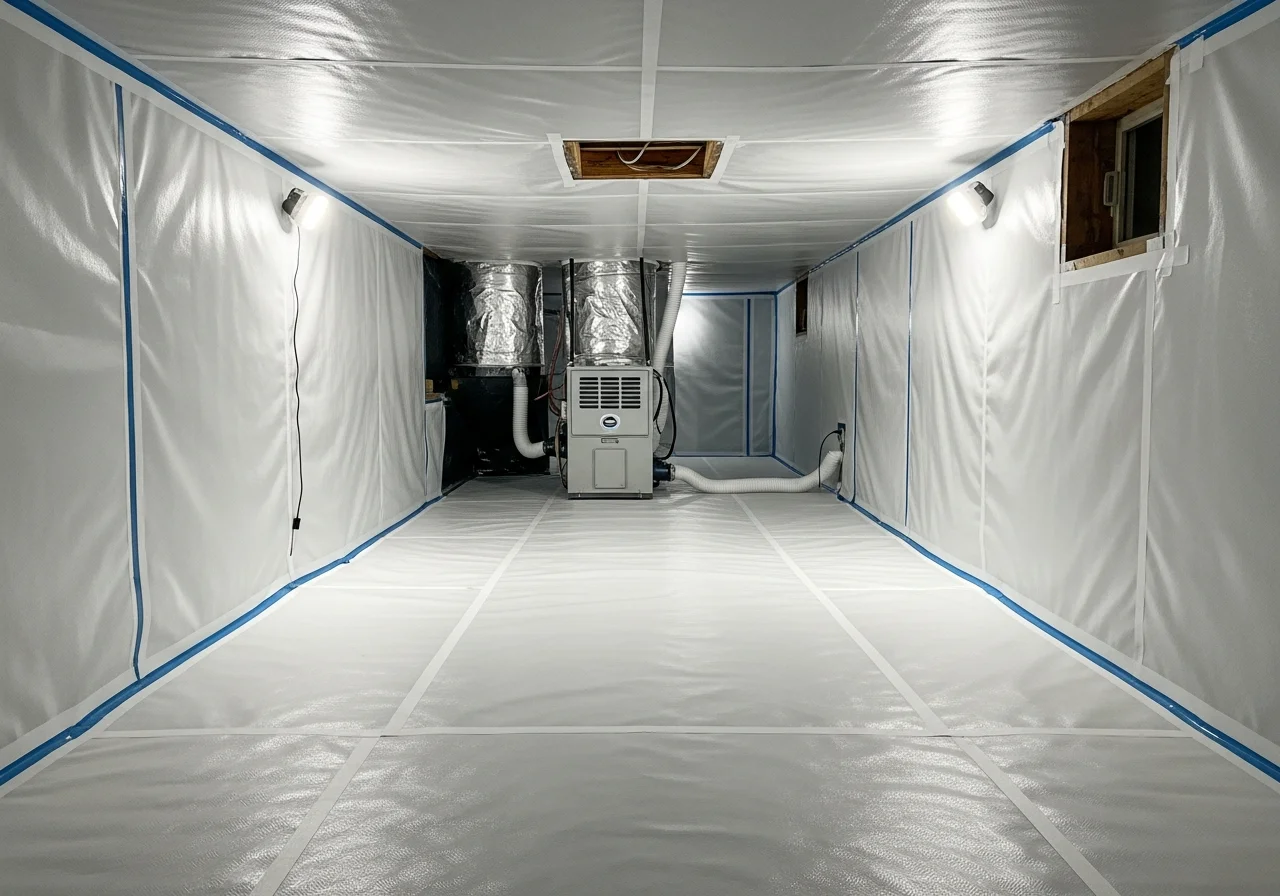
Crawl Space Cleanup & Encapsulation in Matthews, NC
The majority of 1980s-1990s Matthews homes were built with vented crawl space foundations on Cecil clay soil — a combination that guarantees chronic moisture problems. Palm Build provides complete crawl space remediation for Matthews homeowners: mold removal, moisture control, encapsulation, and structural repair, addressing the root cause of why Matthews crawl spaces fail.
15 minutes from Matthews via I-485 Same day Response IICRC Certified
Why Matthews Has the Worst Crawl Spaces in the Charlotte Metro
Matthews' combination of Cecil clay soil, 1980s-1990s vented crawl space construction,
and humid subtropical climate creates a perfect storm for crawl space failure. The
majority of Matthews homes with crawl space foundations show moisture damage, active
mold, or both at first professional inspection. This isn't a maintenance issue — it's a
structural conflict between how these homes were built and the soil and climate they
were built on.
Cecil Clay Soil — NC's State Soil
<0.2 in/hr
Cecil clay drainage
Matthews sits squarely on Cecil series clay — North Carolina's official state soil — containing approximately 37% clay and 27% silt with an infiltration rate below 0.2 inches per hour. This soil covers 59% of Mecklenburg County and behaves fundamentally differently from sandy or loamy soils. After rainfall, Cecil clay holds moisture against your foundation like a wet compress — water doesn't drain away in hours, it persists for days or weeks, continuously feeding moisture into the crawl space through block walls, footer joints, and every hairline crack in the foundation. But Cecil clay does something sandy soil doesn't: it expands when wet and contracts when dry. This cyclical mechanical stress physically pushes against foundation walls during wet periods and pulls away during dry spells, gradually opening cracks, shifting mortar joints, and creating new water entry pathways with every season. The clay beneath your Matthews home is not just holding water — it's actively working against your foundation.
Vented Foundation Condensation Cycle
69-75%
Summer outdoor RH
The majority of Matthews homes built in the 1980s and 1990s were constructed with vented crawl space foundations — open foundation vents that allow outdoor air to circulate freely beneath the house. Building codes of that era required these vents based on the theory that airflow would prevent moisture buildup. In Matthews' humid subtropical climate, this theory fails catastrophically. During summer months, outdoor relative humidity regularly reaches 69-75%. When this warm, humid air enters a cooler crawl space through open foundation vents, it hits surfaces 10-15 degrees cooler than the outdoor temperature — floor joists, ductwork, water pipes, the ground itself — and condenses. This condensation cycle repeats daily from May through September, depositing moisture on every surface in the crawl space. The vents that were supposed to reduce moisture are the primary mechanism introducing it. A vented crawl space in Matthews doesn't ventilate — it irrigates.
Year-Round Moisture Pressure
43+ in
Annual rainfall
Matthews receives over 43 inches of rain annually with no true dry season. Combined with Cecil clay's near-zero drainage rate, this means the soil beneath Matthews homes is never fully dry. Even during the driest months (October-November), soil moisture remains high enough to generate significant vapor through uncovered crawl space floors. During wet seasons (March-April and July-August), soil saturation reaches levels that push liquid water through foundation walls via hydrostatic pressure. The result is a crawl space that faces moisture pressure from two directions simultaneously: groundwater pushing up through the floor and humid air pushing in through foundation vents. Most Matthews crawl spaces exceed 60% relative humidity year-round — well above the threshold where mold growth begins and wood moisture content rises to decay-supporting levels.
1980s-1990s Construction Era
30-45 yrs
Home age range
Matthews' residential construction boom coincided with a period when vented crawl spaces were standard and the building science community hadn't yet recognized that ventilation actually worsens moisture problems in humid climates. North Carolina didn't update its building code to allow sealed (encapsulated) crawl spaces until 2009. This means the vast majority of Matthews' housing stock — the subdivisions built during the town's rapid growth period — has the worst possible crawl space configuration: vented foundations on expansive Cecil clay in a humid subtropical climate. These homes are now 30-45 years old, and most have been accumulating moisture damage for their entire lives. The HVAC ductwork in these crawl spaces has been corroding for decades. The floor joists have been absorbing moisture for decades. The fiberglass insulation installed between the joists has long since fallen to the ground. By the time Matthews homeowners call us, the crawl space has typically been failing for years.
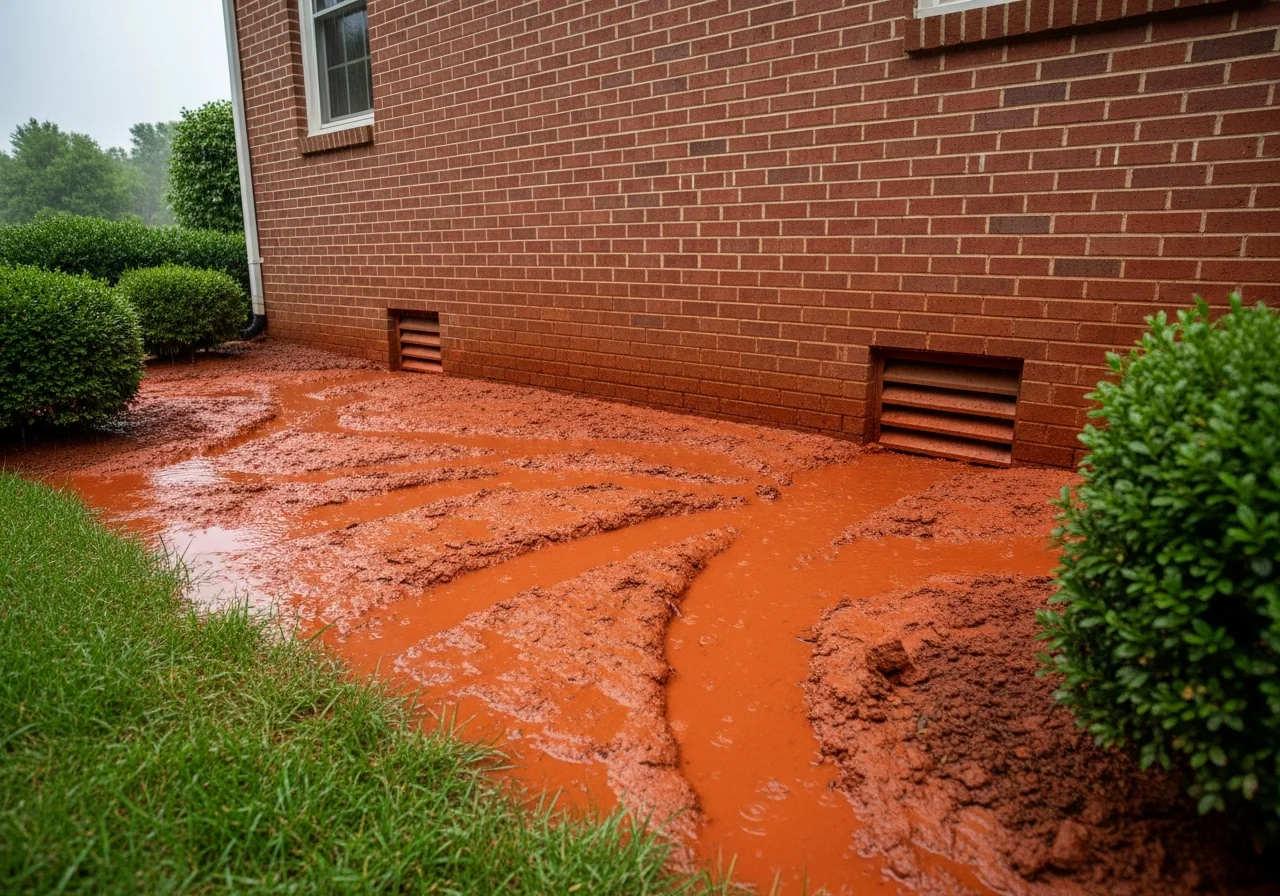
Cecil clay soil at a Matthews foundation — note the dense, poorly draining material
holding moisture directly against the block wall. This soil covers 59% of Mecklenburg
County.
Warning Signs
6 Signs Your Matthews Home Has a Crawl Space Problem
Crawl space problems in Matthews rarely announce themselves dramatically. They develop
slowly — over months or years — and by the time symptoms appear inside the home, the
crawl space condition has usually progressed well beyond a simple fix. Here are the
warning signs every Matthews homeowner should recognize, especially in the 1980s-1990s
homes with vented crawl space foundations that dominate the town's housing stock.
Musty or Earthy Smell
The most common first sign Matthews homeowners notice is a persistent musty, earthy smell on the first floor — particularly noticeable when the HVAC system kicks on. This smell originates in the crawl space, where mold and mildew are actively growing on floor joists, subfloor panels, and fallen insulation. Because warm air in the crawl space rises through the stack effect — migrating through gaps around plumbing penetrations, electrical runs, and HVAC supply boots — the odor travels directly into your living space. In Matthews' humidity, this smell intensifies from May through September and often becomes the defining characteristic of the home. If your Sardis Forest ranch or Brightmoor colonial smells musty despite regular cleaning, the crawl space is almost certainly the source.
Sagging or Bouncy Floors
When crawl space moisture saturates floor joists and subfloor panels over years, the wood softens and loses structural integrity. Joists develop fungal decay (wood rot) that reduces their load-bearing capacity, and subfloor panels — particularly the OSB (oriented strand board) used extensively in 1980s-1990s Matthews construction — swell, delaminate, and lose rigidity. The result is floors that sag, bounce, or feel spongy underfoot. You might notice a low spot in the hallway, a bounce walking across the living room, or doors that have started sticking because the floor has shifted. In severe cases, the floor deflects visibly when walked on. Matthews homes built in the 1980s with original OSB subfloor over deteriorating joists are the most susceptible — the OSB absorbs moisture faster than plywood and fails more dramatically.
Condensation on Windows and Pipes
Excessive crawl space moisture raises the overall humidity level in the home. When indoor humidity exceeds 55-60%, condensation appears on cold surfaces — window glass in winter, cold water pipes year-round, toilet tanks, and air conditioning supply registers. If you notice persistent window condensation, water droplets on bathroom cold water supply lines, or wet spots around HVAC registers, the crawl space is pushing moisture into the living space faster than your HVAC system can remove it. Matthews homes with crawl space humidity of 70-80% commonly have interior humidity of 60-70% — well above the 30-50% range recommended for comfort and health. Your HVAC system runs harder trying to condition this excess moisture, driving up energy bills.
Increased Allergy Symptoms
The connection between crawl space mold and indoor air quality is well documented. Mold spores, dust mite colonies (which thrive in humid environments), and bacterial growth in the crawl space produce airborne particulate that migrates into the living space through the stack effect. Matthews residents with crawl space problems often report worsening allergy symptoms, unexplained respiratory issues, and chronic sinus problems that improve when they leave the house and return when they come home. Children, elderly residents, and anyone with asthma or compromised immune systems are particularly affected. If your allergist can't explain why symptoms are worse at home than elsewhere, a crawl space inspection should happen before pursuing additional medical treatments.
Falling or Sagging Insulation
Fiberglass batt insulation installed between floor joists in Matthews crawl spaces follows a predictable failure pattern. When crawl space humidity saturates the fiberglass, the batts absorb moisture, become heavy, and pull away from the joists — sagging first, then eventually falling to the ground in wet, compressed piles. Once on the ground, this fallen insulation becomes a moisture trap and mold breeding ground. If you look into your crawl space and see insulation hanging like stalactites or lying in soggy heaps on the vapor barrier, you're seeing a crawl space that has been running at excessive humidity for months or years. The insulation failure is not the problem — it's a symptom of the underlying moisture condition that needs to be addressed at the source.
Visible Mold or Wood Damage
By the time you can see mold growth on crawl space surfaces — white, green, or black colonies on floor joists, rim joists, sill plates, or subfloor panels — the moisture problem has been active for an extended period. Visible wood damage (soft spots, dark discoloration, crumbling material when probed with a screwdriver) indicates fungal decay that has compromised structural integrity. In Matthews crawl spaces, the most common mold species are Aspergillus, Penicillium, and Cladosporium, with Stachybotrys (black mold) appearing in areas with chronic water intrusion. Because North Carolina has no mold licensing requirement, any company can claim to offer mold remediation — verify IICRC S520 certification before hiring anyone for crawl space mold work.
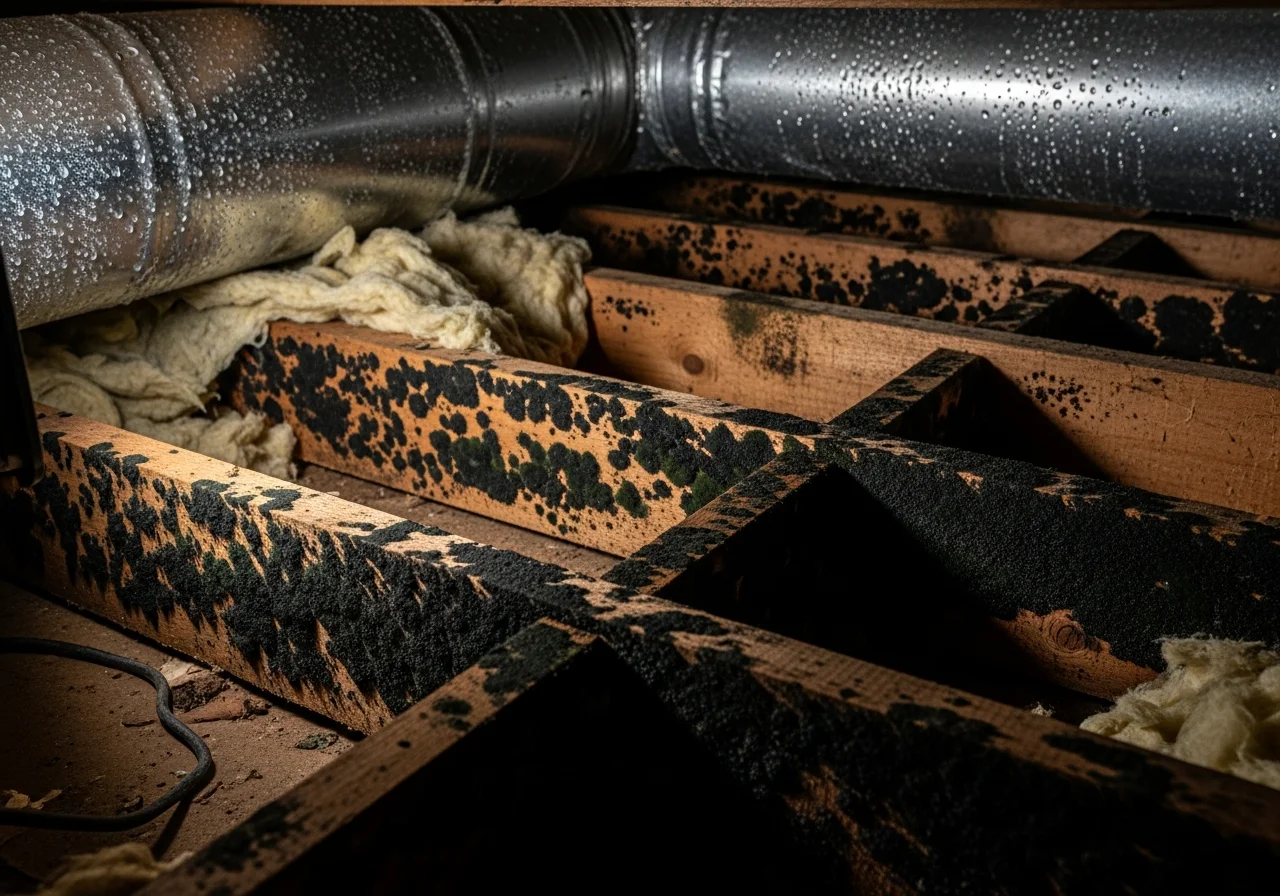
Mold growth on floor joists in a Matthews crawl space. By the time mold is visible on
structural wood, the moisture problem has been active for months or years.
Neighborhood-Level Risk
Which Matthews Neighborhoods Have the Worst Crawl Space Problems
Crawl space risk in Matthews correlates directly with construction era, lot topography,
and proximity to natural drainage. Neighborhoods built in the 1980s on the lowest-lying
lots have the most severe conditions. Here are the Matthews neighborhoods where we see
the worst crawl space problems — and the specific factors driving damage in each area.
Sardis Forest
Critical Risk
Built: 1980s-1990s
Primary risks: Cecil clay concentration, vented crawl space construction, mature tree root intrusion
Sardis Forest is one of Matthews' highest-risk neighborhoods for crawl space problems. Built during the peak vented-crawl-space era on dense Cecil clay, these homes have been accumulating moisture damage for 30-40+ years. The neighborhood's mature hardwood tree canopy — while beautiful — creates root systems that penetrate foundation walls and footer joints, opening water entry points. The shaded lots also reduce soil evaporation, keeping the clay wetter for longer periods after rainfall. Sardis Forest crawl spaces consistently show elevated humidity, mold on floor joists, and fallen insulation at first inspection.
Brightmoor's topography includes several low-lying areas where surface water naturally collects during rain events. Combined with Cecil clay's refusal to drain, these low spots create conditions where water pools against foundations for extended periods. The neighborhood's 1980s-era construction means most homes have vented crawl spaces with original HVAC ductwork that has been corroding in humid conditions for decades. Rusted ductwork in the crawl space doesn't just affect air quality — it reduces HVAC efficiency, drives up energy costs, and eventually requires complete duct replacement. Brightmoor homes near drainage swales are highest priority for encapsulation.
Cherokee Woods
Critical Risk
Built: 1970s-1980s
Primary risks: Older construction, mixed foundation types, proximity to creek drainage
Cherokee Woods includes some of Matthews' older housing stock, with homes dating to the 1970s that have been exposed to moisture conditions even longer than the 1980s-1990s subdivisions. The neighborhood's proximity to natural creek drainage channels elevates groundwater risk during wet seasons. Some Cherokee Woods homes have mixed foundation types — partial crawl space, partial slab — which create moisture migration pathways where the two foundation types meet. These transition points are common locations for water entry and mold growth that can go undetected for years.
The Heathers
High Risk
Built: 1980s-1990s
Primary risks: Standard vented crawl space construction, Cecil clay, mature landscape drainage issues
The Heathers represents the typical Matthews crawl space challenge: well-maintained 1980s-1990s homes built with vented crawl space foundations on Cecil clay. Homeowners here often don't realize there's a problem until symptoms appear inside the home — musty smell, bouncy floors, or allergy symptoms that worsen at home. The neighborhood's established landscaping has matured over decades, and root systems, grading shifts, and mulch buildup against foundations have gradually worsened drainage conditions that were marginal when the homes were new. The Heathers crawl spaces are a textbook case of slow, progressive moisture damage.
Shannamara
High Risk
Built: 1990s-2000s
Primary risks: Mixed crawl space and basement foundations, clay expansion stress on deeper walls
Shannamara includes homes with both crawl space and full basement foundations. Basements on Cecil clay face the same expansion-contraction stress as crawl spaces — but with taller foundation walls that have more surface area for water entry and greater hydrostatic pressure at the footer. Some Shannamara homes have walkout basements where the rear foundation wall is fully exposed to clay soil moisture while the front sits above grade. These split-level foundations create complex moisture dynamics where different parts of the below-grade space have different humidity levels and different moisture entry points.
Stevens Mill
High Risk
Built: 1990s-2000s
Primary risks: Later construction still used vented crawl spaces, fill-soil foundation concerns
Stevens Mill was developed in the late 1990s and early 2000s — still before North Carolina's 2009 code change allowing sealed crawl spaces. Many of these homes sit on fill soil that was graded and compacted during development, and this fill soil can settle unevenly over time, creating low spots around foundations that collect water. While Stevens Mill homes are newer than some Matthews neighborhoods, they have the same fundamental vented-crawl-space-on-clay-soil configuration. The primary advantage is that they've had fewer years of moisture accumulation — making encapsulation now a proactive investment rather than emergency remediation.
Callaway Plantation / Ashley Farm
Moderate
Built: 1990s-2000s
Primary risks: Rapid development era, variable soil compaction, standard vented foundation design
These subdivisions were built during Matthews' rapid growth period when development outpaced careful site preparation. Variable soil compaction beneath homes means some foundations have settled unevenly, opening cracks and gaps that allow water entry. Both neighborhoods used standard vented crawl space construction on Cecil clay with fiberglass batt insulation — the same configuration that fails across Matthews. Callaway Plantation and Ashley Farm homes are generally in the 25-35 year age range, meaning moisture damage has been accumulating for decades but may not yet have reached the severity seen in older Matthews neighborhoods.
Deerfield Creek / Glenwood Manor / Blackstone
Moderate
Built: 2000s-2010s
Primary risks: Newer construction but Cecil clay persists, some may still have vented foundations
The newer Matthews subdivisions benefit from improved building practices and some may have been built with sealed crawl space foundations after the 2009 code change. However, they still sit on Cecil clay, and homes built before 2009 have the same vented crawl space configuration as older neighborhoods. Even sealed crawl spaces on Cecil clay can develop moisture issues if the dehumidifier fails, drainage was inadequate, or the vapor barrier was improperly installed during original construction. These neighborhoods are the best candidates for preventive encapsulation — addressing moisture conditions before mold and structural damage develop.
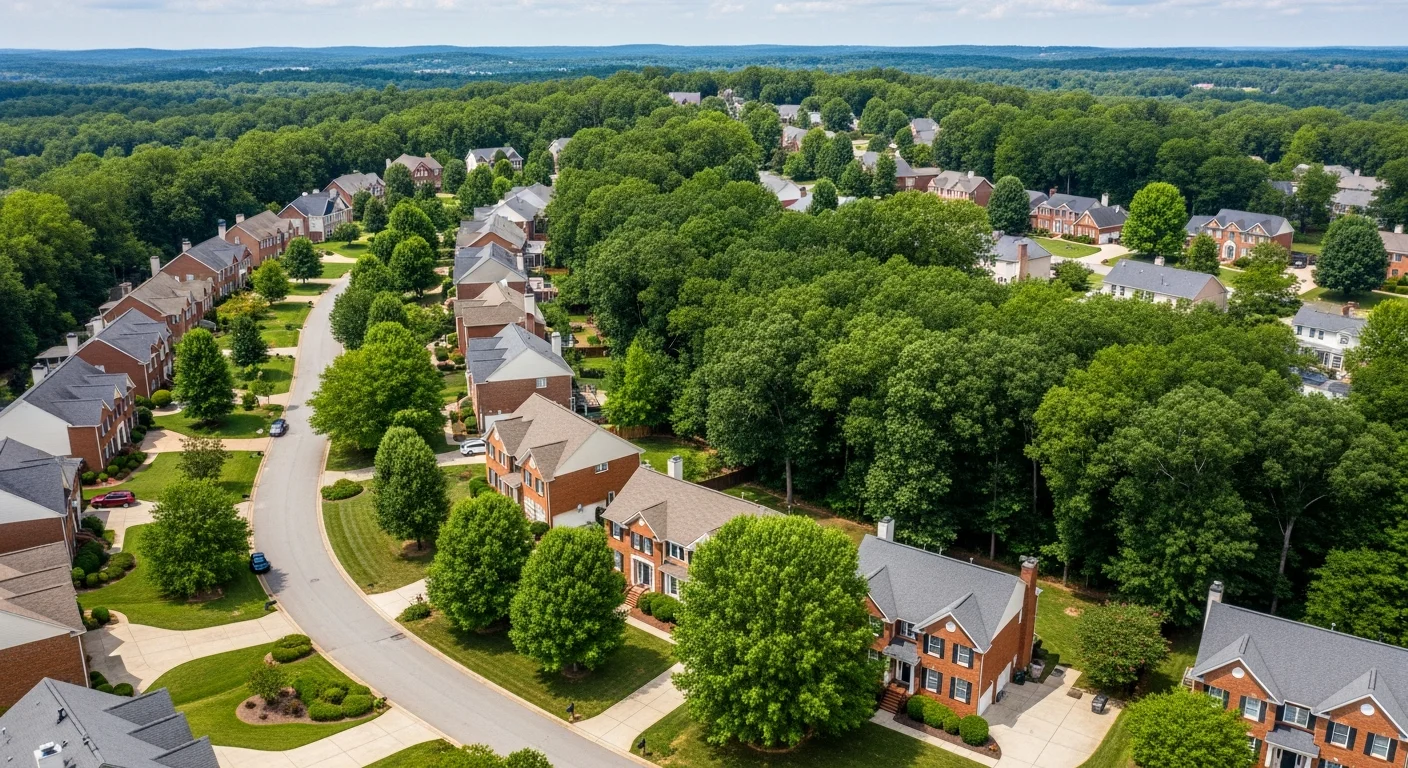
Aerial view of a Matthews neighborhood — note the mature tree canopy and dense
residential development typical of 1980s-1990s construction on Cecil clay soil.
Our Matthews Encapsulation Process
How We Fix Matthews Crawl Spaces — Permanently
Crawl space encapsulation isn't a single product — it's a multi-step system designed to
address every moisture pathway. Here's the complete process our team follows for
Matthews homes, from initial inspection through long-term monitoring.
01
Comprehensive Inspection
Day 1
02
Mold Remediation
Days 2-5
03
Drainage Correction
Days 3-7
04
Vapor Barrier Installation
Days 5-8
05
Dehumidifier Installation
Days 7-9
06
Monitoring & Warranty
Ongoing
01
Comprehensive Inspection
Day 1
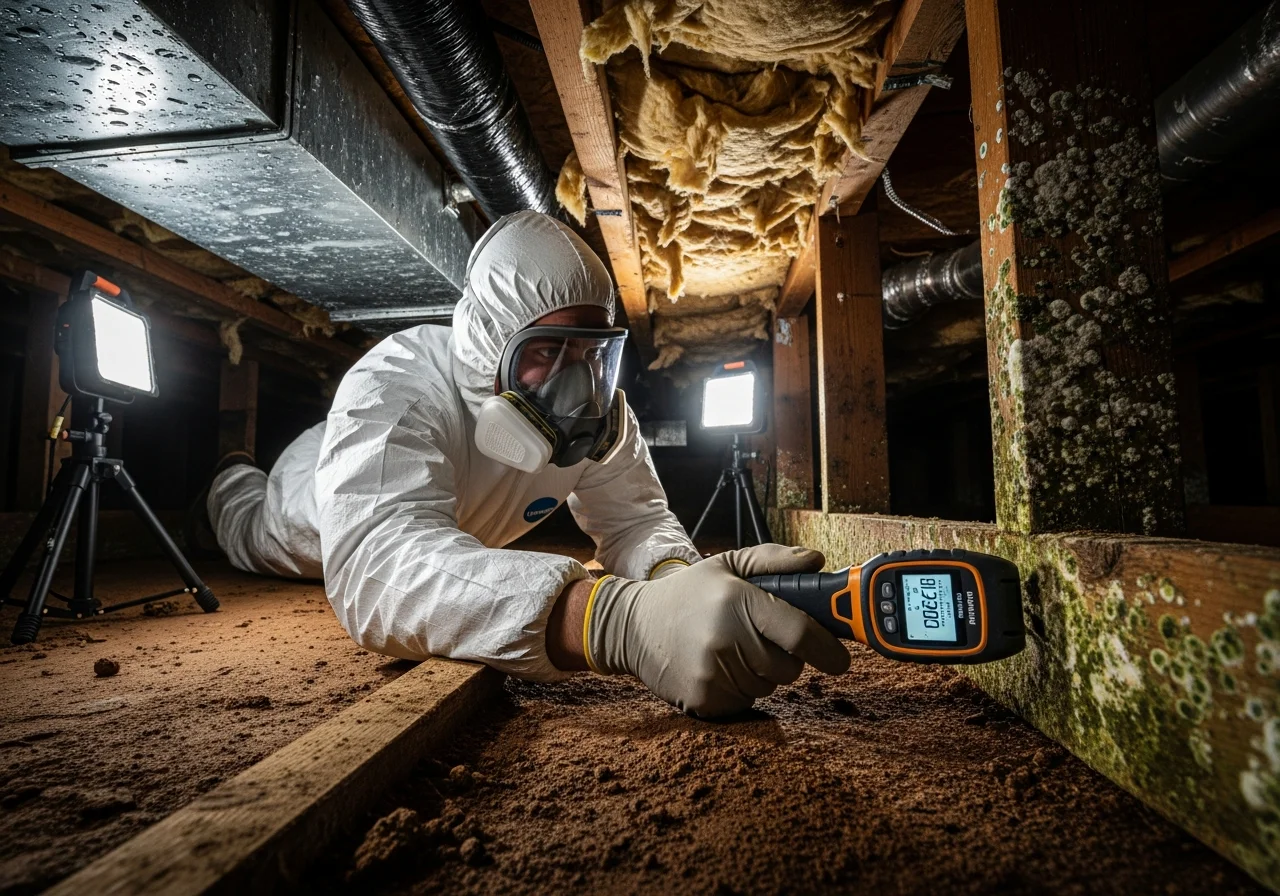
Before any work begins, our team conducts a full Matthews crawl space inspection — not a 15-minute sales pitch, but a documented assessment with moisture readings at multiple points, humidity measurements, structural wood probing for decay, mold sampling where visible growth is present, and photographic documentation of every condition found. We measure moisture content of floor joists, sill plates, and subfloor panels using pin-type and pinless meters. We record ambient humidity with calibrated hygrometers. We probe structural wood for soft spots indicating fungal decay. For Matthews homes, we also evaluate Cecil clay conditions at the foundation perimeter — checking for expansion evidence, crack patterns, and water entry pathways created by the clay's wet-dry cycling. This inspection determines the full scope of work.
02
Mold Remediation
Days 2-5
If the inspection reveals mold growth on crawl space surfaces — which it does in the majority of Matthews crawl spaces with moisture problems — remediation must happen before encapsulation. Sealing mold behind a vapor barrier doesn't kill it; it creates an environment where mold continues to grow unseen. Our remediation team removes all fallen insulation, debris, and organic material from the crawl space floor. All affected structural wood surfaces are treated with EPA-registered fungicide applied to manufacturer specifications. Heavily contaminated or structurally compromised materials are removed and replaced. Because North Carolina has no mold licensing requirement, we follow IICRC S520 standards — the industry benchmark — and conduct post-remediation air quality testing to confirm spore counts have returned to ambient levels before encapsulation begins.
03
Drainage Correction
Days 3-7
Matthews' Cecil clay soil means surface water and groundwater will continue pushing against your foundation regardless of what happens inside the crawl space. For properties with active water intrusion — standing water during rain events, visible water entry through foundation walls, or hydrostatic pressure through the floor — interior drainage must be installed before encapsulation. Our drainage solutions include interior French drain systems along the foundation perimeter, sump pump installation with battery backup (Matthews loses power during major storms), and grading corrections where the crawl space floor directs water toward the pump. Not every Matthews crawl space needs drainage — some only have humidity-driven moisture from the vented foundation. But when liquid water is entering the space, encapsulation alone will not solve the problem.
04
Vapor Barrier Installation
Days 5-8
The vapor barrier is the centerpiece of encapsulation — a continuous, sealed sheet of reinforced polyethylene covering the crawl space floor and extending up the foundation walls. We use 20-mil reinforced vapor barrier material — not the 6-mil poly sheeting from hardware stores, which tears during installation and degrades within years. The barrier is sealed at every seam with polyethylene tape rated for below-grade adhesion, attached to foundation walls with mechanical fasteners and sealant, sealed around every pier, pipe penetration, and support column, and terminated with a clean professional finish. Foundation vents are permanently sealed with rigid foam board and sealant — eliminating the primary moisture entry point that has been feeding humidity into your Matthews crawl space since the house was built in the 1980s or 1990s. NC building code requires a 3-4 inch termite inspection gap at the foundation perimeter.
05
Dehumidifier Installation
Days 7-9
Encapsulation without active dehumidification is incomplete — especially in Matthews' climate on Cecil clay. Even with a properly sealed crawl space, moisture will continue to enter through vapor-permeable concrete foundation walls, soil vapor pressure beneath the barrier, and seasonal humidity fluctuations. A commercial-grade crawl space dehumidifier maintains humidity below 55% year-round, preventing condensation and mold growth regardless of exterior conditions. We install Santa Fe, Aprilaire, or equivalent commercial-grade units sized for the specific square footage and moisture load of your Matthews crawl space. These are purpose-built systems that operate continuously with direct drainage — not residential units that fill a bucket. The target is crawl space humidity below 55% at all times, keeping wood moisture content below the threshold where mold growth and fungal decay begin.
06
Monitoring & Warranty
Ongoing
After encapsulation is complete, we install a remote humidity monitoring system that tracks crawl space conditions continuously and alerts both you and our team if humidity exceeds target thresholds. This monitoring catches issues before they become problems — a dehumidifier filter that needs cleaning, a drain line blockage, or a new water intrusion source from Cecil clay expansion cracking. Our Matthews crawl space encapsulation includes a warranty on materials and workmanship, with annual inspection options that verify continued performance. The monitoring data also provides documentation for real estate transactions — Matthews home buyers are increasingly aware of crawl space conditions, and documented encapsulation with monitoring history adds measurable value to your property in a market where crawl space problems are the norm, not the exception.
Crawl space costs in Matthews vary dramatically based on what 30-40 years of vented
foundation on Cecil clay has done to your home. Basic encapsulation for a dry crawl
space with no mold runs around $5,100. A typical Matthews project with mold remediation
runs $12,000-$20,000. Full-scope work with drainage, structural repair, and remediation
can exceed $20,000. Here are real-world cost ranges based on Matthews-area projects.
Basic Encapsulation
Moisture control only — no mold, no drainage needed
This scope applies to Matthews crawl spaces with humidity problems but no active mold growth, no standing water, and no structural damage. In Matthews, this represents a small minority of projects — most homes have at least some mold on the joists by the time homeowners call, given that these crawl spaces have been vented on Cecil clay for 30-40 years.
Encapsulation + Mold Remediation
Mold present on joists/subfloor — no drainage needed
This is the most common scope for Matthews crawl space projects. The majority of homes we inspect in Sardis Forest, Brightmoor, Cherokee Woods, and The Heathers have mold on structural wood that requires remediation before encapsulation. The 30-40 year accumulation period on Cecil clay means mold has had decades to establish.
Full-scope projects in Matthews are common in low-lying areas of Brightmoor, near creek drainage in Cherokee Woods, and in any neighborhood where Cecil clay expansion has cracked foundation walls enough to allow liquid water intrusion. These homes need drainage solutions before encapsulation — sealing the space without addressing the water source traps water inside.
Every Matthews crawl space is different. Call (704) 464-0121 for a free inspection and detailed estimate.
We'll tell you exactly what your crawl space needs — and more importantly, what it doesn't
— before any work begins.
The Palm Build Difference
Why Matthews Homeowners Choose Palm Build for Crawl Space Work
Matthews has multiple companies offering crawl space encapsulation. The difference is in
how the work is scoped, how mold is handled, whether radon is tested, and what happens
when the crawl space reveals problems beyond a vapor barrier and dehumidifier. Palm
Build approaches crawl space work as restoration professionals — not salespeople selling
a product.
Matthews Crawl Space Specialists — 15 Minutes Away
We're not a national franchise applying a one-size-fits-all encapsulation template. Our team operates from our Charlotte hub at 378 Crompton Street — 15 minutes from Matthews via I-485. We understand Cecil clay behavior, the specific moisture patterns in Sardis Forest versus Stevens Mill, and the foundation types found in each era of Matthews construction. We know which crawl spaces need drainage and which need only encapsulation. We know which neighborhoods have the 1980s OSB subfloor that fails faster than plywood. This local knowledge means we scope the work you actually need — not the maximum package regardless of conditions.
IICRC S520 Mold Remediation — Not Just Encapsulation
North Carolina has no mold remediation licensing requirement — anyone can legally advertise mold services. Many Matthews encapsulation companies install vapor barriers over existing mold, sealing contamination behind the barrier where it continues growing unseen. Palm Build always remediates mold before encapsulating. Our technicians hold current IICRC S520 certifications and follow the full protocol: containment, removal, EPA-registered fungicide treatment, and post-remediation air quality testing to confirm spore counts have returned to ambient levels. This approach costs more upfront but prevents the cycle of encapsulation failure that happens when mold is sealed in rather than eliminated.
Full-Service Restoration — Not Just Encapsulators
Crawl space encapsulation companies install vapor barriers and dehumidifiers. When they encounter structural damage, plumbing failures, mold beyond their scope, or water damage that has migrated into the living space above, they refer you to another contractor. Palm Build is a full-service restoration company that handles the entire scope — mold remediation, structural joist repair, subfloor replacement, HVAC ductwork coordination, and any interior damage that originated from the crawl space condition. One company, one project manager, one scope of work from underneath the house to the living space above. For Matthews homes where crawl space problems have been developing for 30-40 years, this integrated approach is critical.
Radon Testing During Crawl Space Work
Charlotte-area residential radon tests have averaged 7.33 pCi/L — well above the EPA action level of 4 pCi/L. Crawl space encapsulation addresses the same soil-to-home interface that radon travels through, making it the ideal time to test. We offer radon testing as part of our Matthews crawl space inspection scope. If elevated levels are found, the encapsulation vapor barrier provides the foundation for a sub-membrane depressurization system that can be integrated during the project — far more efficient than addressing radon as a separate project after the crawl space is already sealed.
Remote Monitoring and Accountability
Every encapsulation we install in Matthews includes remote humidity monitoring. We don't seal your crawl space and walk away — we verify performance continuously. If humidity spikes above target levels, our system alerts both you and our team so we can identify and address the cause before damage occurs. On Cecil clay, this monitoring is especially important: the clay's expansion-contraction cycle can open new water entry points over time, and early detection prevents small issues from becoming large repairs. The monitoring data also provides documentation for real estate transactions — invaluable in a market where crawl space problems are Matthews' most common property issue.
Insurance Documentation From Day One
When crawl space damage is caused by a covered peril — burst pipe, appliance failure, storm-driven water intrusion — homeowner's insurance may cover remediation and repair costs. Palm Build's documentation is formatted for insurance submission from the first inspection, with timestamped photographs, moisture readings, cause-of-loss documentation, and line-item scopes that adjusters can process efficiently. We identify which components of the crawl space work may have coverage implications and document them separately from preventive encapsulation costs.
Completed encapsulation in a Matthews home — 20-mil vapor barrier, sealed vents,
commercial dehumidifier maintaining humidity below 55%. This crawl space went from 80%+
humidity and active mold to a dry, controlled environment.
Common Questions
Matthews Crawl Space Cleanup FAQ
Crawl space problems are Matthews' #1 property issue. Here are the questions Matthews
homeowners ask most about Cecil clay soil, vented versus encapsulated crawl spaces,
radon risk, and what it takes to fix a crawl space permanently.
Why are Matthews crawl spaces so problematic?
Matthews sits on Cecil clay soil — North Carolina's official state soil — which contains approximately 37% clay and 27% silt with an infiltration rate below 0.2 inches per hour. This clay expands when wet and contracts when dry, creating cyclical mechanical stress on every crawl space wall and foundation. Combined with the fact that the majority of Matthews homes built in the 1980s-1990s have vented crawl space foundations, you get a town where humid summer air (69-75% RH) is actively drawn into crawl spaces and condenses on cooler surfaces. The result is chronic moisture, mold growth, and wood rot across Matthews neighborhoods.
What does Cecil clay soil do to crawl spaces specifically?
Cecil clay covers 59% of Mecklenburg County and creates two distinct crawl space problems. First, the clay's near-zero drainage rate keeps moisture against foundation walls for days or weeks after rainfall — continuously feeding moisture into the crawl space through block walls, footer joints, and foundation cracks. Second, the clay's expansion-contraction cycle physically stresses foundation walls and footer joints with every wet-dry cycle, gradually opening cracks and entry points for water. Over decades, this mechanical action creates the hairline cracks and shifted mortar joints that allow liquid water intrusion during heavy rain.
What is the difference between a vented and encapsulated crawl space?
A vented crawl space has open foundation vents that allow outside air to circulate freely beneath the home. In theory, this air movement prevents moisture buildup. In Matthews' humid subtropical climate, it does the opposite — warm, humid summer air enters the cooler crawl space and condenses on every surface. An encapsulated crawl space has sealed vents, a continuous heavy-gauge vapor barrier covering the floor and walls, and a commercial dehumidifier maintaining humidity below 55%. Encapsulation converts the crawl space from an outdoor environment to a controlled indoor environment, eliminating the condensation cycle entirely.
How much does crawl space encapsulation cost in Matthews?
Basic encapsulation (vapor barrier, vent sealing, commercial dehumidifier) for a Matthews home averages approximately $5,100. Most Matthews projects require mold remediation before encapsulation, bringing the typical scope to $12,000-$20,000. Full-scope projects with drainage correction, structural joist repair, and remediation can exceed $20,000. Cost varies significantly based on crawl space square footage, accessibility, extent of mold growth, and whether structural wood has been compromised. Every Matthews crawl space gets a free detailed inspection before we quote any work.
Should I test for radon during crawl space work in Matthews?
Yes. While Mecklenburg County is classified as EPA Radon Zone 3 (predicted low risk), actual residential tests in the Charlotte metro area have averaged 7.33 pCi/L — well above the EPA action level of 4 pCi/L. Crawl space encapsulation addresses the same soil-to-home interface that radon travels through, making it the ideal time to test. If radon levels are elevated, the encapsulation vapor barrier provides the foundation for a sub-membrane depressurization system that can be added during or after the project. Testing during crawl space work is efficient and inexpensive compared to addressing radon as a separate project later.
Does North Carolina require mold remediation licensing?
North Carolina has no state mold remediation licensing requirement — which means anyone can legally advertise mold remediation services regardless of training or equipment. This is why Matthews homeowners should verify IICRC S520 certification (the industry standard for mold remediation) before hiring any company for crawl space mold work. Palm Build's remediation technicians hold current IICRC certifications and follow S520 protocols for containment, removal, treatment, and post-remediation verification. We also conduct post-remediation air quality testing to confirm spore counts have returned to ambient levels.
Is crawl space encapsulation covered by homeowner's insurance?
Encapsulation as a moisture prevention measure is generally not covered — insurance covers damage from sudden events, not preventive upgrades. However, if a covered peril caused the crawl space damage (burst pipe, appliance failure, storm-driven water intrusion), the remediation and repair of that damage is typically covered. If crawl space moisture has caused structural damage to joists or subfloor, the structural repair may have coverage implications depending on the cause. Palm Build documents the cause-of-loss from day one so that any insurable components are properly identified and submitted.
How long does crawl space encapsulation take in Matthews?
Encapsulation only (no mold present): 2-4 days. Mold remediation plus encapsulation: 1-2 weeks. Full-scope work including drainage correction, structural joist repair, and encapsulation: 2-4 weeks. Matthews' Cecil clay soil can extend drainage work timelines if heavy rain saturates the soil during installation. We schedule around weather when possible, but clay soil work requires flexibility. Every project gets a specific timeline estimate after the initial inspection.
Matthews Crawl Space Problems? We Fix the Root Cause.
Palm Build's Matthews crawl space team addresses Cecil clay moisture, vented foundation condensation, mold, and structural damage at the source. Encapsulation, drainage, mold remediation, and joist repair — all managed as one coordinated project from our Charlotte hub, 15 minutes away.