INDIAN LAND SC — CRAWL SPACE CLEANUP & ENCAPSULATION
Crawl Space Cleanup & Encapsulation in Indian Land, SC
Indian Land's explosive growth has dropped thousands of high-value homes onto Piedmont clay soil that drains at less than 0.2 inches per hour. Communities like Sun City Carolina Lakes, Walnut Creek, and Riverchase Estates sit on Cecil and Pacolet series clay that holds water against every foundation it touches — feeding moisture into crawl spaces year-round through capillary action, soil evaporation, and the vented construction still common in Lancaster County single-family homes. Palm Build provides complete crawl space remediation for Indian Land homeowners: moisture control, mold removal, encapsulation, vapor barriers, dehumidification, and structural repair, addressing the root cause beneath your home.
Charlotte Office — ~20 minutes to Indian Land Same day Response IICRC Certified
Why Indian Land Crawl Spaces Fail: 4 Contributing Factors
Indian Land's combination of Piedmont clay soil, high annual rainfall, humid subtropical
climate, and vented crawl space construction creates persistent moisture problems
beneath thousands of homes across Lancaster County. The area's rapid residential growth
from the early 2000s onward means many homes are now reaching the 15-25 year mark — the
age when crawl space moisture damage becomes unmistakable.
Piedmont Clay Soil
<0.2 in/hr
Clay drainage rate
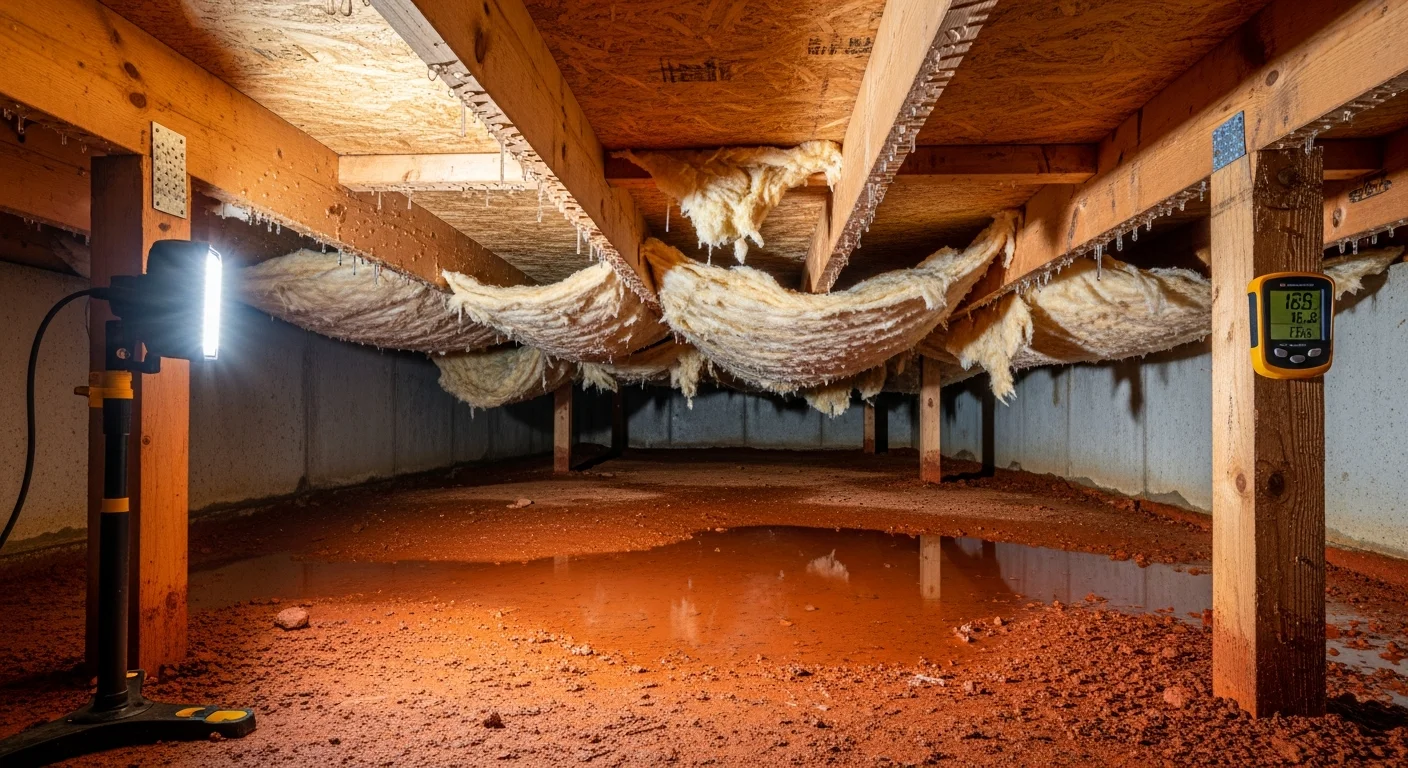
Indian Land sits on the Piedmont clay soil belt — the same expansive, poorly draining Cecil and Appling series red clay found throughout the Charlotte metro. After rainfall, this clay holds moisture against foundations like a sponge pressed against a wall. The water doesn't drain away in hours like sandy soil — it persists for days or weeks, continuously feeding moisture into the crawl space through foundation walls, footer joints, and cracks in block or poured concrete. During Indian Land's heavy rain events (2-3 inches in an hour during summer thunderstorms), the clay becomes fully saturated and surface water pools against foundations in every low spot. This standing water enters crawl spaces through foundation vents, over footer lips, and through block wall capillary action.
Humidity & Condensation
70-90%
Crawl space humidity
Indian Land's summer dew points regularly exceed 70 degrees Fahrenheit, with relative humidity reaching 80-90% during July and August. When this warm, humid air enters a vented crawl space and contacts cooler surfaces — floor joists, ductwork, water pipes, and the ground itself — condensation forms. On a 90-degree day with 85% humidity, a vented crawl space can produce enough condensation to wet floor joists, saturate fiberglass insulation (which then falls from the joists), create standing water on vapor barriers, and coat metal ductwork with moisture. This condensation cycle repeats daily from May through September, creating chronic moisture conditions indistinguishable from an active water leak.
47+ Inches of Annual Rainfall
47 in
Annual rainfall
Indian Land receives an average of 47 inches of rain per year — slightly higher than Charlotte due to the area's position at the edge of the Piedmont and Sandhills regions. Rain is distributed relatively evenly across all twelve months, meaning the clay soil beneath Indian Land homes is never fully dry. Even during the driest months, soil moisture levels remain high enough to generate vapor through uncovered crawl space floors. Combined with the clay soil's refusal to drain, this rainfall ensures that Indian Land crawl spaces never get a break from moisture pressure.
Vented Crawl Space Design
Pre-2009
Homes with vented design
Many Indian Land homes — particularly those built before South Carolina updated building code in 2009 to allow sealed crawl spaces — have vented foundations. Foundation vents invite warm, humid air into the crawl space, where it contacts cooler surfaces and condenses. The vents that were supposed to reduce moisture actually introduce it. While Indian Land has a higher percentage of newer construction than Charlotte's inner-ring neighborhoods, the 2000-2009 building boom produced thousands of homes with vented crawl spaces that are now 15-25 years old and showing the consequences of this design flaw.
Warning Signs
6 Signs Your Indian Land Home Has a Crawl Space Problem
Crawl space problems rarely announce themselves dramatically. They develop slowly — over
months or years — and by the time symptoms appear inside the home, the crawl space
condition has usually progressed significantly. Here are the warning signs every Indian
Land homeowner should recognize.
Musty or Earthy Smell
The most common first sign Indian Land homeowners notice is a persistent musty smell on the first floor — particularly noticeable when the HVAC system cycles on. This smell originates in the crawl space, where mold and mildew are actively growing on floor joists, subfloor panels, fallen insulation, and sometimes the ground itself. Because warm air in the crawl space rises into the living space through gaps around plumbing penetrations, electrical runs, and HVAC supply boots, the odor migrates upward through the stack effect. If your home smells musty despite regular cleaning, the crawl space is almost certainly the source.
Sagging or Bouncy Floors
When crawl space moisture saturates floor joists and subfloor panels over months or years, the wood softens and loses structural integrity. Joists develop fungal decay (wood rot) that reduces their load-bearing capacity, and subfloor panels — particularly the OSB (oriented strand board) common in Indian Land's 2000s-era construction — swell, delaminate, and lose rigidity. The result is floors that sag, bounce, or feel spongy underfoot. You might notice a low spot in a hallway, a bounce when walking across the living room, or doors that have started sticking because the floor has shifted.
Condensation on Windows & Pipes
Excessive crawl space moisture raises the overall humidity level in the home. When indoor humidity exceeds 55-60%, condensation appears on cold surfaces — window glass in winter, cold water pipes year-round, toilet tanks, and air conditioning ducts. If you notice persistent window condensation or water droplets on your bathroom cold water supply lines, the crawl space is likely pushing moisture into the living space faster than your HVAC system can remove it.
Increased Allergy Symptoms
Mold spores, dust mite colonies (which thrive in humid environments), and bacterial growth in the crawl space all produce airborne particulate that migrates into the living space. Indian Land residents with crawl space problems often report worsening allergy symptoms, unexplained respiratory issues, and chronic sinus problems that improve when they leave the house and return when they come home. Children, elderly residents, and anyone with asthma or compromised immune systems are particularly affected.
Falling or Sagging Insulation
Fiberglass batt insulation installed between floor joists in Indian Land crawl spaces has a predictable failure pattern. When crawl space humidity saturates the fiberglass, the batts absorb moisture, become heavy, and pull away from the joists — sagging first, then eventually falling to the ground. Once fallen, the insulation sits on the damp crawl space floor and becomes a breeding ground for mold and a habitat for pests. If you see insulation hanging or lying on the ground in wet piles, you're seeing the end stage of a moisture problem.
Visible Mold or Wood Damage
By the time you can see mold growth on crawl space surfaces — white, green, or black colonies on floor joists, rim joists, sill plates, or subfloor panels — the moisture problem has been active for an extended period. Visible wood damage (soft spots, dark discoloration, crumbling material when probed) indicates fungal decay that has compromised structural integrity. Any visible mold or wood damage should be evaluated by a qualified remediation company — not a home inspector or a pest control company offering mold services as a sideline.
Our Encapsulation Process
How We Fix Indian Land Crawl Spaces — Permanently
Crawl space encapsulation isn't a single product — it's a multi-step system designed to
address every moisture pathway. Here's the complete process our team follows for Indian
Land homes, from initial inspection through long-term dehumidification.
01
Comprehensive Inspection
Day 1
02
Debris Removal & Cleanup
Days 2-3
03
Mold Treatment & Remediation
Days 3-5
04
Drainage Installation (If Needed)
Days 4-7
05
Vapor Barrier & Vent Sealing
Days 5-8
06
Dehumidifier Installation
Days 7-9
01
Comprehensive Inspection
Day 1
Before any work begins, our team conducts a full crawl space inspection — not a 15-minute walkthrough with a flashlight, but a documented assessment with moisture readings at multiple points, humidity measurements, structural wood probing for decay, mold sampling where visible growth is present, and photographic documentation. We measure moisture content of floor joists, sill plates, and subfloor panels. This inspection determines the full scope — whether the crawl space needs basic encapsulation, mold remediation plus encapsulation, or full-scope work including drainage and structural repair.
02
Debris Removal & Cleanup
Days 2-3
All fallen insulation, debris, organic material, and any standing water are removed from the crawl space floor. For Indian Land homes where fallen fiberglass insulation has been sitting on damp ground for years, this step often reveals the true extent of mold growth beneath the insulation layer. The crawl space floor is cleared to clean dirt, providing a clean surface for vapor barrier installation. All removed materials are bagged, contained, and disposed of properly per Lancaster County requirements.
03
Mold Treatment & Remediation
Days 3-5
If the inspection reveals mold growth on crawl space surfaces — which it does in the majority of Indian Land crawl spaces with moisture problems — remediation must happen before encapsulation. Sealing mold behind a vapor barrier doesn't kill it. All affected structural wood surfaces are treated with EPA-registered fungicide applied to manufacturer specifications. Heavily contaminated or structurally compromised materials are removed and replaced. Post-remediation air quality testing confirms spore counts have returned to ambient levels before encapsulation begins.
04
Drainage Installation (If Needed)
Days 4-7
For Indian Land properties with active water intrusion — standing water during rain events, visible water entry through foundation walls, or hydrostatic pressure through the floor — interior drainage must be installed before encapsulation. Our drainage solutions include interior French drain systems along the foundation perimeter, sump pump installation with battery backup (Indian Land loses power during severe storms), and grading corrections where the crawl space floor directs water toward the pump. Not every crawl space needs drainage — some only have humidity-driven moisture.
05
Vapor Barrier & Vent Sealing
Days 5-8
We install 20-mil reinforced vapor barrier material — not the 6-mil poly sheeting sold at hardware stores, which tears during installation and degrades within a few years. The barrier is sealed at every seam with polyethylene tape rated for below-grade adhesion, attached to foundation walls with mechanical fasteners and sealant, sealed around every pier, pipe penetration, and support column, and terminated at the wall with a professional finish. Foundation vents are permanently sealed with rigid foam board and sealant — eliminating the primary moisture entry point.
06
Dehumidifier Installation
Days 7-9
Encapsulation without active dehumidification is incomplete — especially in Indian Land's humid climate. Even with a properly sealed crawl space, moisture will continue to enter through concrete foundation walls and soil vapor pressure beneath the barrier. A commercial-grade dehumidifier maintains humidity below 55% year-round. We install Santa Fe, Aprilaire, or equivalent commercial-grade units sized for the specific square footage and moisture load. These are purpose-built systems that operate continuously with direct drainage, not residential dehumidifiers from a hardware store.
Which Indian Land Communities Have Crawl Space Issues
Crawl space risk in Indian Land depends heavily on when the home was built and what
foundation type was used. Communities developed before 2009 — when SC code still
required vented crawl spaces — have significantly higher moisture risk than newer
developments using slab or sealed crawl space designs.
Sun City Carolina Lakes
High Risk
Built: 2000s-2010sFoundation: Crawl space and slab mix
Primary risks: Large community with mixed foundation types; crawl space homes on lower lots face significant moisture issues
Sun City is Indian Land's largest master-planned community — a 55+ Del Webb community with thousands of homes. The community sits on rolling terrain where lot grading varies significantly. Homes on lower lots or at the bottom of gentle slopes frequently experience crawl space moisture problems as surface water drains toward their foundations. The 2000s-era construction used standard vented crawl space design on many lots, and after 15-20+ years, these crawl spaces are showing classic moisture damage: mold on joists, fallen insulation, and musty odors. Slab homes in the same community have no crawl space issues — the foundation type at purchase is the determining factor.
Founders Pointe
High Risk
Built: 2005-2015Foundation: Predominantly crawl space
Primary risks: Vented crawl space construction during the 2000s building boom; clay soil drainage issues
Founders Pointe homes were built during the period when vented crawl spaces were still standard in South Carolina. The community's clay soil and relatively flat terrain mean surface water doesn't drain quickly away from foundations. Many homeowners are now 10-15 years into ownership and noticing the first symptoms of crawl space moisture problems — musty odors, higher humidity inside the home, and insulation falling from joists. The community's HOA-maintained landscaping keeps exterior grading neat, but doesn't address the subsurface moisture issues affecting crawl spaces.
Bridgemill
High Risk
Built: 2004-2012Foundation: Mixed crawl space and slab
Primary risks: Golf course community with irrigation proximity and clay soil moisture retention
Bridgemill's position around the golf course means some homes are adjacent to irrigated turf areas that add moisture to the soil near foundations. Combined with Piedmont clay soil and vented crawl space construction, these conditions create elevated moisture levels in crawl spaces — particularly on lots that border fairways or water features. Homes built in the earlier phases (2004-2008) are most likely to have vented crawl spaces and are now showing 15-20 years of accumulated moisture damage.
Regent Park
Moderate Risk
Built: 2006-presentFoundation: Mixed — newer phases more likely slab
Primary risks: Earlier phases have vented crawl spaces; newer construction trending toward slab
Regent Park's development has spanned nearly two decades, meaning earlier phases used vented crawl space construction while newer phases increasingly use slab foundations. Homeowners in the 2006-2012 phases should have their crawl spaces inspected — the 10-15 year mark is when moisture damage becomes apparent in Indian Land's climate. Later phases benefit from updated building science, but any home with a vented crawl space in this area will eventually develop moisture issues without intervention.
Chestnut Lane / Panther Creek
High Risk
Built: 2000s-2010sFoundation: Predominantly crawl space
Primary risks: Smaller subdivisions with standard 2000s construction on clay soil
These smaller Indian Land subdivisions represent the standard 2000s-era residential construction pattern: concrete block foundations with vented crawl spaces on Piedmont clay soil. Without the scale of larger master-planned communities, these neighborhoods often lack the community-level drainage infrastructure that helps manage surface water. Individual lots with poor grading — where the ground slopes toward the foundation instead of away from it — are particularly susceptible to crawl space water intrusion during heavy rain events.
Newer Construction (2015+)
Lower Risk
Built: 2015-presentFoundation: Slab predominant, some sealed crawl spaces
Primary risks: Lower risk — modern construction standards; sealed crawl spaces where built
Indian Land's newest communities — including developments along Doby's Bridge Road, Harrisburg Road, and newer phases of established communities — increasingly use slab foundations or sealed (conditioned) crawl space designs that comply with post-2009 SC building code. These homes have significantly lower crawl space risk. However, even sealed crawl spaces can develop moisture problems if the dehumidification system fails, the vapor barrier is damaged, or exterior drainage is inadequate. Annual inspection is still recommended.
Indian Land Pricing
Crawl Space Encapsulation Costs in Indian Land
Crawl space costs in Indian Land vary based on what's needed. A basic encapsulation for
a dry crawl space with no mold runs $4,500-$8,000. A typical project with mold
remediation runs $8,000-$18,000. A full system with drainage, structural repair, and
remediation can exceed $25,000. Here are cost ranges based on Indian Land metro projects
— not national averages.
Basic Encapsulation
Moisture control only — no mold, no drainage needed
This scope applies to crawl spaces with humidity problems but no active mold growth, no standing water, and no structural damage. In Indian Land, this represents roughly 20-30% of crawl space projects — most have at least some mold by the time homeowners call.
Encapsulation + Mold Remediation
Mold present on joists/subfloor — no drainage needed
This is the most common scope for Indian Land crawl space projects. The majority of homes we inspect with vented crawl spaces have some degree of mold on structural wood that requires remediation before encapsulation can be effective.
Full-system projects are common in Indian Land homes on lower lots where surface water pools against foundations during heavy rain events. These properties need drainage solutions in addition to encapsulation — sealing the space without addressing the water source will trap water inside.
Every Indian Land crawl space is different. Call (704) 464-0121 for a free inspection and detailed estimate.
We'll tell you exactly what your crawl space needs — and more importantly, what it doesn't
— before any work begins.
The Palm Build Difference
Why Indian Land Homeowners Choose Palm Build for Crawl Space Work
Indian Land has multiple companies offering crawl space encapsulation. The difference is
in how the work is scoped, how mold is handled, and what happens when the crawl space
reveals problems beyond a vapor barrier and dehumidifier.
Indian Land Crawl Space Specialists
We're not a national franchise applying a one-size-fits-all encapsulation template. Our team understands Piedmont clay drainage, the specific foundation types in Indian Land's master-planned communities, and which neighborhoods have the worst crawl space conditions. We know which crawl spaces need drainage and which don't. We know which communities used vented foundations and which used slab. This local knowledge means we scope the work you actually need — not the maximum package regardless of conditions.
Mold Remediation Before Encapsulation
Many contractors install vapor barriers on top of existing mold — sealing the contamination behind the barrier where it continues to grow unseen. Palm Build always remediates mold before encapsulating. We remove contaminated materials, treat affected structural wood with EPA-registered fungicides, and verify with post-remediation air testing that spore counts have returned to ambient levels before any vapor barrier goes down. This approach prevents the cycle of encapsulation failure that happens when mold is sealed in rather than eliminated.
Restoration Company, Not Just Encapsulators
Crawl space encapsulation companies install vapor barriers and dehumidifiers. When they encounter structural damage, plumbing failures, mold beyond their scope, or water damage that has migrated into the living space above, they refer you to another contractor. Palm Build is a full-service restoration company that handles the entire scope — mold remediation, structural joist repair, plumbing coordination, subfloor replacement, and any interior damage that originated from the crawl space condition. One company, one project manager, one scope.
Monitoring & Accountability
Every encapsulation we install includes remote humidity monitoring. We don't seal your crawl space and walk away — we verify performance continuously. If humidity spikes above target levels, our system alerts both you and our team so we can identify and address the cause before damage occurs. This monitoring data also provides documentation for real estate transactions — Indian Land home buyers are increasingly aware of crawl space conditions.
Insurance & Real Estate Documentation
When crawl space damage is caused by a covered peril — burst pipe, appliance failure, storm damage — homeowner's insurance may cover remediation and repair costs. Palm Build's documentation is formatted for insurance submission from day one, with timestamped photographs, moisture readings, and line-item scopes that adjusters can process efficiently. For real estate transactions, our reports provide the detail that inspectors and buyers' agents need.
Lancaster County Expertise
As an unincorporated Lancaster County community, Indian Land's building requirements go through the county — not a municipal office. We understand Lancaster County's permitting requirements for structural repairs associated with crawl space work, including joist replacement, sill plate repair, and any modifications that affect the building's structural integrity. This knowledge ensures all work is properly documented and inspected.
Common Questions
Indian Land Crawl Space Cleanup FAQ
Why are Indian Land SC crawl spaces so prone to moisture problems?
Indian Land sits on Piedmont clay soil — Cecil and Pacolet series clay that drains at less than 0.2 inches per hour, holding water against foundations for days after every rain. Combined with a humid subtropical climate that pushes dew points above 65 degrees from May through October, vented crawl space construction in single-family homes, and proximity to water features in communities like Sun City Carolina Lakes, Indian Land crawl spaces face year-round moisture loads that exceed the 60% relative humidity mold colonization threshold for most of the year — not just seasonally.
How much does crawl space encapsulation cost in Indian Land, SC?
Basic cleanup and encapsulation for an Indian Land home — vapor barrier installation, vent sealing, commercial dehumidifier, and minor drainage correction — typically runs $5,000-$9,000 depending on crawl space size. Indian Land's larger homes mean larger crawl spaces. Full-scope projects that include mold remediation, structural joist repair, interior perimeter drainage with sump pump, and high-capacity dehumidification for water-feature-adjacent properties range from $14,000-$25,000+. Older homes in Belair and Pleasant Plains with decades of accumulated damage typically require the full remediation scope.
Does Sun City Carolina Lakes proximity to water features make crawl space problems worse?
Yes, significantly. Sun City Carolina Lakes' integrated lakes, ponds, and retention features generate a persistent humidity field that elevates ambient moisture for homes throughout the community. Crawl spaces in pond-adjacent and lakeside sections consistently measure 5-15% higher relative humidity than comparable homes on higher ground. For homes already operating near the mold threshold, that additional humidity pushes conditions into active colonization range. If your Sun City home has a crawl space, dehumidification is not optional — it is the most critical component of any remediation plan.
My Indian Land home was built in the last 10 years. Is my crawl space still at risk?
Yes — if your home has a crawl space foundation. Construction year affects the severity of existing damage, but the root causes — Piedmont clay soil, humid subtropical climate, and vented crawl space design — are the same regardless of when the home was built. A 2015 Indian Land home on a vented crawl space has been accumulating moisture for 10+ years. Newer homes may not yet show structural damage, but humidity levels, condensation, and early mold colonization are typically present. Earlier intervention means simpler, less expensive encapsulation before mold and structural damage develop.
How do I know if my Indian Land home has a crawl space or a slab foundation?
Look for a crawl space access door — a small opening in the foundation wall (usually on the back or side of the home) or a hatch in the interior floor, often in a closet or utility room. If your home sits noticeably above grade with a visible gap between the ground and the siding, you likely have a crawl space. Slab homes sit directly on the ground with no visible foundation wall gap. Your home's original building permit at Lancaster County also specifies the foundation type. If you are unsure, a professional crawl space inspection will confirm foundation type and assess conditions.
Is crawl space encapsulation covered by insurance in Indian Land?
Encapsulation as a preventive measure is generally not covered — insurers classify it as home improvement. However, if crawl space damage resulted from a sudden covered event (burst pipe, appliance failure, storm-driven water intrusion through a foundation breach), the remediation of that specific damage is typically covered. Mold remediation from a covered water event may carry coverage up to the policy's mold sublimit, typically $5,000-$10,000 on South Carolina policies. Palm Build documents every project with cause-of-loss analysis to identify claimable portions.
How long does crawl space encapsulation take in Indian Land?
Encapsulation only with no active mold: 2-4 days. Mold remediation plus encapsulation: 1-2 weeks, including containment, treatment, post-remediation air quality testing, and then encapsulation. Full-scope projects with drainage correction, structural repair, mold remediation, and encapsulation: 2-4 weeks. Piedmont clay soil can extend drainage work during wet periods. We schedule around weather when possible and maintain communication with Indian Land homeowners throughout the project.
Is Indian Land crawl space moisture seasonal or year-round?
Year-round — and this is what makes Indian Land different from some other Charlotte metro communities. The combination of water feature proximity in Sun City Carolina Lakes and other communities, lower Piedmont elevation, southern sun exposure warming clay soil, and the Catawba River watershed keeps ambient humidity elevated even during winter months. While summer is the worst period, Indian Land vented crawl spaces rarely drop below the 60% mold threshold even in December and January. Encapsulation with active dehumidification is the only solution that addresses this 12-month moisture reality.
Indian Land Crawl Space Problems? We Fix the Root Cause.
Palm Build's crawl space team addresses Piedmont clay moisture, vented foundation condensation, water feature humidity, mold, and structural damage beneath Indian Land homes at the source. Complete remediation: mold removal, encapsulation, drainage, structural repair, and dehumidification managed as one coordinated project from our Charlotte hub — approximately 20 minutes from Indian Land.