Large loss project management is a discipline distinct from field restoration. The PM does not run equipment or swing hammers — they coordinate schedules, manage stakeholders, track budgets, resolve disputes, and ensure documentation meets carrier standards. On projects exceeding $500K, the PM role is full-time.
Disaster Recovery Management
Managing Complexity When the Stakes Are Highest
Large loss projects fail or succeed based on project management, not technical skill. Documentation quality, stakeholder communication, schedule management, budget tracking, and insurance coordination determine whether a multi-million-dollar restoration finishes on time and within approved scope — or spirals into disputes, delays, and cost overruns.
- Project Management
- Documentation
- Multi-Carrier
- Portfolio Recovery
What you need to know
Daily reporting is the backbone of large loss project management. Reports include crews on site, work completed, moisture readings, equipment deployed, photos of progress, and any issues requiring stakeholder decisions. Insurance carriers and property owners receive these reports simultaneously.
Xactimate estimating at large loss scale requires specialized expertise. Line items must be coded correctly, unit costs must reflect current pricing, supplements must include supporting documentation, and the final estimate must reconcile with approved scope. Errors in estimating create payment delays that can stall entire projects.
Multi-carrier coordination means managing separate communication streams for property, flood, wind, business interruption, and contents carriers — each with different adjusters, different documentation formats, and different approval timelines. The PM synthesizes all carrier interactions into a unified project plan.
Portfolio-level disaster recovery planning serves property management companies with multiple properties. Pre-arranged response plans, standardized documentation, preferred pricing, and dedicated account management ensure consistent quality and priority response across an entire portfolio when events occur.
Change order management prevents scope disputes. Field conditions on large loss projects always reveal damage beyond initial scope. Formal change order processes with photo documentation, cost estimates, and carrier pre-approval prevent end-of-project billing disputes that can delay final payment by months.
From the Field
What this work actually looks like
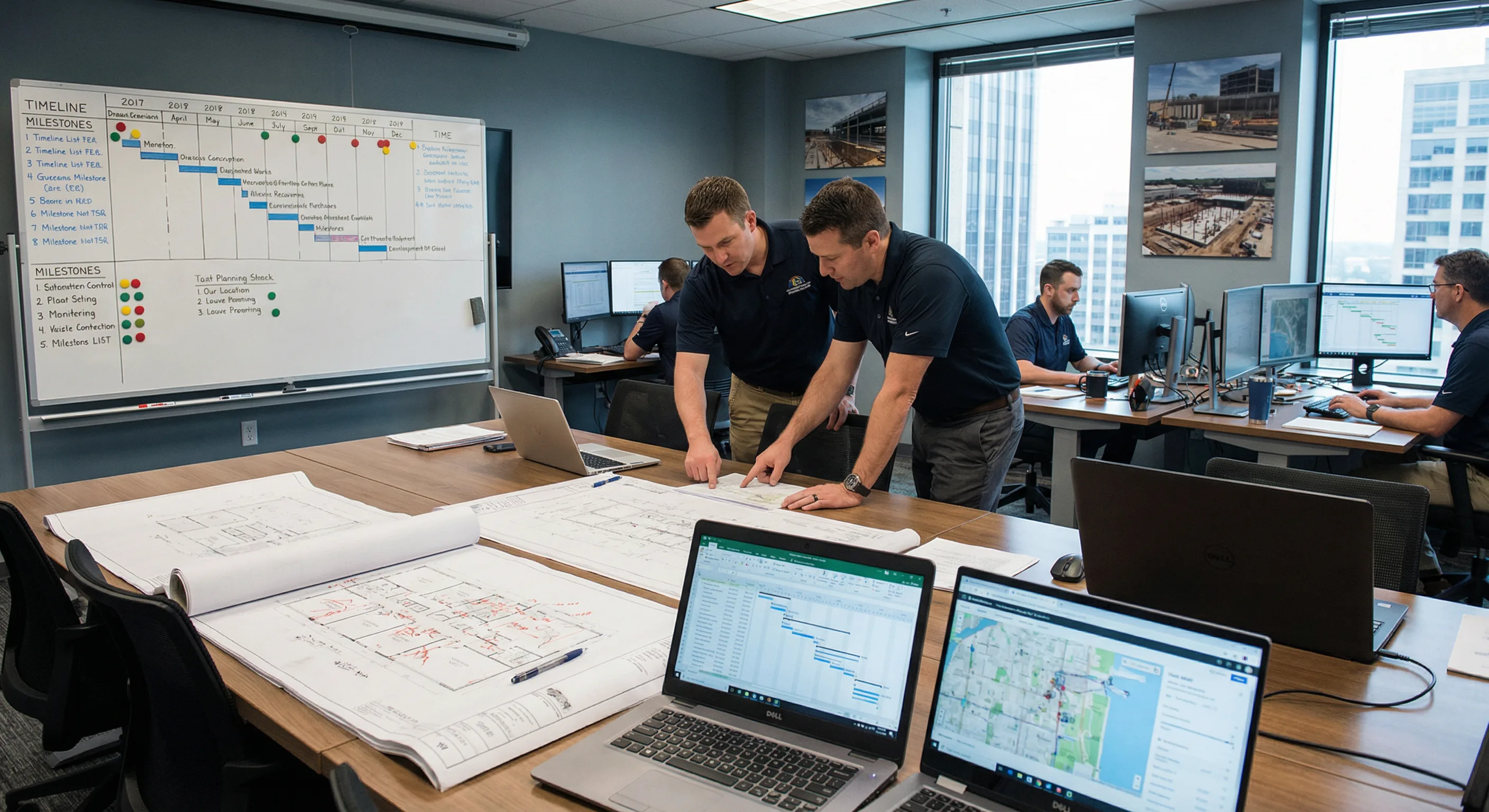
Large loss project management command center
Dedicated project managers coordinating multi-site restoration. Whiteboards track project milestones, building plans detail scope, and project management software monitors schedules.

Comprehensive documentation package for carrier submission
Daily reports, moisture readings, photo logs, and insurance correspondence organized for multi-carrier claim processing. Digital dashboards provide real-time project status.
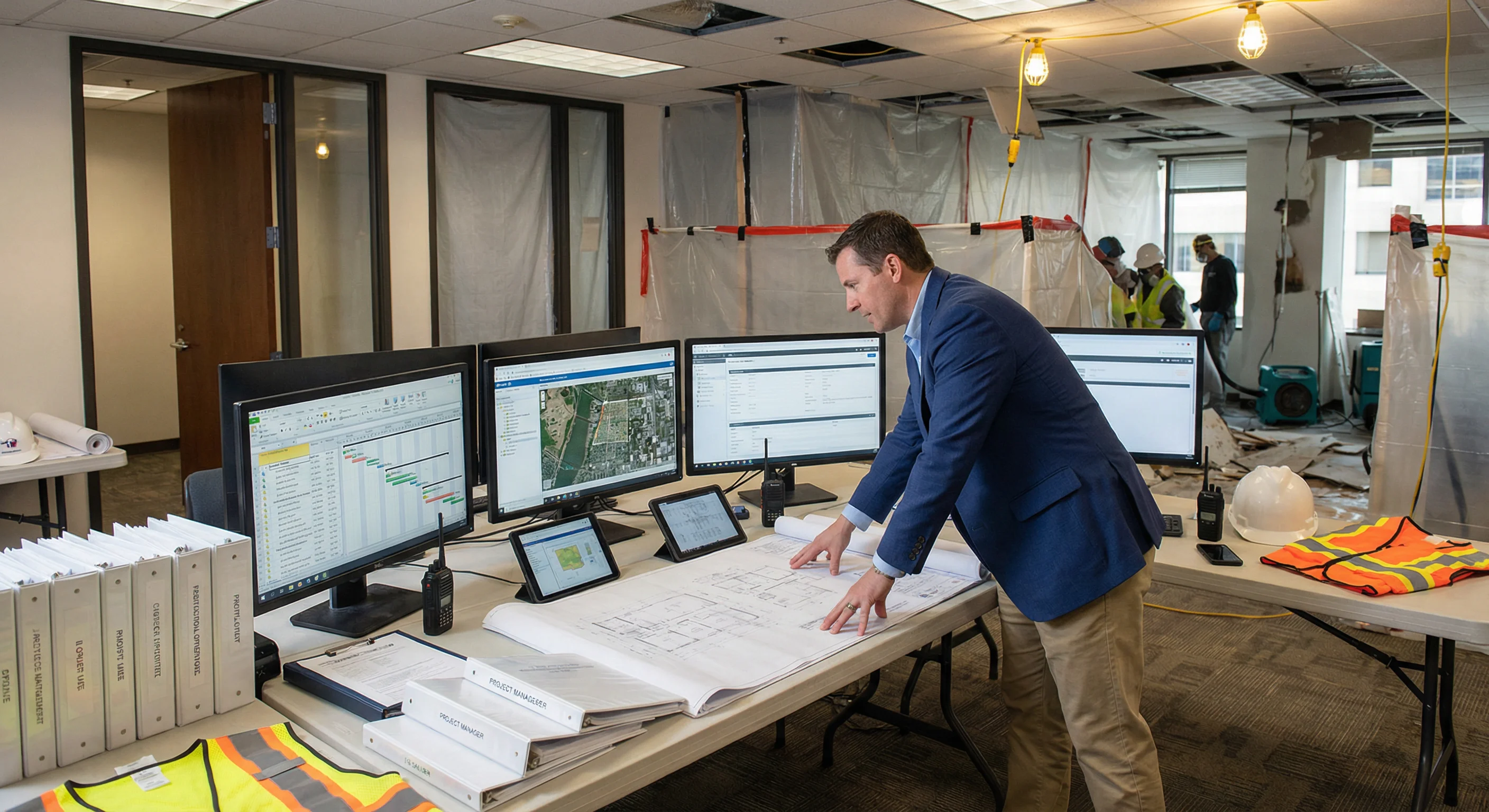
Real-time project monitoring and stakeholder communication
Project management technology enables daily progress tracking, budget monitoring, and multi-stakeholder communication across all active large loss sites.
Professional Process
How this work is done right
Each step ensures quality, compliance, and minimal disruption at scale.
Project initiation and stakeholder alignment
Dedicated PM assigned. Stakeholder roles defined — property owner, insurance adjuster, engineer, legal counsel. Communication cadence established (daily field reports, weekly stakeholder calls). Master project schedule drafted with milestones.
Scope development and carrier coordination
Comprehensive Xactimate estimate developed with carrier-specific formatting. Joint inspections scheduled. Scope negotiation conducted with supporting documentation. Approved scope becomes the project baseline with formal change order process.
Execution management and progress tracking
Daily field reports document crews, work completed, equipment, and issues. Budget tracking compares approved scope to actual progress. Schedule updates identify potential delays before they impact milestones. Quality inspections at each phase gate.
Close-out documentation and final billing
Completion documentation compiled: final photos, certificate of completion, moisture clearance data, permit sign-offs, and warranty information. Final billing reconciled against approved scope and change orders. Documentation package archived for carrier and legal reference.
Cost Guidance
What to expect on pricing
Large loss restoration costs vary significantly by damage extent, facility type, and number of structures. These ranges reflect typical projects in our service areas.
Dedicated project management (% of project)
5% - 10%
Industry standard for dedicated PM on large loss. Included in Xactimate overhead and profit line items. The investment prevents scope disputes, payment delays, and rework that cost far more.
Emergency Response Plan (annual retainer)
$2,500 - $15,000/year
Pre-arranged pricing, priority response, property-specific plans, and dedicated account management. Pricing depends on portfolio size and property types. ERP clients receive guaranteed response during CAT events.
Documentation package (large loss)
Included in scope
Comprehensive documentation — daily reports, photos, moisture data, Xactimate estimates, change orders — is included in the restoration scope, not billed separately. Quality documentation protects both parties.
Regional considerations
Florida
Florida large loss project management must account for hurricane season planning, flood zone compliance, and strict code requirements. Property managers with coastal portfolios benefit most from pre-arranged ERPs because CAT event demand overwhelms response capacity. AOB (Assignment of Benefits) rules affect how restoration contracts are structured.
North Carolina
Charlotte property managers managing apartment and commercial portfolios face winter pipe burst events as the most common large loss trigger. Having an ERP in place before freeze season ensures priority response when dozens of properties experience simultaneous damage. Mountain properties face different seasonal risks than Piedmont.
South Carolina
Coastal SC portfolio managers need hurricane-specific ERPs with pre-arranged staging areas and crew deployment plans. Charleston historic district properties require PM teams experienced with preservation requirements, which add documentation and approval layers beyond standard commercial restoration.
Related Guides
Connect this work with the bigger picture
Need large loss restoration?
Discuss your situation with our large loss team. We assess scope, coordinate with insurance, and deploy the resources your project demands.